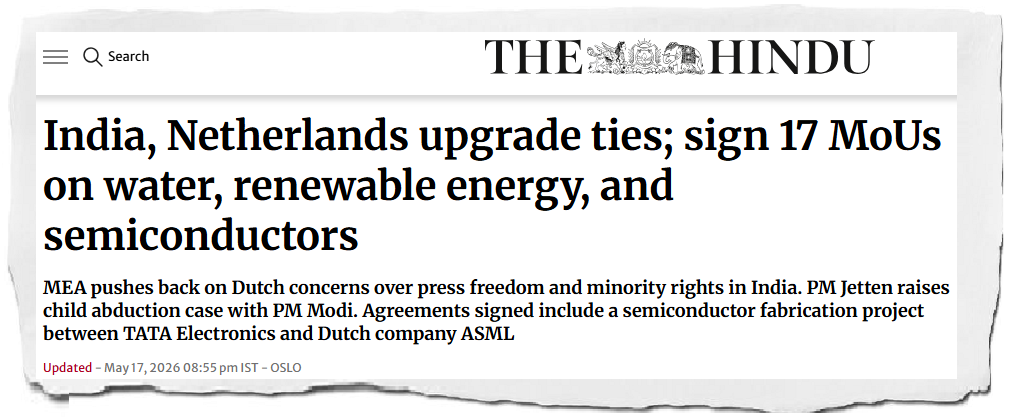
India, Netherlands upgrade ties; sign 17 MoUs on water, renewable energy, and semiconductors
India–Netherlands Strategic Partnership: Expanding Cooperation in Technology, Water and Geoeconomic Security
Why in News?
India and the Netherlands elevated their bilateral relationship to a Strategic Partnership during Prime Minister Narendra Modi’s visit in May 2026. Both countries signed 17 agreements and MoUs covering water management, renewable energy, semiconductors, agriculture, health, critical minerals and technology cooperation, reflecting the growing depth of India–Europe engagement.
UPSC Relevance
Prelims: India–Netherlands relations, semiconductors, critical minerals, Strait of Hormuz, strategic partnerships, renewable energy initiatives.
Mains:
GS II: – Bilateral relations, international groupings, India and Europe relations;
GS III: – Science and Technology, semiconductor ecosystem, energy security, critical minerals, economic diplomacy.
Background/Context
India and the Netherlands have maintained diplomatic relations since India’s independence. The relationship initially focused on trade and development cooperation but has gradually evolved into a multidimensional partnership involving economic, technological, environmental and strategic sectors.
The Netherlands occupies a unique position in Europe because of:
- One of the world’s most technologically advanced agricultural systems.
- Major expertise in water management and flood-control technologies.
- Strategic maritime connectivity through Rotterdam Port.
- Advanced semiconductor manufacturing capabilities.
- Strong renewable energy and innovation ecosystems.
India’s growing economic size and technological ambitions have increased the importance of this relationship.
The elevation to a Strategic Partnership indicates a transition from issue-specific cooperation to a broader long-term framework involving strategic, technological and geopolitical coordination.
Understanding Strategic Partnership
A Strategic Partnership generally refers to an institutionalised framework of cooperation extending beyond routine diplomatic engagement.
It usually includes cooperation in:
- Defence and security
- Technology and innovation
- Trade and investments
- Energy security
- Geopolitical coordination
- People-to-people ties
For India, strategic partnerships constitute an important element of its policy of multi-alignment and strategic autonomy.
Examples include India’s strategic partnerships with:
- United States, France, Japan, Russia, Australia
Areas of Cooperation Under the New Partnership
Water Cooperation
Water cooperation has historically been one of the strongest pillars of India–Netherlands relations.
The Netherlands possesses globally recognised expertise in:
- Flood management, Delta management, River basin planning, Water recycling, Climate-resilient urban systems
This assumes significance for India because of: Increasing water stress, Urban flooding, River pollution, Climate-related vulnerabilities
Examples include collaboration under:
- Indo-Dutch Water Alliance, River rejuvenation projects, Urban water management initiatives
The partnership also aligns with India’s objectives under:
- Jal Jeevan Mission, Namami Gange Programme, Sustainable Development Goals
Semiconductor Cooperation
Semiconductors have emerged as a major strategic component of modern economies.
The agreement involving Tata Electronics and ASML is particularly important.
ASML is globally significant because:
- It is the dominant producer of Extreme Ultraviolet (EUV) lithography machines.
- EUV technology is essential for advanced semiconductor fabrication.
- Only a few countries possess capabilities in high-end semiconductor manufacturing.
Importance for India:
- Reducing dependence on imports.
- Supporting electronics manufacturing.
- Enhancing technological sovereignty.
- Supporting programmes like:
- India Semiconductor Mission
- Make in India
- Digital India
Renewable Energy and Critical Minerals
Energy transition requires reliable access to critical minerals such as:
- Lithium, Cobalt, Nickel. Rare earth elements
These minerals are essential for:
- Electric vehicles, Solar panels, Battery storage systems, Wind energy infrastructure
India’s growing clean energy ambitions make supply-chain diversification essential.
This cooperation aligns with:
- National Green Hydrogen Mission
- India’s Net Zero target by 2070
- International Solar Alliance
Agriculture and Health Cooperation (WAH Framework)
The “WAH” framework focuses on:
Water
Sustainable management of water resources and climate resilience.
Agriculture
The Netherlands is among the world’s largest agricultural exporters despite limited land area because of:
- Precision farming, Greenhouse technologies, Efficient irrigation systems
India could benefit from Agri-technology transfer, Sustainable farming techniques,Food processing innovations
Health
Cooperation may include:
- Medical technologies, Research collaboration, Digital health infrastructure, Healthcare innovation
Strategic Significance for India
Strengthening India–Europe Relations
India increasingly views Europe as an important strategic and economic partner.
Recent developments include:
- India–EU Free Trade negotiations
- Enhanced ties with France
- Nordic cooperation
- Technology partnerships
The Netherlands partnership broadens India’s engagement beyond traditional major powers.
Supply Chain Diversification
Recent global disruptions exposed vulnerabilities in concentrated supply chains.
Examples include:
- COVID-19 disruptions
- Russia–Ukraine conflict
- West Asian instability
- Semiconductor shortages
Diversified partnerships help India improve resilience.
Supporting Strategic Autonomy
India follows an approach of maintaining relations with multiple centres of power while preserving policy independence.
Technology and economic partnerships with European countries provide India greater flexibility in pursuing strategic autonomy.
Maritime and Geoeconomic Importance
The Netherlands possesses major maritime significance because Rotterdam Port is among the world’s busiest ports.
Closer cooperation can support:
- Trade connectivity
- Logistics
- Maritime technology
- Blue economy initiatives
Geopolitical Dimensions
Energy Security Concerns
Discussions during the visit reportedly included concerns over possible disruptions around the Strait of Hormuz.
The Strait of Hormuz is strategically important because:
- Around one-fifth of global oil trade passes through it.
- India imports a substantial share of energy requirements through this route.
Disruptions could lead to:
- Higher energy prices
- Inflationary pressures
- Trade disruptions
India and Rules-Based International Order
Both countries emphasised:
- Democracy
- Rule of law
- Good governance
- International norms
India generally supports a multipolar and rules-based order while retaining strategic flexibility.
Economic Dimensions
India and the Netherlands already maintain substantial economic relations.
The Netherlands has consistently remained among the largest foreign investors in India.
Major sectors attracting investments include:
- Logistics, Renewable energy Technology, Agriculture, Manufacturing, Services
The partnership can improve:
- FDI inflows
- Employment generation
- Technology transfer
- Industrial competitiveness
Challenges and Concerns
Technology Dependence Risks
High-end technologies often come with concerns relating to:
- Intellectual property restrictions
- Limited transfer of core technology
- External control over supply chains
Technology partnerships may not always translate into complete domestic capability development.
Regulatory and Trade Barriers
Differences in:
- Standards
- Data regulations
- Market access
- Sustainability requirements
may slow implementation of agreements.
Geopolitical Uncertainty
Global geopolitical tensions can affect:
- Energy markets
- Technology supply chains
- Trade flows
India must maintain balance among competing powers.
Human Rights and Political Sensitivities
Differences occasionally emerge regarding:
- Human rights discourse
- democratic practices
- domestic political issues
Managing these differences while preserving broader cooperation remains important.
Way Forward
Strengthening Technology Partnerships
India should move beyond buyer-seller relationships and seek:
- Joint research initiatives
- Co-development projects
- Technology transfer mechanisms
- Domestic manufacturing capabilities
Building Semiconductor Ecosystems
India must complement international cooperation with:
- Skilled workforce development
- R&D investments
- Supply-chain integration
- Domestic fabrication capacity
Expanding Water and Climate Cooperation
India can leverage Dutch expertise for:
- Urban flood management
- River basin planning
- Climate adaptation
- Sustainable agriculture
Diversifying Critical Mineral Sources
Long-term agreements for critical mineral supply chains should be strengthened to reduce strategic vulnerabilities.
Deepening People-to-People Engagement
Academic exchanges, innovation partnerships and cultural engagement can strengthen long-term bilateral trust.
Conclusion
The India–Netherlands Strategic Partnership reflects India’s growing focus on technology, geoeconomic resilience and diversified global engagement. Cooperation in semiconductors, water, renewable energy and critical minerals goes beyond traditional diplomacy and addresses emerging strategic challenges.
The success of this partnership, however, will depend on whether India can convert agreements into concrete technological capabilities, stronger supply chains and sustainable long-term cooperation.
Prelims Practice Questions
Consider the following statements regarding semiconductors:
- Semiconductor chips are essential components in electronic devices.
- Extreme Ultraviolet (EUV) lithography is used in advanced chip manufacturing.
- India currently dominates global semiconductor fabrication.
Which of the statements given above are correct?
(a) 1 and 2 only
(b) 2 and 3 only
(c) 1 and 3 only
(d) 1, 2 and 3
Correct Answer: (a) 1 and 2 only
Explanation: Semiconductor chips are essential for modern electronics and EUV lithography is critical for advanced manufacturing. India is expanding semiconductor capabilities but does not currently dominate global fabrication.
Consider the following statements regarding the Strait of Hormuz:
- It connects the Persian Gulf with the Gulf of Oman.
- A substantial proportion of global oil trade passes through it.
- It lies entirely within the territorial waters of India.
Which of the statements given above are correct?
(a) 1 and 2 only
(b) 2 and 3 only
(c) 1 and 3 only
(d) 1, 2 and 3
Correct Answer: (a) 1 and 2 only
Explanation: The Strait of Hormuz connects the Persian Gulf to the Gulf of Oman and is a vital global energy chokepoint.
Mains Practice Questions
- Examine the role of semiconductor ecosystems and critical mineral supply chains in strengthening India’s technological and economic security.
- Discuss the strategic significance of India’s growing engagement with European countries in the context of emerging geopolitical and geoeconomic challenges.