India ranks 131st on the Global Gender Gap Index 2026
Why in News?
India retained the 131st rank among 145 economies, closing 64.5% of its gender gap, in the World Economic Forum’s Global Gender Gap Index 2026. Its score improved marginally, but remained below the global average of 69.2%.
| UPSC Relevance: GS-1 Indian Society: Women and social empowerment; GS-2 Social Justice: Vulnerable sections Prelims: Global Gender Gap Index Mains: Reasons for gender gap in India |
Global Gender Gap Index:
- Publisher: World Economic Forum; introduced in 2006 and released annually.
- Four dimensions:
- Economic Participation and Opportunity
- Educational Attainment
- Health and Survival
- Political Empowerment.
- Score: Ranges from 0 to 1, indicating progress towards gender parity; a higher score means a smaller gap. A 100% score would mean gender parity has been achieved.
- What it measures: Relative gaps between women and men, rather than a country’s overall level of development. Equal outcomes can coexist with inadequate opportunities for both sexes.
Global Gender Gap Index 2026:
(i) Global Highlights:
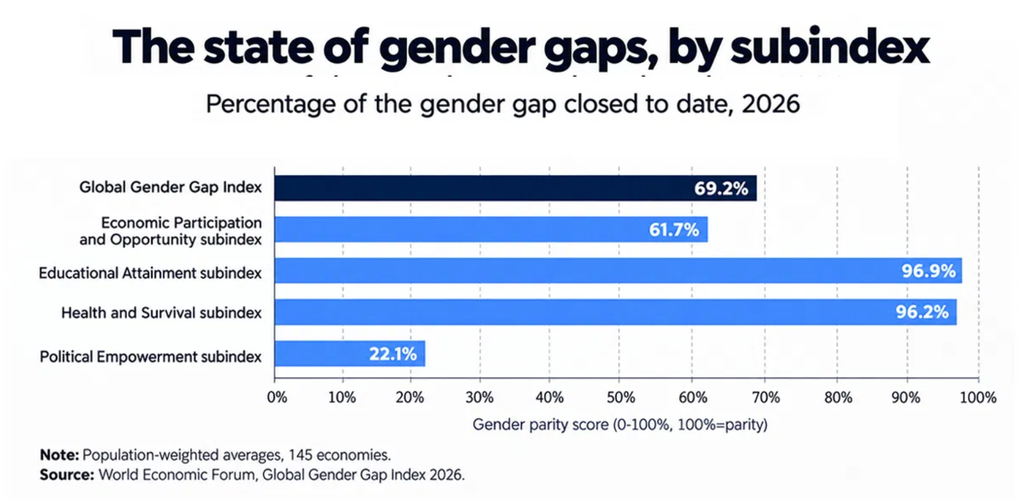
- Leading countries: Iceland, Finland and Norway; Namibia ranked fourth, while Australia entered the top ten for the first time.
- Iceland: Closed 93% of its gap (the only economy above 90%).
- Time to parity: An estimated 120 years at the prevailing pace, rather than a fixed prediction.
- Regional concern: South Asia remained the weakest region in economic participation and opportunity.
- Unequal influence: Women held 19.1% of CEO roles in the report’s data and accounted for fewer than one in five AI engineers.
(ii) India’s Performance:
In India, progress towards gender parity stands at 64.5%. India’s overall gains towards gender parity amount to a 4.3% advance since 2006, mainly due to improvements in educational attainment.
- Economic Participation and Opportunity: India reported a 41.2% parity score – higher than the previous edition, but lower than its best result in 2013 of 44.6%. Professional and technical worker parity rose, while parity among legislators, senior officials and managers remained only 13.1%.
- Educational Attainment: India’s gender parity score in educational attainment is 96.6%, lower than last year.
- Health and Survival: India’s score improved from last year to 95.6% parity.
- Political Empowerment: India is ranked 67th in the world with 24.5% parity.
What Explains the Persistent Gap?
- Weak transition from education to employment: The contrast between 96.6% educational parity and 41.2% economic parity suggests that schooling gains alone cannot overcome barriers to paid work and earnings.
- Care responsibilities interrupt careers: The report finds women almost twice as likely as men to take career breaks; persistent disadvantages follow parenting breaks in career progression.
- Limited advancement into leadership: India’s 49.9% professional-worker parity, alongside only 13.1% senior-role parity, indicates that entry into skilled work does not ensure equal advancement.
- Presence does not ensure influence: Low ministerial parity highlights the need to examine access to decision-making authority alongside numerical representation.
- New technology can reproduce old inequalities: Women’s underrepresentation in AI engineering risks limiting their access to emerging high-value occupations.
Way Forward:
- Make care infrastructure employment-linked: Locate affordable crèches near workplaces and industrial clusters, with hours matching women’s shifts.
- Convert qualifications into careers: Link skilling incentives to women’s placement, earnings and retention, not enrolment alone.
- Make promotion accountable: Require large employers to disclose gender pay and promotion gaps, including progression after maternity breaks.
- Move SHGs beyond microcredit: Secure procurement contracts and timely payments so women’s enterprises gain sustained revenue.
- Turn representation into authority: Give women winnable party tickets and leadership of influential ministries and legislative committees.
- Budget for measurable gains: Assess gender budgets against women’s paid employment, asset ownership and reduced unpaid-work burden.
UPSC PYQ 2017
Q. Which of the following gives ‘Global Gender Gap Index’ ranking to the countries of the world?
(a) World Economic Forum
(b) UN Human Rights Council
(c) UN Women
(d) World Health Organisation
Answer: (a)
UPSC Mains PYQ 2021 (GS 2)
Q. Can the vicious cycle of gender inequality, poverty and malnutrition be broken through microfinancing of women SHGs? Explain with examples. (Answer in 250 words)