India’s Renewable Capacity Crosses the 200 GW Threshold
Why in News?
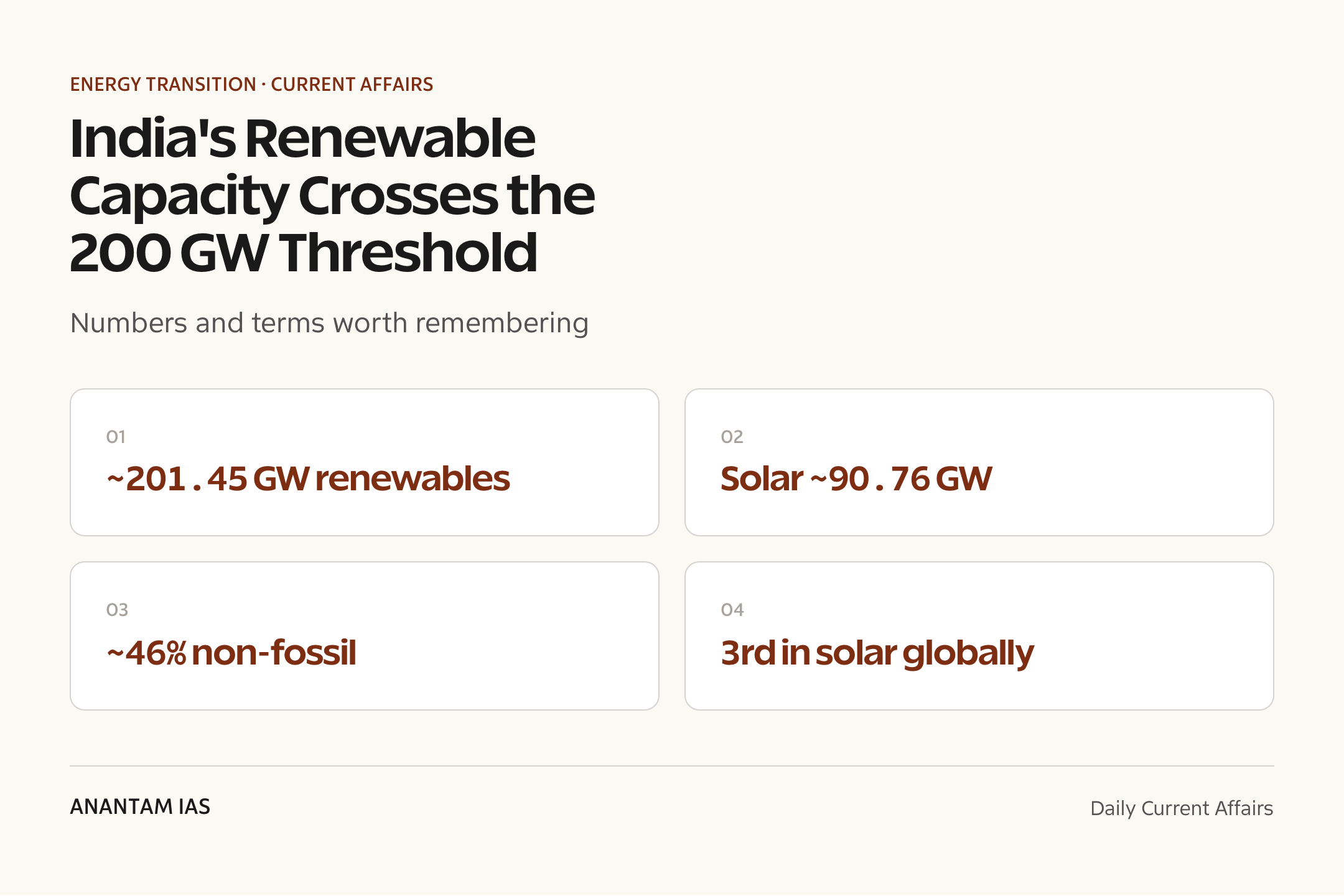
By December 2025, India’s operational renewable-energy capacity has crossed the 200 GW mark, a structural milestone in the country’s power mix. Reporting collated by the Ministry of New and Renewable Energy (MNRE) data and current-affairs trackers puts installed renewables at about 201.45 GW, with solar the single largest contributor.
The headline fact: non-fossil sources now make up close to half of India’s total installed generation capacity, putting the country well ahead of the timeline implied by its 2030 Nationally Determined Contribution (NDC) for non-fossil power.
- Renewable-energy installed capacity stands at about 201.45 GW out of a total installed capacity of roughly 452.69 GW.
- Solar leads with about 90.76 GW, followed by wind (~47.36 GW), large + small hydro (~51.99 GW) and bio-power (~11.32 GW).
- Non-fossil sources are about 46% of installed capacity, near the half-way mark.
- India is the third-largest solar power producer globally, after China and the United States.
- Leading states include Rajasthan, Gujarat, Tamil Nadu and Karnataka, which host most utility-scale capacity.
The development matters in the context of:
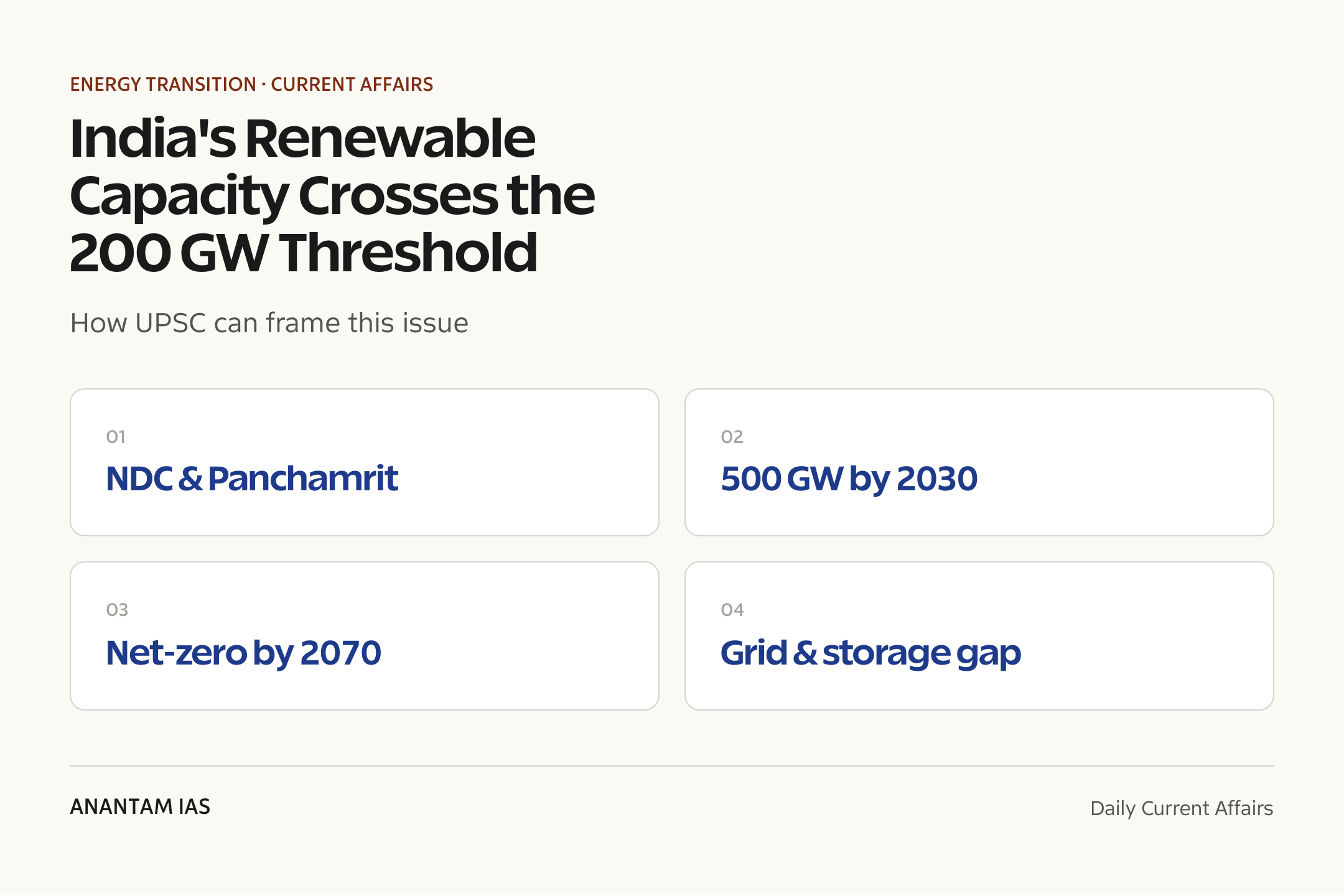
- It matters because India’s Panchamrit pledge at COP26 set a target of 500 GW non-fossil capacity by 2030 — the 200 GW renewable milestone is a checkpoint on that path.
- It matters because non-fossil capacity is the supply-side anchor of India’s net-zero-by-2070 commitment and its energy-security strategy against imported fuel.
UPSC Relevance
Prelims Relevance
- Installed capacity is the rated power a plant can produce, not the energy it actually generates; renewables have lower capacity utilisation factors (CUF) than thermal plants.
- Non-fossil sources = solar + wind + hydro + nuclear + biomass; renewable energy excludes large hydro in some older definitions.
- India’s NDC (2022 update): cut emissions intensity of GDP by 45% from 2005 levels by 2030; reach about 50% non-fossil installed capacity by 2030.
- Panchamrit targets (COP26, Glasgow, 2021): 500 GW non-fossil capacity and 50% energy from renewables by 2030; net-zero by 2070.
- National Solar Mission (Jawaharlal Nehru National Solar Mission), launched 2010, part of the National Action Plan on Climate Change (NAPCC).
- PM-Surya Ghar: Muft Bijli Yojana — rooftop-solar scheme for households launched in 2024.
- PM-KUSUM — solarises agricultural pumps and supports farmer solar capacity.
- PLI scheme for solar PV modules targets domestic manufacturing of high-efficiency modules.
- Bhadla (Rajasthan) and Pavagada (Karnataka) are among the world’s largest solar parks.
- Green Energy Corridor (GEC) builds transmission to evacuate renewable power from generation-rich states.
Mains Relevance
GS Paper 3
- Assess India’s progress on renewable-energy targets and the technical challenges of integrating variable solar and wind into the grid.
- Examine energy security and the role of domestic manufacturing (PLI) in reducing import dependence for solar modules and cells.
GS Paper 2
- Evaluate India’s international climate commitments (NDC, Panchamrit) and how domestic policy delivers on multilateral pledges.
Essay
- Powering a billion aspirations: India’s energy transition between growth and the climate clock.
- From fossil dependence to a non-fossil future: the politics and economics of clean power.
Background and Context
What the 200 GW milestone actually counts
The figure is installed renewable capacity, and reading it correctly matters for Prelims and Mains.
- Total renewable capacity is about 201.45 GW; total installed generation capacity (all fuels) is roughly 452.69 GW.
- Solar (~90.76 GW) is now the largest renewable source, overtaking hydro and wind.
- Adding nuclear to renewables gives the wider non-fossil basket, which is near 46% of installed capacity.
- Capacity is not generation: because solar and wind have lower capacity utilisation factors, their share of electricity actually generated is smaller than their share of capacity.
The policy architecture behind the surge
A stack of missions and incentives, built over fifteen years, produced this capacity.
- The National Solar Mission (2010), under the National Action Plan on Climate Change, seeded large-scale solar deployment and falling tariffs.
- PM-Surya Ghar: Muft Bijli Yojana pushes household rooftop solar, widening generation beyond utility-scale parks.
- PM-KUSUM solarises farm pumps, linking clean energy to rural livelihoods and the agriculture sector.
- The PLI scheme for solar PV modules targets domestic, high-efficiency manufacturing to cut reliance on imported cells and modules.
- 100% FDI under the automatic route and the Green Energy Corridor for transmission round out the enabling framework.
Where the capacity sits
Renewable capacity is geographically concentrated, which shapes the grid challenge.
- Rajasthan (~29.98 GW) and Gujarat (~29.52 GW) lead, on the back of strong solar and wind resources.
- Tamil Nadu (~23.70 GW) and Karnataka (~22.37 GW) follow, with mature wind and solar fleets.
- Mega solar parks like Bhadla in Rajasthan and Pavagada in Karnataka anchor utility-scale output.
- Concentration in a few resource-rich states makes inter-state transmission and evacuation the binding constraint.
How it maps to India's climate commitments
The milestone is best read against the targets India put on the table at Glasgow.
- At COP26 (2021), the Panchamrit pledge set 500 GW non-fossil capacity and 50% of energy from renewables by 2030.
- India’s updated NDC (2022) commits to reducing the emissions intensity of GDP by 45% from 2005 levels by 2030.
- The non-fossil share near 46% puts India ahead of the implied glide path well before 2030.
- All of this nests inside the long-term goal of net-zero by 2070 announced at the same summit.
The hard part: integration and intermittency
Adding green megawatts is the easier half; running a stable grid on them is the harder one.
- Solar and wind are variable — output swings with sunlight, cloud and wind speed, straining grid balancing.
- Energy storage (battery and pumped hydro) is still small relative to the renewable build-out, limiting round-the-clock supply.
- Discoms’ weak finances and payment delays raise the cost of contracting new renewable capacity.
- Land acquisition and module-supply bottlenecks slow large parks, even as tariffs stay low.
Energy security and the manufacturing question
Clean power is also a strategic and industrial story, not only a climate one.
- Scaling renewables cuts exposure to imported coal, oil and gas and the foreign-exchange burden that comes with them.
- A heavy reliance on imported solar cells and modules, much of it from a single source country, is itself a vulnerability.
- The PLI scheme and Approved List of Models and Manufacturers aim to localise the value chain.
- Clean-energy manufacturing ties the transition to jobs, exports and Atmanirbhar Bharat goals.
Way Forward
Build the grid and storage, not just the plants
- Accelerate transmission corridors and inter-state evacuation so generation-rich states can export surplus.
- Scale battery storage and pumped hydro to firm up variable solar and wind and enable round-the-clock supply.
Fix the demand side and the discoms
- Strengthen discom finances so renewable contracts are bankable and payments are timely.
- Expand rooftop solar uptake under PM-Surya Ghar with simpler net-metering and financing.
Deepen domestic manufacturing
- Use the PLI scheme to localise cells, modules and emerging technologies, reducing import dependence.
- Build skills and supply chains for green hydrogen and storage as the next frontier.
Conclusion
Crossing 200 GW of renewable capacity, with non-fossil sources near half of installed power, marks a genuine structural shift in how India makes electricity — and signals that its 2030 climate targets are within reach ahead of schedule.
The harder work now moves downstream: storage, transmission, discom health and domestic manufacturing. Capacity has been built; the task is to turn it into reliable, affordable, round-the-clock clean power that also secures India’s energy independence.
UPSC Practice Questions
Prelims MCQ 1
With reference to India’s renewable-energy capacity, consider the following statements:
- Solar is the largest single source within India’s installed renewable-energy capacity.
- Installed capacity and actual electricity generated are the same measure.
- India is among the top three solar power producers in the world.
How many of the above statements are correct?
(a) Only one (b) Only two (c) All three (d) None
Answer: (b) Only two
Explanation:
Solar is the largest renewable source and India ranks third in solar globally, so statements 1 and 3 are correct. Statement 2 is wrong: installed capacity is rated power, while generation depends on the capacity utilisation factor, which is lower for solar and wind.
Prelims MCQ 2
The ‘Panchamrit’ targets, central to India’s energy-transition framing, were announced at which forum?
(a) G20 Summit, New Delhi (b) COP26 climate summit, Glasgow (c) International Solar Alliance founding summit (d) UN General Assembly, New York
Answer: (b) COP26 climate summit, Glasgow
Explanation:
India announced the five ‘Panchamrit’ commitments — including 500 GW non-fossil capacity by 2030 and net-zero by 2070 — at the COP26 summit in Glasgow in 2021.
UPSC Mains Questions
- India’s installed renewable capacity has crossed 200 GW, with non-fossil sources nearing half of total capacity. Examine the achievements and the integration challenges of this energy transition for grid stability and energy security.
- Domestic manufacturing is increasingly seen as central to a credible clean-energy transition. Critically evaluate the role of schemes such as the PLI for solar modules in reducing India’s import dependence.
Sources: Ministry of New and Renewable Energy (MNRE) and Khan Global Studies Current Affairs.
Frequently Asked Questions
What does crossing 200 GW of renewable capacity mean?
It means India’s operational renewable-energy plants — solar, wind, hydro and bio-power combined — can together supply about 201 GW of power at full rating. This is installed capacity, not actual generation; renewables produce less energy than this peak because the sun and wind are variable. It is a structural marker of how clean India’s power mix has become.
What share of India’s power capacity is now non-fossil?
Non-fossil sources — renewables plus nuclear — make up close to 46% of India’s total installed generation capacity of about 452 GW. That puts India near the half-way mark and ahead of the glide path implied by its 2030 climate target, which aims for roughly half of installed capacity from non-fossil sources.
Which renewable source is the largest in India?
Solar is now the single largest renewable source, at about 90 GW, having overtaken wind and hydro. India is the world’s third-largest solar power producer after China and the United States. Wind contributes about 47 GW and hydro about 52 GW, with bio-power making up the rest of the renewable basket.
What is India’s 2030 renewable-energy target?
Under the Panchamrit commitments announced at COP26 in Glasgow, India aims for 500 GW of non-fossil installed capacity by 2030 and to meet half of its energy needs from renewables. These sit within India’s updated NDC and its long-term goal of reaching net-zero emissions by 2070.
What is PM-Surya Ghar: Muft Bijli Yojana?
It is a rooftop-solar scheme that helps households install solar panels and receive subsidies, lowering electricity bills and adding distributed solar capacity. Alongside utility-scale parks and PM-KUSUM for farm pumps, it widens where clean power is generated and brings consumers directly into the energy transition.
Why is the milestone significant for energy security?
Scaling renewables reduces India’s dependence on imported coal, oil and gas, cutting both the import bill and exposure to global price shocks. Domestic manufacturing under the PLI scheme aims to localise solar cells and modules, so the transition strengthens self-reliance as well as the climate effort.