India Enters the Top 100 of the UN SDG Index
Why in News?
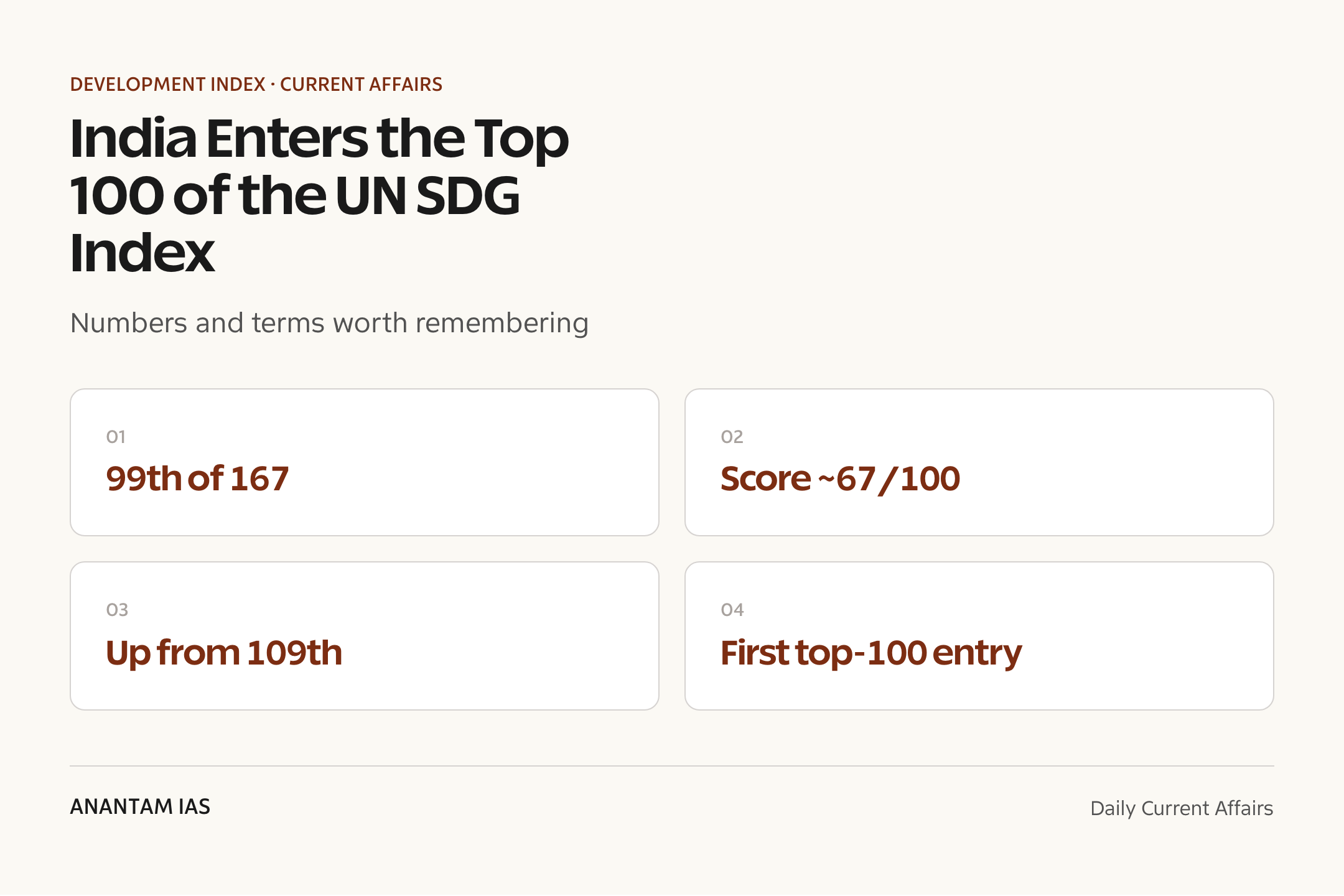
India broke into the top 100 of the global SDG Index for the first time, ranking 99th out of 167 countries on the Sustainable Development Report 2025, the annual benchmark published by the UN Sustainable Development Solutions Network (SDSN).
India scored about 67 on a 0-100 scale, climbing 10 places from 109th in 2024 on the strength of poverty reduction and clean-energy access, while still trailing on environment and biodiversity goals.
- Rank: 99th of 167; score ~67/100 — first-ever entry into the top 100.
- Trajectory: 116th (2017) to 112th (2023) to 109th (2024) to 99th (2025).
- Published in the Sustainable Development Report 2025, lead author economist Jeffrey Sachs.
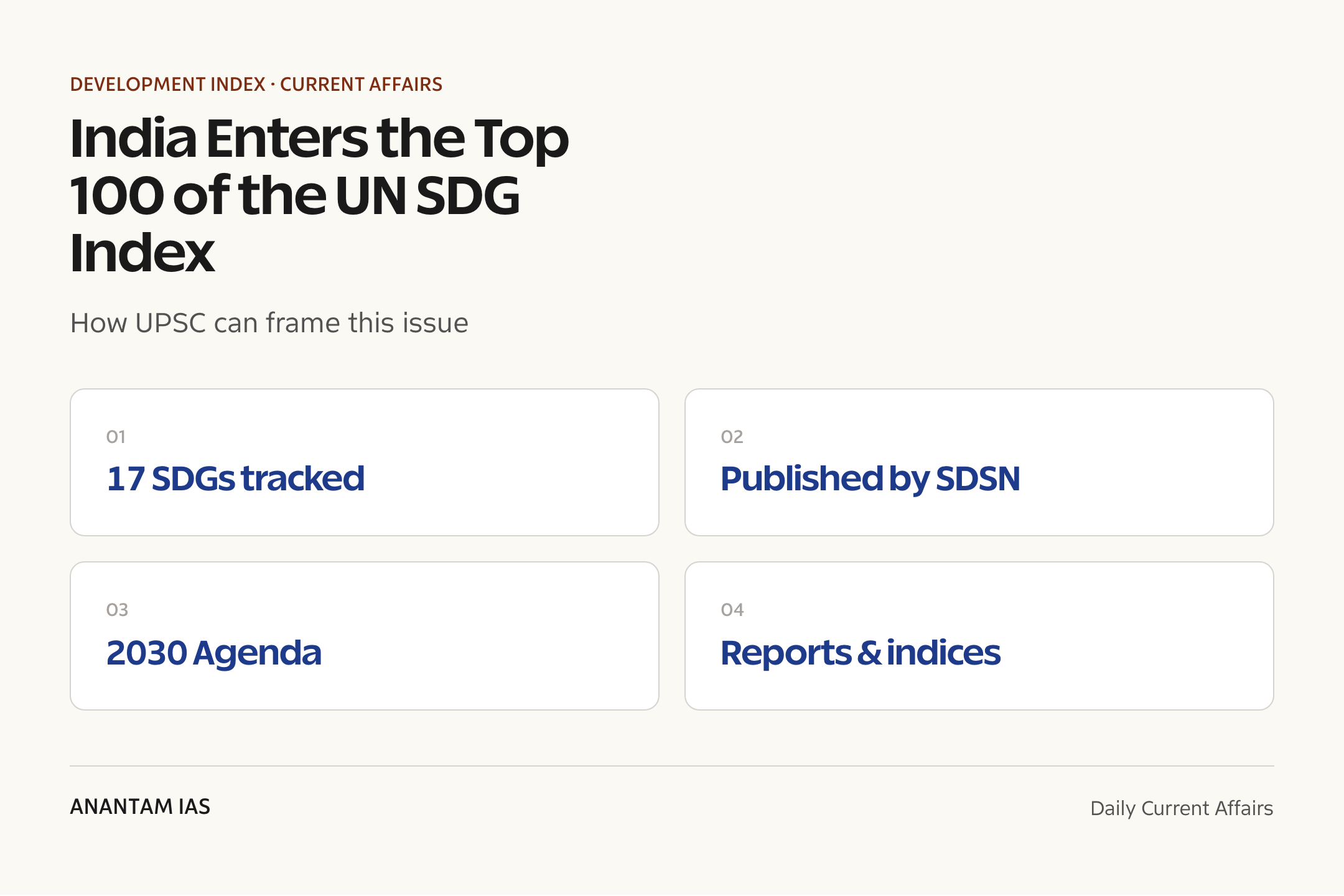
- Tracks all 17 SDGs under the UN’s 2030 Agenda adopted in 2015.
- Globally only 17% of SDG targets are on track to be met by 2030.
- Top three: Finland, Sweden, Denmark; 19 of the top 20 are European.
The development matters in the context of:
- A staple reports-and-indices item that ties directly to the 2030 Agenda and India’s domestic SDG localisation under NITI Aayog.
- Useful for the GS2 governance angle on welfare delivery and the GS3 angle on the environment-development trade-off.
UPSC Relevance
Prelims Relevance
- Publisher: UN Sustainable Development Solutions Network (SDSN), not a UN treaty body.
- Sustainable Development Report (SDR) is the source publication; the SDG Index is its headline ranking.
- 17 SDGs and 169 targets under the 2030 Agenda for Sustainable Development (adopted September 2015).
- India’s 2025 rank 99th of 167, score ~67.
- Top performer Finland; 19 of top 20 are European countries.
- Neighbourhood: Bhutan 74th, Nepal 85th, Sri Lanka 93rd, Bangladesh 114th, Pakistan 140th; Maldives 53rd.
- The report also computes a Spillover Index measuring negative cross-border effects of rich-country consumption.
- Distinguish the SDG Index from NITI Aayog’s SDG India Index, the domestic state-level tracker.
- China 49th, USA 44th on the 2025 ranking.
Mains Relevance
GS Paper 2
- India’s progress on the SDGs as a measure of welfare-delivery and governance capacity.
- The gap between social-sector gains (poverty, energy, child health) and weaker performance on accountability and environment goals.
GS Paper 3
- The development-versus-environment trade-off visible in India’s lag on biodiversity and sustainable consumption (SDG 15).
GS Paper 1
- Society-level drivers behind India’s improvement, from energy access to declining child mortality.
Essay
- Growth that leaves no one behind: can India meet the 2030 promise?
- Prosperity and the planet need not be rivals.
Background and Context
What the SDG Index Measures
The index converts country performance across all 17 goals into a single comparable score.
- Compiled annually since 2016 in the Sustainable Development Report (SDR) by the SDSN and partners.
- Scores each country 0-100, where 100 means full achievement of every SDG target.
- Covers goals from no poverty (SDG 1) and zero hunger (SDG 2) to climate action (SDG 13) and strong institutions (SDG 16).
- A country’s score is read as the percentage of the way it has travelled toward the 2030 targets.
India's Climb to 99th
India added roughly ten places in a single year to cross the symbolic top-100 line.
- Up from 109th (2024) and 112th (2023), continuing a steady multi-year rise.
- Score of about 67 places India just behind Sri Lanka (93rd) in the region.
- Gains driven by wider electricity access (SDG 7), expanding mobile broadband (SDG 9), and falling child mortality (SDG 3).
- Welfare schemes on poverty, health, education and clean energy are credited as the main levers.
Where India Still Lags
The same report flags goals where India and most large economies are moving backward.
- Weak scores on biodiversity loss (SDG 15) and sustainable land use.
- Pressure on nitrogen management and rising obesity (SDG 2) noted as reversals since 2015.
- Mixed performance on SDG 16 measures such as press freedom and corruption perception.
- Environment and consumption goals remain the hardest globally, even for top-ranked nations.
The 2030 Agenda Behind the Number
The ranking sits on the UN framework every member state signed in 2015.
- The 2030 Agenda for Sustainable Development set 17 goals and 169 targets.
- It succeeded the Millennium Development Goals (MDGs), which ran 2000-2015.
- The SDGs are universal — binding on developed and developing countries alike.
- India tracks them domestically through NITI Aayog’s SDG India Index, a separate state and UT-level tool.
The Global and Regional Picture
The 2025 edition warns that the world is far off the 2030 pace.
- Only 17% of targets are projected to be achieved on time worldwide.
- Finland, Sweden and Denmark top the table; 19 of the top 20 are European.
- Regionally Maldives (53rd) and Bhutan (74th) lead among India’s neighbours.
- The report blames conflicts, structural vulnerabilities and limited fiscal space for the slowdown.
How to Read the Index Critically
The ranking is a useful signal but carries known limitations.
- It is a non-official, expert-network product, not a UN-mandated official statistic.
- Data gaps and lags mean some indicators rely on modelled or older figures.
- A high aggregate score can mask poor performance on a few critical goals.
- Cross-country comparison is sensitive to how missing indicators are handled.
Way Forward
Close the environment gap
- Pair welfare gains with stronger action on biodiversity, land use and nitrogen pollution.
- Mainstream SDG 13 and SDG 15 targets into state-level planning.
Strengthen data and localisation
- Improve real-time SDG data so India is judged on current rather than lagged figures.
- Deepen district and city-level tracking through NITI Aayog and the MoSPI framework.
Sustain the social-sector momentum on poverty, health and clean energy while financing the harder environment and institutional goals through a coherent, all-of-government SDG strategy.
Conclusion
Crossing into the top 100 is a genuine milestone: it confirms that India’s investments in energy access, health and poverty reduction are registering on a global scoreboard.
But a score of 67 with five years left to 2030 also marks how far the country, and the world, still has to travel — especially on the environment and accountability goals where progress has stalled or reversed.
UPSC Practice Questions
Prelims MCQ 1
With reference to the SDG Index in the Sustainable Development Report, consider the following statements:
- It is published annually by the UN Sustainable Development Solutions Network (SDSN).
- It scores countries on their progress across all 17 Sustainable Development Goals.
- It is the same as the SDG India Index released by NITI Aayog.
How many of the above statements are correct?
(a) Only one (b) Only two (c) All three (d) None
Answer: (b) Only two
Explanation:
Statements 1 and 2 are correct. Statement 3 is wrong — the SDSN’s SDG Index and NITI Aayog’s SDG India Index are two distinct rankings; the latter tracks Indian states and UTs.
Prelims MCQ 2
In the Sustainable Development Report 2025, India was ranked:
(a) 53rd of 167 (b) 85th of 167 (c) 99th of 167 (d) 114th of 167
Answer: (c) 99th of 167
Explanation:
India ranked 99th of 167 countries with a score of about 67, entering the top 100 for the first time, up from 109th in 2024.
UPSC Mains Questions
- India has crossed into the top 100 of the global SDG Index for the first time. Examine the factors behind this improvement and the goals where India continues to lag. (250 words)
- “Social-sector progress on the SDGs cannot substitute for action on environment and accountability goals.” Discuss in the context of India’s 2025 SDG Index performance. (250 words)
Sources: Sustainable Development Report 2025 (UN SDSN) and Drishti IAS / Outlook Business.
Frequently Asked Questions
What is the SDG Index?
The SDG Index is the headline ranking inside the annual Sustainable Development Report, published by the UN Sustainable Development Solutions Network (SDSN). It scores 167 countries from 0 to 100 on how far they have progressed across all 17 Sustainable Development Goals under the 2030 Agenda.
What rank did India get in 2025?
India ranked 99th out of 167 countries on the Sustainable Development Report 2025, with a score of about 67 on the 0-100 scale. This was India’s first-ever entry into the top 100, up ten places from 109th in 2024.
Who publishes the Sustainable Development Report?
It is published by the UN Sustainable Development Solutions Network (SDSN), with economist Jeffrey Sachs as lead author. The SDSN is an expert network, so the report is an independent benchmark rather than an official UN statistic.
Which goals does India perform well and poorly on?
India shows gains on electricity access (SDG 7), mobile broadband (SDG 9) and falling child mortality (SDG 3). It lags on environment and biodiversity goals such as biodiversity loss (SDG 15), nitrogen management and rising obesity, alongside mixed scores on institutional measures under SDG 16.
How does India compare with its neighbours?
Among regional neighbours, Maldives ranked 53rd, Bhutan 74th, Nepal 85th and Sri Lanka 93rd ahead of India at 99th, while Bangladesh (114th) and Pakistan (140th) ranked lower. Finland topped the global table, with 19 of the top 20 countries in Europe.
How is the SDG Index different from the SDG India Index?
The SDG Index ranks countries globally and is produced by the SDSN. The SDG India Index is a domestic tool released by NITI Aayog that ranks Indian states and union territories on the same goals. They are separate exercises measuring performance at different levels.