India-Seychelles Fisheries Cooperation Agenda
Why in News?
India-Seychelles fisheries cooperation advanced through bilateral talks on 25 August 2026, but the official release recorded proposals and interest in an MoU, not a newly signed fisheries agreement.
- India’s Department of Fisheries hosted the Seychelles delegation to review existing frameworks and explore a collaborative road map for fisheries and aquaculture.
- The agenda covered stock assessment, fisheries data systems, monitoring-control-surveillance infrastructure, mariculture, hatcheries, tuna value chains and conservation.
- Both sides identified an annual work plan, regulatory alignment, reciprocal laboratory access and jointly designed pilots as routes for implementation.
- Seychelles expressed interest in a dedicated fisheries-and-aquaculture MoU; the release did not say that such an MoU was signed.
- The proposed architecture moves bilateral cooperation from broad diplomatic intent toward measurable tasks, responsible institutions, shared evidence and recurring review.
- Fisheries cooperation requires ecological data and compliance capacity because harvest expansion without stock assessment or surveillance can weaken both livelihoods and conservation.
- Small pilots can test hatchery, mariculture, processing or waste-management approaches before either country treats an unproven model as an operational programme.
UPSC Relevance
Prelims Relevance
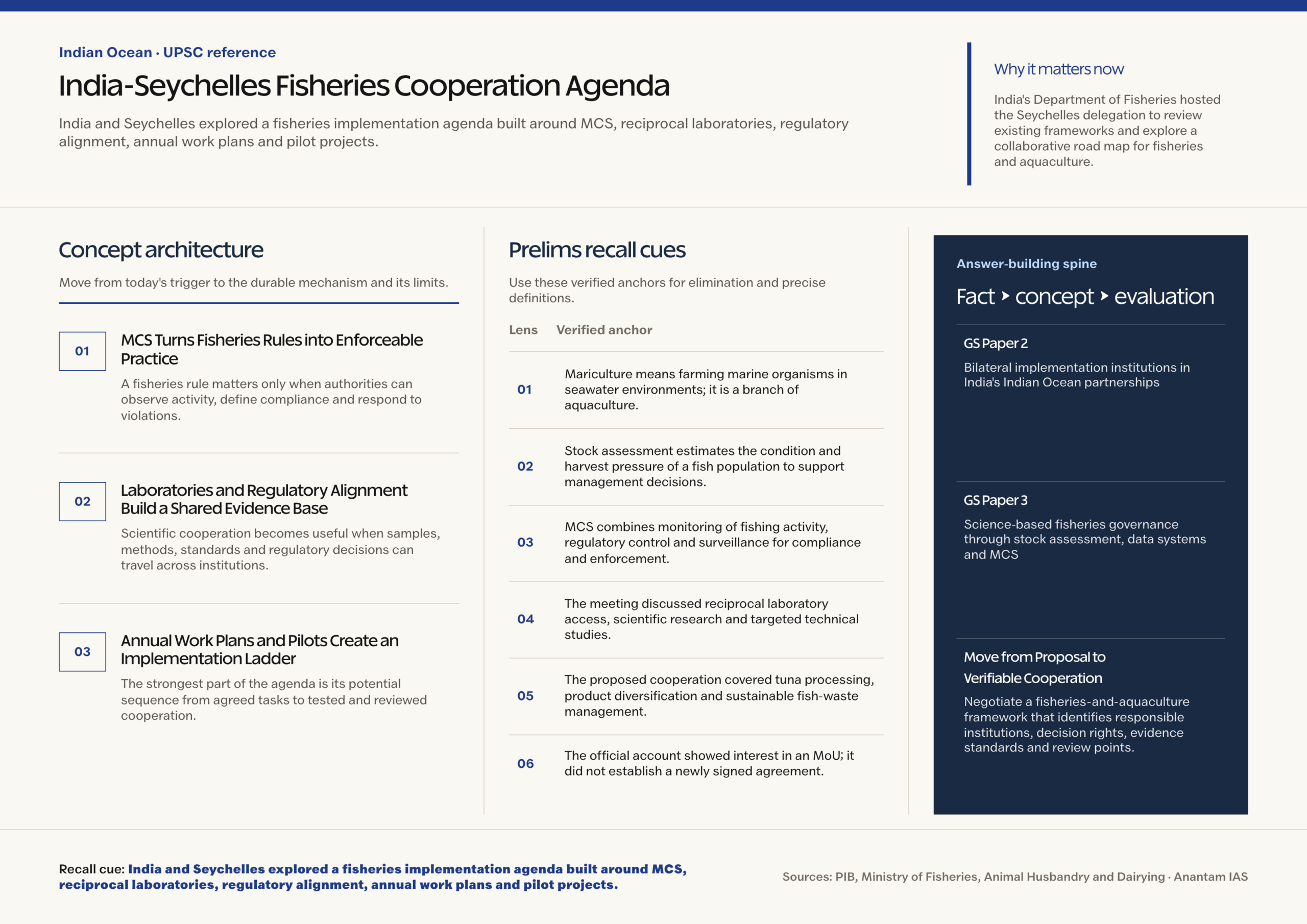
- Mariculture means farming marine organisms in seawater environments; it is a branch of aquaculture.
- Stock assessment estimates the condition and harvest pressure of a fish population to support management decisions.
- MCS combines monitoring of fishing activity, regulatory control and surveillance for compliance and enforcement.
- The meeting discussed reciprocal laboratory access, scientific research and targeted technical studies.
- The proposed cooperation covered tuna processing, product diversification and sustainable fish-waste management.
- The official account showed interest in an MoU; it did not establish a newly signed agreement.
Mains Relevance
GS Paper 2
- Bilateral implementation institutions in India’s Indian Ocean partnerships
- Technical cooperation, regulatory alignment and capacity-building between India and Seychelles
GS Paper 3
- Science-based fisheries governance through stock assessment, data systems and MCS
- Mariculture, tuna value chains, post-harvest engineering and marine conservation
Essay
- Durable international cooperation depends less on broad declarations than on institutions that turn shared intent into evidence, rules, pilots and accountable review.
Background and Context
MCS Turns Fisheries Rules into Enforceable Practice
A fisheries rule matters only when authorities can observe activity, define compliance and respond to violations.
- Monitoring collects information on vessels, fishing effort, catch, landing and location so regulators can compare actual activity with authorised activity and scientific advice.
- Control supplies the legal and administrative layer: licences, permitted gear, reporting duties, harvest conditions, closed areas or seasons, and sanctions for non-compliance.
- Surveillance checks behaviour through inspections, patrols and other verification tools, allowing authorities to detect discrepancies and direct limited enforcement resources toward higher-risk activity.
- A joint agenda can improve interoperability between data systems and procedures, but the talks did not establish that shared MCS infrastructure or artificial-intelligence tools were already operational.
- Stock assessment gives MCS an ecological purpose: compliance data and scientific evidence can inform harvest decisions rather than treating vessel tracking as an isolated security exercise.
Laboratories and Regulatory Alignment Build a Shared Evidence Base
Scientific cooperation becomes useful when samples, methods, standards and regulatory decisions can travel across institutions.
- The talks proposed reciprocal laboratory access, enabling researchers and technical agencies to use complementary facilities for testing, training and joint scientific work.
- Targeted studies can connect stock assessment with hatchery, mariculture, tuna-processing, conservation and fish-waste questions instead of producing research detached from implementation needs.
- Regulatory alignment does not require identical domestic laws; it can begin with compatible definitions, sampling protocols, documentation, quality controls and reporting practices for agreed activities.
- Comparable evidence can reduce disputes over methods and help administrators judge whether a pilot should be expanded, modified or stopped before it creates ecological or market risk.
- Commercialising joint research requires clear safeguards for data governance, scientific integrity, intellectual contributions, biosecurity and public-interest regulation; the release proposed acceleration but supplied no completed arrangement.
Annual Work Plans and Pilots Create an Implementation Ladder
The strongest part of the agenda is its potential sequence from agreed tasks to tested and reviewed cooperation.
- An annual work plan can assign institutions, milestones, training needs, data outputs and review dates, making bilateral intent easier to monitor than an open-ended cooperation statement.
- A mariculture or hatchery pilot should establish baseline ecological conditions, species suitability, disease safeguards, feed and waste controls, community participation and measurable stop-or-scale criteria.
- A tuna-value-chain pilot can examine post-harvest engineering, processing, product diversification and waste management without assuming that greater harvest volume is the only route to higher value.
- Extension services, exposure visits and specialised exchanges can translate laboratory knowledge into operational practice while revealing whether methods fit each country’s administrative and ecological conditions.
- The sequence remains proposed: talks identified work plans, alignment, laboratories and pilots, while Seychelles sought a dedicated MoU to institutionalise continuing engagement.
Way Forward
Move from Proposal to Verifiable Cooperation
- Negotiate a fisheries-and-aquaculture framework that identifies responsible institutions, decision rights, data-sharing safeguards and a public method for reviewing annual work-plan results.
- Choose pilots through stock evidence and ecological risk screening, then define baseline indicators, time limits and stop-or-scale criteria before implementation.
- Align laboratory protocols, catch documentation and compliance definitions sufficiently for evidence to be compared without erasing each country’s domestic regulatory authority.
- Evaluate value-chain gains alongside stock health, waste reduction, livelihood access and enforcement costs rather than measuring cooperation only by production or export volume.
Conclusion
- The talks matter as a proposed implementation architecture: MCS, shared science, reciprocal laboratories, regulatory alignment, annual planning and pilots can connect diplomacy with measurable fisheries governance.
- A strong answer should distinguish an agenda from an agreement; Seychelles expressed interest in a dedicated MoU, but the official release did not show a new fisheries MoU as signed.
- The test of cooperation will be whether pilots produce traceable evidence, compatible rules and sustainable value chains without treating higher extraction as the default measure of success.
UPSC Practice Questions
Prelims MCQ 1
With reference to fisheries governance, consider the following statements:
- Mariculture is the farming of marine organisms in seawater environments.
- Stock assessment helps estimate the condition and harvest pressure of fish populations.
- Monitoring, Control and Surveillance refers only to scientific estimation of fish stocks.
How many of the above statements are correct?
(a) Only one (b) Only two (c) All three (d) None
Answer: (b) Only two
Explanation:
Statements 1 and 2 are correct. MCS covers observing fishing activity, setting regulatory controls and checking compliance; stock assessment is related scientific evidence, not the complete meaning of MCS.
Prelims MCQ 2
Which of the following best describes the outcome recorded by the official release on the 25 August 2026 India-Seychelles fisheries meeting?
(a) A new fisheries MoU entered into force immediately (b) A common fishing fleet began joint operations (c) The sides explored cooperation instruments and Seychelles expressed interest in a dedicated MoU (d) A binding regional tuna quota was adopted
Answer: (c) The sides explored cooperation instruments and Seychelles expressed interest in a dedicated MoU
Explanation:
The release describes talks, proposed implementation instruments and Seychelles’ interest in an MoU. It does not report a newly signed fisheries MoU, joint fleet or binding tuna quota.
UPSC Mains Questions
- India-Seychelles fisheries cooperation can become a model of implementation-led Indian Ocean diplomacy. Examine the role of MCS, shared laboratories, regulatory alignment and annual work plans.
- Why should mariculture and fisheries value-chain pilots be tied to stock assessment, ecological safeguards and measurable stop-or-scale criteria? Discuss.
Source: PIB, Ministry of Fisheries, Animal Husbandry and Dairying.
Frequently Asked Questions
What did India and Seychelles decide on fisheries cooperation?
They explored cooperation on MCS, laboratories, research, mariculture, value chains, regulatory alignment, annual planning and pilots. The release recorded proposals, not completed implementation.
Was a new India-Seychelles fisheries MoU signed?
No new signed fisheries MoU was reported. Seychelles expressed interest in a dedicated fisheries-and-aquaculture MoU supported by an advanced work plan and continuing institutional engagement.
What is Monitoring, Control and Surveillance in fisheries?
MCS combines information on fishing activity, regulatory rules and compliance checks so authorities can compare actual conduct with licences, management measures and conservation requirements.
Why does reciprocal laboratory access matter?
It can let institutions use complementary facilities, compare methods, train specialists and conduct joint studies, creating a stronger evidence base for regulation and pilot evaluation.
How should a mariculture pilot be evaluated?
It should begin with ecological baselines and assess species suitability, disease, feed, waste, community access and compliance against stated time limits and stop-or-scale criteria.