India Shipbuilding by 2047

Why in news:
The Government of India has announced that with less than 1% share in global shipbuilding at present, India is aiming to be among the top 5 shipbuilding nations by 2047.
UPSC Relevance:
Infrastructure: Energy, Ports, Roads, Airports, Railways et. and Shipping Industry
UPSC PYQ 2017:
Examine the developments of Airports in India through Joint Ventures under Public-Private Partnership (PPP) model. What are the challenges faced by the authorities in this regard.
India’s maritime legacy is as vast and dynamic as its 11098-kilometer coastline, which anchors 12 major ports and over 200 minor ones. Positioned along the world’s busiest shipping routes, India is not just a key trading hub but a rising global power. In 2023, the nation contributed 16 percent of global growth, and according to some estimates, it is on course to become the third-largest economy within the next three years. As India ascends the global stage, its maritime sector emerges as a linchpin for commerce, connectivity, and international cooperation.
Industry Overview:
- Around 95% of India’s trading by volume and 70% by value is done through maritime transport. In November 2020, Hon’ble Prime Minister renamed the Ministry of Shipping as the Ministry of Ports, Shipping and Waterways.
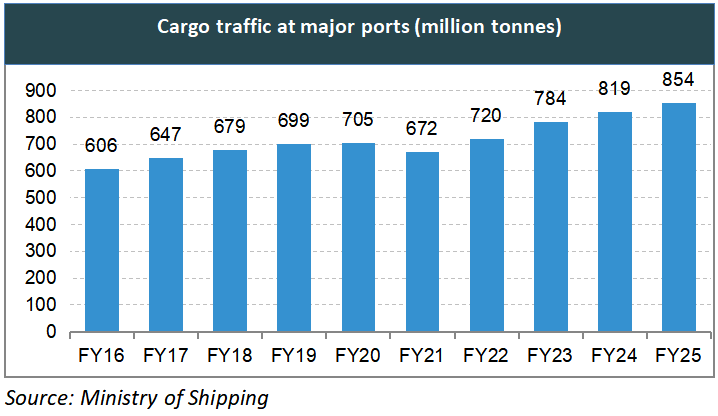
- During FY25, all key ports in India handled 853.56 million tonnes (MT) of cargo traffic compared to 819 MMT handled during FY24. Merchandise exports reached Rs. 37,34,255 crore (US$ 437.42 billion) in FY25.
- India has less than 1% share in global shipbuilding at present.
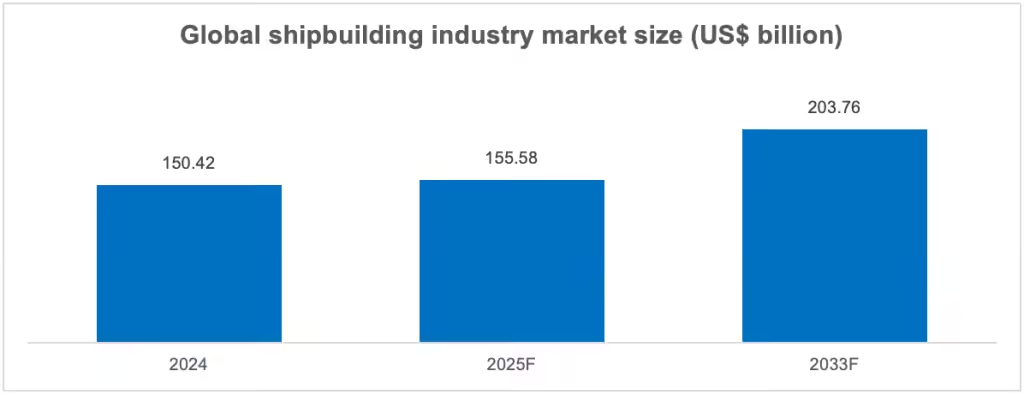
- The value of the global shipbuilding market was estimated at US$ 150.42 billion in 2024 and is projected to increase at a compound annual growth rate (CAGR) of 3.43% from US$ 155.58 billion in 2025 to US$ 203.76 billion in 2033.
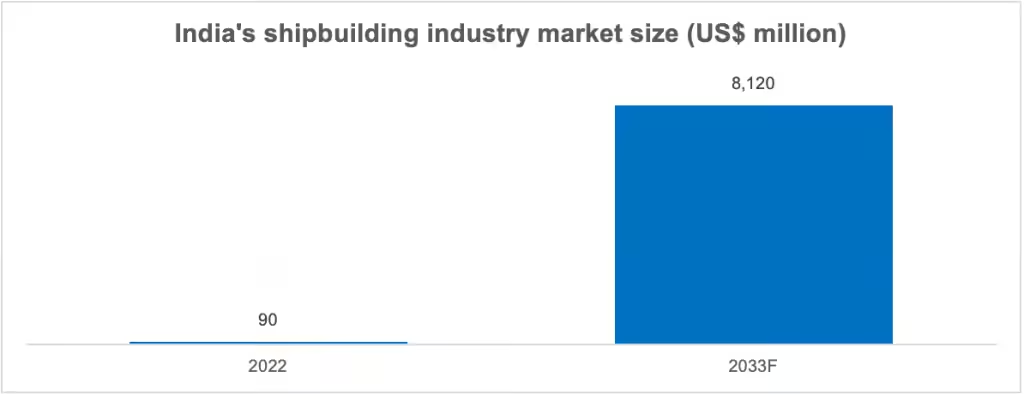
Indian Shipbuilding Market Size:
Public sector shipyards
- Cochin Shipyard Limited (CSL):India’s largest shipyard, known for building commercial vessels, defence ships, and the INS Vikrant, India’s first indigenous aircraft carrier.
- Mazagaon Dock Shipbuilders Limited (MDL): Specialises in constructing submarines, warships, and offshore patrol vessels for the Indian Navy.
- Garden Reach Shipbuilders & Engineers (GRSE): Focuses on frigates, corvettes, and patrol vessels, and has also built export ships for international clients.
- Goa Shipyard Limited (GSL): Primarily constructs offshore patrol vessels (OPVs), fast patrol boats, and interceptor boats for defence forces.
- Hindustan Shipyard Limited (HSL): Handles naval support vessels, submarines, and ship repair services.
Private sector shipyards
Shoft Shipyard and ABG Shipyard: Focus on small vessels, tugboats and support ships.
Larsen & Toubro (L&T Shipbuilding): Specialises in high-speed interceptors, defence vessels, and offshore support ships.
Reliance Naval and Engineering Limited (RNEL): Engages in naval and commercial shipbuilding, although financial issues have impacted operations.
Govt. Initiatives:
New targets set by the Govt.:
- Expand Indian seafarers’ share of the global workforce from 12% to 25%.
- Rank among the top 10 maritime nations by 2030.
- Rank among the top 5 by 2047.
- Raise maritime sector’s contribution from 4% to 12% of GDP.
- Advance from 16th position globally to 5th by 2047.
Maritime India Vision, 2030:
(i) Ministry has amended the Shipbuilding Financial Assistance Policy (SBFAP) guidelines on 29.01.2025 to encourage more participation in the shipbuilding activities.
(ii) The Government, in November, 2021, has released Standard Tug Designs of five variants for use by Major Ports for procurement of tugs to be built in Indian Shipyards.
(iii) To promote indigenous shipbuilding, the Ministry of Ports, Shipping and Waterways on 20.09.2023 has revised the hierarchy of Right of First Refusal (RoFR) to be followed in any kind of charter of a vessel which is undertaken through a tender process.
v) Government has launched the Harit Nauka guidelines for inland vessels which aim to promote the adoption of greener technologies in inland waterway vessels.
Shipbreaking Credit Note Scheme:
- Offers 40% credit on the scrap value of old ships, usable for purchasing new ‘Made in India’ vessels.
Maritime Development Fund
- Rs 25,000 crore fund created (49% government-funded), to provide long-term, low-cost financing for shipbuilding, ship repair, and infrastructure.