India’s Statistical Databases Upgraded: New Base Years for GDP, CPI and IIP
Why in News?
India’s official statistics machinery has rolled out its biggest overhaul in over a decade. The Ministry of Statistics and Programme Implementation (MoSPI) and the National Statistical Office (NSO) have shifted the base years of the country’s three headline indicators — GDP, the Index of Industrial Production (IIP) and the Consumer Price Index (CPI) — so that they reflect a far more recent picture of the economy.
The new series, explained by The Hindu, rebase GDP and IIP to 2022-23 and CPI to 2024, move manufacturing GDP to double deflation, and weave in administrative and big data such as GST records. A companion Hindu editorial called these “essential upgrades” but flagged that frequent, well-documented revisions and transparency must follow.
- GDP base year moves from 2011-12 to 2022-23; the new GDP series was released on 27 February 2026.
- CPI base year shifts to 2024 (from 2012), with the new inflation series released on 12 February 2026.
- IIP base year also moves to 2022-23 (from 2011-12), with the new factory-output series slated for May 2026.
- Double deflation replaces single deflation for the manufacturing sector, deflating outputs and inputs by separate price indices.
- Real administrative databases — GST, e-Vahan (vehicle registrations) and PFMS — plus survey data now feed the estimates.
The development matters in the context of:
- Rebasing periodically resets the reference year so that price-volume weights mirror the current structure of output and consumption rather than a decade-old one.
- MoSPI’s Advisory Committee on National Accounts Statistics (ACNAS), a 26-member body set up in June 2024 under economist Biswanath Goldar, recommended the 2022-23 base and the new data sources.
- The exercise also compresses release timelines and launches the e-Sankhyiki portal for faster data dissemination.
UPSC Relevance
Prelims Relevance
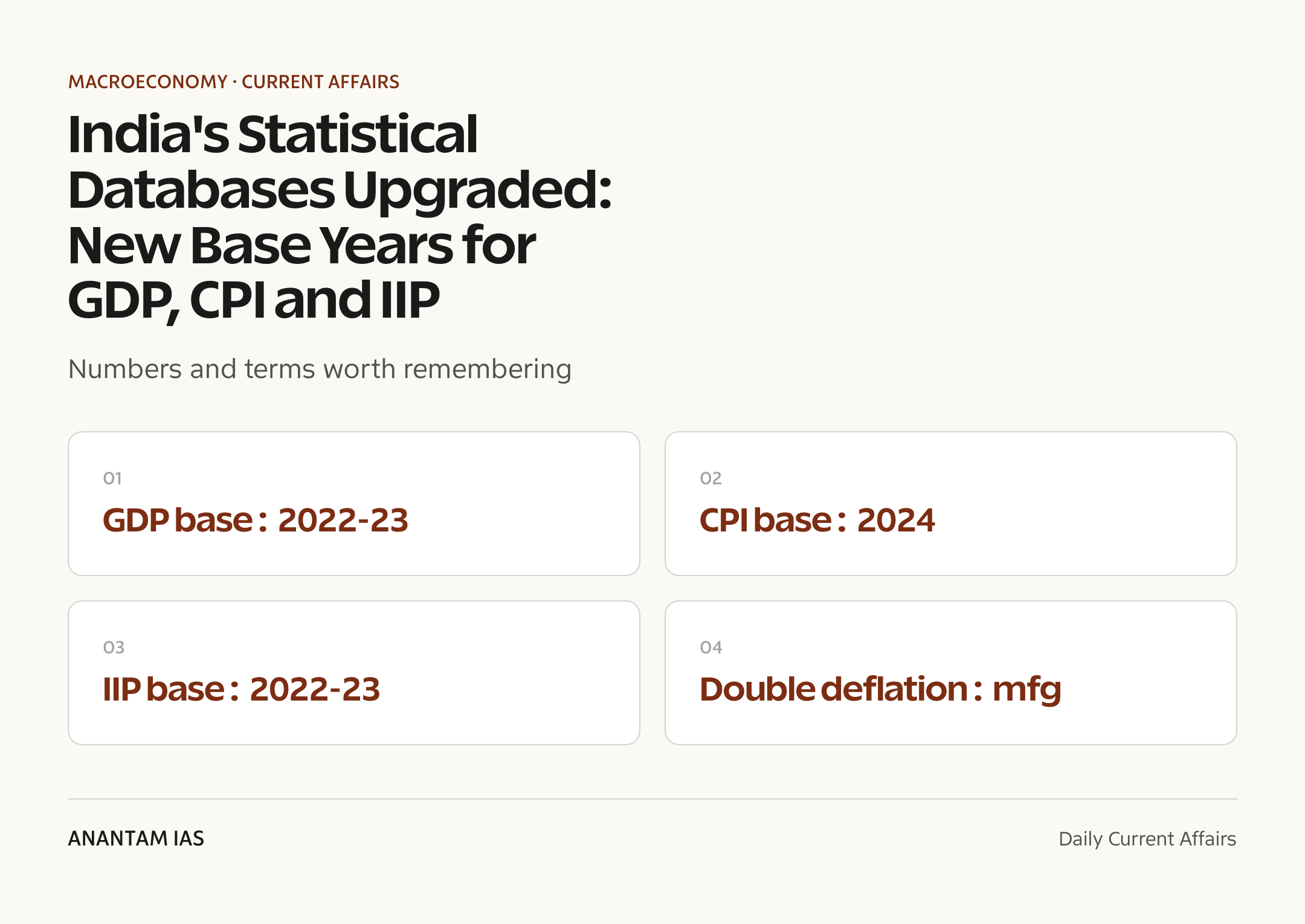
- GDP and IIP new base year is 2022-23; the old base was 2011-12.
- CPI new base year is 2024; the previous CPI base was 2012.
- MoSPI is the nodal ministry; the NSO (which absorbed the erstwhile Central Statistics Office, CSO, and NSSO in 2019) compiles National Accounts.
- Double deflation uses separate price indices for inputs and outputs — now applied to manufacturing GDP.
- IIP measures industrial output; CPI is the headline inflation gauge used by the RBI for its 4% (+/-2%) target.
- ACNAS (Advisory Committee on National Accounts Statistics) advises MoSPI on base year and methodology; chaired by Biswanath Goldar.
- Administrative-data sources folded in include GST, e-Vahan and the PFMS.
- The e-Sankhyiki portal was launched for data dissemination and management.
- Release sequence: CPI 12 Feb 2026, GDP 27 Feb 2026, IIP May 2026.
- Aim of rebasing is improved accuracy, relevance and international comparability of official data.
Mains Relevance
GS Paper 3
- How periodic rebasing of GDP, CPI and IIP affects measured growth, inflation and industrial output, and why it matters for fiscal and monetary policy.
- Significance of double deflation and administrative-data integration (GST, e-Vahan, PFMS) for the accuracy of national income accounting.
GS Paper 2
- Strengthening institutional credibility of official statistics — the role of MoSPI, NSO and expert committees like ACNAS in ensuring transparent, comparable and timely data for governance.
Essay
- What gets measured gets managed — the politics and policy stakes of how a nation counts its growth and inflation.
- Data as public infrastructure: credible statistics as a foundation of democratic accountability.
Background and Context
What rebasing means and why it was overdue
Rebasing resets the reference year against which real growth and price change are measured, so the weights reflect today’s economy.
- An index compares current values to a fixed base year; if that base is stale, the basket of goods and sector weights no longer match how the economy actually produces and consumes.
- GDP and IIP had been anchored to 2011-12 for over a decade; CPI to 2012 — a period before the rise of digital services, renewable energy and post-GST formalisation.
- Structural shifts — new industries, changed consumption baskets and investment behaviour — mean an old base understates fast-growing sectors and overweights declining ones.
- MoSPI’s stated objective is to improve the accuracy, relevance and international comparability of India’s official data.
The three new series and their dates
The rollout staggers India’s three flagship indicators across early 2026.
- GDP: base shifts from 2011-12 to 2022-23; the new National Accounts series was released on 27 February 2026.
- CPI: base shifts to 2024; the new retail-inflation series went live on 12 February 2026.
- IIP: base shifts to 2022-23; the new industrial-output series is scheduled for May 2026.
- Under the new GDP series, real growth for FY 2025-26 is estimated near 7.6%, with nominal GDP up about 8.6% — figures that may differ from the old-base estimates.
- Read the foundations in our explainer on Gross Domestic Product (GDP) explained.
Double deflation — a methodological upgrade
The way real manufacturing GDP is computed changes substantively, not just cosmetically.
- Earlier, manufacturing used single deflation — a single price index applied to value-added, which can distort real growth when input and output prices move differently.
- Double deflation deflates outputs and inputs separately using their respective price indices, then takes the difference.
- This better captures the real value-added of manufacturing, especially when raw-material prices diverge sharply from finished-goods prices.
- It aligns India closer with international System of National Accounts (SNA) best practice long urged by economists.
Administrative and big data come into the fold
The new series leans less on periodic surveys alone and more on real-time digital footprints of the economy.
- GST returns offer granular, high-frequency data on turnover across sectors and geographies.
- e-Vahan (vehicle registrations) and the Public Financial Management System (PFMS) provide near real-time activity and expenditure signals.
- Blending these with surveys aims to plug coverage gaps and reduce the lag between an economic event and its appearance in the data.
- MoSPI also launched the e-Sankhyiki portal and shortened publication timelines for annual, quarterly and monthly results.
Institutions behind the numbers
A clear institutional chain decides what gets measured and how.
- MoSPI is the nodal ministry; the NSO — formed in 2019 by merging the Central Statistics Office (CSO) and the National Sample Survey Office — compiles the National Accounts.
- The Advisory Committee on National Accounts Statistics (ACNAS), a 26-member expert body set up in June 2024 under Biswanath Goldar, recommends the base year, new data sources and methodology.
- These bodies sit within a wider statistical architecture that includes the National Statistical Commission and sector ministries supplying source data.
- See how this ties into wider data governance in our note on the National Statistical Commission.
What the editorial flagged
The Hindu welcomed the rebasing but set conditions for it to genuinely strengthen trust.
- Upgrades are essential given how much the economy has changed, but credibility depends on transparent documentation of methods and sources.
- Frequent, predictable revisions and full disclosure of back-series data help users and markets interpret the new numbers.
- Administrative data must be quality-checked — GST and similar databases were built for compliance, not statistics, so coverage and definitional gaps need careful handling.
- An independent, well-resourced statistical system insulated from short-term pressures remains the bedrock of credible data.
Way Forward
Transparency and documentation
- Publish detailed methodology notes, back-series data and the rationale for new data sources so users can reconcile old and new estimates.
- Set a predictable, well-communicated revision calendar to avoid surprise jumps in headline numbers.
Data-quality safeguards
- Validate GST, e-Vahan and PFMS feeds against surveys before they drive headline estimates.
- Strengthen the autonomy and capacity of MoSPI, the NSO and the National Statistical Commission.
Build a culture of using administrative data responsibly — with clear definitions, audit trails and openness to external scrutiny.
Conclusion
Rebasing GDP and IIP to 2022-23 and CPI to 2024, adopting double deflation and folding in GST and administrative data marks the most consequential refresh of India’s statistical core in over a decade. Done well, it gives policymakers, the RBI and markets a sharper, more current read on growth, inflation and industrial output.
The gains hinge on execution. Credible, comparable statistics demand transparent methods, disciplined revisions and an independent statistical system. The rebasing is the easy part; sustaining trust in the numbers is the lasting test.
UPSC Practice Questions
Prelims MCQ 1
With reference to the recent upgrade of India’s statistical databases, consider the following statements:
- The base year for both GDP and the Index of Industrial Production has been revised to 2022-23.
- Double deflation has been adopted for the manufacturing sector in the new GDP series.
- The Consumer Price Index base year has been retained at 2011-12.
How many of the above statements are correct?
(a) Only one (b) Only two (c) All three (d) None
Answer: (b) Only two
Explanation:
Statements 1 and 2 are correct — GDP and IIP move to a 2022-23 base, and manufacturing now uses double deflation. Statement 3 is wrong: the CPI base year was revised to 2024 (from 2012), not retained at 2011-12.
Prelims MCQ 2
Which body recommended the new base year and data sources for India’s National Accounts in the recent revision?
(a) National Statistical Commission (b) Central Statistics Office (c) Advisory Committee on National Accounts Statistics (d) Reserve Bank of India’s Monetary Policy Committee
Answer: (c) Advisory Committee on National Accounts Statistics
Explanation:
The 26-member Advisory Committee on National Accounts Statistics (ACNAS), set up by MoSPI in June 2024 under Biswanath Goldar, advised on the 2022-23 base year, new data sources and compilation methodology. The CSO was merged into the NSO in 2019.
UPSC Mains Questions
- Periodic rebasing of GDP, CPI and IIP is necessary but not sufficient for credible economic statistics. Examine, with reference to India’s recent shift to a 2022-23 base year and the adoption of double deflation. (250 words)
- Integrating administrative and big data such as GST into national income accounting promises timeliness but raises quality concerns. Discuss the opportunities and safeguards needed. (250 words)
Sources: The Hindu and The Hindu (Editorial).
Frequently Asked Questions
What are the new base years for GDP, CPI and IIP?
GDP and the Index of Industrial Production (IIP) have shifted to a base year of 2022-23 (from 2011-12), while the Consumer Price Index (CPI) has moved to a 2024 base (from 2012). The new GDP series was released on 27 February 2026 and the CPI series on 12 February 2026.
What is double deflation and why does it matter?
Double deflation deflates a sector’s outputs and inputs separately, using their own price indices, before taking the difference to get real value-added. The new manufacturing GDP uses it instead of single deflation, giving a more accurate read of real industrial growth when input and output prices diverge.
Why is the base year of an index changed periodically?
An index compares current values against a fixed base year. Over time, the economy’s structure, consumption basket and sector weights change. A stale base year understates fast-growing sectors and overstates declining ones, so rebasing keeps measures of growth and inflation accurate, relevant and internationally comparable.
Which institutions are responsible for these statistics?
MoSPI is the nodal ministry. The National Statistical Office (NSO) — formed in 2019 by merging the Central Statistics Office (CSO) and the National Sample Survey Office — compiles National Accounts. The Advisory Committee on National Accounts Statistics (ACNAS), set up in June 2024, advised on the base year and methodology.
What new data sources feed the revised series?
Alongside surveys, the new series draws on real-time administrative databases — the GST system, e-Vahan (vehicle registrations) and the Public Financial Management System (PFMS). MoSPI also launched the e-Sankhyiki portal and shortened publication timelines to make data faster and more granular.
How does this affect inflation and growth figures?
New base years reset the weights in CPI and GDP, so headline inflation and growth numbers may differ from the old-base series. Under the new GDP series, FY 2025-26 real growth is estimated near 7.6%. Comparisons across the old and new series must be made carefully using the published back-series.