India Becomes the World’s Top Ship Recycling Nation: 35.4% Share and the Hong Kong Convention
Why in News?
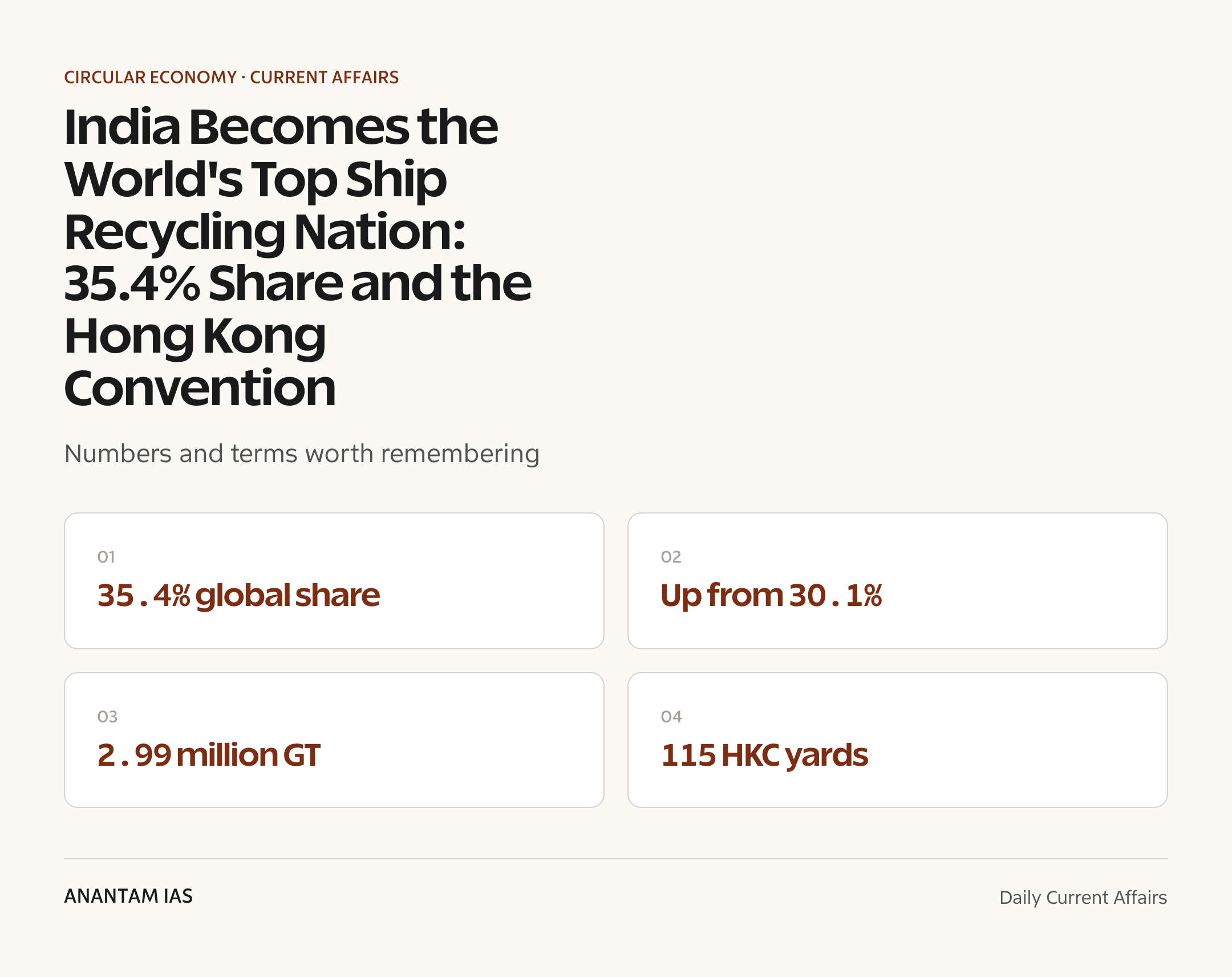
India has emerged as the world’s largest ship recycling nation in 2025, the Ministry of Ports, Shipping & Waterways announced, with its share of the global market climbing to 35.4% from 30.1% a year earlier. The milestone means India has met a key Maritime India Vision 2030 target a full five years ahead of schedule.
The leap rests on a policy stack built over the past few years — the Recycling of Ships Act, 2019, India’s early ratification of the Hong Kong Convention (which entered into force on 26 June 2025), a network of 115 HKC-compliant yards at Alang-Sosiya, and the new Ship-breaking Credit Note Scheme that links green recycling to fresh shipbuilding orders.
- Global market share rose to 35.4% in 2025, up from 30.1% in 2024 — the highest of any country.
- Recycled tonnage grew nearly 60%, from 1.86 million GT in 2024 to 2.99 million GT in 2025.
- India achieved its Maritime India Vision (MIV) 2030 ship-recycling leadership target five years early.
- Union Minister Sarbananda Sonowal credited the Recycling of Ships Act, HKC compliance and the Credit Note Scheme.
- Rs 53.5 crore in financial assistance has supported yard modernisation; 115 yards are now HKC-compliant.
The development matters in the context of:
- Ship recycling (ship-breaking) is the dismantling of end-of-life vessels to recover steel and reusable equipment — a classic circular-economy activity.
- India competes mainly with Bangladesh, Pakistan and Turkey; the Alang-Sosiya belt in Gujarat is among the largest recycling clusters on earth.
- The sector ties together three syllabus strands: the maritime economy, environmental governance, and India’s role in international conventions.

UPSC Relevance
Prelims Relevance
- India became the world’s top ship-recycling nation in 2025 with a 35.4% global share (up from 30.1% in 2024).
- The achievement met a Maritime India Vision 2030 target five years ahead of schedule.
- The Recycling of Ships Act, 2019 is India’s domestic law governing safe ship recycling.
- India acceded to the Hong Kong International Convention in 2019; the Convention was adopted in 2009 and entered into force on 26 June 2025.
- The HKC requires every ship to carry an Inventory of Hazardous Materials (IHM) and every yard to have a Ship Recycling Facility Plan.
- The Convention enters into force only after ratification by 15 states representing 40% of world merchant shipping tonnage plus a combined recycling-volume threshold.
- Alang-Sosiya in Gujarat is India’s principal ship-recycling hub; 115 yards there are HKC-compliant.
- The Ship-breaking Credit Note Scheme gives owners credit notes worth 40% of a vessel’s scrap value, usable for up to 5% of new-vessel construction cost at Indian yards.
- The administering ministry is the Ministry of Ports, Shipping & Waterways, headed by Sarbananda Sonowal.
- Alang’s capacity is being expanded toward about 9 million LDT (light displacement tonnes).
Mains Relevance
GS Paper 3
- Ship recycling as a model of the circular economy — recovering steel and equipment from end-of-life assets while creating coastal employment.
- Role of targeted policy (Recycling of Ships Act, Credit Note Scheme, yard subsidies) in building a globally competitive maritime manufacturing ecosystem.
- Balancing industrial growth with occupational safety and coastal-pollution control at hubs like Alang.
GS Paper 2
- India’s compliance with the Hong Kong Convention and its leverage in shaping global maritime-environment governance.
- Centre-state coordination (Gujarat) and the use of financial incentives to drive a regulated, green sector.
Essay
- Growth that does not cost the earth: India’s green ship-recycling story
- From scrap to strategy — building a circular maritime economy
Background and Context
What changed in 2025 — the headline numbers
India did not just grow its recycling business; it overtook every rival to lead the world.
- Global share jumped to 35.4% in 2025 from 30.1% in 2024, lifting India to the No. 1 position.
- Volume rose nearly 60% — from 1.86 million GT to 2.99 million GT — in a single year.
- The surge fulfilled a Maritime India Vision 2030 ambition five years early.
- On current share, India recycles an estimated 500-600 vessels a year.
- Global demand is set to climb: industry body BIMCO projects more than 16,000 vessels reaching end-of-life over the next decade, much of which India is positioned to capture.
- The gain is also a quality story — India pulled ahead while moving its yards to internationally certified standards, not by undercutting on safety or environment.
The domestic law — Recycling of Ships Act, 2019
India’s recycling boom sits on a statutory base passed in 2019.
- The Recycling of Ships Act, 2019 created a national framework for the safe and environmentally sound recycling of ships.
- It mandates authorisation of recycling yards and an Inventory of Hazardous Materials for vessels brought in for dismantling.
- The Act effectively domesticated the standards of the Hong Kong Convention ahead of its global entry into force.
- It is administered by the Ministry of Ports, Shipping & Waterways, with the Gujarat Maritime Board a key state regulator at Alang.
The Hong Kong Convention enters into force
The global rulebook for green ship recycling finally became binding in June 2025.
- The Hong Kong International Convention for the Safe and Environmentally Sound Recycling of Ships was adopted under the International Maritime Organization (IMO) on 15 May 2009.
- It entered into force on 26 June 2025, 16 years after adoption, once the ratification thresholds were met.
- Entry into force needed 15 states representing 40% of world merchant shipping tonnage, plus a combined annual recycling-volume threshold.
- Core duties: ships must carry an Inventory of Hazardous Materials (IHM); yards must operate to an approved Ship Recycling Facility Plan and prepare a vessel-specific Ship Recycling Plan.
- It restricts hazardous substances such as asbestos, ozone-depleting substances and certain heavy metals, and requires initial, renewal and final surveys.
Alang-Sosiya — the engine of the sector
Almost all of India’s recycling happens along one stretch of the Gujarat coast.
- The Alang-Sosiya belt in Bhavnagar district, Gujarat, is among the world’s largest ship-recycling clusters.
- 115 yards there are now certified HKC-compliant, a credential that attracts EU-flagged tonnage.
- Government support of Rs 53.5 crore has funded yard modernisation and worker-safety upgrades.
- Capacity is being scaled up toward roughly 9 million LDT to handle rising global demand.
- The cluster recovers large volumes of recyclable steel, feeding domestic re-rolling mills and cutting reliance on virgin ore.
The Ship-breaking Credit Note Scheme
A new incentive closes the loop between recycling old ships and building new ones.
- Under the Ship-breaking Credit Note Scheme, owners who recycle a vessel at an Indian yard get a credit note worth 40% of the vessel’s scrap value.
- The note can be set against up to 5% of the cost of building a new vessel at an Indian shipyard.
- It is designed to retain end-of-life tonnage in India while seeding demand for domestic shipbuilding.
- Read our dedicated explainer: India’s first ship-recycling credit note.
Why it matters strategically
The ranking is more than a statistic; it strengthens several national goals at once.
- Reinforces the circular economy by turning retired vessels into steel, machinery and jobs.
- Advances the Maritime India Vision 2030 and the longer-horizon Amrit Kaal Vision 2047 for the blue economy.
- HKC compliance lets Indian yards bid for high-value, well-regulated European tonnage that once avoided South Asia.
- It anchors a wider push for self-reliant shipbuilding and ship repair under maritime-sector reforms.
- Recovered steel substitutes for imported and virgin material, easing pressure on iron-ore demand and the carbon footprint of fresh steelmaking.
- Generates large-scale coastal employment and downstream trade in re-rollable steel, machinery and ship equipment.
Way Forward
Lock in green credibility
- Sustain HKC compliance across all yards and pursue third-party certification to keep attracting EU-flagged ships.
- Strengthen downstream hazardous-waste handling for asbestos, oils and heavy metals beyond the cutting beach.
Protect workers and the coast
- Make worker safety, training and health monitoring non-negotiable, given the sector’s history of accidents.
- Monitor and remediate intertidal-zone pollution at Alang with independent audits.
Build the full value chain
- Use the Credit Note Scheme to translate recycling leadership into a credible domestic shipbuilding order book.
- Diversify hubs beyond Gujarat and invest in mechanised, less labour-intensive dismantling.
Conclusion
India’s rise to the top of global ship recycling is a rare case of an industrial target met ahead of schedule and on the back of a coherent policy stack — a domestic law, an international convention, certified infrastructure and a clever incentive that links recycling to new orders.
The next test is qualitative, not quantitative. Holding the No. 1 spot will mean proving that 35.4% of the world’s ship recycling can be done safely, cleanly and in a way that feeds India’s wider maritime ambitions rather than scarring its coast.
UPSC Practice Questions
Prelims MCQ 1
With reference to ship recycling in India, consider the following statements:
- India became the world’s largest ship-recycling nation in 2025 with about a 35.4% global share.
- The Recycling of Ships Act was enacted in 2019.
- The Hong Kong International Convention on ship recycling is administered by the World Trade Organization.
How many of the above statements are correct?
Only one Only two All three None
Answer: Only two
Explanation:
Statements 1 and 2 are correct — India led globally in 2025 with a 35.4% share, and the Recycling of Ships Act dates to 2019. Statement 3 is wrong: the Hong Kong Convention is adopted under the International Maritime Organization (IMO), not the WTO.
Prelims MCQ 2
The Ship-breaking Credit Note Scheme allows a shipowner to receive a credit note worth what share of the recycled vessel’s scrap value?
20% 40% 60% 75%
Answer: 40%
Explanation:
Under the scheme, owners recycling a vessel at an Indian yard receive a credit note equal to 40% of the vessel’s scrap value, usable against up to 5% of the cost of building a new ship at an Indian shipyard.
UPSC Mains Questions
- India’s rise to the top of global ship recycling reflects a coherent policy stack rather than a single reform. Examine the roles of the Recycling of Ships Act, 2019, the Hong Kong Convention and the Ship-breaking Credit Note Scheme. (250 words)
- Ship recycling embodies both the promise and the perils of a circular economy. Discuss with reference to the Alang-Sosiya cluster, balancing economic gains against environmental and occupational risks. (250 words)
- How can India convert its leadership in ship recycling into a competitive domestic shipbuilding and ship-repair industry? Suggest a way forward. (150 words)
Sources: DD News (Ministry of Ports, Shipping & Waterways) and Business Standard.
Frequently Asked Questions
What is India’s current share of global ship recycling?
India recycled about 35.4% of the world’s tonnage in 2025, up from 30.1% in 2024, making it the world’s largest ship-recycling nation. Recycled volume rose nearly 60%, from 1.86 million GT to 2.99 million GT, lifting India ahead of competitors such as Bangladesh, Pakistan and Turkey.
What is the Maritime India Vision 2030 link?
Maritime India Vision (MIV) 2030 set targets for the maritime sector, including ship-recycling leadership. By topping the global rankings in 2025, India met that goal five years ahead of the 2030 deadline, signalling rapid progress on its blue-economy roadmap.
When did the Hong Kong Convention enter into force?
The Hong Kong International Convention for the Safe and Environmentally Sound Recycling of Ships was adopted under the IMO in 2009 and entered into force on 26 June 2025, once enough states representing the required share of world tonnage and recycling volume had ratified it.
What does the Hong Kong Convention require?
Ships must carry an Inventory of Hazardous Materials (IHM) listing substances like asbestos and heavy metals, and undergo initial, renewal and final surveys. Recycling yards must operate to an approved Ship Recycling Facility Plan and prepare a vessel-specific Ship Recycling Plan for each ship.
Where does most ship recycling happen in India?
The Alang-Sosiya belt in Bhavnagar district, Gujarat, is India’s principal ship-recycling hub and one of the largest in the world. It now hosts 115 HKC-compliant yards, supported by Rs 53.5 crore in modernisation assistance, with capacity expanding toward about 9 million LDT.
How does the Ship-breaking Credit Note Scheme work?
Owners recycling a vessel at an Indian yard receive a credit note worth 40% of its scrap value. The note can be set against up to 5% of the cost of building a new vessel at an Indian shipyard, encouraging owners to recycle in India and place fresh shipbuilding orders domestically.