India-UK CETA: 1,000 advisory personnel deployed to help exporters
Why in News?
Speaking at the 10th Annual UK-India Week in London, Commerce and Industry Minister Piyush Goyal announced that the Centre will deploy roughly 1,000 advisory personnel across the country and upgrade its trade portal to help businesses extract the full benefit of the India-UK Comprehensive Economic and Trade Agreement (CETA).
The move marks the shift from signing to implementation. With CETA set to enter into force on 15 July 2026, the focus is now on outreach so that small exporters and MSMEs, not just large firms, actually use the new tariff concessions, as reported by PIB and the Ministry of Commerce and Industry.
- About 1,000 advisory personnel / field officers to be deployed nationwide to hand-hold exporters on using CETA.
- The Commerce Ministry’s trade portal will be upgraded to guide businesses on tariff lines, rules of origin and documentation.
- Announcement made at the 10th Annual UK-India Week, ahead of CETA’s 15 July 2026 entry into force.
- Outreach explicitly targets Tier-2 and Tier-3 city exporters and first-time exporters, several of whom joined the London delegation.
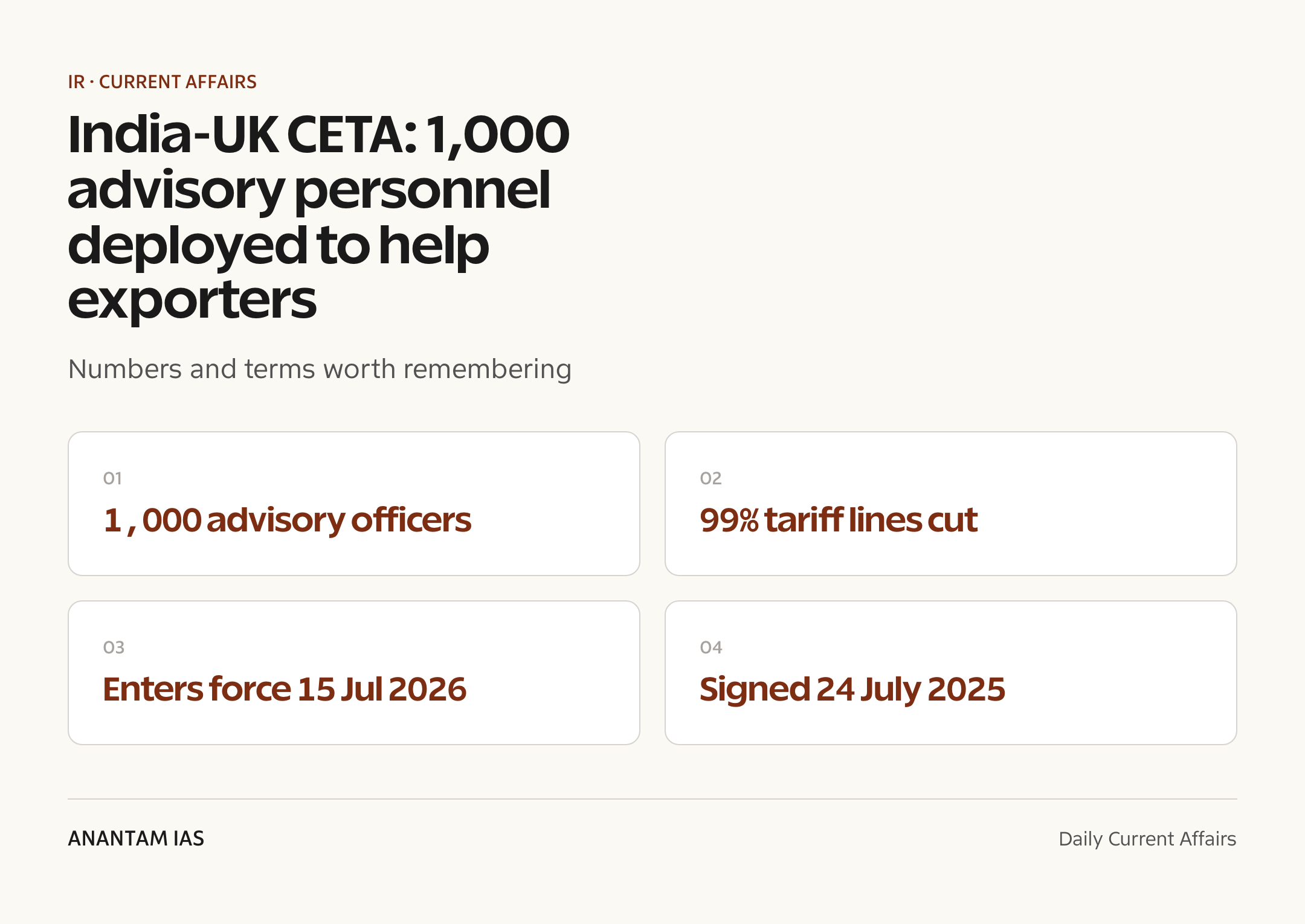
- CETA is projected to lift bilateral trade by about GBP 25.5 billion a year over the long run.
The development matters in the context of:
- India-UK CETA was signed in London on 24 July 2025 and is India’s most comprehensive trade pact with a G-7 economy.
- Both the CETA and the linked Double Contribution Convention (DCC) on social security take effect on 15 July 2026 after completing ratification in both countries.
- A recent India-UK free trade agreement note already covered the deal’s terms and the July-15 start date; this update tracks the implementation and awareness rollout.
UPSC Relevance
Prelims Relevance
- CETA (Comprehensive Economic and Trade Agreement) is a wide free trade agreement covering goods, services, investment, mobility and other rule-areas, broader than a simple goods FTA.
- India-UK CETA was signed 24 July 2025 in London; it enters into force on 15 July 2026.
- The UK will eliminate duties on about 99% of Indian tariff lines on entry into force.
- Sector tariff removals include up to 70% on some processed foods, 21.5% on marine products, 18% on engineering goods, 16% on leather and footwear and 12% on textiles and clothing.
- The Double Contribution Convention (DCC) gives eligible Indian professionals a three-year-plus social-security exemption window (about five years as cited by the minister) so they pay social security in only one country at a time.
- The nodal body for India’s FTAs and exporter facilitation is the Department of Commerce, with the DGFT (Directorate General of Foreign Trade) handling foreign-trade policy.
- Rules of origin decide whether a good qualifies as ‘Indian’ enough to claim preferential CETA tariffs and are a key compliance hurdle for exporters.
- The implementation push was announced at the 10th Annual UK-India Week in London by Piyush Goyal.
Mains Relevance
GS Paper 2
- India-UK CETA as an instrument of bilateral diplomacy and India’s post-Brexit engagement with a G-7 economy.
- The advisory rollout shows how trade-agreement gains depend on state capacity for implementation, not just negotiation.
GS Paper 3
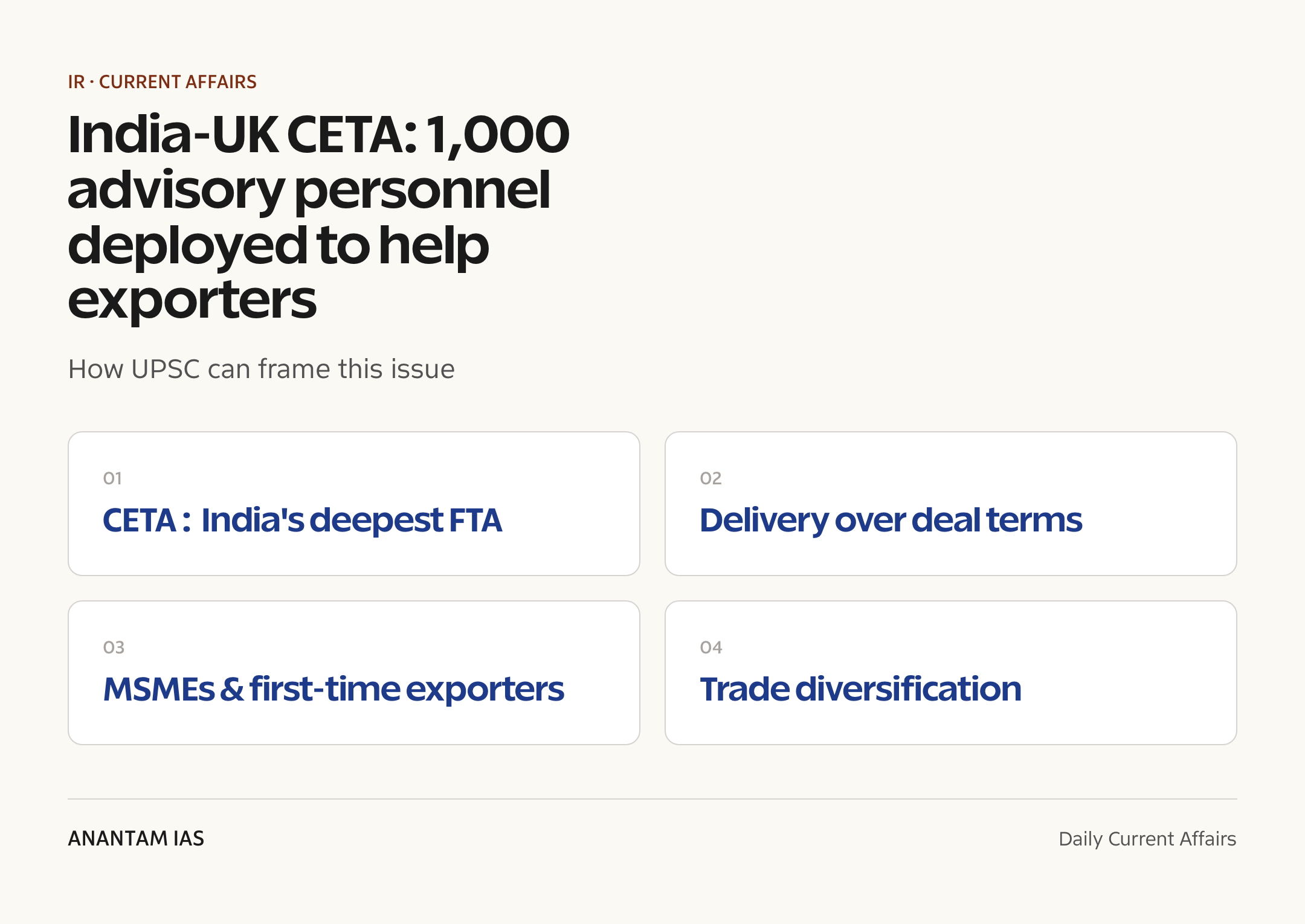
- How FTA outreach to MSMEs and first-time exporters supports export-led growth and India’s trade-diversification strategy.
Essay
- Trade agreements are written by negotiators but realised by exporters: implementation capacity decides who actually gains.
- Diversification and self-reliance can coexist when openness is paired with support for small producers.
Background and Context
The advisory rollout: the new development
The headline is delivery, not deal terms.
- The Centre will field roughly 1,000 advisory personnel across states to guide exporters through CETA’s tariff schedules, certificates and procedures.
- The Commerce Ministry’s trade portal is being upgraded into a single window for tariff-line lookups, rules-of-origin checks and documentation help.
- Outreach is pitched at Tier-2 and Tier-3 city exporters and first-time exporters, the firms most likely to miss out on a complex new agreement.
- Timing is deliberate: the drive runs in the weeks before CETA’s 15 July 2026 entry into force so businesses are ready on day one.
- The aim is to convert headline tariff cuts into actual shipments by closing the information gap small firms face.
- Several first-time exporters and businesses from smaller cities joined the UK-India Week delegation, signalling that the outreach is meant to widen, not just deepen, the exporter base.
- Awareness sessions, helpdesks and the upgraded portal together form the delivery layer that sits on top of the signed agreement.
India-UK CETA in brief
A quick refresher on the deal being implemented.
- CETA was signed in London on 24 July 2025 and is India’s most comprehensive trade pact with a G-7 nation.
- On entry into force the UK removes duties on about 99% of Indian tariff lines, covering the bulk of India’s exports by value.
- Big tariff gains land in labour-intensive sectors: textiles and clothing (12% duty removed), leather and footwear (16%), marine products (21.5%) and engineering goods (18%).
- The accompanying Double Contribution Convention spares eligible Indian professionals double social-security payments while on short UK postings.
- CETA goes beyond goods into services, investment, mobility, government procurement and cooperation on technology, clean energy and critical minerals.
- The minister has framed the long-run prize as a roughly GBP 25.5 billion annual increase in bilateral trade once the agreement is fully working.
- An FTA (free trade agreement) lowers or removes tariffs between partners; a CETA is a deeper version that also writes rules for services, investment and people movement.
What exporters and MSMEs gain
Lower duties only help if firms can claim them.
- Zero or near-zero UK duties make Indian textiles, leather, marine and engineering exports sharply more competitive against rivals still facing tariffs.
- MSMEs get a clearer route into global value chains serving UK buyers, plus easier access to inputs and technology, building on India’s existing MSME sector support framework.
- Hand-holding on rules of origin and certificates of origin reduces the compliance cost that usually deters smaller exporters.
- First-time exporters in Tier-2 and Tier-3 cities can test export markets with official support rather than navigating paperwork alone.
- Service professionals benefit from mobility commitments and the DCC’s relief on social-security contributions.
India's FTA strategy and trade diversification
CETA fits a wider pivot in trade policy.
- After years of caution, India has moved to sign deep agreements with partners such as Australia, the UAE and the EFTA bloc, with the UK pact among the most ambitious.
- The strategy is diversification: widening export destinations and supply sources to cut over-dependence on any single market, a theme that runs through India’s wider free trade agreements push.
- Deals are increasingly paired with domestic reforms and capacity-building so that gains reach producers rather than staying on paper.
- Region-to-region links such as Birmingham-Gujarat and Manchester-Maharashtra aim to embed business ties below the central level.
- The 1,000-officer rollout signals that implementation capacity is now treated as part of trade strategy, not an afterthought.
Significance
Why the rollout matters beyond one agreement.
- It tests whether India can translate a landmark FTA into measurable export and MSME gains within a tight timeline.
- Success would set a template for delivering future agreements, including ongoing talks with the United States and others.
- Targeting smaller cities and first-time exporters spreads trade gains more widely and supports inclusive growth.
- Stronger India-UK economic ties reinforce a broader strategic partnership spanning technology, defence and clean energy.
Implementation challenges
Delivery at this scale is not guaranteed.
- Training and coordinating around 1,000 advisory personnel across states demands sustained administrative effort.
- Rules-of-origin compliance and quality standards remain demanding, especially for first-time and small exporters.
- Awareness drives must reach beyond metros to genuinely cover Tier-2 and Tier-3 producers.
- Tariff cuts alone do not fix logistics costs, financing gaps and non-tariff barriers that constrain Indian exports.
- Sustained outreach beyond the launch window is needed so firms keep using CETA over time.
- Coordination between the Department of Commerce, the DGFT, customs and state export agencies has to be tight, or businesses will face conflicting guidance on the ground.
Way Forward
Sustain the outreach machinery
- Keep advisory officers active well past the 15 July launch with periodic district-level export clinics.
- Track usage data so support flows to sectors and regions that under-utilise CETA concessions.
Simplify compliance
- Make rules-of-origin self-certification and the upgraded trade portal as simple as possible for small firms.
- Integrate the portal with DGFT and customs systems to cut duplicate paperwork.
Address structural costs
- Pair tariff gains with logistics, credit and quality-certification support so exporters can actually deliver.
- Use region-to-region partnerships to build durable buyer-supplier links in the UK market.
Conclusion
The deployment of around 1,000 advisory personnel and an upgraded trade portal turns India-UK CETA from a signed text into a working tool for exporters. The message is that a trade deal’s value is decided after the ink dries, in the hands of the firms expected to use it.
If the outreach genuinely reaches MSMEs and first-time exporters in smaller cities before 15 July 2026, CETA could become a model for delivering, not just negotiating, India’s growing roster of free trade agreements.
UPSC Practice Questions
Prelims MCQ 1
With reference to the India-UK Comprehensive Economic and Trade Agreement (CETA), consider the following statements:
- It was signed in 2025 and is scheduled to enter into force in July 2026.
- On entry into force, the United Kingdom will eliminate duties on about 99% of Indian tariff lines.
- It is confined strictly to trade in goods and does not cover services or professional mobility.
How many of the above statements are correct?
(a) Only one (b) Only two (c) All three (d) None
Answer: (b) Only two
Explanation:
CETA was signed on 24 July 2025 and enters into force on 15 July 2026, and the UK removes duties on roughly 99% of Indian tariff lines, so statements 1 and 2 are correct. Statement 3 is wrong: CETA also covers services, investment and professional mobility, with a linked Double Contribution Convention.
Prelims MCQ 2
The ‘Double Contribution Convention’ linked to the India-UK CETA primarily deals with which of the following?
(a) Avoidance of double taxation of corporate profits (b) Social security contributions for professionals working across the two countries (c) Twin certification of rules of origin for exported goods (d) Joint contributions to a bilateral infrastructure fund
Answer: (b) Social security contributions for professionals working across the two countries
Explanation:
The Double Contribution Convention ensures that employees moving between India and the UK, and their employers, pay social security contributions in only one country at a time, sparing eligible Indian professionals double payments during short postings.
UPSC Mains Questions
- The gains from a free trade agreement depend less on its terms than on the state’s capacity to help firms use it. Examine in the light of India’s implementation rollout for the India-UK CETA.
- Discuss how the India-UK CETA fits into India’s broader strategy of trade diversification, and the steps needed to ensure its benefits reach MSMEs and first-time exporters.
Source: PIB, Ministry of Commerce and Industry.
Frequently Asked Questions
What is the new development around India-UK CETA?
The Commerce Ministry announced it will deploy about 1,000 advisory personnel across India and upgrade its trade portal to help exporters and MSMEs use CETA, ahead of the deal taking effect on 15 July 2026.
When does the India-UK CETA come into force?
Both the CETA and the linked Double Contribution Convention enter into force on 15 July 2026, after completing ratification in both countries. The agreement was signed on 24 July 2025.
What does CETA mean?
CETA stands for Comprehensive Economic and Trade Agreement, a wide free trade agreement covering goods, services, investment, mobility and other rule-areas, broader than a goods-only FTA.
How much will the UK cut tariffs under CETA?
On entry into force the UK eliminates duties on about 99% of Indian tariff lines, with large cuts in textiles, leather and footwear, marine products, engineering goods and processed foods.
Who is the rollout meant to help?
It targets exporters and MSMEs, and especially first-time exporters and firms in Tier-2 and Tier-3 cities, so that the tariff gains are not captured only by large companies.
What is the Double Contribution Convention?
It is a social-security agreement ensuring that employees moving between India and the UK pay social security in only one country at a time, sparing eligible Indian professionals double contributions during short postings.