India-US Interim Trade Deal: What Is at Stake as Talks Near the Finish
Why in News?
India and the United States are reported to be closing the open ends of an interim trade agreement, with negotiators aiming to lock the first tranche before a tariff deadline of 24 July 2026, when a temporary 10 per cent United States tariff on goods from several trading partners is set to expire. Commerce and Industry Minister Piyush Goyal and United States Trade Representative Jamieson Greer have held repeated rounds, and Indian officials have described the first phase of a Bilateral Trade Agreement as close to execution.
The talks matter because they would roll back a punishing tariff escalation: United States reciprocal tariffs on Indian goods had climbed to roughly 50 per cent, and the interim understanding under discussion would bring the headline rate down to about 18 per cent. In exchange, India is reported to be shielding politically sensitive farm sectors while granting limited access to selected United States agricultural goods, making this a live test of India’s trade strategy and its agricultural red lines.
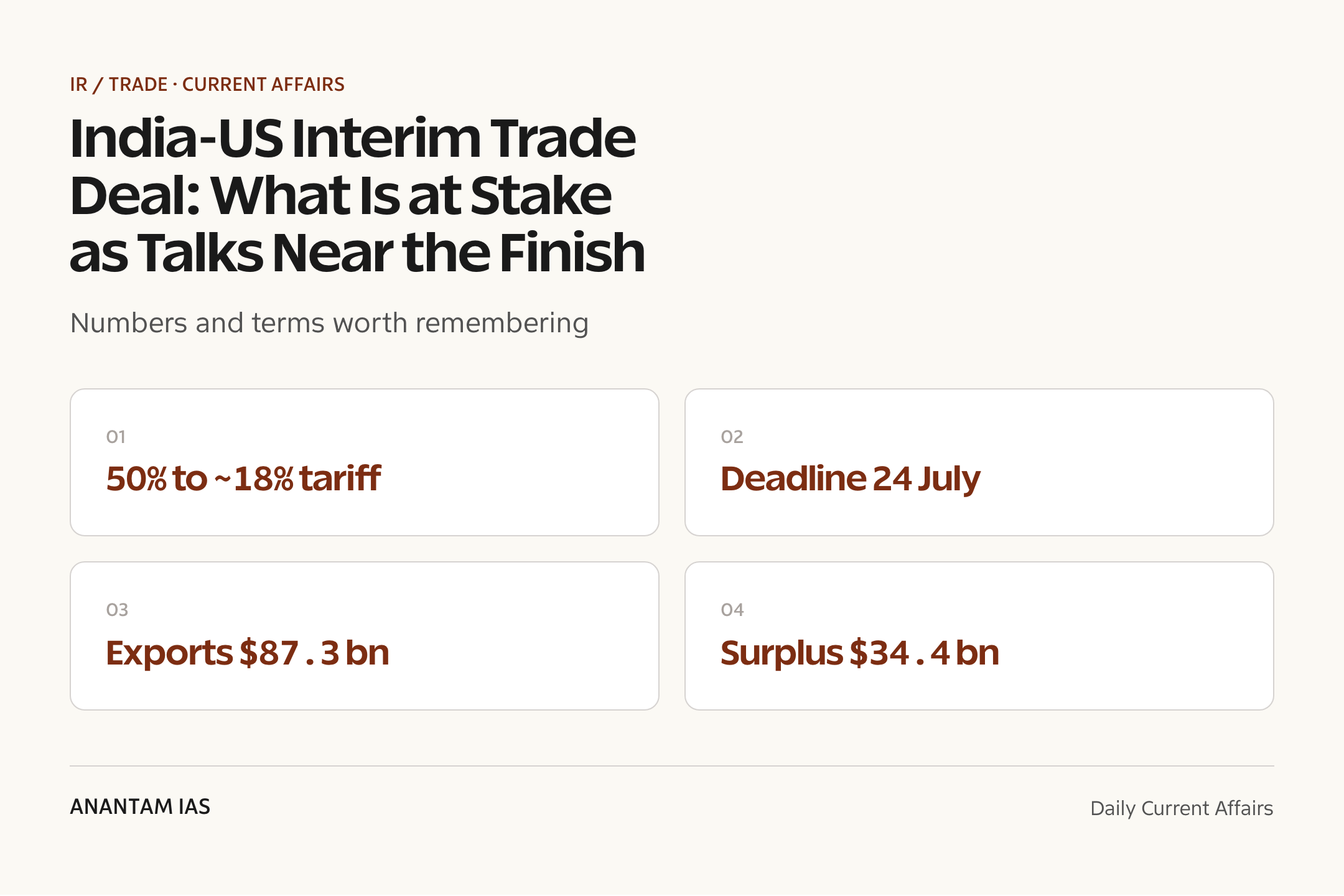
- Negotiators target the 24 July 2026 deadline, when a temporary 10 per cent United States tariff window expires.
- United States reciprocal tariffs on Indian goods had risen to about 50 per cent; the interim deal would cut the headline rate to roughly 18 per cent.
- Talks led on the Indian side by Commerce Minister Piyush Goyal and on the United States side by USTR Jamieson Greer.
- The pact is framed as a first tranche, feeding into a wider Bilateral Trade Agreement (BTA) still under negotiation.
- India is reported to be protecting dairy, rice and millets while opening limited access for United States farm goods such as DDGs, soybean oil and tree nuts.
The development matters in the context of:
- The standoff followed United States reciprocal tariffs first announced in April 2025 and escalated through 2025, straining a long-standing trade relationship.
- The United States was India’s second-largest trading partner in 2025-26, making the dispute consequential for export-heavy sectors like textiles, gems and pharmaceuticals.
UPSC Relevance
Prelims Relevance
- Reciprocal tariffs: a tariff set to mirror or counter the duties and barriers another country imposes; central to the recent United States trade approach.
- Bilateral Trade Agreement (BTA): a negotiated pact between two countries to lower tariffs and trade barriers, distinct from a multilateral WTO round.
- Headline tariff arc in this dispute: escalation to about 50 per cent on Indian goods, interim target near 18 per cent.
- India’s farm red lines: dairy, rice, wheat, maize and millets kept outside tariff concessions.
- United States farm goods under limited-access discussion: DDGs (dried distillers’ grains), red sorghum, soybean oil, tree nuts, fruit, wine and spirits.
- India-United States goods trade 2025-26: Indian exports about USD 87.3 billion, imports about USD 52.9 billion.
- India’s goods trade surplus with the United States narrowed to about USD 34.4 billion in 2025-26 from roughly USD 40.9 billion the year before.
- GSP (Generalised System of Preferences): the United States duty-free scheme from which India was removed in 2019, part of the earlier friction.
- Non-tariff barriers: regulatory hurdles such as standards and approvals, flagged alongside tariffs in the talks.
- Rules of origin: criteria that decide a product’s economic nationality, used to ensure benefits accrue to the partner countries.
Mains Relevance
GS Paper 2
- India-United States bilateral relations: trade as a pillar of a broader strategic partnership spanning defence, technology and Indo-Pacific cooperation.
- Effect of policies of developed countries on India’s interests: how United States tariff actions shape India’s external economic environment.
- Negotiation as statecraft: balancing market access demands against domestic political economy and farmer interests.
GS Paper 3
- External sector and trade policy: managing tariff shocks, export competitiveness and the trade balance with a major partner.
- Agriculture and food security: protecting dairy, rice and millet producers while selectively opening to imports like soybean oil and tree nuts.
- Issues of buffer stocks, subsidies and the WTO context that frame India’s agricultural defensive lines.
Essay
- Globalisation and self-reliance: can a country open to trade while guarding its most vulnerable producers?
- Negotiating from strength: the ethics and economics of protecting livelihoods in a deal-making world.
Background and Context
How the tariff standoff built up
The interim talks are an attempt to unwind an escalation that disrupted a major trade corridor.
- United States reciprocal tariffs on several partners were first announced in 2025, with India among those facing steep rates.
- Duties on Indian goods escalated to roughly 50 per cent, hitting labour-intensive exports such as textiles, leather and gems.
- A temporary 10 per cent tariff window is set to expire on 24 July 2026, giving the talks their urgency.
- Both governments framed an interim understanding as a way to halt escalation while a fuller agreement is negotiated.
What the interim deal would change on tariffs
The headline shift is a sharp reduction in the rate facing Indian exporters.
- The interim target is to bring the United States reciprocal rate on Indian goods down to about 18 per cent from roughly 50 per cent.
- Sectors cited for relief include textiles and apparel, leather and footwear, organic chemicals and certain machinery.
- The United States is reported to be weighing removal of duties on items like generic pharmaceuticals, gems and aircraft parts as the deal completes.
- The pact is described as a first tranche, with a wider Bilateral Trade Agreement to follow.
India's agricultural red lines
Farm policy is the hardest constraint India brings to the table.
- India is reported to keep dairy, rice, wheat, maize and millets outside tariff concessions, citing livelihoods of small producers.
- Dairy is especially sensitive given the scale of small and marginal milk producers and cultural concerns over feed sourcing.
- Protecting staple grains aligns with food-security priorities and the public procurement system.
- These red lines reflect a recurring tension in India’s trade talks, also visible in stalled negotiations with other partners.
What the United States gains in farm access
India is reported to offer limited, calibrated openings rather than blanket access.
- Items under limited-access discussion include DDGs (dried distillers’ grains) and red sorghum used as animal feed.
- Other goods cited are soybean oil, tree nuts, fresh and processed fruit, and wine and spirits.
- The United States has also pressed India on non-tariff barriers affecting food, medical devices and information-technology goods.
- India has separately signalled large purchases of United States energy, aircraft and technology over coming years as part of rebalancing.
The trade numbers behind the talks
The scale of the relationship explains why both sides want a deal.
- The United States was India’s second-largest trading partner in 2025-26.
- Indian goods exports to the United States were about USD 87.3 billion, up marginally over the year.
- Indian imports from the United States rose to about USD 52.9 billion, led by mineral fuels and oils.
- India’s goods trade surplus narrowed to roughly USD 34.4 billion in 2025-26 from about USD 40.9 billion a year earlier.
The longer history: GSP, mini-deal and the WTO frame
The current talks sit on a decade of stop-start engagement.
- The United States withdrew India’s GSP duty-free benefits in 2019, an early flashpoint in the trade ties.
- An earlier limited or mini-deal was discussed in the prior United States administration but never concluded.
- India also defends its farm support and stockholding positions in the WTO, shaping its caution on agriculture.
- The present effort marks the most concrete attempt yet to convert friction into a structured Bilateral Trade Agreement.
Way Forward
Lock the first tranche, protect the floor
- Close the interim pact before the deadline to give exporters tariff certainty, while keeping dairy and staple grains off the table.
- Sequence concessions so that limited farm openings come paired with credible safeguards and review clauses.
Build toward a durable BTA
- Use the interim deal as a confidence-building step toward a comprehensive Bilateral Trade Agreement covering services and digital trade.
- Address non-tariff barriers transparently and invest in standards and testing so Indian exporters can use the lower tariff.
Cushion the farm sector
- Strengthen domestic competitiveness in dairy and edible oils so selective imports do not destabilise producers.
- Diversify export markets through deals with other partners to reduce single-market dependence.
Conclusion
An interim India-United States trade deal would convert a damaging tariff escalation into a managed reduction, cutting the headline rate on Indian goods from around 50 per cent toward 18 per cent and restoring some predictability for exporters. The deadline of 24 July gives the talks momentum, but the substance lies in how carefully India trades limited farm access for that relief.
For aspirants, the episode is a compact case study in modern trade statecraft: reciprocal tariffs as leverage, agricultural red lines as the hardest domestic constraint, and a phased Bilateral Trade Agreement as the institutional vehicle. The test of the deal will be whether tariff relief reaches exporters without eroding the livelihoods the red lines were drawn to protect.
UPSC Practice Questions
Prelims MCQ 1
With reference to the India-United States interim trade agreement under negotiation, consider the following statements:
- India is reported to keep dairy, rice and millets outside its tariff concessions.
- The interim understanding aims to bring the United States reciprocal tariff on Indian goods down to about 18 per cent.
- India is reported to grant limited access to United States goods such as dried distillers’ grains, soybean oil and tree nuts.
How many of the above statements are correct?
Only one Only two All three None
Answer: All three
Explanation:
All three reflect the reported terms: India shields dairy, rice and millets; the interim deal targets a headline rate near 18 per cent (down from roughly 50 per cent); and India offers limited access to United States farm goods including DDGs, soybean oil and tree nuts.
Prelims MCQ 2
In the context of trade policy, the term ‘reciprocal tariff’ is best described as:
A tariff set to mirror or counter the duties and barriers another country imposes on one’s exports A uniform tariff applied equally to all imports regardless of source A duty-free preference granted to developing countries unilaterally A tax levied only on re-exported goods
Answer: A tariff set to mirror or counter the duties and barriers another country imposes on one's exports
Explanation:
A reciprocal tariff is designed to match or offset the tariffs and barriers a trading partner applies. The unilateral duty-free preference for developing countries describes a scheme like the GSP, not a reciprocal tariff.
UPSC Mains Questions
- The India-United States interim trade talks show that agriculture remains India’s hardest red line in external negotiations. Examine why dairy and staple grains are treated as non-negotiable, and assess how India can protect producers while expanding trade. (GS3)
- Reciprocal tariffs have become a prominent instrument in contemporary trade diplomacy. Discuss their impact on India’s external sector and the strategy India should adopt to safeguard exporters and the trade balance. (GS3)
- Trade is increasingly central to the India-United States strategic partnership. Critically analyse how an interim deal and a wider Bilateral Trade Agreement could reshape the bilateral relationship. (GS2)
Sources: Indian Express Explained and India Briefing.
Frequently Asked Questions
What is the India-US interim trade deal about?
It is a reported first-tranche understanding under which the United States would cut its reciprocal tariff on Indian goods from about 50 per cent to roughly 18 per cent. In return, India would shield sensitive farm sectors while opening limited access to selected United States agricultural goods. It feeds into a wider Bilateral Trade Agreement still being negotiated.
Why is the 24 July deadline important?
A temporary 10 per cent United States tariff applied to several trading partners is set to expire on 24 July 2026. Negotiators want to lock the interim pact before that date so Indian exporters gain tariff certainty and avoid a fresh escalation. Indian officials have described the first phase as close to execution around that window.
Which Indian farm products are being protected?
India is reported to keep dairy, rice, wheat, maize and millets outside its tariff concessions. These sectors involve large numbers of small and marginal producers and are tied to food security and public procurement, making them politically and socially sensitive red lines that India has long defended in trade talks.
What access would the United States get to Indian agriculture?
India is reported to offer limited, calibrated access rather than blanket entry. The goods under discussion include dried distillers’ grains and red sorghum for animal feed, soybean oil, tree nuts, fresh and processed fruit, and wine and spirits. The United States has also raised non-tariff barriers affecting food and other products.
How large is India-US trade?
The United States was India’s second-largest trading partner in 2025-26. Indian goods exports were about USD 87.3 billion and imports about USD 52.9 billion, leaving a surplus of roughly USD 34.4 billion, narrower than the previous year. The scale of this relationship is a key reason both sides want to resolve the tariff standoff.
What is a Bilateral Trade Agreement (BTA)?
A BTA is a negotiated pact between two countries to lower tariffs and trade barriers and set rules for trade between them. The current interim understanding is described as a first tranche that builds toward a fuller India-United States BTA, which would aim to cover wider goods, services and other trade rules over time.