India-US Javelin Agreement: Procurement, Capability and Defence Cooperation
Why in News?
India signed a Letter of Offer and Acceptance with the United States for procuring the Javelin anti-tank guided missile system through the Foreign Military Sales route.
- The signed Letter of Offer and Acceptance converts an earlier proposed sale into a concrete government-to-government acquisition step.
- The report describes Javelin as a medium-range, fire-and-forget anti-tank guided missile for armoured vehicles and fortified positions.
- The agreement makes India a customer of the system, which is already operated by United States forces and several international customers.
- The signing may facilitate later co-production discussions, but the report does not establish that co-production or technology transfer forms part of this procurement contract.
- The acquisition can strengthen portable infantry anti-armour options, but capability depends on training, doctrine, logistics, target identification and integration with other battlefield systems.
- Using the FMS route embeds the purchase in an established inter-governmental process and adds another practical link in the India-US Major Defence Partnership.
- Industrial cooperation should be assessed through negotiated work share, intellectual-property access, maintenance capacity and supply resilience, not through diplomatic language alone.
UPSC Relevance
Prelims Relevance
- The Javelin is an anti-tank guided missile system, not a surface-to-air missile or an artillery gun.
- It is described as fire-and-forget, meaning the operator need not continuously guide the missile after launch.
- The acquisition uses the United States’ Foreign Military Sales route, a government-to-government mechanism.
- A signed Letter of Offer and Acceptance is distinct from an earlier proposed or notified sale.
- The system is produced by the Javelin Joint Venture comprising RTX and Lockheed Martin.
Mains Relevance
GS Paper 2
- Defence procurement as an operational pillar of the India-US Major Defence Partnership.
- Interoperability benefits and the strategic risks of long-term dependence on foreign supply and support chains.
GS Paper 3
- Infantry anti-armour capability, training, maintenance and integration within combined-arms operations.
- Conditions under which acquisition can support credible co-production, domestic maintenance and defence-industrial learning.
Essay
- Strategic partnership becomes durable when political alignment is translated into usable capability, reliable institutions and mutually beneficial production relationships.
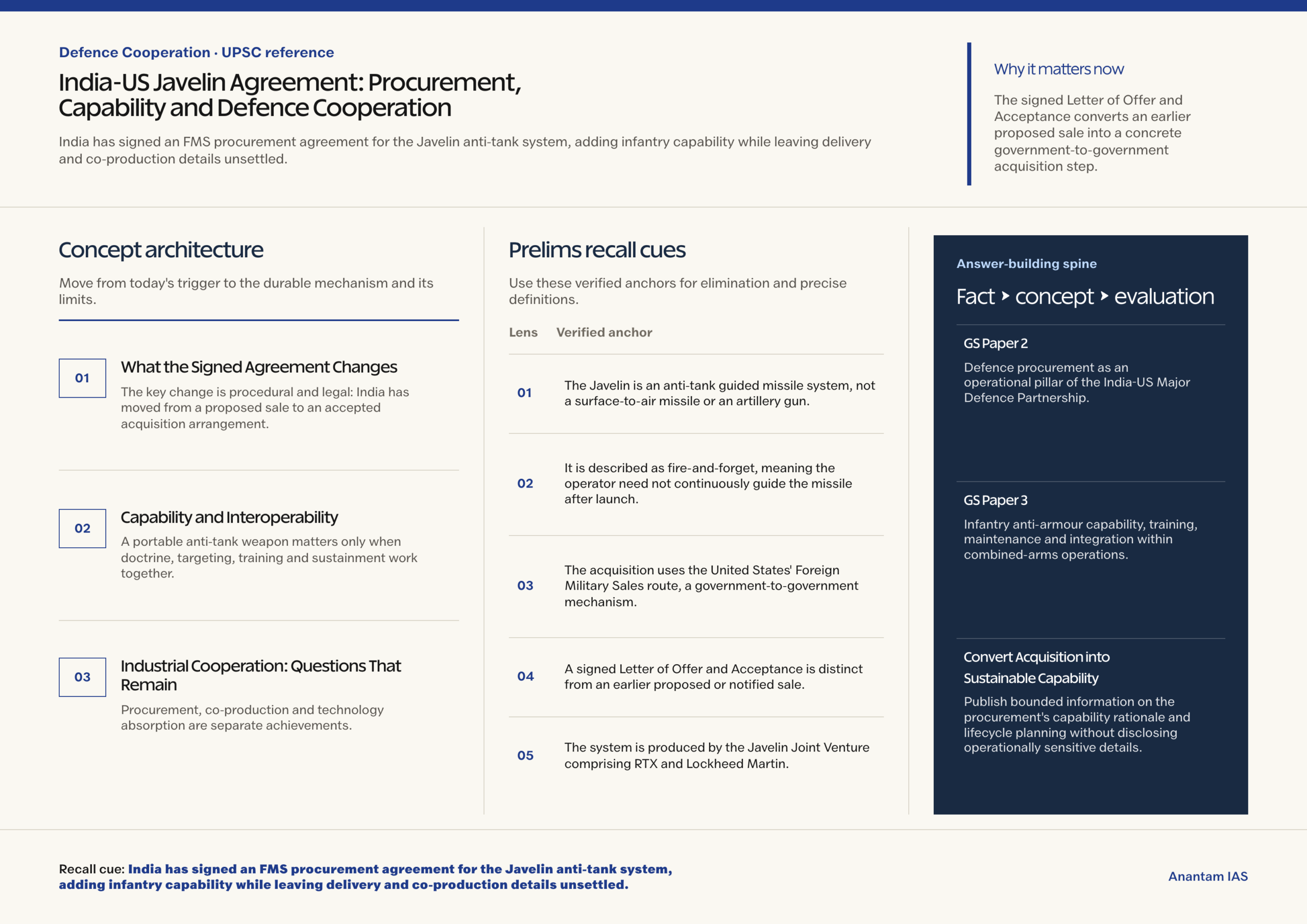
Background and Context
What the Signed Agreement Changes
The key change is procedural and legal: India has moved from a proposed sale to an accepted acquisition arrangement.
- Under the Foreign Military Sales route, the purchasing government deals with the United States government, which manages the case rather than treating it as an ordinary private commercial purchase.
- The Letter of Offer and Acceptance records acceptance of the offered procurement case and is stronger evidence of acquisition than an earlier request, approval proposal or sale notification.
- This distinction prevents a common exam error: a proposed FMS case shows authorization to proceed, while a signed LOA shows that the customer has accepted the acquisition terms.
- The report does not provide a verified delivery schedule, induction date or operational deployment. Signing should not be equated with systems already reaching Indian Army units.
- Nor does the report establish contracted technology transfer. It says the signing can facilitate discussions on mutually beneficial co-production, which remains a prospective industrial track.
Capability and Interoperability
A portable anti-tank weapon matters when it fits doctrine, targeting, training and sustainment rather than operating as an isolated platform.
- The Javelin is described as a medium-range, fire-and-forget guided system capable of engaging armoured vehicles and fortified positions, giving infantry a precision anti-armour option.
- Fire-and-forget capability can allow an operator to relocate after launch instead of remaining exposed while continuously guiding the weapon, but battlefield effectiveness still depends on correct target acquisition.
- Its value lies in combined-arms use: infantry anti-armour teams must coordinate with surveillance, manoeuvre, artillery, air defence and logistics rather than substitute for those capabilities.
- Interoperability may improve when partners use compatible training concepts, support procedures and communications during exercises, yet common equipment alone does not guarantee seamless joint operations.
- A new system also creates obligations for training rounds, simulators, spares, storage, inspection and maintenance. Readiness depends on this support chain across the equipment’s service life.
Industrial Cooperation: Questions That Remain
The agreement opens an industrial conversation, but procurement, co-production and technology absorption are separate achievements.
- The United States Embassy said the signing would facilitate discussions on mutually beneficial co-production; this wording signals an opportunity for negotiation, not a completed production arrangement.
- A credible industrial package would specify work share, production scale, quality control, intellectual-property boundaries, export permissions and the Indian entities responsible for manufacturing or support.
- Domestic maintenance and repair can improve availability and turnaround time, but meaningful learning requires access to processes, tooling, testing and skilled personnel rather than final assembly alone.
- Supply resilience requires planning for spares, components and replenishment during disruptions. Dependence is reduced by diversified stocks and local capability, not merely by changing the procurement channel.
- For policy evaluation, separate three tests: whether the weapon meets a defined operational gap, whether lifecycle costs are sustainable, and whether promised industrial cooperation becomes contractually measurable.
Way Forward
Convert Acquisition into Sustainable Capability
- Publish bounded information on the procurement’s capability rationale and lifecycle planning without disclosing operationally sensitive details.
- Build training, simulation, maintenance, storage and replenishment plans before induction so hardware availability translates into usable readiness.
- Negotiate industrial cooperation through measurable work share, quality standards, maintenance access and realistic technology-absorption milestones.
- Integrate the system into Indian doctrine and exercises while preserving diversified supply options and indigenous anti-tank development.
Conclusion
- The Javelin LOA is significant because it records a signed FMS acquisition, strengthens a specific infantry capability and deepens the operational content of India-US defence cooperation.
- In a Mains answer, distinguish procurement from delivery and industrial opportunity from contracted technology transfer, then assess capability through interoperability, lifecycle support and domestic absorption.
UPSC Practice Questions
Prelims MCQ 1
With reference to the Javelin procurement agreement, consider the following statements:
- The procurement is being undertaken through the United States Foreign Military Sales route.
- The Javelin is described as a fire-and-forget anti-tank guided missile system.
- The signed agreement itself establishes a completed technology-transfer and co-production arrangement in India.
How many of the above statements are correct?
(a) Only one (b) Only two (c) All three (d) None
Answer: (b) Only two
Explanation:
Statements 1 and 2 are correct. The report says the signing may facilitate co-production discussions; it does not establish completed co-production or technology transfer.
Prelims MCQ 2
In the context of the United States Foreign Military Sales route, the Letter of Offer and Acceptance is best understood as:
(a) a request by a buyer for preliminary information (b) a notification that automatically delivers the equipment (c) the customer’s acceptance of the offered government-to-government procurement case (d) a licence granting unrestricted domestic production rights
Answer: (c) the customer's acceptance of the offered government-to-government procurement case
Explanation:
The signed LOA marks acceptance of the FMS acquisition terms. It is distinct from a preliminary request, delivery, or an automatic grant of production rights.
UPSC Mains Questions
- How can a foreign defence acquisition strengthen military capability without creating unsustainable lifecycle dependence? Discuss with reference to the India-US Javelin agreement.
- A defence procurement agreement and a defence-industrial partnership are related but distinct. Examine the conditions needed to convert acquisition into meaningful industrial cooperation.
Source: The Hindu.
Frequently Asked Questions
What has India signed for the Javelin system?
India has signed a Letter of Offer and Acceptance with the United States to procure the Javelin anti-tank guided missile system through the Foreign Military Sales route.
What does fire-and-forget mean?
It means the missile does not require continuous operator guidance after launch, allowing the operator to relocate while the weapon proceeds toward its acquired target.
Does the agreement mean Javelin systems have already been delivered?
No. The report confirms the signed procurement agreement but does not provide a verified delivery schedule, induction date or evidence that systems have reached operational units.
Does the agreement include co-production or technology transfer?
The report says the signing can facilitate co-production discussions. It does not establish a contracted co-production package or technology-transfer arrangement, so those outcomes remain prospective.
Why is the agreement relevant to India-US relations?
It adds a concrete capability transaction to the Major Defence Partnership and may support interoperability and industrial discussions, subject to implementation and lifecycle support.