India Valve Registry: Building Patient-Level Evidence for Heart Care
Why in News?
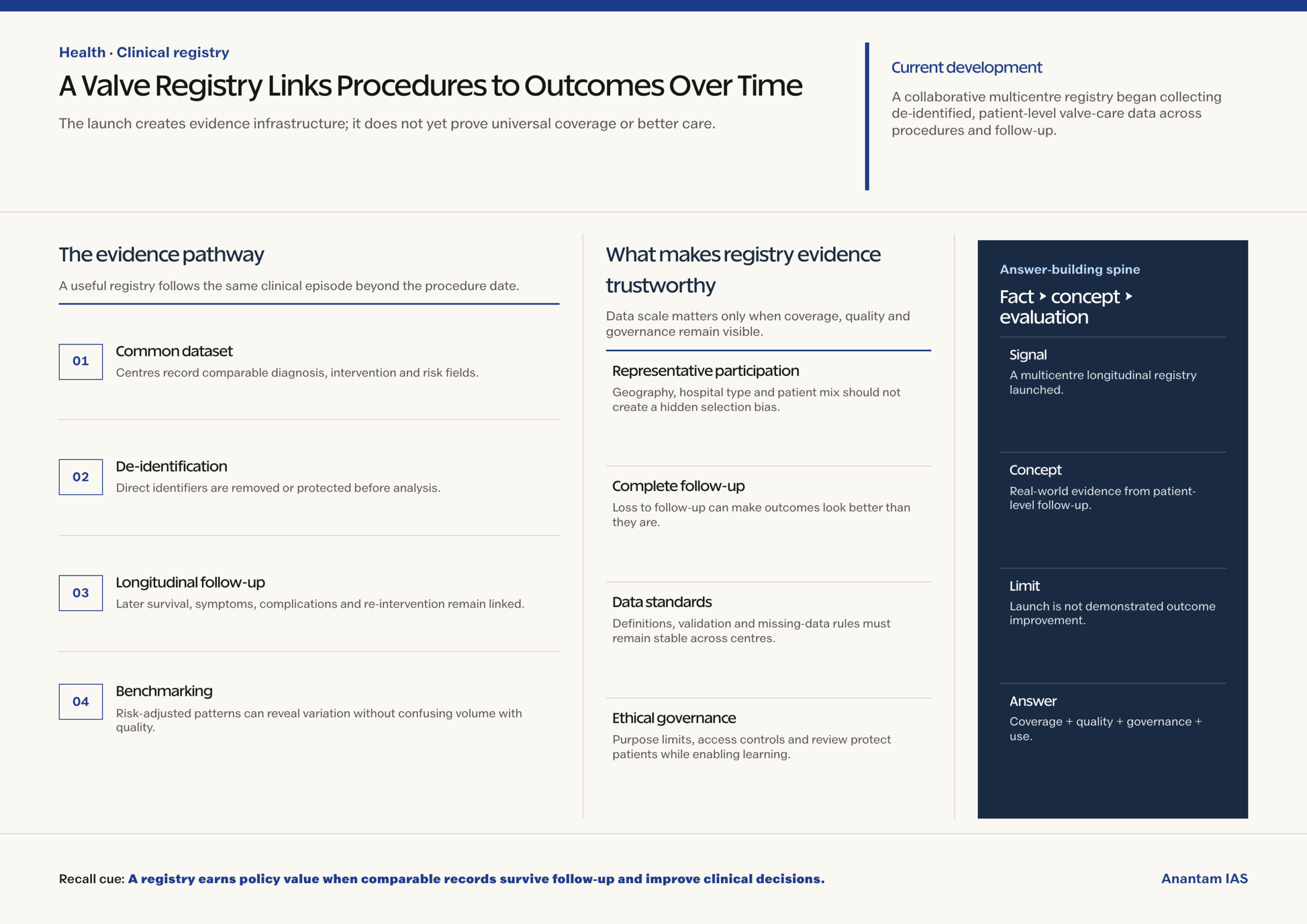
The India Valve Registry was launched in Chennai on September 5 as a clinician-led, multicentre platform for de-identified, patient-level and longitudinal evidence on valve disease and interventions.
- The registry is designed to collect real-world data on transcatheter valve interventions across participating centres.
- Its intended record follows treatment beyond the procedure, including complications, discharge outcomes, rehospitalisation, functional recovery and survival during follow-up.
- The development is a new evidence infrastructure; it is not a statutory programme or proof that clinical outcomes have already improved.
- The initiative seeks to convert distributed clinical experience into comparable, India-specific evidence for research and care decisions.
- Valve-care evidence from other populations may not fully reflect India’s patient profiles, disease severity, referral pathways or follow-up conditions.
- A registry can reveal patterns in routine care, but its conclusions depend on representative participation, consistent definitions, complete follow-up and sound data governance.
UPSC Relevance
Prelims Relevance
- Clinical registry and real-world evidence
- Patient-level and longitudinal data
- De-identification and data privacy
- Valvular and structural heart disease
- Transcatheter valve intervention
- Registry versus randomised controlled trial
Mains Relevance
GS Paper 2
- Public-health value of India-specific clinical evidence
- Privacy, representativeness and accountability in health-data infrastructure
GS Paper 3
- Use of longitudinal real-world data in medical research and technology assessment
Essay
- Health systems learn when individual clinical encounters become trustworthy collective evidence without sacrificing patient privacy.
Background and Context
What the Registry Is Designed to Record
A clinical registry follows routine care, creating a structured record across patients, centres and time for later comparison and quality review.
- The India Valve Registry focuses on valve diseases and interventions, with the official release specifically describing real-world data on transcatheter valve procedures.
- Its intended baseline record includes clinical profile, disease severity, imaging, anatomy, treatment selection and planning. These fields can support risk adjustment when comparing unlike patient groups.
- The procedural layer can document devices and techniques, immediate results and complications, enabling practice comparisons and helping centres examine where approaches or results differ.
- The longitudinal layer extends observation after discharge to rehospitalisation, functional recovery and survival. This matters because clinically important effects may emerge only over time.
- Because records are patient-level, researchers can study how characteristics, treatment choices and follow-up outcomes relate; aggregated hospital totals cannot support the same analysis.
How Patient-Level Data Become Clinical Evidence
The registry’s value lies in comparable observations and in whether the dataset reflects diverse patients and care settings, not merely in accumulating records.
- A multicentre design can capture variation in patients, referral settings and treatment practices better than a record maintained by one institution alone.
- Common data definitions enable like-for-like analysis and periodic quality audits; inconsistent descriptions of severity, complications or recovery can produce misleading comparisons.
- Longitudinal linkage helps distinguish an immediate technical result from later patient experience, including repeat admission, functional recovery and survival during follow-up.
- Registry analysis can generate hypotheses, identify care gaps and support quality review. Results still require adjustment for case-mix differences, and observational associations do not prove causation.
- India-specific evidence can complement international studies when clinicians and policymakers assess whether findings transfer to local disease patterns and delivery conditions.
Safeguards, Limits and the Key Exam Distinction
A newly launched registry is a capacity to learn; its coverage, data quality and effects remain unproven, preventing premature claims about national performance.
- De-identification reduces direct identifiability, but it does not remove every privacy risk when detailed health records are combined or linked.
- Governance should specify lawful collection, access controls, permitted research uses, retention, security, accountability and procedures for responding to a data breach.
- Voluntary or uneven centre participation can create selection bias; findings may overrepresent hospitals with stronger infrastructure, specialised teams or better follow-up capacity and exclude underserved settings.
- Missing follow-up can distort survival, recovery and rehospitalisation patterns, especially if patients who disappear from records differ systematically from those retained.
- Do not equate a registry with a randomised trial: registries observe real-world care, while randomisation is designed to balance confounding factors when testing causal effects.
Way Forward
Build Trustworthy and Usable Evidence
- Publish a transparent data dictionary, participation criteria and outcome definitions so that centres record the same clinical events in comparable ways.
- Use privacy-by-design safeguards, role-based access, audit trails and independent oversight for de-identified patient-level data and approved research use.
- Track missingness, follow-up completeness and centre diversity, and state these limitations whenever registry findings are reported or used in policy.
- Translate mature findings into peer-reviewed research, quality-improvement feedback and carefully evaluated standards without treating early associations as settled causal evidence.
Conclusion
- The India Valve Registry matters because it can connect multicentre, de-identified and longitudinal observations into India-specific evidence. Its value requires consistent, representative, complete data and transparent limits before findings guide standards or financing decisions.
- In a Mains answer, separate launch from impact: explain the evidence opportunity, then examine representation, standardisation, follow-up, privacy and the limits of observational inference before recommending policy use.
UPSC Practice Questions
Prelims MCQ 1
With reference to clinical registries, consider the following statements:
- Longitudinal data can connect a patient’s baseline characteristics with outcomes recorded during later follow-up.
- De-identification eliminates every possibility of privacy risk in detailed health datasets.
- A multicentre registry can document variations in real-world clinical practice across participating institutions.
How many of the above statements are correct?
(a) Only one (b) Only two (c) All three (d) None
Answer: (b) Only two
Explanation:
Statements 1 and 3 are correct. De-identification reduces direct identifiability but cannot guarantee zero privacy risk, particularly when rich records are linked with other data.
Prelims MCQ 2
Which feature best distinguishes an observational clinical registry from a randomised controlled trial?
(a) A registry can include patient outcomes, while a trial cannot (b) A registry observes care delivered in practice, while a trial randomly assigns interventions under a study protocol (c) A registry always represents every hospital in a country (d) A registry proves that an observed treatment caused an outcome
Answer: (b) A registry observes care delivered in practice, while a trial randomly assigns interventions under a study protocol
Explanation:
Registries are valuable for real-world patterns and longitudinal outcomes, but non-random treatment selection can leave confounding. Randomised trials are structured to test causal effects more directly.
UPSC Mains Questions
- How can a multicentre, longitudinal clinical registry strengthen evidence-based healthcare in India? Discuss the India Valve Registry as an example.
- Clinical registries expand the capacity to learn from routine care, but data volume alone does not create trustworthy evidence. Examine the necessary safeguards and methodological limits.
Sources: PIB, Vice President's Secretariat and The Hindu.
Frequently Asked Questions
What is the India Valve Registry?
It is a clinician-led, multicentre research platform intended to collect de-identified, patient-level and longitudinal real-world data on valve disease and transcatheter valve interventions across participating Indian centres.
What does longitudinal patient-level data mean?
Patient-level data connect observations to an individual record, while longitudinal data follow that record over time from clinical profile and treatment through discharge and later outcomes.
Does de-identification make health data completely risk-free?
No. It removes or transforms direct identifiers to reduce risk, but detailed records may remain vulnerable to re-identification or misuse without access controls, security and accountable governance.
Has the registry already improved patient outcomes?
No such result has yet been established. The reported development is the launch of an evidence platform; coverage, data quality, findings and effects on care require future evaluation.
Is participation in the registry a statutory national requirement?
The cited reports describe a collaborative multicentre initiative, not a statutory or universal mandate. Its representativeness will depend on which centres participate and how completely they submit follow-up data.