IndiaAI Impact Summit 2026: Global South, AI Governance and Digital Public Infrastructure
IndiaAI Impact Summit 2026 entered the January current-affairs cycle as the government positioned India to host a major global AI conversation with a Global South lens. The framing matters because AI governance is increasingly geopolitical.
For UPSC, the topic connects science and technology with international relations, digital public infrastructure, data governance, ethics, compute access and development equity.
This article explains why IndiaAI Impact Summit matters for AI governance and how India can use its DPI experience in global technology diplomacy.
Quick Facts
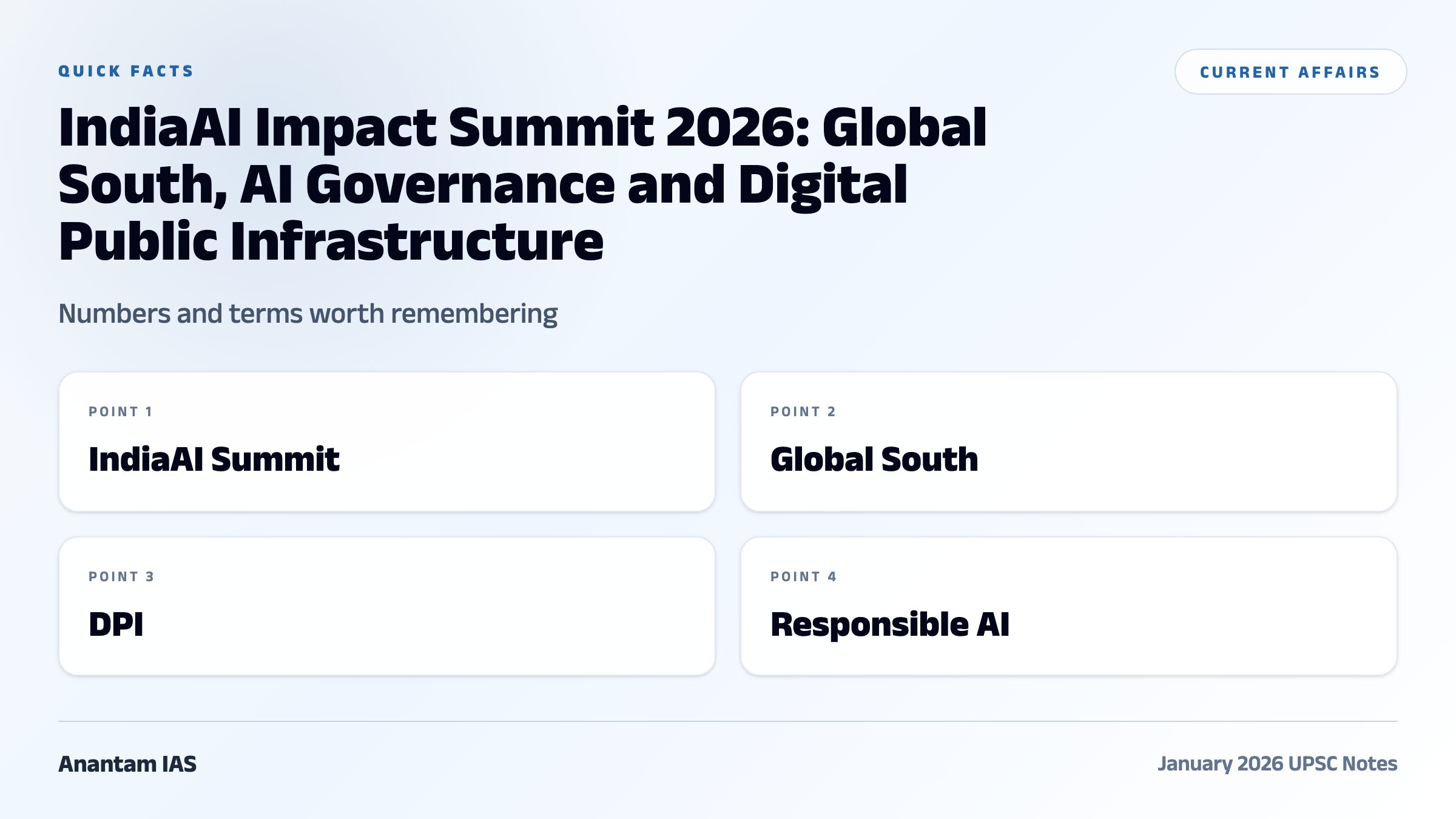
- IndiaAI Impact Summit 2026 was positioned as a global AI forum hosted by India.
- The summit carries a Global South and impact-oriented framing.
- It is linked to India’s wider IndiaAI Mission ecosystem.
- Key themes include responsible AI, inclusion, compute, datasets, innovation and public-interest AI.
- Digital public infrastructure is central to India’s technology diplomacy.
- Official source: PIB MeitY release dated 30 January 2026.
- Official source: PIB, Ministry of Electronics and IT.
What Just Happened
The government highlighted global participation and the impact agenda for IndiaAI Impact Summit 2026.
The event signals India’s attempt to shape AI governance debates beyond the US-China-Europe triangle.
For aspirants, this is a useful IR-plus-technology topic because it shows how standards, compute and ethics are becoming diplomatic issues.
Background and Historical Context
Global AI governance is being shaped through national regulations, safety summits, model-evaluation debates, data governance and compute-access questions.
India has built a strong global narrative around digital public infrastructure through Aadhaar, UPI, DigiLocker and India Stack-style platforms.
The Global South faces AI adoption constraints: limited compute, language diversity, data gaps, weaker regulation and fear of technological dependence.
Key Features of Global AI Governance
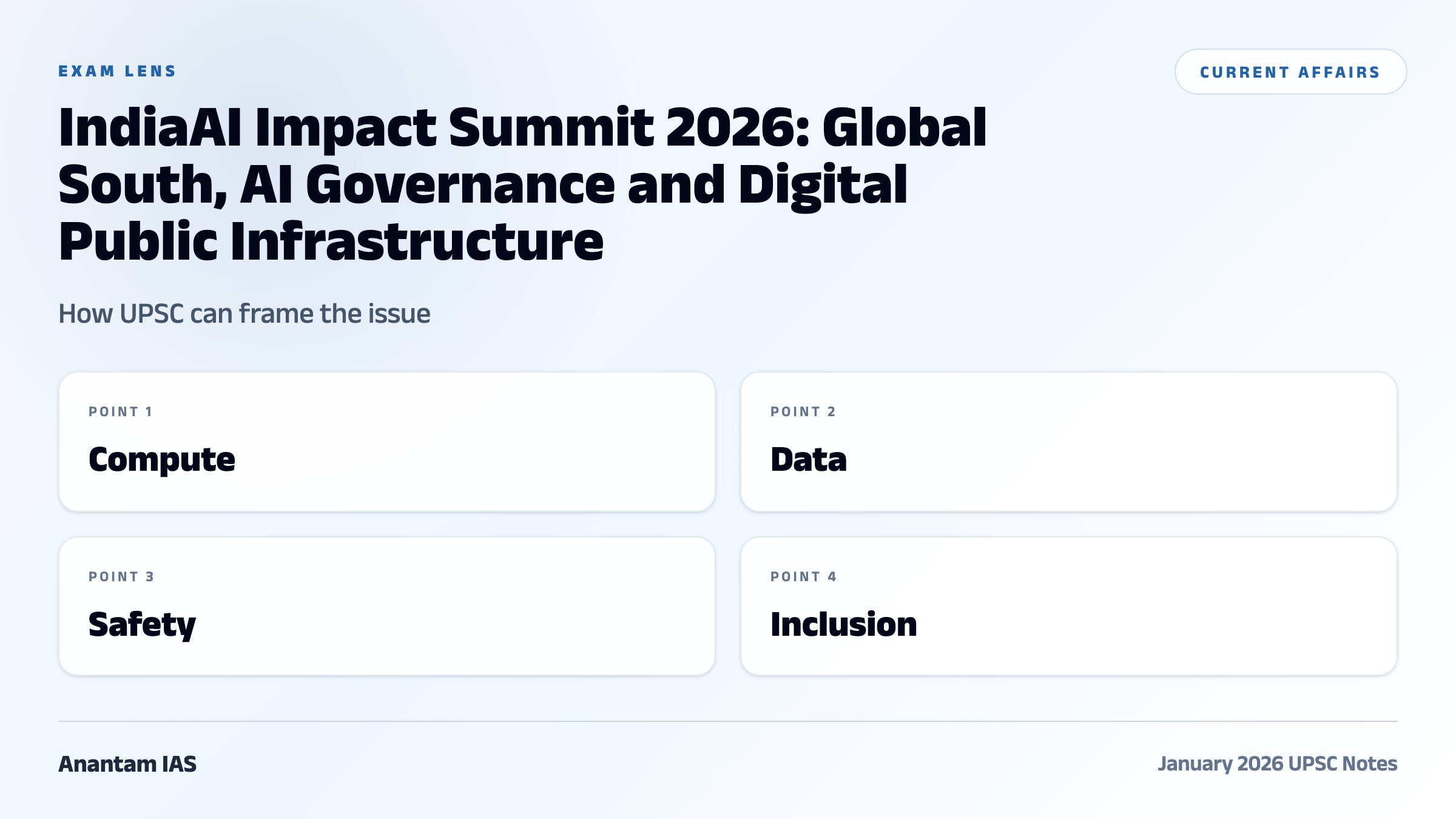
The core policy architecture can be read through these features.
- Global South lens: AI governance must include developing-country priorities.
- Impact focus: AI for health, education, agriculture and public services matters.
- DPI diplomacy: India can link AI with trusted digital public infrastructure.
- Responsible AI: safety, fairness and accountability remain central.
- Compute access: developing countries need affordable AI infrastructure.
- Standards debate: global rules can shape market access and sovereignty.
Why It Matters
This is a high-yield UPSC topic because it joins current news with durable syllabus themes.
- It connects a January 2026 event with durable UPSC syllabus themes.
- It gives usable facts for Prelims and analytical hooks for Mains.
- It helps students move from news recall to policy reasoning.
- It can be linked with static concepts in polity, economy, governance, science, environment or society.
Detailed Analysis: Global AI Governance Lens
AI governance is now foreign policy. Standards, data flows, chips and model access all affect strategic autonomy.
India’s comparative advantage is public-interest technology. DPI gives India a credible voice on inclusion, but AI systems require stronger safeguards.
The Global South frame is useful but demanding. India must offer practical cooperation, not only rhetoric: datasets, language models, capacity building and open tools.
Comparative Perspective
A comparison helps prevent the answer from becoming a one-dimensional news summary.
- EU AI Act: risk-based regulation and rights-focused compliance.
- US approach: innovation-led with executive and sectoral safeguards.
- China: state-guided AI development and content controls.
- India: DPI-linked, development-focused and still evolving regulatory architecture.
Challenges
The policy or institutional promise runs into recurring constraints.
- India must balance innovation with regulation.
- Compute access remains costly.
- Indian-language AI quality is uneven.
- Data protection and consent systems must mature.
- Global standards may be shaped by countries with more market and compute power.
Prelims Pointers
- IndiaAI Mission supports India’s AI ecosystem.
- DPI means Digital Public Infrastructure.
- Responsible AI includes fairness, transparency, accountability, privacy and safety.
- The Global South refers broadly to developing countries in global governance debates.
- Compute capacity is essential for training and deploying large AI systems.
- AI governance includes law, standards, ethics and institutional oversight.
Mains Questions
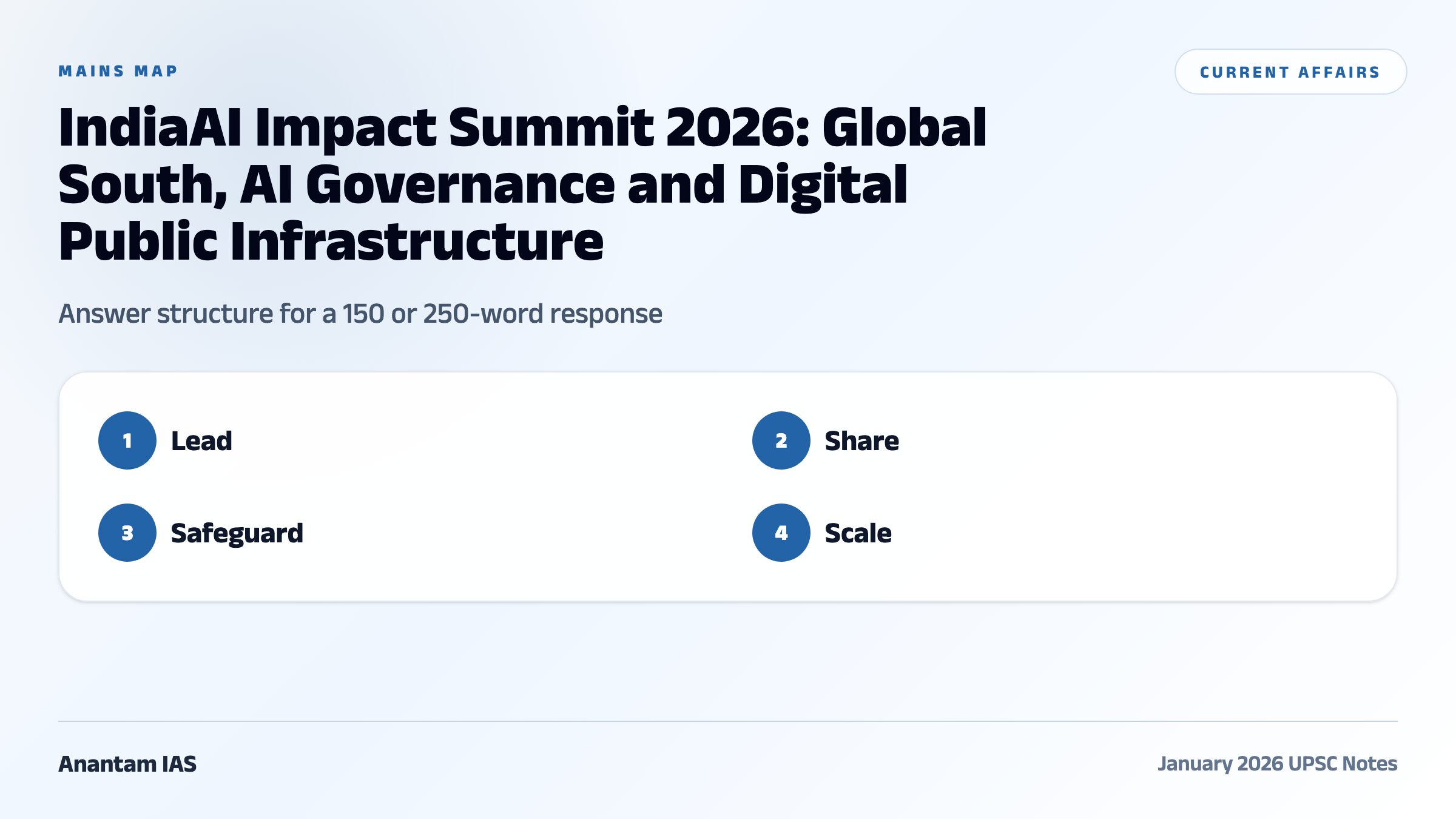
- AI governance has become an important dimension of India’s technology diplomacy. Discuss. (GS Paper II/III, 250 words)
- How can India use its digital public infrastructure experience in Global South cooperation on AI? (GS Paper II, 250 words)
- Responsible AI requires inclusion as well as safety. Analyse from the perspective of developing countries. (GS Paper III, 250 words)
- Compare India’s emerging AI governance approach with the EU’s risk-based model. (GS Paper III, 150 words)
Way Forward
India should use the summit to build practical coalitions on Indian-language AI, public datasets, compute access, AI safety evaluation and AI for public services.
Domestic governance must keep pace. India cannot lead globally if privacy, accountability and procurement safeguards remain weak at home.
For UPSC, this is a premium example of technology becoming diplomacy.
The examiner is unlikely to reward a bare fact dump here. The better answer connects the January 2026 event to institutional design, implementation capacity and India’s long-term development priorities.
Frequently Asked Questions
What is IndiaAI Impact Summit 2026?
It is a global AI forum hosted by India with an impact and Global South-oriented framing.
Why does it matter for UPSC?
It connects AI governance with international relations, digital public infrastructure and development.
What is DPI?
Digital Public Infrastructure refers to shared digital systems such as identity, payments and data-exchange rails.
What is responsible AI?
AI that is fair, safe, transparent, accountable and respectful of rights.
Why is the Global South angle important?
Developing countries face different constraints in compute, data, language and capacity.
What is the main challenge for India?
Balancing innovation, inclusion, regulation and global leadership.