Indian Pharmacopoeia Commission Gains a Wider Regional Role
Why in News?
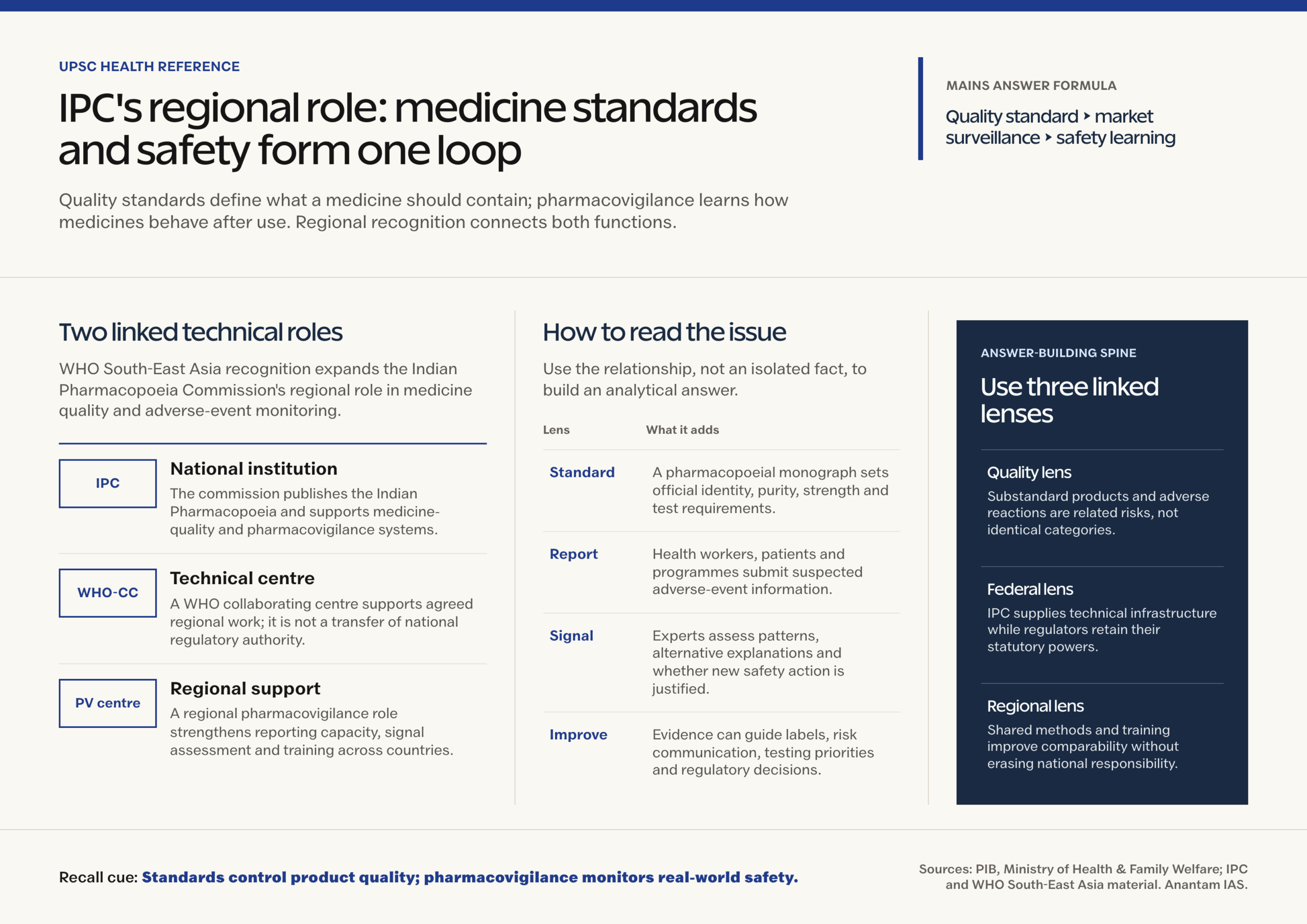
The Ministry of Health and Family Welfare announced that the WHO South-East Asia Region has recognised the Indian Pharmacopoeia Commission as a regional pharmacovigilance centre and a technical centre for medicine quality .
- The recognition covers two related but distinct functions: post-market safety monitoring and technical support for medicine quality.
- IPC is an autonomous institution under the Union Ministry of Health and Family Welfare and is based in Ghaziabad.
- IPC publishes the Indian Pharmacopoeia, India’s official book of standards for medicines manufactured or marketed in the country.
- IPC also houses the National Coordination Centre of PvPI, which receives and analyses reports of suspected adverse drug reactions and supports regulatory decisions.
- Regional recognition does not mean that WHO has certified every medicine made in India or that all countries must adopt Indian Pharmacopoeia standards.
- Safe medicines require both quality standards before and during manufacture and continuous monitoring after products reach diverse patient populations.
- Many countries in the region face limited laboratory capacity, under-reporting of adverse events and uneven regulatory systems; shared technical resources can reduce these gaps.
- For India, the role links public health with science diplomacy, pharmaceutical credibility and the responsibility that comes with being a major supplier of generic medicines and vaccines.
UPSC Relevance
Prelims Relevance
- The Indian Pharmacopoeia Commission is an autonomous institution under the Ministry of Health and Family Welfare, not the Ministry of Chemicals and Fertilizers or the Ministry of Ayush.
- The Indian Pharmacopoeia is the official book of standards for drugs manufactured or marketed in India.
- A pharmacopoeial monograph can specify a medicine’s identity, purity, strength, tests, assay, storage and other quality requirements.
- The Pharmacovigilance Programme of India is India’s national system for collecting, collating and analysing suspected adverse events related to medicines.
- IPC functions as the National Coordination Centre for PvPI; regulatory action is taken through the competent drug-regulatory system, including CDSCO.
- WHO defines pharmacovigilance as the science and activities relating to detection, assessment, understanding and prevention of adverse effects or any other drug-related problem.
Mains Relevance
GS Paper 2
- Public-health governance through medicine-quality standards, patient-safety reporting and evidence-based regulatory action.
- India’s role in regional capacity building and health diplomacy under the WHO South-East Asia architecture.
GS Paper 3
- Scientific standard-setting through validated analytical methods, reference substances, laboratory quality systems and harmonised data.
- The relationship between India’s pharmaceutical manufacturing strength, export credibility and regulatory science.
Essay
- Affordable medicine is not truly accessible unless its quality and safety can be trusted.
Background and Context
What the Indian Pharmacopoeia Commission does
IPC connects three parts of medicine governance: standards, rational use and post-market safety.
- IPC develops and updates the Indian Pharmacopoeia, which provides official standards for medicines available in India.
- It prepares drug monographs and associated analytical requirements with expert input, laboratory verification and revision as products and testing science evolve.
- IPC supplies Indian Pharmacopoeia Reference Substances, which laboratories use as authoritative comparison materials when performing specified tests.
- It publishes the National Formulary of India to support rational prescribing and use of medicines; a formulary guides use, while a pharmacopoeia sets quality standards.
- IPC is also the National Coordination Centre for PvPI, creating a bridge between product standards and evidence that emerges after medicines are used in practice.
How a pharmacopoeia protects patients
A medicine name is not enough; every batch must meet measurable requirements for what the product is and how it performs.
- An official monograph can describe tests for identity, ensuring that the stated active pharmaceutical ingredient is actually present.
- Tests for strength or assay measure whether the amount of active ingredient falls within the accepted range rather than being sub-potent or excessive.
- Purity and impurity limits help detect contaminants, degradation products and unwanted chemicals that may affect safety or stability.
- Dosage-form tests such as dissolution can examine whether a tablet releases its ingredient as required; packaging and storage standards protect quality through shelf life.
- Reference standards, validated methods and calibrated laboratories allow results from different locations to be compared more reliably.
Pharmacovigilance begins after approval
Clinical trials cannot reveal every rare, delayed or population-specific risk before a product enters wide use.
- WHO defines pharmacovigilance as detection, assessment, understanding and prevention of adverse effects or other drug-related problems.
- Patients and healthcare professionals can report a suspected adverse drug reaction even when they are not certain that the medicine caused it.
- An Adverse Drug Reaction Monitoring Centre checks the report and sends an Individual Case Safety Report through the national system for review.
- At IPC, reports are assessed for completeness, coding and clinical information before valid cases contribute to national analysis and the global WHO programme.
- Multiple reports, patterns, biological plausibility, background rates and other evidence may generate a safety signal. A signal is a question requiring investigation, not a final verdict.
India in the WHO global drug-safety network
National reporting becomes more powerful when anonymised case patterns can be examined across countries.
- The WHO Programme for International Drug Monitoring was created after the World Health Assembly called for systematic collection of serious adverse-reaction information.
- Participating national centres submit Individual Case Safety Reports to VigiBase, the global database managed by the Uppsala Monitoring Centre.
- A larger dataset can reveal rare patterns that may not be visible within one hospital or country, especially when a medicine is used by different age, genetic or disease groups.
- International data still require careful interpretation because reporting practices, prescribing patterns and background disease rates vary among countries.
- IPC-PvPI has already worked as a WHO Collaborating Centre for pharmacovigilance in public health programmes and regulatory services. The new regional roles broaden the platform for practical support.
Way Forward
Publish a regional work plan
- IPC and WHO South-East Asia should state the services offered, eligibility, governance and measurable deliverables for both regional functions.
- Baseline each participating country’s laboratory and pharmacovigilance capacity before setting training priorities.
- Report outcomes such as improved report completeness, response time, laboratory proficiency and regulatory follow-through, not only workshop counts.
Conclusion
- WHO South-East Asia’s recognition gives the Indian Pharmacopoeia Commission a stronger platform to connect medicine standards, laboratory quality and real-world safety monitoring across the region.
- India should use the role to make reports more informative, laboratories more comparable and safety decisions faster and clearer.
UPSC Practice Questions
Prelims MCQ 1
With reference to the Indian Pharmacopoeia Commission, consider the following statements:
- It is an autonomous institution under the Ministry of Health and Family Welfare.
- It publishes the Indian Pharmacopoeia and functions as the National Coordination Centre for the Pharmacovigilance Programme of India.
- It grants marketing authorisation for every new drug in India.
How many of the above statements are correct?
(a) Only one (b) Only two (c) All three (d) None
Answer: (b) Only two
Explanation:
Statements 1 and 2 are correct. Statement 3 is incorrect: IPC develops standards and coordinates PvPI, while marketing authorisation and legal regulatory action fall within the competent drug-regulatory framework, including CDSCO.
Prelims MCQ 2
Which one of the following best describes VigiBase?
(a) India’s official book of medicine-quality standards (b) WHO’s global database of Individual Case Safety Reports, managed by the Uppsala Monitoring Centre (c) A WHO list of prequalified generic-drug manufacturers (d) India’s database of licensed retail pharmacies
Answer: (b) WHO's global database of Individual Case Safety Reports, managed by the Uppsala Monitoring Centre
Explanation:
VigiBase receives Individual Case Safety Reports from members of the WHO Programme for International Drug Monitoring. It supports signal detection but does not itself prove causality in an individual report.
UPSC Mains Questions
- WHO South-East Asia’s recognition of the Indian Pharmacopoeia Commission can strengthen both regional public health and India’s pharmaceutical credibility. Discuss the opportunities and institutional safeguards required. (250 words)
- Explain how pharmacopoeial standards and pharmacovigilance perform different but complementary roles in medicine safety. (150 words)
Sources: PIB, Ministry of Health and Family Welfare and Indian Pharmacopoeia Commission.
Frequently Asked Questions
What is the Indian Pharmacopoeia Commission?
IPC is an autonomous institution under the Union Health Ministry. It develops and publishes the Indian Pharmacopoeia, supplies reference standards, publishes the National Formulary of India and serves as the National Coordination Centre for the Pharmacovigilance Programme of India.
What is the Indian Pharmacopoeia?
The Indian Pharmacopoeia is India’s official book of standards for drugs manufactured or marketed in the country. Its monographs prescribe measurable requirements such as identity, strength, purity, analytical tests, storage and other quality attributes for medicines and pharmaceutical substances.
What is pharmacovigilance?
WHO defines pharmacovigilance as the science and activities relating to detecting, assessing, understanding and preventing adverse effects or other drug-related problems. It continues after approval because rare, delayed and population-specific risks may become visible only during wider real-world use.
Does an adverse drug reaction report prove that a medicine caused the event?
No. A suspected report provides information that may contribute to a safety signal, but temporal association is not proof of causation. Experts examine clinical details, alternative causes, repeated patterns, biological plausibility and other evidence before recommending regulatory action.
What does WHO regional recognition of IPC mean?
It gives IPC an expanded regional technical and capacity-building role in pharmacovigilance and medicine quality. It can support training, data systems, laboratory methods and regulatory capability across the WHO South-East Asia Region while national authorities retain their legal decision-making powers.