Indian Statistical Institute Bill: Autonomy, Accountability and Governance Reform
Why in News?
The government has prepared the Indian Statistical Institute Bill, 2026 for introduction in the Lok Sabha, proposing a comprehensive statutory framework for the Indian Statistical Institute (ISI).
- The proposed law would repeal and replace the Indian Statistical Institute Act, 1959, while retaining ISI’s status as an Institution of National Importance.
- It seeks to incorporate ISI as a statutory body corporate with perpetual succession, property-holding and contracting powers, replacing the unusual arrangement under which an institution declared nationally important continued to operate as a registered society.
- A March 2026 Lok Sabha reply said the proposed Board of Governors would have 11 members: one government nominee, five external experts including the Chairperson, and five internal members including two Academic Council members.
- The President of India would be the Visitor; the Board would be the principal policy-making executive body; and the Academic Council would remain the principal academic body.
- The framework seeks greater autonomy for centres through Management Councils, while placing them within the Institute’s common academic planning and governance structure.
- ISI was founded in 1931. Parliament declared it an Institution of National Importance through the 1959 Act, recognising its contribution to statistics, research, teaching and planning.
- MoSPI has cited review committees, including the fourth committee chaired by R. A. Mashelkar, as identifying delayed decisions, weak accountability and structural inertia in the society-based model.
- The governance reform matters beyond one institute because credible statistics, data science and quantitative research support evidence-based public policy, economic measurement and state capacity.
UPSC Relevance
Prelims Relevance
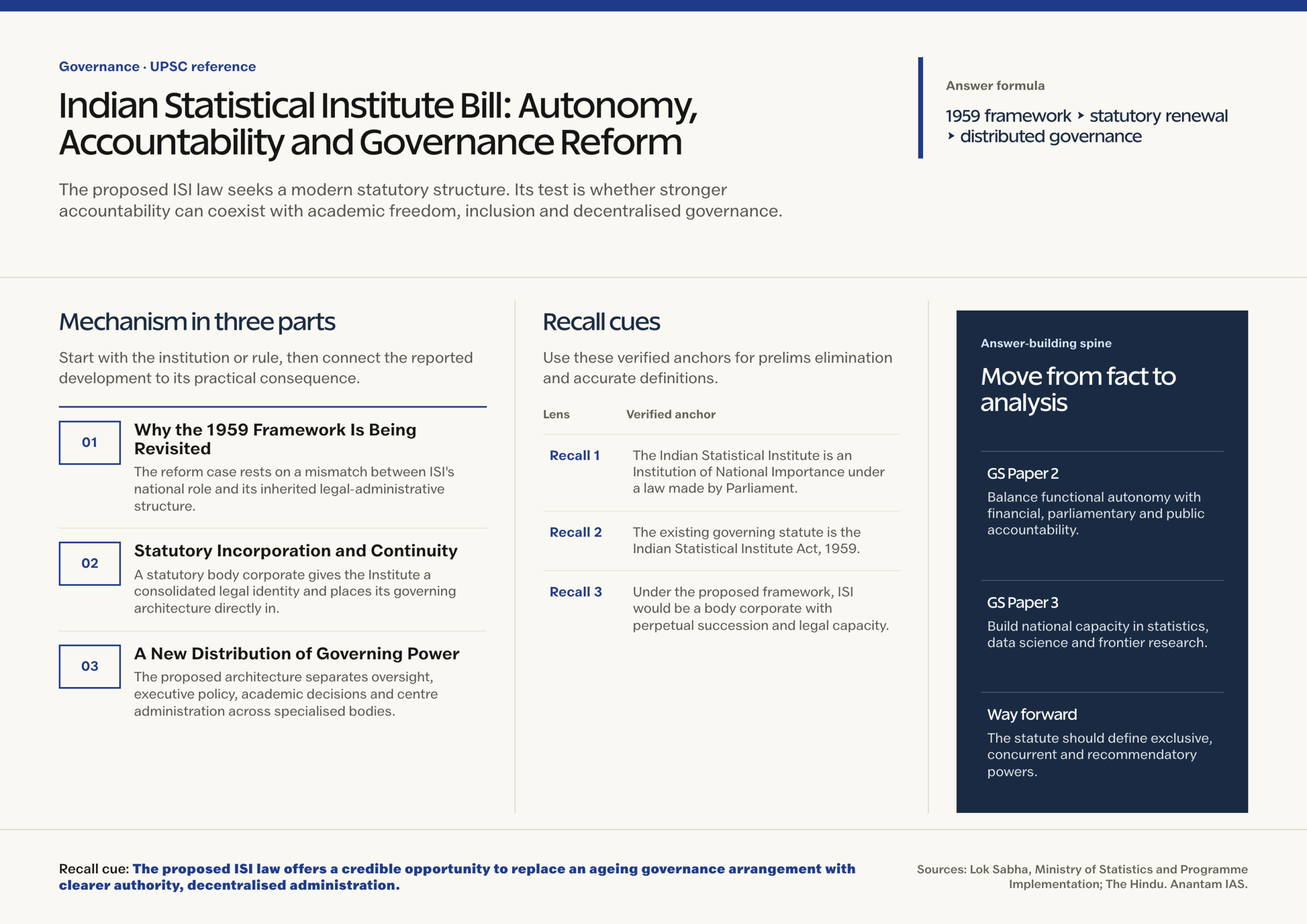
- The Indian Statistical Institute is an Institution of National Importance under a law made by Parliament.
- The existing governing statute is the Indian Statistical Institute Act, 1959; it was amended in 1995 to widen the subjects in which ISI could grant degrees and diplomas.
- Under the proposed framework, ISI would be a body corporate, meaning a legal person with perpetual succession that may hold property, contract, and sue or be sued in its own name.
- The President of India is proposed as the Visitor of the Institute, with powers to order reviews or inquiries and act on their reports.
- The proposed Board of Governors is the principal policy-making executive body, while the Academic Council is the principal academic body.
- The publicly available revised draft provided for 11 Board members: five external experts including the Chairperson, five internal representatives and one nominee of the administrative ministry.
Mains Relevance
GS Paper 2
- Governance of autonomous public institutions: balancing functional autonomy with financial, parliamentary and performance accountability.
- Design of governing bodies: representation, independent expertise, transparency of appointments, conflict-of-interest safeguards and the relationship between executive and academic organs.
GS Paper 3
- Building national capability in statistics, data science and frontier technologies for research, innovation and evidence-based governance.
- Protecting research quality and credibility while encouraging collaboration with government, industry and international institutions.
Essay
- Institutions become credible when freedom to pursue knowledge is matched by a duty to explain decisions and outcomes.
Background and Context
Why the 1959 Framework Is Being Revisited
The reform case rests on a mismatch between ISI’s national role and its inherited legal-administrative structure.
- The 1959 Act declared ISI nationally important and empowered it to award academic qualifications, but the Institute continued as a registered society. MoSPI says this structure is now exceptional among more than 160 Institutions of.
- The Ministry’s official FAQ said ISI’s General Body has more than 1,000 members and that changes to prescriptive society instruments require approval by three-fourths of members voting. It presented this as a cause of slow reform.
- MoSPI also reported that the Governing Council had grown to 33 members, with substantial internal representation. Successive review committees had recommended a smaller council and clearer executive responsibility.
- These are the government’s stated reasons, not a complete evaluation. Institutional participation can prevent arbitrary decisions, while an oversized body can diffuse responsibility. Reform must preserve the benefits of collegial governance without allowing veto points to.
Statutory Incorporation and Continuity
A statutory body corporate gives the Institute a consolidated legal identity and places its governing architecture directly in legislation.
- The proposed incorporation would give ISI perpetual succession, a common seal, power to acquire and dispose of property, capacity to contract and the ability to sue or be sued.
- The revised draft contained transition clauses transferring the existing society’s assets, liabilities, contracts and legal proceedings to the statutory Institute.
- It also protected continuity for existing employees and students, subject to the detailed statutory transition. Such provisions reduce the risk that organisational conversion interrupts teaching, research, employment or pending legal obligations.
- Statutory status is not automatically equivalent to autonomy. The practical outcome depends on who appoints office-holders, which matters require government approval, how regulations are made and whether academic bodies possess clearly protected decision rights.
A New Distribution of Governing Power
The proposed architecture separates oversight, executive policy, academic decisions and centre administration across specialised bodies.
- The Visitor may cause the Institute’s work and progress to be reviewed, order inquiries and issue directions after considering reports. This creates an apex oversight channel, but its use should follow due process and respect expert.
- The 11-member Board is intended to be leaner and expertise-led. Its mixed composition can reduce direct government presence, yet safeguards are still needed for transparent nomination, diversity, fixed tenure, conflict disclosure and recorded reasons for major.
- The Board would exercise general superintendence and control, approve budgets and development plans, create posts, and act on centres and programmes. The earlier draft also described it as the final decision-making body across academic, administrative, personnel.
- That breadth creates an important design question: where the Academic Council has mandatory functions, the Board should not substitute managerial preference for disciplinary expertise. A statutory non-interference clause, consultation requirements and published decision protocols can make.
Academic Autonomy and the Role of Faculty
Academic freedom becomes operational only when the academic body controls core scholarly standards.
- The revised draft made the Academic Council the principal academic body and included the Director, Centre-Directors, division heads, all full-time professors, a specified number of other full-time faculty and deans.
- Its direct functions included organising and modifying courses, deciding student eligibility and selection procedures, specifying examination and evaluation systems, and promoting interdisciplinary study and research.
- For introduction or discontinuation of programmes, award of degrees and external collaboration, the draft used a recommendation-to-Board model. This is where careful drafting matters: consultation should be meaningful, and departure from academic recommendations should require written.
- Academic autonomy also needs protections below the council level: peer-led hiring and promotion, freedom to publish, access to research data, ethical review, stable funding for basic research and space for minority scholarly views.
Way Forward
Clarify the Autonomy Boundary in the Law
- Protect the Academic Council’s final authority over curriculum, evaluation and research standards, with a narrowly defined process for reconsideration on legal or financial grounds.
- Require the Board to record reasons when it differs from an academic recommendation and publish non-confidential decisions and minutes within a fixed period.
- Use publicly known eligibility criteria, diverse search-cum-selection committees, conflict-of-interest declarations and fixed timelines for choosing the Chairperson, Director and external experts.
- Ensure meaningful representation of faculty, centres, women and relevant disciplines without allowing any single internal or external constituency to dominate.
Conclusion
- The proposed ISI law offers a credible opportunity to replace an ageing governance arrangement with clearer authority, decentralised administration and stronger public reporting.
- The durable test is whether the final Act makes academic judgement secure, leadership selection transparent, centres genuinely capable, and oversight proportionate.
UPSC Practice Questions
Prelims MCQ 1
With reference to the proposed governance framework for the Indian Statistical Institute, consider the following statements:
- The President of India is proposed to be the Visitor of the Institute.
- The Academic Council is proposed as the principal academic body of the Institute.
- The Institute is proposed to operate as a for-profit government company.
How many of the above statements are correct?
(a) Only one (b) Only two (c) All three (d) None
Answer: (b) Only two
Explanation:
Statements 1 and 2 are correct. The proposed framework names the President as Visitor and the Academic Council as the principal academic body. Statement 3 is incorrect because the revised draft treats ISI as a not-for-profit statutory body corporate, not a government company operating for profit.
Prelims MCQ 2
Which one of the following best describes a statutory body corporate?
(a) A temporary committee created only by an executive order (b) A private association having no separate legal personality (c) A legal entity created or incorporated under a statute, with continuity and powers defined by law (d) A constitutional body whose composition can be changed only by a constitutional amendment
Answer: (c) A legal entity created or incorporated under a statute, with continuity and powers defined by law
Explanation:
A statutory body derives its existence, powers and governance framework from legislation. Incorporation gives it a legal identity with continuity and the capacity to hold property, contract, and sue or be sued, subject to its parent law.
UPSC Mains Questions
- A public academic institution needs autonomy from day-to-day control but cannot be exempt from public accountability. Examine this proposition in the context of the proposed Indian Statistical Institute governance reforms. (250 words)
- How can the design of governing boards and academic councils balance executive efficiency, expert judgement and stakeholder representation in Institutions of National Importance? Discuss. (250 words)
Sources: Lok Sabha, Ministry of Statistics and Programme Implementation and The Hindu.
Frequently Asked Questions
Why is a new law proposed for the Indian Statistical Institute?
The government says the 1959 Act is too limited for contemporary governance, finance and accountability needs, while ISI still operates through a society-based structure. The proposed law would incorporate ISI as a statutory body corporate, create defined authorities and align.
Will the Bill end ISI’s status as an Institution of National Importance?
No. The proposal reiterates ISI’s status as an Institution of National Importance. The change concerns its legal incorporation and governance architecture. It would replace the 1959 Act with a more detailed statute while continuing the Institute’s nationally important academic.
What is the proposed role of the Board of Governors?
The Board would be the principal policy-making executive body. It would oversee strategy, budgets, development, appointments and administration. The official March 2026 parliamentary reply described an 11-member Board with five external experts, five internal members and one nominee of the.
How does the framework seek to protect academic autonomy?
It identifies the Academic Council as the principal academic body and assigns it functions concerning courses, student selection, examinations, evaluation and interdisciplinary research. Real protection will depend on the final allocation of powers, transparent appointments and whether the Board must.
Does the draft require higher fees or end student stipends?
The government’s FAQ says the framework itself does not alter the existing fee or stipend regime. It enables revenue from fees, consultancy, research, intellectual property and donations, while keeping ISI not-for-profit and providing for scholarships. Future regulations, budgets and disclosure.