Indian Telecom Services Performance Indicator Report: Q2 July–Sept 2024
Why in News?
The Telecom Regulatory Authority of India (TRAI) has released its quarterly “Indian Telecom Services Performance Indicator Report” for the period 1 July to 30 September 2024. The report compiles sector-wide metrics on mobile and broadband subscribers, quality of service (QoS) parameters, complaint statistics and broadcasting service indicators (Cable TV, DTH and radio). It is a routine release, but one that carries fresh empirical inputs used by policymakers, regulators, market analysts and civil-society stakeholders to gauge the health of India’s digital infrastructure.
Beyond headline subscriber numbers, the report provides granular signals about network congestion, ARPU (Average Revenue Per User) trends, rural–urban divides in broadband access and the status of transport infrastructure such as fibre backhaul. These signals directly inform spectrum management choices, investment needs for fibre and backhaul, and targeted interventions for improving service delivery in underserved geographies — matters that are central to GS3 topics on technology, infrastructure and economic growth.
- Release: TRAI published the performance indicator report for the quarter ending 30 September 2024; the executive summary and the full report are available on TRAI’s website and via the Department of Telecommunications press release.
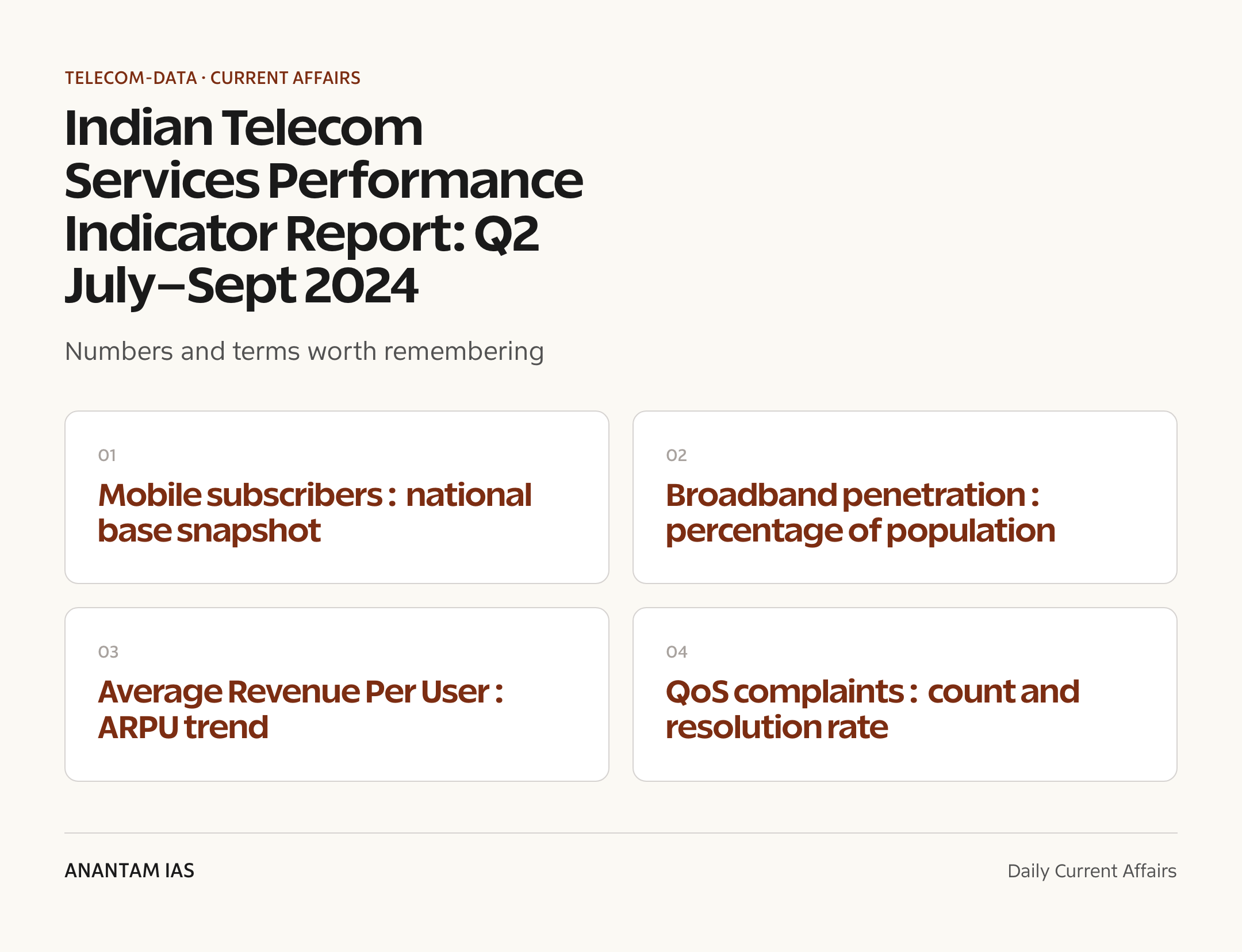
- Subscriber trends: The report details national aggregates and quarterly net additions for mobile, broadband and fixed-line segments, including the mix of prepaid/postpaid and the distribution across urban and rural areas — critical for assessing market saturation and outreach.
- Quality metrics and complaints: QoS statistics such as call-drop rates, data throughput and latency together with complaint volumes and resolution times provide an evidence base for enforcement, licence-condition reviews and consumer protection measures.
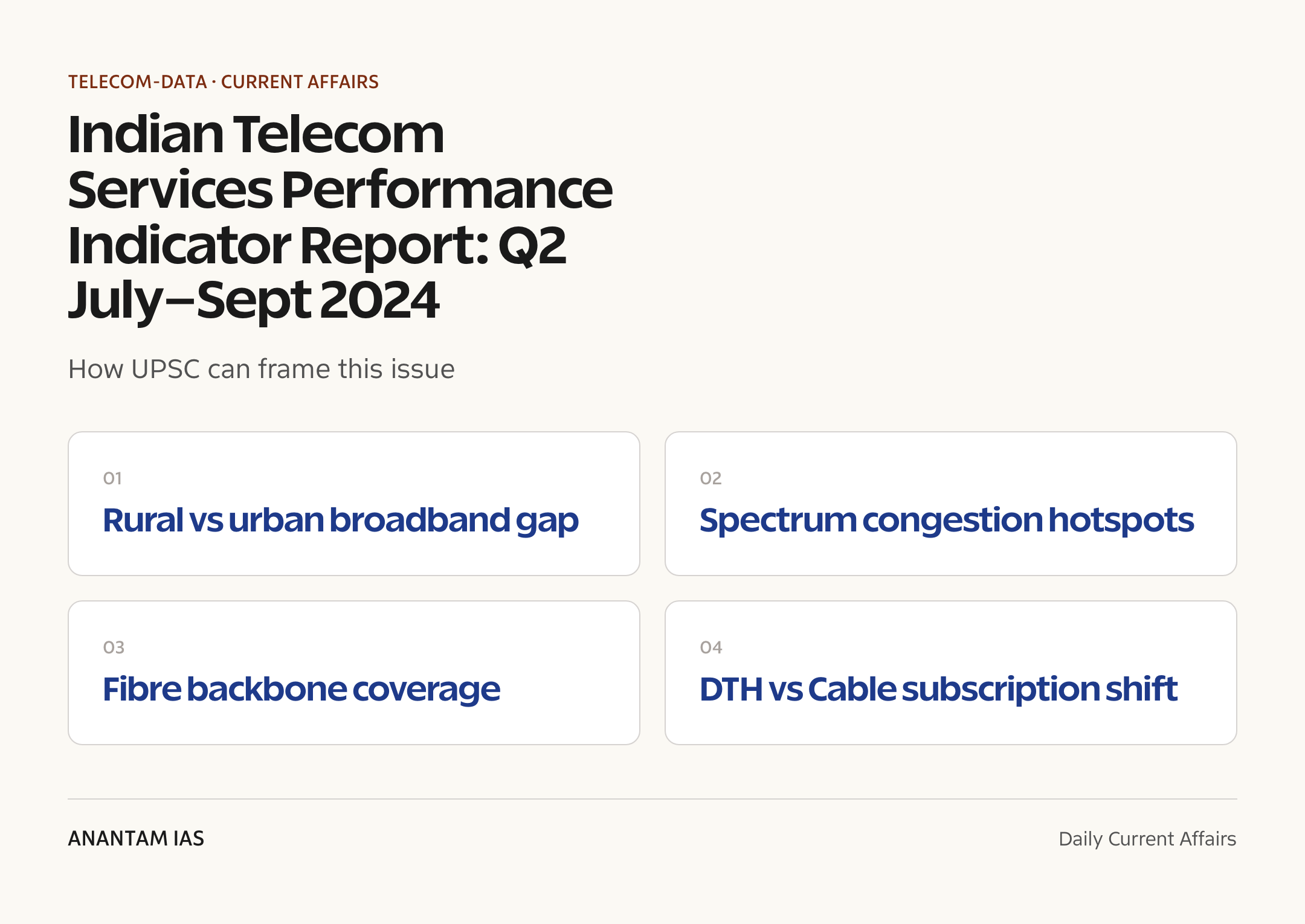
- Spectrum and capacity indicators: Information on spectrum usage, utilisation pressures in specific frequency bands and indications of congestion in urban hotspots help shape auctions, refarming decisions and policies on sharing or dynamic spectrum access.
- Broadcasting trends: DTH, Cable TV and radio service metrics in the report reflect consumer behaviour shifts — for example migration to OTT platforms — and inform regulatory choices in content distribution, carriage and signalling.
The development matters in the context of:
- Regulatory input: Quarterly TRAI reports are primary inputs for DoT policy deliberations, parliamentary questions and industry consultations on licensing and spectrum.
- Digital India objectives: Broadband penetration and quality metrics bear directly on goals such as e-governance delivery, digital education and access to health services.
- Market structure and competition: Subscriber additions, churn, ARPU and market share trends help competition authorities and policymakers assess concentration risks and the financial health of operators.
- Investment signals: Persistent QoS problems and spectrum pressure indicate where private capex or public interventions (e.g., incentives for fibre rollout) are needed to expand capacity.
- Consumer protection: Complaint patterns and QoS shortfalls drive regulatory action on penalties, mandatory remediation and improvements to grievance redress systems.

UPSC Relevance
Prelims Relevance
- – Sectoral statistics on subscriber counts, broadband penetration rates and broadcasting subscriber numbers are concrete factual details useful for preliminary examinations. The report’s definition of broadband, frequency bands commonly referenced (e.g., 700 MHz, 3.5 GHz) and institutional roles (TRAI vs DoT) are high-yield facts.
Mains Relevance
GS3 Economy
- – Use the report’s empirical data to frame answers on telecom regulation, digital infrastructure deficits, spectrum policy and the economic implications for the digital economy.
- – Incorporate QoS and ARPU trends when discussing industry viability, investment needs and the case for public policy support in low-ARPU rural markets.
- – Draw on broadcasting metrics to discuss the interplay between content distribution markets (DTH, Cable, OTT) and regulation of carriage, pricing and consumer choice.
Essay
- – The report provides data points and trends that strengthen essays on technology and development, infrastructure-led growth, the digital divide and regulatory challenges in transitioning to a 5G/6G-enabled economy.
Background and Context
TRAI and Reporting
Mandate: TRAI is the statutory regulator for telecommunications in India and is responsible for monitoring sector performance and advising the government.
- TRAI issues periodic performance indicator reports that aggregate data furnished by service providers, offering a consolidated view of sector metrics.
- The reports are non-financial and focus on operational parameters such as subscribers, QoS, complaints and broadcasting statistics.
- Findings from these reports feed into DoT decisions on licensing, spectrum allocation and regulatory enforcement.
- TRAI’s methodology typically includes definitions for metrics (for instance, what counts as broadband) and standardised reporting templates used by operators.
Subscriber Metrics and Market Structure
Key indicators: Total mobile and broadband subscriber numbers, net additions and the split between prepaid and postpaid services provide a snapshot of market dynamics.
- Net additions reveal current growth momentum; stagnation or decline can signal market saturation or competitive pressures.
- Prepaid-dominated markets have different revenue profiles and service expectations compared with postpaid-heavy segments.
- Urban–rural splits in subscriber distribution expose the geographic reach of services and where policy focus is required.
- Subscriber churn, while not always published in every quarter, is a useful indicator of competitive intensity and service quality.
Broadband Definitions and Penetration
Broadband penetration is frequently used as a proxy for digital access and socioeconomic inclusion.
- TRAI defines broadband for the purposes of its reporting; the threshold (e.g., minimum speed) can change over time and affect comparability.
- Penetration is expressed as subscriptions per 100 population and is sensitive to multiple SIM ownership and inactive accounts.
- Fixed broadband (fibre/DSL) and mobile broadband trends together determine effective internet reach.
- Affordability, availability of handsets and last-mile infrastructure (fibre to home or wireless links) are key determinants of real uptake.
Quality of Service and Consumer Complaints
Operational quality metrics measure whether services meet licence obligations and consumer expectations.
- QoS metrics commonly tracked include call completion rates, dropped-call rates, accessibility of signaling channels, data throughput and latency.
- TRAI also publishes complaint statistics — volume, types (billing, network, service denial), and resolution times — which spotlight consumer-facing problems.
- Persistently high complaint volumes or QoS breaches may lead to regulatory directives, inspection of networks or monetary penalties.
- Improved monitoring (e.g., use of crowdsourced speed tests) complements operator-reported metrics and can reveal ground realities.
Spectrum Management and Capacity
Spectrum is a scarce national resource; its allocation and efficient use underpin network capacity and the rollout of new services.
- Reports can signal congestion in particular bands and geographies, prompting considerations for auctioning additional spectrum or enabling sharing.
- Refarming (repurposing older spectrum holdings) and densification using small cells are common technical responses to capacity constraints.
- Backhaul capacity, especially fibre to towers and to the last mile, affects how much traffic can be carried without overloading radio spectrum.
- Policy tools such as spectrum caps, sharing frameworks, and dynamic access regimes are calibrated using utilization and congestion indicators.
Broadcasting and Content Distribution
Cable TV, DTH and radio indicators show the demand-side evolution in content consumption and revenue models.
- DTH and cable subscriber shifts point to migration patterns and monetisation through subscriptions versus ad-supported models.
- Radio reach remains significant for news, emergency messaging and local language content, especially in semi-urban and rural areas.
- The rise of OTT streaming affects traditional broadcasters’ market share and drives convergence in regulation and taxation debates.
- Regulatory concerns for broadcasting include carriage charges, interconnection agreements and consumer choice preservation.
Economic Linkages and Policy Implications
Telecom sector performance has multiplier effects on economic activity, governance and inclusion.
- Higher broadband penetration supports digital commerce, telemedicine, remote education and improved market access for microenterprises.
- ARPU levels and operator revenues influence willingness to invest in network expansion and technology upgrades like 5G.
- A predictable regulatory regime and clarity on spectrum pricing reduce investment risk for long-duration capex decisions.
- Policy interventions may include targeted subsidies, public infrastructure sharing and incentives for rural network expansion.
Way Forward
Accelerate Fibre and Backhaul Expansion
- Prioritise fibre-to-tower and fibre-to-the-premises rollouts to increase transport capacity and reduce reliance on scarce radio spectrum.
- Encourage municipal-level permissions, right-of-way simplification and coordinated trenching to lower deployment costs.
- Promote public–private partnerships and viability-gap funding for fibre in low-return rural corridors.
- Mandate dark-fibre access and infrastructure sharing to reduce duplication and speed up last-mile connectivity.
Improve Spectrum Management and Utilisation
- Adopt flexible approaches such as spectrum sharing, geographic licensing and market-based dynamic access where feasible.
- Regularly review band utilisation to enable refarming of legacy allocations for more efficient bands.
- Use data from TRAI reports to prioritise auctions or temporary spectrum assignments in chronic congestion hotspots.
- Design auction and pricing parameters that balance revenue needs with the imperative to expand capacity rapidly.
Focus on Rural and Low-ARPU Markets
- Deploy targeted subsidy mechanisms, performance-based support or concessional access to public infrastructure to make rural rollouts viable.
- Encourage affordable device programmes and digital literacy campaigns so that physical availability converts to effective usage.
- Leverage universal service obligations and funds to incentivise operators to meet minimum QoS and coverage thresholds in underserved areas.
- Support community networks and last-mile innovations such as shared-owned micro-operators where commercial models alone fall short.
Strengthen QoS Monitoring and Consumer Redressal
- Upgrade monitoring systems, including independent measurements and crowdsourced data, to validate operator-reported QoS.
- Mandate faster grievance redress timelines and transparent escalation paths for unresolved consumer complaints.
- Introduce outcome-based performance standards tied to license renewals or incentives to align operator behaviour with public interest.
- Publicly publish more granular QoS and complaint metrics to increase accountability and enable civil-society scrutiny.
Conclusion
The TRAI Q2 2024-25 performance indicator report supplies policymakers and market actors with current, operational data about subscriber dynamics, service quality and capacity constraints. Policymakers should use these empirical signals to prioritise fibre expansion, refine spectrum management, and deploy targeted interventions for rural connectivity. Improving monitoring and consumer redress mechanisms will strengthen trust in services while a predictable regulatory environment will encourage sustained private capital for 5G rollouts and future digital infrastructure.
UPSC Practice Questions
Prelims MCQ 1
Which body publishes the Indian Telecom Services Performance Indicator Report?
(a) Department of Telecommunications (DoT) (b) Telecom Regulatory Authority of India (TRAI) (c) Ministry of Electronics and Information Technology (MeitY) (d) Telecommunications Consultants India Limited (TCIL)
Answer: (b) Telecom Regulatory Authority of India (TRAI)
Explanation:
TRAI is the statutory regulator that compiles operational data from service providers and issues periodic performance indicator reports covering telecom and broadcasting sectors.
Prelims MCQ 2
A key capacity-related lever that can relieve spectrum congestion noted in TRAI reports is:
(a) Increase in DTH subscriptions (b) Fibre deployment to towers and last mile (c) Reduction of radio stations (d) Closure of small telecom operators
Answer: (b) Fibre deployment to towers and last mile
Explanation:
Fibre backhaul and last-mile fibre increase transport capacity, enabling higher data throughput and offloading traffic from radio links; this directly reduces spectral pressure and improves QoS.
UPSC Mains Questions
- {‘question’: ‘Critically examine how telecom performance indicators influence spectrum policy and auction timings in India.’, ‘answer’: ‘Telecom performance indicators such as congestion metrics, band utilisation reports and QoS degradations provide the empirical basis for spectrum policy choices. When TRAI highlights persistent congestion in specific bands or geographies, policymakers and DoT must weigh the immediacy of capacity needs against fiscal and market considerations. Auction timing can be accelerated to supply scarce spectrum, though aggressive pricing may deter participation and delay network upgrades. Alternative tools include enabling spectrum sharing, allowing temporary liberalised access in emergencies, and refarming legacy bands for newer technologies. A balanced approach combines targeted auctions for critical bands with regulatory facilitation of sharing and reuse to address immediate capacity shortfalls while preserving revenue objectives. Case examples where QoS deterioration precipitated regulatory engagement illustrate that timely data can trigger interventions such as temporary spectrum assignments or directives for infrastructure augmentation.’}
- {‘question’: ‘Evaluate the role of broadband penetration and network quality in achieving Digital India objectives, using insights from TRAI quarterly reports.’, ‘answer’: ‘Broadband penetration and network quality are foundational to Digital India goals across governance, education, health and commerce. TRAI reports reveal not only headline subscription counts but also quality dimensions — latency, throughput and outage frequency — which determine whether digital services are usable. Urban–rural disparities in these metrics point to persistent access gaps; improving mere coverage without quality will not achieve service delivery objectives. Policy responses include large-scale fibre buildout to support high-capacity services, targeted subsidies or VGF for low-ARPU areas, and regulatory obligations that ensure minimum QoS. Coordinated action to lower deployment costs (streamlined permissions), incentivise private investment and leverage universal service funds can accelerate inclusive digital access. The argument should stress that broadband is an enabler: improved penetration must be coupled with quality and affordability to yield the socioeconomic benefits envisioned under Digital India.’}
Source: PIB, Department of Telecommunications (DoT).
Frequently Asked Questions
q
a
q
a
q
a
q
a
q
a