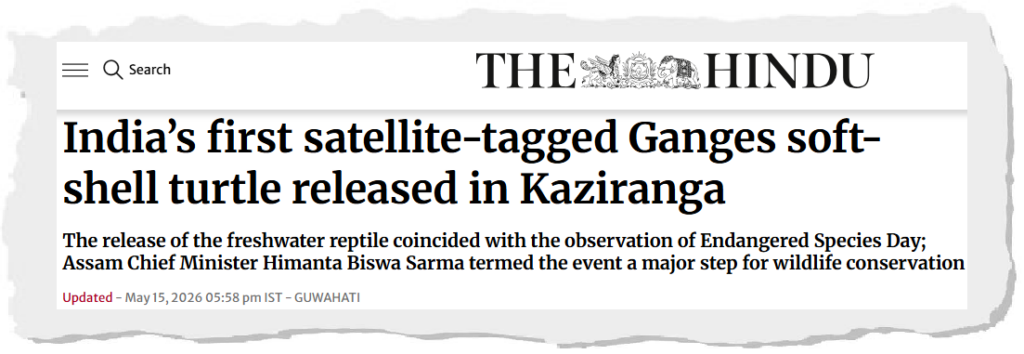
India’s first satellite-tagged Ganges soft-shell turtle released in Kaziranga
Why in News?
India’s first satellite-tagged Ganges soft-shell turtle was released in Kaziranga National Park and Tiger Reserve on May 15, 2026, coinciding with Endangered Species Day. The initiative aims to study the movement ecology, habitat use and conservation requirements of the endangered freshwater turtle species in the Brahmaputra river basin.
UPSC Relevance
Prelims: Ganges soft-shell turtle, Kaziranga National Park, Wildlife Protection Act 1972, IUCN Red List, satellite telemetry, freshwater biodiversity
Mains:
GS III: – biodiversity conservation, wildlife protection, riverine ecosystems, conservation technology, environmental governance
GS I: – geography of biodiversity hotspots and river ecosystems
Background and Context
Freshwater ecosystems are among the most threatened ecological systems globally due to:
- Habitat degradation
- River pollution
- Sand mining
- Damming and hydrological alterations
- Illegal wildlife trade
- Climate change
India is home to rich freshwater turtle diversity, particularly in the Gangetic and Brahmaputra river systems. However, many turtle species face severe population decline because of:
- Hunting for meat and traditional medicine
- Egg collection
- Habitat fragmentation
- River pollution
Assam occupies a particularly important position in freshwater turtle conservation. The Brahmaputra floodplains and wetlands support several rare and threatened turtle species.
Among India’s eight recorded soft-shell turtle species, five occur in the Kaziranga landscape, making the region globally significant for freshwater turtle conservation.
About the Ganges Soft-Shell Turtle
Taxonomic Identity
The Ganges soft-shell turtle is scientifically known as Nilssonia gangetica.
It is a large freshwater turtle species found mainly in:
- Ganga basin
- Brahmaputra basin
- Large rivers
- Reservoirs and wetlands
Distinctive Features
The species can be identified through:
- Soft leathery shell
- Streamlined body adapted for aquatic life
- Arrowhead-shaped markings on the head
Its body structure allows efficient swimming and adaptation to riverine ecosystems.
Ecological Importance
The turtle acts as an important scavenger and predator within freshwater ecosystems.
It contributes to:
- Removal of dead and decaying organic matter
- Nutrient recycling
- Maintenance of aquatic ecological balance
Thus, it plays a role similar to “natural sanitation workers” within river systems.
Conservation Status
IUCN Red List
International Union for Conservation of Nature classifies the species as Endangered on the IUCN Red List.
Wildlife Protection Act, 1972
The species is protected under Schedule I of the Wildlife Protection Act 1972.
Schedule I status provides:
- Highest degree of legal protection
- Strict penalties for hunting and trade
- Priority conservation attention
CITES Protection
Freshwater turtles are also protected under the Convention on International Trade in Endangered Species of Wild Fauna and Flora framework to regulate illegal international wildlife trade.
Satellite Tagging and Its Importance
What is Satellite Tagging?
Satellite tagging involves attaching a small transmitter to an animal to track its movement using satellite-based communication systems.
The technology helps scientists gather real-time information about:
- Seasonal migration
- Habitat preference
- Nesting behaviour
- Feeding grounds
- Breeding areas
- Threat zones
Importance in Turtle Conservation
Freshwater turtles are difficult to study because:
- They spend most of their time underwater
- River systems are dynamic and vast
- Nesting sites are often poorly documented
Satellite telemetry can help identify:
- Critical habitats
- Ecological corridors
- Human-induced threats
- Seasonal movement patterns
Such information is essential for evidence-based conservation planning.
Role of Scientific Institutions
The tagging exercise was conducted by the Wildlife Institute of India in collaboration with:
- Assam Forest Department
- Kaziranga National Park authorities
The project was supported by the National Geographic Society.
Ecological Importance of Kaziranga Landscape
A Riverine Biodiversity Hotspot
Kaziranga National Park and Tiger Reserve is globally known for:
- One-horned rhinoceros
- Tigers
- Elephants
- Wetland ecosystems
However, its riverine biodiversity often receives less attention.
The Brahmaputra river system supports:
- Freshwater turtles
- River dolphins
- Fish diversity
- Migratory birds
Dynamic Floodplain Ecology
Kaziranga’s ecology is shaped by:
- Annual flooding
- Sediment deposition
- Wetland formation
- River channel shifts
These processes create suitable habitats for freshwater turtles.
Threats to Freshwater Turtles in India
Habitat Degradation
River modification through:
- Dams
- Embankments
- Sand mining
- Urbanisation
disrupts turtle nesting and feeding habitats.
Water Pollution
Industrial waste, sewage discharge and agricultural runoff degrade freshwater ecosystems.
Pollution affects: Water quality, Food availability, Reproductive success
Illegal Hunting and Trade
Freshwater turtles are illegally hunted for:
- Consumption, Traditional medicine, International pet trade
India remains vulnerable to transboundary wildlife trafficking networks.
Climate Change
Climate change may alter:
- River flow patterns, Flood cycles, Nesting temperatures
This can affect turtle reproduction and survival.
Fishing Activities
Accidental entanglement in fishing nets is a major threat to aquatic reptiles.
Importance of Freshwater Biodiversity Conservation
Freshwater ecosystems support:
- Drinking water security
- Fisheries
- Agriculture
- Flood regulation
- Nutrient cycling
Despite occupying a small percentage of Earth’s surface, freshwater ecosystems host disproportionately high biodiversity.
However, freshwater species are declining faster than many terrestrial species globally.
Conservation of turtles therefore contributes to:
- River health
- Ecosystem resilience
- Biodiversity sustainability
Government Initiatives and Policy Measures
National Wildlife Action Plan (2017–2031)
The plan emphasises:
- Species recovery programmes
- Landscape-level conservation
- Community participation
- Scientific monitoring
Integrated Development of Wildlife Habitats
This centrally sponsored scheme supports:
- Habitat restoration
- Wildlife monitoring
- Protected area management
Project Dolphin and River Conservation
River conservation initiatives indirectly benefit freshwater turtles through:
- Pollution control
- Habitat protection
- River ecosystem restoration
Use of Technology in Wildlife Conservation
India increasingly uses:
- Satellite telemetry
- Camera traps
- GIS mapping
- Drone surveillance
for wildlife monitoring and conservation planning.
Challenges in Freshwater Turtle Conservation
Limited Ecological Data
Many freshwater turtle species remain poorly studied.
Lack of data affects:
- Population assessment
- Habitat management
- Species recovery planning
Weak River Governance
River conservation remains fragmented across multiple agencies dealing with:
- Irrigation
- Hydropower
- Pollution control
- Fisheries
Integrated river basin management remains inadequate.
Human-Wildlife Interface
Communities dependent on rivers often rely on:
- Fishing
- Sand extraction
- Wetland resources
Balancing conservation and livelihoods remains challenging.
Inadequate Public Awareness
Freshwater turtles receive relatively little conservation attention compared to charismatic mammals.
Way Forward
Strengthening Riverine Habitat Conservation
Conservation efforts should focus on:
- Protecting nesting sites
- Maintaining ecological flows
- Reducing habitat fragmentation
- Restoring wetlands
Expanding Scientific Monitoring
Satellite telemetry and long-term ecological studies should be expanded to other threatened freshwater species.
Integrated River Basin Management
River conservation policies should integrate:
- Biodiversity protection
- Water governance
- Pollution control
- Sustainable livelihoods
Community Participation
Local communities should be involved in:
- Turtle monitoring
- Nest protection
- Anti-poaching efforts
- Sustainable river management
Controlling Illegal Wildlife Trade
Stronger interstate and international coordination is needed to curb illegal turtle trade networks.
Awareness and Education
Educational campaigns can help improve public understanding of:
- Freshwater biodiversity
- Ecological role of turtles
- River ecosystem conservation
Conclusion
The satellite-tagging of the Ganges soft-shell turtle marks an important milestone in India’s freshwater conservation efforts. Beyond symbolic value, the initiative reflects the growing use of science and technology in biodiversity management. Freshwater turtles are vital indicators of river health, and their conservation is closely linked to broader ecological sustainability in the Gangetic and Brahmaputra river systems.
As India faces mounting pressures on its rivers from pollution, infrastructure expansion and climate change, protecting freshwater biodiversity will require integrated governance, scientific research and active community participation. The Kaziranga initiative demonstrates how modern conservation approaches can contribute to preserving fragile aquatic ecosystems for the future.
UPSC Practice Questions
- Consider the following statements regarding the Ganges soft-shell turtle:
I. It is classified as Endangered on the IUCN Red List.
II. It is protected under Schedule I of the Wildlife Protection Act, 1972.
III. It is primarily a marine turtle species found along India’s eastern coast.
Which of the statements given above are correct?
(a) I and II only
(b) II and III only
(c) I and III only
(d) I, II and III
Correct Answer: (a) I and II only
Explanation:
Statements I and II are correct because the Ganges soft-shell turtle is listed as Endangered by the IUCN and protected under Schedule I of the Wildlife Protection Act, 1972.
Statement III is incorrect because it is a freshwater turtle species inhabiting rivers and wetlands.
- With reference to satellite telemetry in wildlife conservation, consider the following statements:
I. It helps track animal movement and habitat use.
II. It can assist in identifying breeding and nesting areas.
III. It is used only for studying migratory birds.
Which of the statements given above are correct?
(a) I and II only
(b) II and III only
(c) I and III only
(d) I, II and III
Correct Answer: (a) I and II only
Explanation:
Satellite telemetry is widely used in wildlife conservation to monitor animal movement, migration and habitat use.
Statement III is incorrect because the technology is used for multiple species including mammals, reptiles and marine animals.
Mains Question:
1.“Conservation of freshwater biodiversity is essential for ecological sustainability and water security.” Analyse in the context of India’s river ecosystems.
2. Discuss the ecological importance of freshwater turtles in river ecosystems. Examine the major threats faced by them in India.