India’s Strategic Petroleum Reserves
Why in News?
India’s Strategic Petroleum Reserves are in focus due to the raging war in West Asia, which has disrupted energy flows. One-third of India’s strategic petroleum reserves are empty.
| UPSC Relevance: GS-3 Economy Prelims: Energy; Strategic Petroleum Reserves (Location & Significance). |
What are Strategic Petroleum Reserves?
- Strategic Petroleum Reserves (SPRs) are an emergency stockpile of crude oil held by the government of a country in government facilities. Meant to act as a buffer for short-term supply-chain disruption, like wars and economic crises.
- The concept of dedicated SPRs was first mooted in 1973, after the first OPEC oil crisis.
- SPRs are stored in underground rock caverns, which are safer, secure, and suited for long-term preservation.
India’s Strategic Petroleum Reserves:
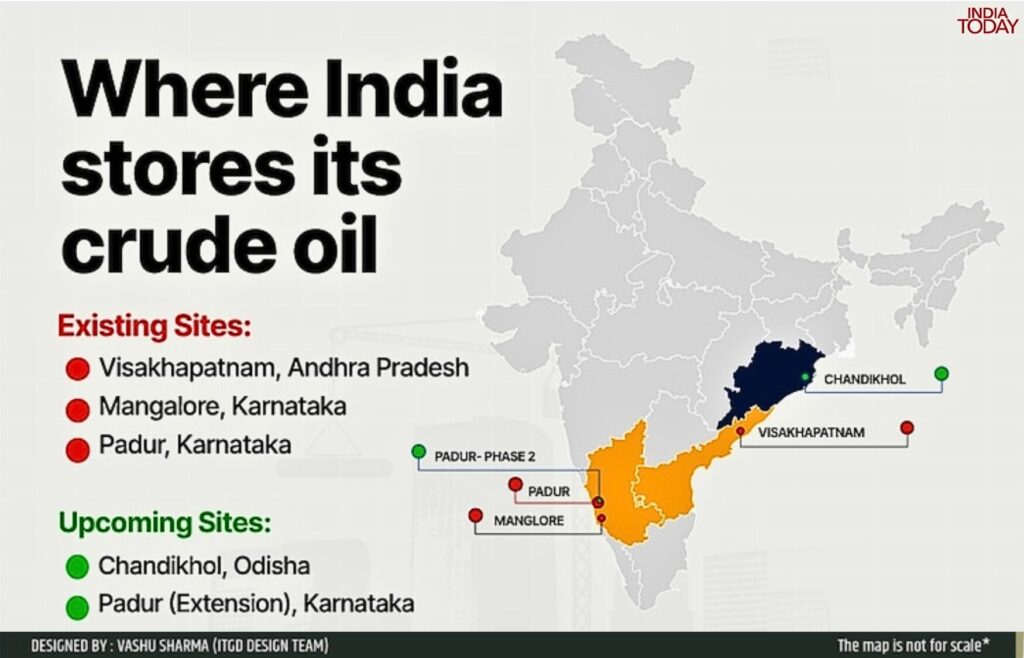
- Existing Infrastructure: India has a capacity to store 5.33 million tonnes of crude oil in three SPRs. At full capacity, the SPRs cover around 9.5 days of India’s crude oil supplies.
- 1. Visakhapatnam, Andhra Pradesh (1.33 million tonnes)
- 2. Mangaluru, Karnataka (1.5 million tonnes)
- 3. Padur, Karnataka (2.5 million tonnes)
- Proposed Infrastructure:
- In 2021, the government had approved the establishment of two more commercial-cum-strategic petroleum reserves in:
- Chandikhol, Odisha (6.5 million tonnes to 4 million tonnes)
- Padur, Karnataka (2.5 million tonnes).
- In 2021, the government had approved the establishment of two more commercial-cum-strategic petroleum reserves in:
- ISPRL (Indian Indian Strategic Petroleum Reserve) is a special purpose vehicle, wholly-owned subsidiary of the Oil Industry Development Board, for building and managing strategic crude storage in India.
India’s Total Oil and Fuel Stockpile:
- India is the world’s third-largest consumer of crude oil and depends on imports to meet over 88% of its requirement.
- The IEA recommends that countries hold oil stocks equivalent to at least 90 days of their net oil imports. IEA members are obligated to maintain these levels of reserves. This 90-day reserve holding can include strategic reserves, as well as commercial inventories.
- India is not a full member of IEA but an associate member.
India’s Three-Pronged Oil Security Framework:
India follows a three-pillar framework to ensure oil security:
- Commercial Oil Stocks (OMCs): Maintained by public and private Oil Marketing Companies (OMCs) such as IOCL, BPCL, HPCL. These stocks form the first line of supply for operational and market needs.
- Strategic Petroleum Reserves (SPR): Managed by ISPRL, a PSU under the Ministry of Petroleum and Natural Gas.
- Equity Oil Abroad: India acquires stakes in oil fields overseas through companies like ONGC Videsh Ltd. to ensure long-term supply diversification.
What are the Concerns?
- Thin Buffer: India’s strategic petroleum reserves (SPRs) currently hold 3.37 million tonnes of oil, or just about two-thirds of their total storage capacity.
- Capacity below IEA benchmark: India’s current total national capacity for storage of crude oil and petroleum products is 74 days (including commercial stocks with refiners and strategic petroleum reserves). It is far below the 90-day benchmark recommended for International Energy Agency (IEA) members.
- Delay in expanding SPR Infrastructure: The development of the proposed SPR Infrastructure is stalled due to bureaucratic hurdles, particularly regarding land acquisition in Odisha.
Expanding the country’s dedicated strategic reserves is something that is long overdue, given India’s high dependency on imported oil and its massive consumption levels.
Significance of expanding the SPR capacity of India:
- Energy Security in the case of short-term supply-chain disruption.
- Market leverage: Extended crude oil storage capacity can offer ISPRL leverage in the international oil markets, with the option of releasing inventory when prices surge and recharging reservoirs whenever the crude is on a downcycle.
- Leasing reserves to foreign refiners: With extended capacity, ISPRL can lease the SPR infrastructure to West Asian refiners (as it reduces their freight costs into Southeast Asian markets). E.g., In 2021, the government approved the commercialisation of Phase-I SPRs under which an agreement was signed between Abu Dhabi National Oil Company (ADNOC) UAE and ISPRL, permitting ADNOC to use 750,000 tonnes capacity at the Mangaluru SPR.
The West Asia crisis has underscored the need to build more oil stocks and reserves for dealing with extended supply disruptions.