India’s Wholesale Inflation hits 42-Month High
Why in News?
Geopolitical tensions in West Asia and a surge in global crude oil prices pushed India’s WPI inflation to 8.3% in April 2026, its highest level since October 2022, raising concerns about imported inflation and downstream consumer price pressures.
| UPSC Relevance: GS-3 Economy: Inflation Prelims: Wholesale Price Index (WPI), Consumer Price Index (CPI), Imported inflation, Base Effect |
What is the Wholesale Price Index?
- The Wholesale Price Index (WPI) is a key economic indicator that tracks the average change in price of goods and commodities at the bulk/producer level before they reach the retail or consumer market.
- It reflects price movements of a basket of goods, including primary articles (food, oilseeds, minerals), fuel and power (petrol, diesel, LPG, electricity), and manufactured products (chemicals, textiles, metals and machinery).
- Published monthly by: Office of the Economic Adviser, Ministry of Commerce and Industry
- Base year: 2011-12
- WPI does not include services. WPI is used to monitor supply-side inflation and is a critical input for industry pricing, taxation and policy-making.
Major Drivers of the Inflation Surge:
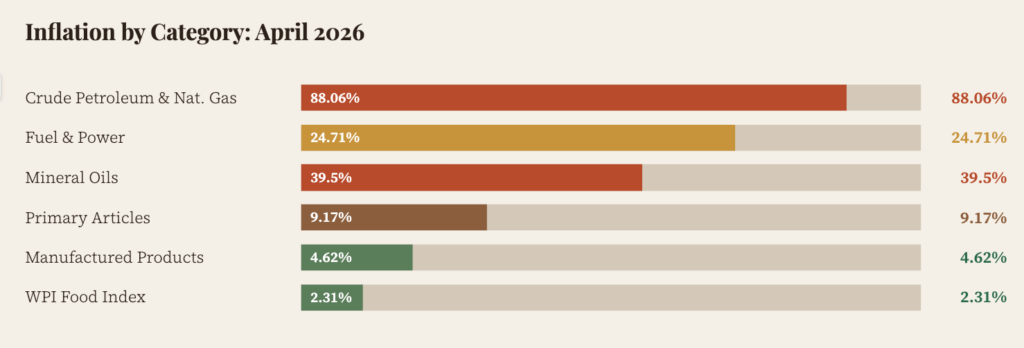
India’s WPI-based inflation surged to 8.3% year-on-year in April 2026, more than doubling from 3.88% in March 2026. The biggest contributor was the sharp increase in global crude prices. The Fuel and Power category witnessed a massive increase in April 2026.
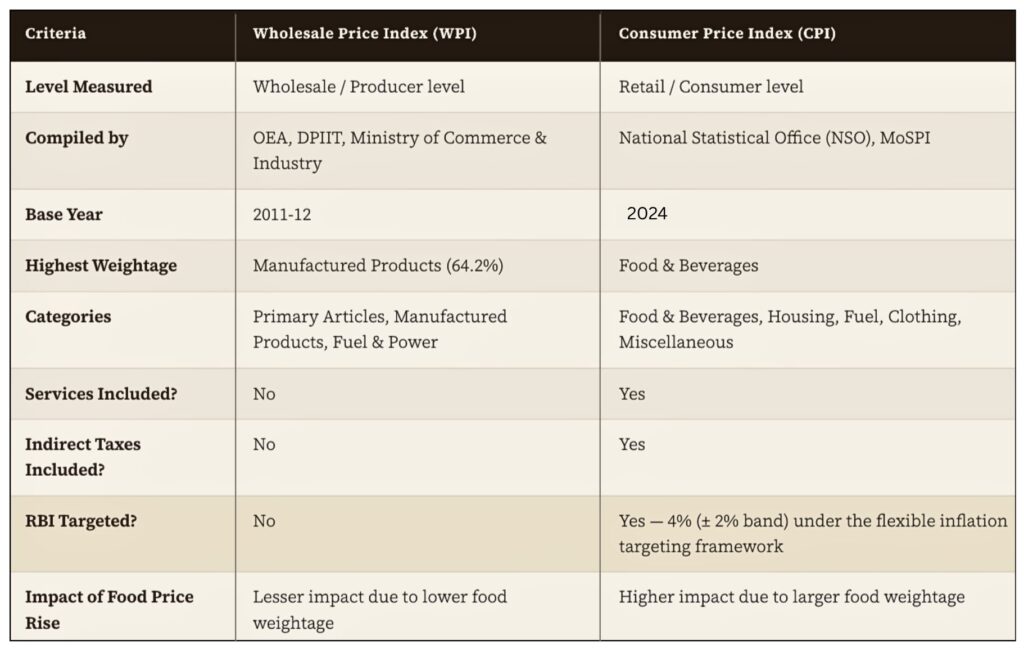
Comparison: WPI vs. CPI:
Why WPI matters despite RBI Targeting CPI?
Although the RBI targets CPI inflation, WPI remains important because it:
- Captures producer-level price pressures
- Indicates future retail inflation trends
- Reflects industrial cost structures
- Helps assess supply-chain stress.
Thus, WPI acts as an early warning indicator for inflationary pressures.
Policy Implications of rising WPI:
- Industry & Corporate Margins: Rising input costs (in energy, metals, and chemicals) are squeezing manufacturing margins. Companies unable to pass on higher costs will face profitability pressure, with a potential slowdown in private capital expenditure.
- Consumers (Risk of Higher Consumer Inflation): Sustained wholesale inflation can eventually pass into retail prices through transport costs, logistics expenses and higher input costs.
- Pressure on RBI Monetary Policy: The RBI targets CPI, not WPI. However, persistent wholesale inflation signalling supply-side stress may constrain the RBI’s ability to reduce policy rates further. It would complicate monetary policy decisions.
- Fuel Pricing & Oil Marketing Companies (OMCs): Global crude prices may require domestic fuel prices to rise further for OMCs to return to profitability at last year’s levels. The government faces a fiscal-political trade-off between absorbing the shock (via excise duty cuts or OMC subsidies) and passing it on to consumers.
- Imported Inflation & Current Account Deficit (CAD): With India importing the vast majority of its crude oil, sustained high global oil prices will widen the trade deficit, depreciate the rupee further, and perpetuate imported inflation.
| What is Imported Inflation? • Imported inflation occurs when rising global prices increase domestic inflation through imports. • India imports more than 85% of its crude oil requirements. Large quantities of fertilisers, edible oils, and industrial inputs. • Hence, global commodity shocks directly affect transportation, manufacturing, electricity generation and consumer prices. |
- Base Effect Dynamics: The April 2026 inflation figures are amplified by a favourable base from April 2025, when crude oil and gas saw deep deflation (-15.5%). As the base normalises in subsequent months, headline WPI could moderate even if energy prices remain stable.
| Base Effect and Inflation: • Base Effect: When prices in the previous year were unusually low, current inflation appears disproportionately high even with moderate price increases. • For example, Crude oil and natural gas witnessed deflation in early 2025. This amplified the year-on-year inflation rate in 2026. |
India’s wholesale inflation spike to a 42-month high highlights the economy’s vulnerability to global energy shocks and geopolitical instability.
UPSC PYQ 2020:
Q. Consider the following statements:
1. The weightage of food in the Consumer Price Index (CPI) is higher than that in the Wholesale Price Index (WPI).
2. The WPI does not capture changes in the prices of services, which CPI does.
3. The Reserve Bank of India has now adopted WPI as its key measure of inflation and to decide on changing the key policy rates.
Which of the statements given above is/are correct?
(a) 1 and 2 only
(b) 2 only
(c) 3 only
(d) 1, 2 and 3
Answer: (a)