Indus Waters Treaty in Abeyance: India Ties Restoration to End of Cross-Border Terror
Why in News?
India has said the Indus Waters Treaty (IWT) of 1960 will remain in abeyance until Pakistan “credibly and irrevocably” stops supporting cross-border terrorism. The External Affairs Ministry made the statement on July 3, 2026, in New Delhi, responding to a recent international conference Pakistan hosted seeking the treaty’s restoration.
As reported by The Hindu, official spokesperson Randhir Jaiswal said the treaty stays suspended “with immediate effect” and reiterated Prime Minister Narendra Modi’s position that “water and blood cannot flow together”, firmly linking any revival to an end of terror sponsorship. The restatement lands amid a severe heatwave in Pakistan and fresh protests in Pakistan-Occupied Kashmir.
- India first placed the IWT in abeyance on April 23, 2025, a day after the Pahalgam terror attack that killed 26 civilians and injured dozens.
- The decision was taken by the Cabinet Committee on Security (CCS), India’s apex national-security body chaired by the Prime Minister.
- The attack led to Indian strikes on terror targets inside Pakistan and Pakistan-Occupied Kashmir under Operation Sindoor.
- At a Pakistan conference this week, its Foreign Minister and Deputy PM Ishaq Dar called the IWT vital for “regional peace, stability and cooperation”.
- India has rejected a Court of Arbitration pondage award, calling the parallel proceedings illegal while the treaty is in abeyance.
- On May 13, 2025 the MEA had argued that climate change, demographic shifts and technological changes have “created new realities on the ground” that justify a review.
The development matters in the context of:
- The move reframes a 66-year-old water-sharing pact from a technical arrangement into an instrument of strategic leverage.
- It tests the durability of one of the world’s most-cited transboundary water treaties, brokered by the World Bank.
- The treaty survived the 1965, 1971 and 1999 wars, so abeyance signals a decisive break from six decades of insulating water from wider hostility.
UPSC Relevance
Prelims Relevance
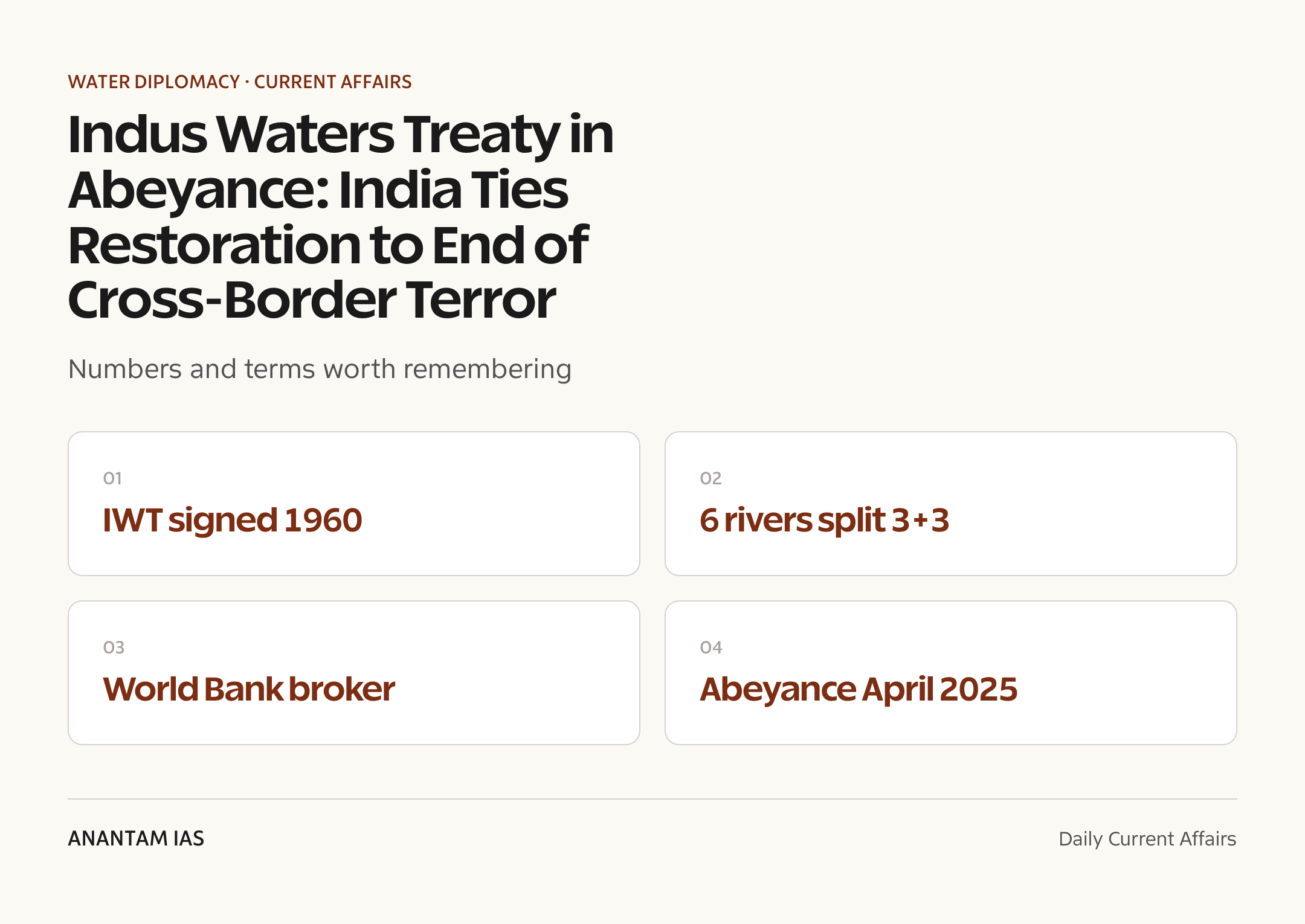
- Indus Waters Treaty signed 1960; brokered by the World Bank; signatories Jawaharlal Nehru and Ayub Khan
- Eastern rivers (Ravi, Beas, Sutlej) allocated to India; western rivers (Indus, Jhelum, Chenab) allocated to Pakistan
- Permanent Indus Commission (PIC): one commissioner from each country
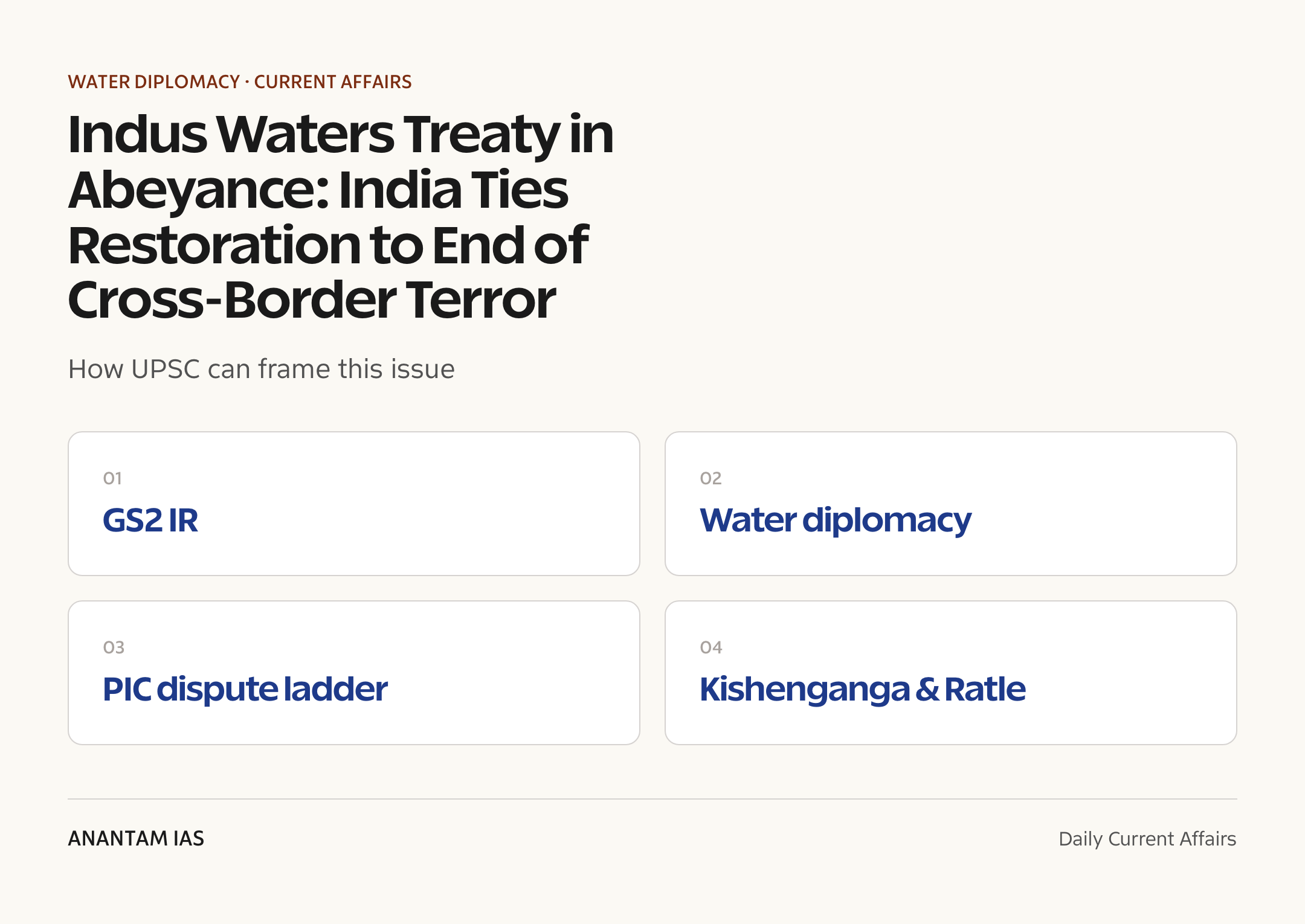
- Three-tier dispute ladder: Permanent Indus Commission -> Neutral Expert -> Court of Arbitration
- Neutral Expert appointed by the World Bank; Court of Arbitration seated at The Hague
- Kishenganga (Jhelum tributary) and Ratle (Chenab) hydro projects are the live disputes
- ‘Abeyance’ is not withdrawal; IWT has no unilateral exit clause
- Cabinet Committee on Security placed the treaty in abeyance after the Pahalgam attack (April 2025)
- Article 62, Vienna Convention on the Law of Treaties (VCLT): fundamental change of circumstances
Mains Relevance
GS Paper 2
- India-Pakistan relations and the use of a water-sharing treaty as diplomatic leverage
- India’s stand on treaty obligations, dispute-resolution mechanisms, and the World Bank’s guarantor role
GS Paper 3
- Cross-border terrorism and the security-development linkage in bilateral engagement
- Water security, hydro-project development, and infrastructure on the western rivers
Essay
- Water can be a bridge or a weapon in inter-state relations
- Sovereignty, security, and the limits of treaty commitments
Background and Context
The 1960 treaty and how it divides the rivers
The IWT is a World Bank-brokered pact splitting the six Indus-system rivers between the two countries after nine years of negotiation.
- Signed on September 19, 1960 in Karachi by PM Jawaharlal Nehru and Pakistan President Ayub Khan, after talks that began in 1951 under World Bank auspices.
- The World Bank (then IBRD) is itself a signatory to the treaty and stands as the guarantor and facilitator for dispute resolution, though it has no adjudicating power of its own.
- The three eastern rivers (Ravi, Beas, Sutlej) are allocated to India for unrestricted use, carrying roughly 33 million acre-feet.
- The three western rivers (Indus, Jhelum, Chenab) are allocated to Pakistan, carrying about 135 million acre-feet, with India permitted only limited non-consumptive, domestic, agricultural and run-of-river hydropower use.
- Pakistan receives roughly 80% of the basin’s total water, reflecting the downstream dependence of its Punjab and Sindh agriculture.
- A 10-year transition period and a World Bank-administered fund financed Pakistani link canals and storage so it could switch off the eastern rivers.
Institutional machinery: the Permanent Indus Commission
The treaty runs on a standing bilateral commission backed by a graded, three-tier dispute ladder.
- The Permanent Indus Commission (PIC) has one commissioner from each country and must meet at least once a year, alternately in India and Pakistan.
- It exchanges hydrological data, inspects works, gives advance notice of new projects, and settles routine ‘questions’ of implementation.
- Unresolved technical ‘differences’ escalate to a Neutral Expert appointed by the World Bank, whose ruling on the seven listed technical matters is final.
- Legal or interpretive ‘disputes’ go to a seven-member Court of Arbitration, historically seated at The Hague.
- This graded design let the treaty survive the 1965, 1971 and 1999 conflicts and the 2001-02 standoff without a single missed PIC cycle until 2025.
Abeyance versus abrogation: what India actually did
Abeyance is a suspension of performance, legally distinct from termination or abrogation.
- The IWT has no unilateral exit clause; Article XII(4) says the treaty continues until terminated by a mutually ratified agreement between the two governments.
- Abrogation would be an outright cancellation; India has deliberately avoided it and chosen the softer, reversible language of abeyance.
- By declaring abeyance, India signals it will not perform treaty duties such as data-sharing, advance notifications and annual PIC meetings, while stopping short of formal withdrawal.
- This preserves India’s legal high ground and keeps a diplomatic off-ramp open, since a suspension can be lifted more easily than a treaty can be re-negotiated.
- Critics note the term ‘abeyance’ does not appear in the treaty text, making its precise legal status contestable in any future forum.
The legal basis: VCLT, changed circumstances and material breach
India grounds the suspension in customary treaty law rather than the IWT’s own text.
- New Delhi has cited fundamentally changed circumstances, invoking climate change, demographic shifts and technological change as new ground realities.
- This mirrors Article 62 of the Vienna Convention on the Law of Treaties (VCLT), the doctrine of rebus sic stantibus, though India is not a party to the VCLT and relies on it as customary international law.
- India also frames Pakistan’s decades of cross-border terrorism as a violation of the treaty’s preambular “spirit of goodwill and friendship”, echoing Article 60 VCLT on suspension for material breach.
- The MEA has argued the treaty was concluded in good faith that Pakistan itself “held in abeyance” through terror sponsorship.
- Legal scholars caution that rebus sic stantibus is narrowly construed and rarely upheld, so India’s strongest lever remains political and hydrological rather than purely juridical.
Kishenganga, Ratle and the parallel-track dispute
The pre-2025 friction centred on two Indian run-of-river hydro projects on the western rivers.
- The Kishenganga project (330 MW) on a Jhelum tributary and the Ratle project (850 MW) on the Chenab are the core technical disputes over pondage, spillway and drawdown design.
- In 2022 the World Bank controversially appointed both a Neutral Expert (at India’s request) and a Court of Arbitration (at Pakistan’s request) on the same issue.
- India rejects this parallel-track process as legally untenable and does not recognise the Court of Arbitration, whose competence it disputes.
- The Court’s supplemental (pondage) award asserting jurisdiction was rejected by India as illegal and void.
- In an earlier 2013 award, a Court of Arbitration had largely upheld India’s right to build Kishenganga while capping drawdown, showing the ladder can favour either side.
The security trigger: Pahalgam and Operation Sindoor
The suspension is rooted in the 2025 terror escalation, not routine river management.
- The Pahalgam attack of April 22, 2025 killed 26 civilians and injured dozens in Jammu and Kashmir.
- The Cabinet Committee on Security, chaired by PM Narendra Modi, placed the IWT in abeyance the very next day as part of a wider package of measures.
- India later struck terror targets inside Pakistan and PoK under Operation Sindoor, marking a sharp escalation.
- On May 22, 2025 India offered to discuss the modality of gaining custody of listed terrorists as a condition of any engagement.
- The July 2026 restatement keeps the treaty frozen amid a heatwave in Pakistan and fresh protests and police crackdowns in Pakistan-Occupied Kashmir.
Leverage, hydrological limits and the internationalisation attempt
Abeyance offers real strategic leverage but faces hard hydrological and legal ceilings, which shapes Pakistan’s response.
- India currently lacks the storage and diversion infrastructure to fully hold back or redirect the vast western-river flows.
- Existing Indian projects on the western rivers are run-of-river with minimal live storage, so an immediate large-scale cut-off of Pakistan’s supply is not physically feasible.
- Suspension does free India from data-sharing, advance-notice and inspection duties, letting it accelerate reservoir flushing, desilting and new storage without Pakistani objection.
- Pakistan calls the move ‘weaponisation of water’, insists the treaty is valid, binding and operative, and has sought to internationalise the issue via the World Bank, the Court of Arbitration and multilateral forums.
- Islamabad, heavily dependent on the Indus for irrigation and hydropower, has warned any diversion would be treated as an act of war, raising the escalation stakes.
- The standoff carries wider consequences for transboundary water governance, upstream-downstream norms and treaty credibility across South Asia and beyond.
Way Forward
Build absorptive capacity on the western rivers
- Fast-track storage, canal and hydropower works on the Chenab and Jhelum so leverage on paper becomes usable capacity on the ground.
- Complete stalled projects, de-silt reservoirs and carry out drawdown flushing that the treaty had constrained, while inspection duties stay suspended.
Hold a firm, calibrated legal line
- Keep restoration tied to a verifiable, irreversible end to cross-border terrorism, avoiding open-ended ambiguity that could be read as bad faith.
- Sustain the position that parallel arbitration is inadmissible, while signalling readiness to use the treaty’s own graded dispute ladder if talks resume.
Manage the international narrative
- Engage the World Bank and key partners to explain the terror-linked rationale and pre-empt Pakistan’s ‘water weaponisation’ framing.
- Anchor any future revival in updated realities of climate change, sedimentation and basin data, pressing for a modernised rather than a frozen 1960 template.
Insulate humanitarian floors
- Keep messaging that abeyance targets treaty obligations, not civilian survival, to hold the moral and legal high ground.
- Avoid steps that could be cast as collective punishment of downstream populations, which would erode India’s upstream credibility on the Brahmaputra and elsewhere.
Prepare a modernised template
- Ready a technical case for a renegotiated treaty that accounts for sedimentation, glacial melt and today’s storage needs, so any revival is on updated terms.
- Invest in basin-wide monitoring and modelling so India negotiates from data, not from the 1950s assumptions frozen into the original text.
Conclusion
India’s insistence that the IWT stays in abeyance until Pakistan ends cross-border terrorism marks a decisive shift from treating water as a purely technical, insulated pact to using it as calibrated strategic leverage.
The chosen path, abeyance rather than abrogation, is deliberately reversible: it keeps India’s legal position defensible, avoids an outright breach, and preserves a diplomatic off-ramp while raising the cost of Pakistan’s terror sponsorship.
The real test lies ahead, in converting suspension into absorptive infrastructure, holding a credible legal line on the disputes ladder, and keeping the door to restoration conditional yet genuine without inviting charges of coercion or humanitarian harm.
UPSC Practice Questions
Prelims MCQ 1
With reference to the Indus Waters Treaty, 1960, consider the following statements:
- The waters of the eastern rivers Ravi, Beas and Sutlej were allocated to India.
- The World Bank is a signatory to the treaty.
- The treaty contains a clause allowing either party to unilaterally withdraw.
How many of the above statements are correct?
(a) Only one (b) Only two (c) All three (d) None
Answer: (b) Only two
Explanation:
Statements 1 and 2 are correct. The eastern rivers go to India and the World Bank is a signatory-guarantor. Statement 3 is wrong: the treaty has no unilateral exit clause; it can be modified only by a further ratified treaty.
Prelims MCQ 2
In the Indus Waters Treaty’s dispute-resolution mechanism, a ‘difference’ that cannot be settled by the Permanent Indus Commission is referred to which authority?
(a) The International Court of Justice (b) A Neutral Expert appointed by the World Bank (c) The United Nations Security Council (d) A joint tribunal of both Prime Ministers
Answer: (b) A Neutral Expert appointed by the World Bank
Explanation:
The treaty’s three-tier ladder routes ‘questions’ to the PIC, technical ‘differences’ to a Neutral Expert appointed by the World Bank, and legal ‘disputes’ to a Court of Arbitration.
UPSC Mains Questions
- India has placed the Indus Waters Treaty in abeyance and tied its restoration to an end of cross-border terrorism. Examine the legal basis and strategic rationale of this decision, and assess its implications for India-Pakistan relations.
- The Indus Waters Treaty is often cited as a model of transboundary water cooperation that survived multiple wars. In light of recent developments, critically evaluate the strengths and limits of its dispute-resolution architecture.
- Discuss how water can function as both a confidence-building measure and an instrument of coercion in inter-state relations, with reference to the Indus basin.
Sources: The Hindu, National and Ministry of External Affairs.
Frequently Asked Questions
What does ‘abeyance’ of the Indus Waters Treaty mean?
Abeyance means India has suspended its performance of treaty obligations, such as sharing hydrological data and holding Permanent Indus Commission meetings, without formally terminating or withdrawing from the pact. The treaty is not cancelled; it is held in a frozen, non-operative state until India decides otherwise, which it has linked to an end of cross-border terrorism.
When and why did India place the treaty in abeyance?
India’s Cabinet Committee on Security placed the treaty in abeyance on April 23, 2025, one day after the Pahalgam terror attack that killed 26 civilians. The suspension was a direct response to the attack and to what India calls Pakistan’s decades-long sponsorship of cross-border terrorism, which it says violates the treaty’s founding spirit of goodwill.
How does the Indus Waters Treaty divide the rivers?
The 1960 treaty, brokered by the World Bank, gives India unrestricted use of the three eastern rivers, Ravi, Beas and Sutlej. Pakistan receives the three western rivers, Indus, Jhelum and Chenab, which carry the bulk of the basin’s water. India may still use the western rivers for limited non-consumptive, agricultural and run-of-river hydropower purposes.
What are the Kishenganga and Ratle disputes?
Both are Indian run-of-river hydro projects on western rivers, Kishenganga on a Jhelum tributary and Ratle on the Chenab. Pakistan alleges treaty violations over their design. In 2022 the World Bank controversially appointed both a Neutral Expert and a Court of Arbitration on the same issue, a parallel process India rejects as legally untenable.
Can India stop water to Pakistan immediately?
Not fully. India currently lacks the large-scale storage and canal infrastructure to divert or hold back the western rivers, and its existing projects are run-of-river with limited storage. Abeyance mainly frees India from data-sharing and inspection duties and creates room to build capacity over time, rather than enabling an instant cut-off.
Why does this matter for UPSC preparation?
It links GS Paper 2 international relations, treaty law and dispute mechanisms with GS Paper 3 internal security and water resources. The topic tests the treaty’s structure, the Permanent Indus Commission, the Neutral Expert and Court of Arbitration ladder, and the strategic use of water diplomacy, making it a high-value current-affairs anchor to durable syllabus concepts.