INS Aridhaman enters India’s naval fleet
Why in News?
India commissioned its third nuclear-powered ballistic missile submarine (SSBN) Aridhaman (S4). INS Arihant was the first vessel under the SSBN project, and was followed by INS Arighat.
| UPSC Relevance: GS-3 Science and Technology: Defence Technology Prelims: Nuclear-Powered Submarines: SSN & SSBN Mains: Significance of India’s submarine fleet: Nuclear deterrence & maritime security. |

INS Aridhaman:
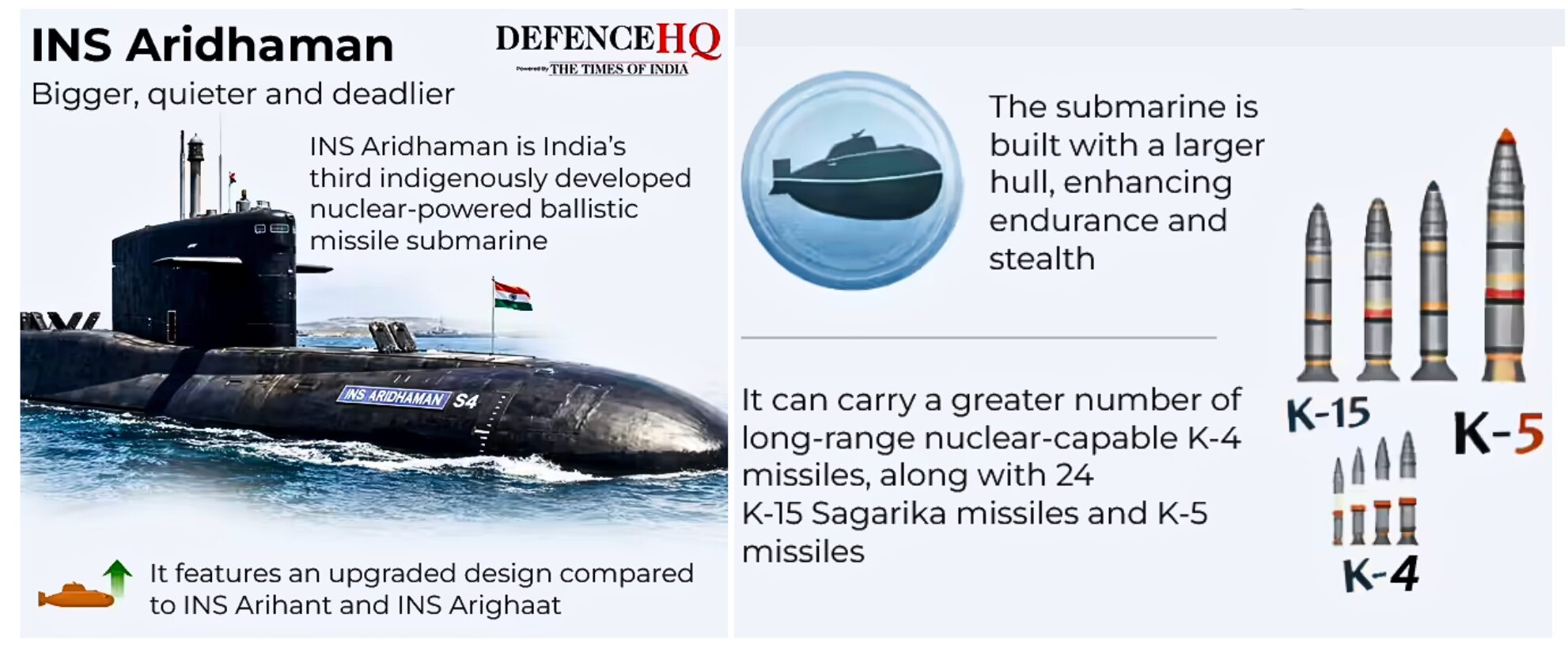
- INS Aridhaman is an advanced version of the Arihant-class submarines.
- Built indigenously under the Advanced Technology Vessel programme.
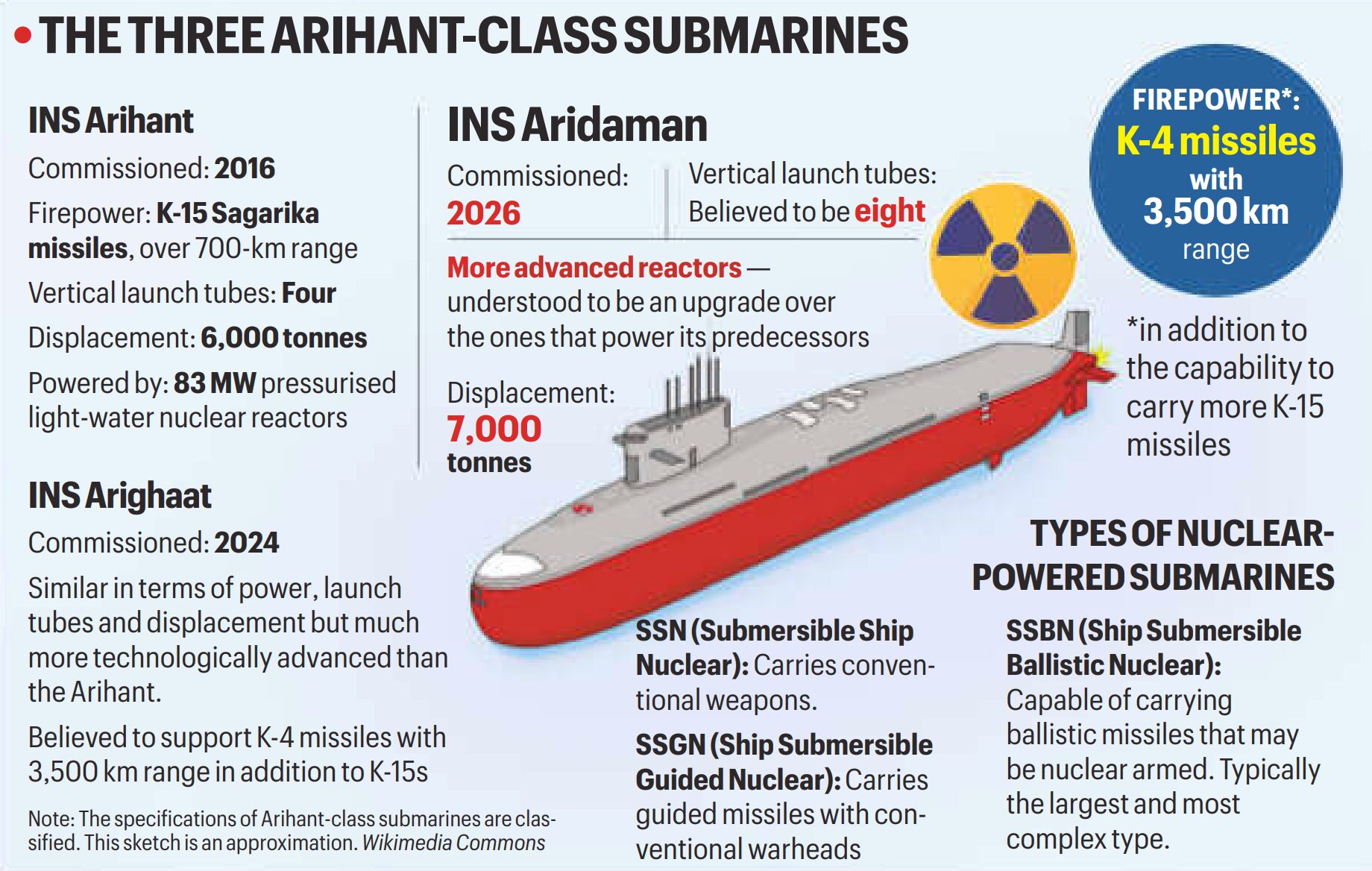
- Measures 125.4 metres and has a displacement of 7000 tons.
- Powered by an 83-MW pressurised light-water reactor with enriched Uranium.
- The submarine features advanced indigenous sonar systems and acoustic suppression technologies, improving its underwater detection and survivability.
- Can carry up to 24 K-15 Sagarika missiles with a range of 750 km, or eight K-4 missiles with a range of 3500 km, or K-5 missiles, which can be nuclear-tipped.
Significance of Arihant-class submarines:
- With the induction of INS Aridhaman, India has completed the nuclear triad, meaning it can launch a nuclear weapon from air, land and under the sea. SSBN’s ability to launch ballistic missiles from under the sea provides India with a secure second-strike capability, a crucial component of its nuclear deterrence strategy.
- Built under the Advanced Technology Vessel programme at Visakhapatnam, the submarine represents a key milestone in India’s indigenous defence capabilities.
- Places India among a select group of countries (the US, Russia, the UK, France, and China) that have nuclear-powered submarines.
With India’s No-First-Use Nuclear Policy, SSBNs play a crucial role in nuclear deterrence due to their stealth capabilities and capability to execute retaliatory strikes.
Nuclear-Powered Submarines in India:
Nuclear submarines can be classified into two categories:
1. Submersible Ship Nuclear (SSN):
- SSNs are nuclear-powered fast-attack submarines designed primarily for offensive combat roles.
- Key Roles:
- Anti-submarine warfare (ASW)
- Anti-surface warfare (ASuW)
- Intelligence, Surveillance and Reconnaissance (ISR)
- Escorting aircraft carriers and SSBNs.
- Capable of launching conventional weapons like torpedoes and cruise missiles.
- E.g., CHAKRA-II (deployed with the Eastern Naval Command)
2. Submersible Ship Ballistic Nuclear (SSBN):
- SSBNs are nuclear-powered submarines equipped with ballistic missiles that can carry nuclear warheads. They contribute to India’s nuclear deterrence capability.
- Key Characteristics:
- Carry Submarine-Launched Ballistic Missiles (SLBMs).
- Designed primarily for deterrence, and not for tactical attack missions.
- Operate stealthily to avoid detection.
- E.g., Arihant-class submarines- Arihant, Arighaat, Aridhaman.
Key Fact: Nuclear propulsion enables the submarines to remain submerged in oceans for extended periods. This is a significant advantage over conventional diesel-electric submarines, which need to surface regularly.
Practice MCQ:
Q. With reference to nuclear-powered submarines, consider the following statements:
1. Ship Submersible Nuclear (SSN) submarines are primarily designed for tactical attack roles such as anti-submarine warfare.
2. Ship Submersible Ballistic Nuclear (SSBN) submarines form the sea-based leg of the nuclear triad.
3. INS Aridhaman is equipped with ballistic missiles capable of carrying nuclear warheads.
Which of the statements given above are correct?
(a) 1 and 2 only
(b) 2 and 3 only
(c) 1 and 3 only
(d) 1, 2 and 3
Answer: (d)
UPSC PYQ 2023
Q. Consider the following statements:
1. Ballistic missiles are jet-propelled at subsonic speeds throughout their flights, while cruise missiles are rocket-powered only in the initial phase of flight.
2. Agni-V is a medium-range supersonic cruise missile, while BrahMos is a solid-fuelled intercontinental ballistic missile.
Which of the statements given above is/are correct?
(a) 1 only
(b) 2 only
(c) Both 1 and 2
(d) Neither 1 nor 2
Answer: (d)