IOC bans Transgender athletes from Women’s Sports
Why in News?
- The International Olympic Committee (IOC) has announced a new Policy on the Protection of the Female (Women’s) Category in Olympic Sport.

| UPSC Relevance: (GS-3 Science and Technology: Biology & Biotechnology) Prelims: SRY gene; Chromosomes |
What is the new Policy?
- Eligibility for any female category event at the Olympic Games or any other IOC event (including individual and team sports) is now limited to biological females, determined based on a one‑time SRY gene screening.
- The eligibility for participation in women’s sporting events will be determined according to sex, and not gender identity or testosterone reduction.
- This policy will exclude transgender and intersex people from participation in any female category event.
- Rationale: As per IOC, it aims to ensure fairness, safety and integrity in elite competition and protection of the female (women’s) category.
- The policy is applicable from the LA28 Olympic Games onwards (Los Angeles, the US, 2028).
What is the SRY gene?
- SRY stands for Sex-determining Region of the Y chromosome.
- SRY is a gene located on the Y chromosome. It plays a crucial role in sex determination during early embryonic development.
- The SRY gene triggers the development of testes in the embryo. The testes produce testosterone and other hormones. These hormones lead to the development of male reproductive organs and male secondary sexual characteristics.
- Disorder of Sex Development (DSD):
- Swyer syndrome: A person has XY chromosomes but develops female external reproductive organs. Occurs due to a non-functional SRY gene or related genetic factors.
- SRY gene screening: A non-intrusive saliva or buccal smear test is used to detect the presence or absence of the SRY gene located on the Y chromosome.
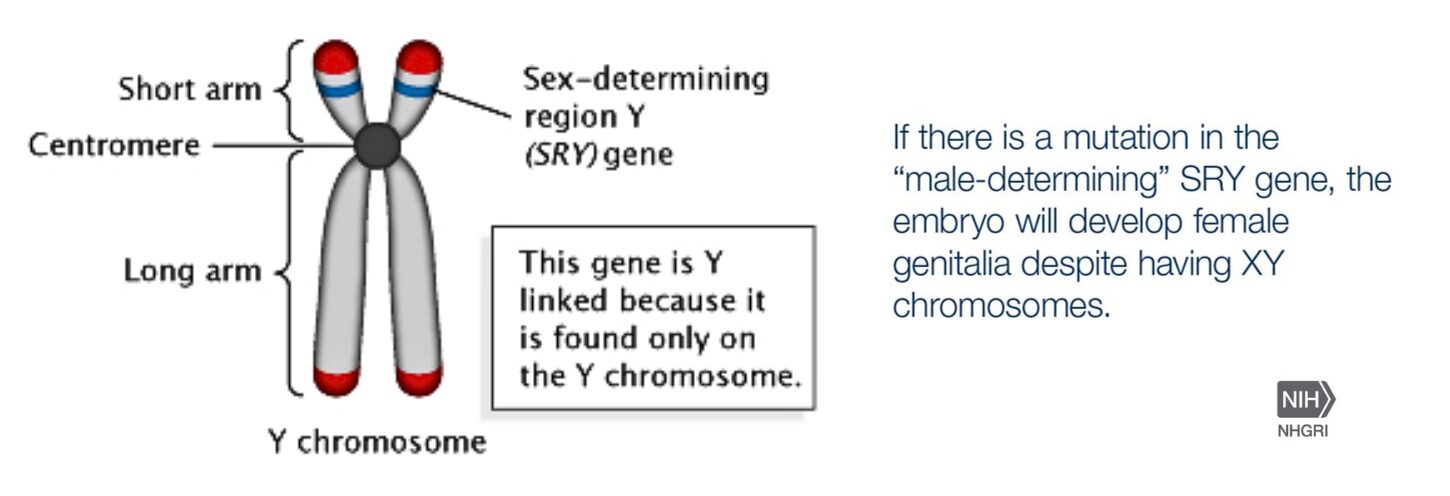
| Key Facts (SRY gene): Present only on the Y chromosome. Found only in genetic males (XY). Absent in genetic females (XX) |
Sex and Gender:
1. Sex:
- Sex (male/female/intersex) is the distinction based on reproductive biology. Sex in humans is determined by chromosomes, which carry genes responsible for development.
- Humans have 23 pairs of chromosomes:
- 22 pairs are the same in males and females (autosomes)
- 1 pair is different, called the sex chromosome.
- Chromosome combination:
- XX: Female sex organs develop
- XY: Male sex organs develop
2. Gender:
- Gender is a social construct: It is a person’s sense of themselves as a woman, a man or neither/non-binary.
- Gender identification can be different from sex. E.g., a transgender woman may have been born with male sex characteristics, but identify as a woman.
Practice MCQ:
Q. With reference to the SRY gene, consider the following statements:
1. SRY stands for Sex-determining Region of the Y chromosome.
2. The SRY gene initiates the development of testes in the embryo.
3. In the absence of SRY gene activity, the embryo typically develops female characteristics.
Which of the statements given above are correct?
(a) 1 and 2 only
(b) 2 and 3 only
(c) 1 and 3 only
(d) 1, 2, and 3
Answer: (d)
UPSC PYQ 2021
Q. The term ‘ACE2’ is talked about in the context of
(a) genes introduced in the genetically modified plants
(b) development of India’s own satellite navigation system
(c) radio collars for wildlife tracking
(d) spread of viral diseases
Answer: (d)