IPTV DRM Audit Draft: Verifying Access and Subscription Records
Why in News?
On 9 October 2026, the Telecom Regulatory Authority of India released a draft DRM audit manual to guide verification of IPTV distribution systems against existing interconnection requirements.
- Consultation status: TRAI invited evidence-backed comments by 30 October; the proposed guidance must not be described as an already finalised manual.
- Existing duty: The Interconnection Regulations already require annual audits of distributors’ addressable systems, including subscriber management, conditional access and DRM.
- Proposed coverage: The manual brings clause-wise procedures, documentary requirements, stakeholder responsibilities and report formats together for Schedule X compliance.
- Auditability connects technical access controls with commercial subscription records: secure delivery alone cannot establish that the subscriber information shared with broadcasters is accurate.
- Regulatory clarity matters because operators, broadcasters and auditors need a common evidentiary basis for checking the same system, rather than incompatible interpretations.
UPSC Relevance
Prelims Relevance
- TRAI and broadcasting interconnection regulation
- IPTV: Internet Protocol Television
- DRM: Digital Rights Management
- SMS: Subscriber Management System
- Schedule X and DRM-based addressable systems
Mains Relevance
GS Paper 2
- Regulatory accountability through auditable procedures and evidence.
GS Paper 3
- Digital content protection, access control and reliable subscriber records.
Essay
- Technical trust depends on institutions that can verify claims.
Background and Context
What the Draft Changes
The immediate change concerns how compliance is checked, while the underlying obligation to undergo an annual audit already exists in regulation.
- The legal baseline is the Interconnection (Addressable Systems) Regulations, 2017. As amended, these cover audits of television distributors’ systems; the October announcement does not create annual auditing for the first time.
- Schedule X specifies DRM requirements primarily for IPTV distribution. The draft translates that regulatory framework into checks that auditors can perform and document, rather than announcing a new broadcasting delivery technology.
- The earlier audit manual addresses Schedule III systems, including conditional access, subscriber management and set-top boxes. The proposed DRM manual addresses the corresponding need for procedures covering the distinct Schedule X framework.
- Stakeholder roles are part of the proposal: the distribution platform operator, broadcaster and auditor have defined responsibilities. Standard declarations and reports can make evidence easier to compare, without substituting paperwork for actual examination.
- Draft status remains decisive. TRAI is seeking comments, supported by reasons and evidence; students should distinguish an existing regulatory requirement from proposed guidance on conducting the audit and recording its findings.

How Subscriber Records Connect to Viewing Access
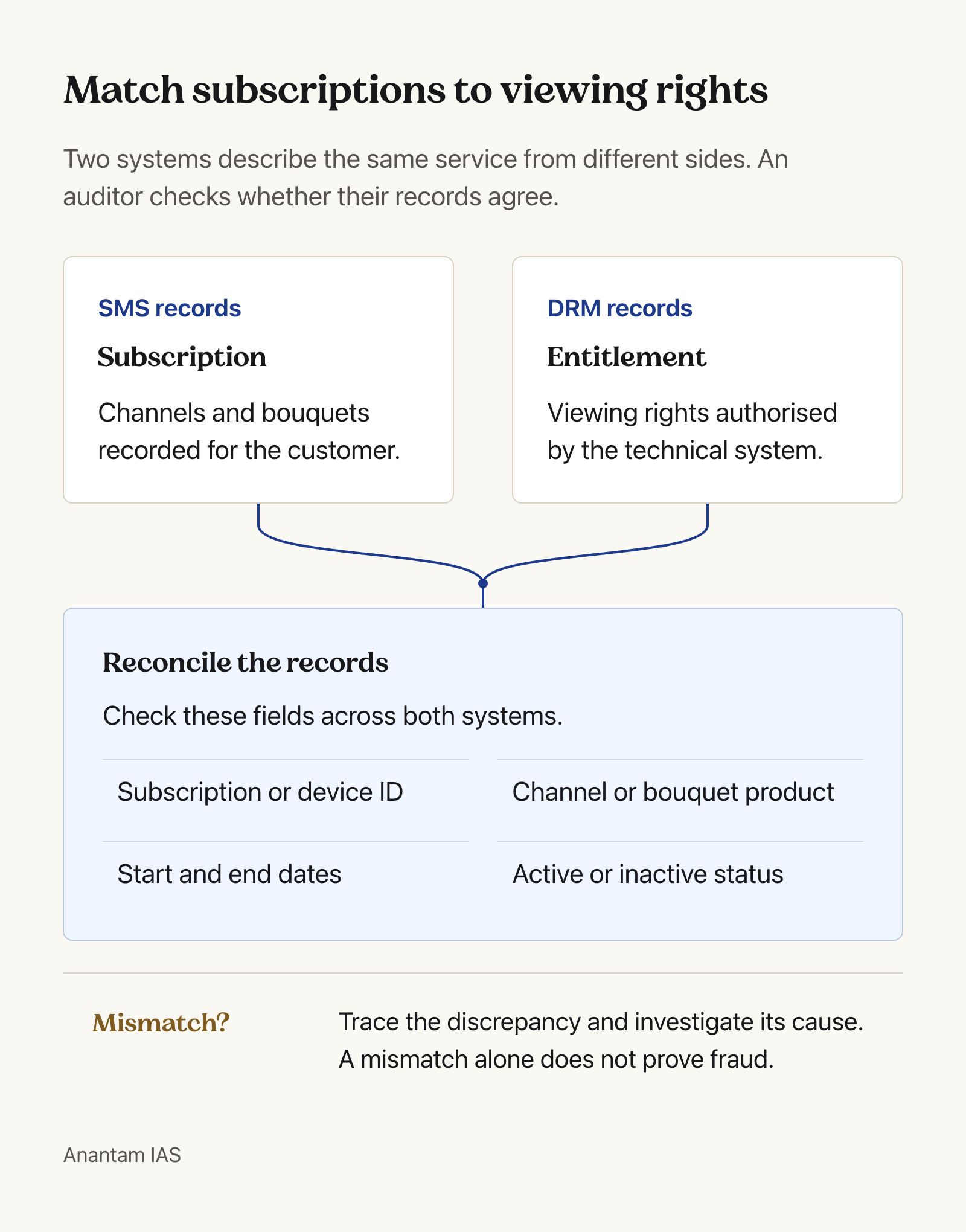
An IPTV service must connect the subscription recorded for a customer with the viewing entitlement enforced by its technical systems.
- IPTV distributes television through Internet Protocol networks. In the draft’s description, its addressable architecture typically uses a DRM packager, licence servers and associated key-management and entitlement systems, sometimes alongside conventional conditional access.
- SMS means Subscriber Management System, not text messaging. Its records identify subscriptions and associated products; the audit relationship concerns whether those records agree with the rights represented in the DRM system.
- DRM manages encryption-related access to protected television content. An entitlement identifies what a subscription may receive; encryption protects delivery, while entitlement controls determine the authorised access represented in the system.
- Reconciliation compares SMS and DRM data to identify inconsistencies. The draft manual proposes examining records together, rather than treating either database as sufficient proof that subscription reporting is correct.
- Useful matching fields include the subscription or device identifier, channel or bouquet product, entitlement dates and active status. These connect an abstract subscriber total to records that an auditor can actually trace and compare.
What an Audit Can Establish
Technical compliance and subscription verification ask related but different questions, so neither should be treated as a complete substitute for the other.
- Compliance checks examine whether the system meets applicable requirements. The proposed procedures cover subscriber management, conditional access and encryption, fingerprinting, and set-top boxes or software applications used to receive the television service.
- Subscription audits examine the reporting side of distribution. Their purpose includes verification of subscription information supplied to broadcasters, connecting the commercial account of service delivery to the underlying addressable-system records and supporting evidence.
- Testing matters alongside documents: the draft includes simulated activation and deactivation checks. Observing an operation helps an auditor examine system behaviour instead of relying entirely on a vendor declaration that a function exists.
- An illustrative discrepancy would be an inactive subscription in one system but a continuing entitlement in the other. It warrants reconciliation and investigation; the mismatch alone does not establish deliberate fraud or explain its cause.
- Audit scope has limits: checking these records does not itself prove freedom from every cyberattack, settle every consumer dispute or validate all streaming services. The relevant question remains compliance within the applicable television-distribution framework.
Way Forward
Make Findings Reproducible
- Operators should maintain traceable records of entitlement changes and reconcile systems so discrepancies can be investigated without relying on reconstructed spreadsheets.
- Auditors should connect each finding to the applicable requirement, tested operation and supporting record, separating observed failures from unexplained discrepancies.
- TRAI should assess consultation responses for procedures that remain practical across different DRM implementations while protecting the reliability of subscription evidence.
Conclusion
- The central distinction is between a subscription record, a technical viewing entitlement and evidence that both agree. An audit makes those relationships examinable; no single database or security feature can replace the full exercise.
- For governance answers, use this draft to explain how regulators turn requirements into verifiable procedures. Preserve the status distinction: annual auditing already exists, while the October DRM audit manual remains a consultation proposal.
UPSC Practice Questions
Prelims MCQ 1
With reference to the draft DRM audit manual, consider the following statements:
- SMS refers to the Subscriber Management System.
- The October draft introduced the annual audit obligation for the first time.
- Schedule X concerns DRM requirements primarily for IPTV distribution.
How many of the above statements are correct?
(a) Only one (b) Only two (c) All three (d) None
Answer: (b) Only two
Explanation:
Statements 1 and 3 are correct. The annual audit duty already exists under the Interconnection Regulations; the draft proposes audit guidance.
Prelims MCQ 2
Which exercise most directly tests consistency between subscription records and technical access entitlements?
(a) Comparing the operator’s advertising budgets (b) Counting channels without checking subscriptions (c) Reconciling SMS and DRM records (d) Measuring television screen dimensions
Answer: (c) Reconciling SMS and DRM records
Explanation:
Reconciliation compares subscription and DRM data, including identifiers, product entitlements, dates and status, to identify inconsistencies.
UPSC Mains Questions
- Explain how auditable technical procedures can strengthen accountability in digital television distribution.
- Distinguish technical compliance from subscription verification in IPTV systems. What evidentiary safeguards make an audit useful?
Sources: PIB, Ministry of Communications and TRAI, Draft DRM Audit Manual.
Frequently Asked Questions
What is the status of the DRM audit manual?
TRAI released it as a consultation draft on 9 October 2026. It proposes guidance for checking existing requirements and invites stakeholder comments; it should not be described as an already finalised manual.
Does SMS mean a mobile text message here?
No. SMS means Subscriber Management System in this broadcasting context. It contains subscription-related records that need to be consistent with the entitlements represented in the DRM system.
Why compare SMS and DRM records?
The two systems represent related aspects of the service: recorded subscriptions and technical access entitlements. Comparing them can reveal inconsistencies requiring investigation, rather than assuming either dataset alone proves accurate reporting.
Did this draft create the annual audit requirement?
No. The Interconnection Regulations already require annual audits of addressable distribution systems. The draft supplies proposed DRM-specific procedures, documentary requirements and standard reporting arrangements for carrying out the relevant checks.