Iran’s Threat to Alternative Gulf Shipping Routes
Why in News?
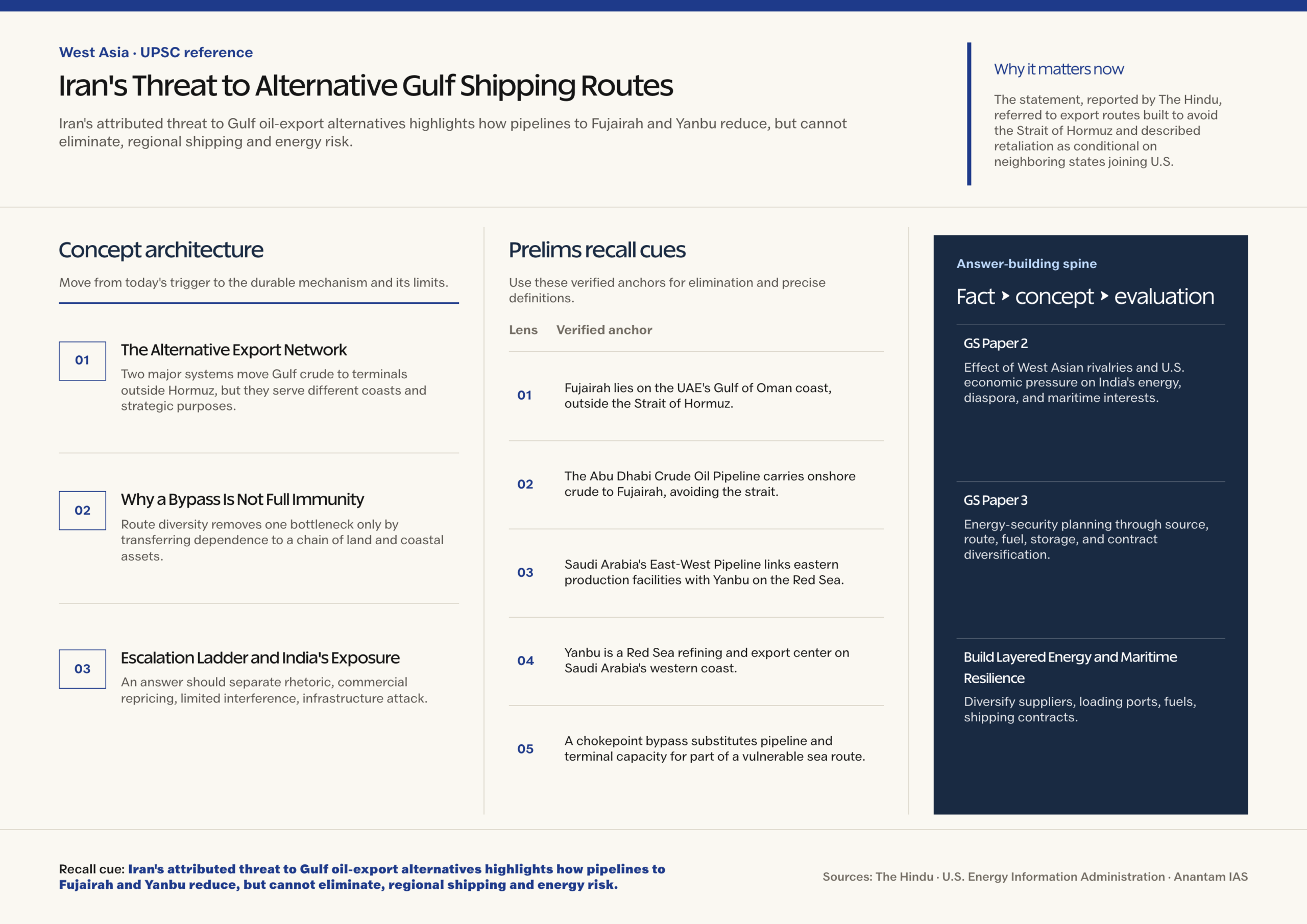
On August 23, Iran’s security chief threatened neighbors’ alternative oil-shipping routes if they joined new U.S. economic pressure, but no route closure or attack was reported.
- The statement, reported by The Hindu, referred to export routes built to avoid the Strait of Hormuz and described retaliation as conditional on neighboring states joining U.S. measures.
- The threat was an attributed contingency, not evidence that Iran had begun an attack, imposed a blockade, or disabled a pipeline or terminal.
- The exposed network includes the UAE’s route to Fujairah on the Gulf of Oman and Saudi Arabia’s cross-country route to Yanbu on the Red Sea.
- The episode shifts analysis from one narrow strait to network resilience: pipelines, export terminals, storage, insurance, naval security, and destination-market access must work together.
- A bypass reduces dependence on one maritime exit, but its fixed capacity, pumping stations, storage sites, and terminal infrastructure create new concentrated points of failure.
- For India, disruption can transmit through freight premiums, war-risk insurance, delivery delays, crude benchmarks, LPG and LNG availability, and pressure on refinery sourcing plans.
- Diplomatic signaling can raise commercial risk before physical disruption because shipowners, insurers, lenders, and charterers price the probability of escalation.
UPSC Relevance
Prelims Relevance
- Fujairah lies on the UAE’s Gulf of Oman coast, outside the Strait of Hormuz.
- The Abu Dhabi Crude Oil Pipeline carries onshore crude to Fujairah, avoiding the strait.
- Saudi Arabia’s East-West Pipeline links eastern production facilities with Yanbu on the Red Sea.
- Yanbu is a Red Sea refining and export center on Saudi Arabia’s western coast.
- A chokepoint bypass substitutes pipeline and terminal capacity for part of a vulnerable sea route; it does not automatically replace all flows.
Mains Relevance
GS Paper 2
- Effect of West Asian rivalries and U.S. economic pressure on India’s energy, diaspora, and maritime interests.
- Role of calibrated diplomacy with Iran, Gulf Arab partners, the United States, and regional mediators.
GS Paper 3
- Energy-security planning through source, route, fuel, storage, and contract diversification.
- Protection of critical pipeline-terminal networks and management of freight, insurance, and supply-chain shocks.
Essay
- Resilience comes from diverse systems and trusted relationships, not from replacing one dependency with another.
Background and Context
The Alternative Export Network
Two major systems move Gulf crude to terminals outside Hormuz, but they serve different coasts and strategic purposes.
- The UAE’s Abu Dhabi Crude Oil Pipeline moves crude from inland fields to Fujairah, where tankers load on the Gulf of Oman side of the strait.
- The U.S. Energy Information Administration describes the UAE pipeline as a 1.8 million-barrel-per-day route, while operational use limits how much additional oil it can absorb during disruption.
- Saudi Arabia’s East-West Pipeline carries crude from the Abqaiq area across the peninsula to Yanbu, shifting the loading point from the Persian Gulf to the Red Sea.
- EIA lists its normal capacity at 5 million barrels per day, with temporary expansion possible; existing use means nameplate capacity is not the same as spare capacity.
- Iran’s own Goreh-Jask system reaches the Gulf of Oman, showing that bypass infrastructure is also part of Iran’s strategy, although EIA records limited historical use.
Why a Bypass Is Not Full Immunity
Route diversity removes one bottleneck only by transferring dependence to a chain of land and coastal assets.
- A pipeline requires functioning pumping stations, power, control systems, storage, maintenance, and a secure export terminal; failure at any critical node can reduce usable throughput.
- Fujairah avoids Hormuz, but cargoes still enter the Gulf of Oman and Arabian Sea; maritime security beyond the strait remains necessary.
- Yanbu avoids Hormuz through a land bridge, yet westbound cargoes may face separate Red Sea routing and security constraints depending on their final destination.
- EIA estimated the combined Saudi-UAE effective unused bypass capacity at about 2.6 million barrels per day in its 2025 assessment, far below total regional export requirements.
- The strategic value is partial continuity: preserve some exports, improve bargaining space, and reduce shock severity rather than promise complete substitution.
Escalation Ladder and India's Exposure
An answer should separate rhetoric, commercial repricing, limited interference, infrastructure attack, and sustained regional disruption.
- At the first rung, a conditional threat changes expectations; insurers and shipowners may demand higher premiums or alter charter terms without any physical incident.
- The next rung could involve harassment, cyber interference, sabotage, or a localized strike; each has different evidence requirements and should not be inferred from rhetoric alone.
- A wider confrontation could threaten pipelines, storage tanks, loading berths, and nearby sea lanes simultaneously, defeating the assumption that a single bypass guarantees continuity.
- India’s exposure is a portfolio problem: crude, LNG, LPG, fertiliser inputs, shipping services, and millions of citizens in the Gulf connect energy security with external affairs.
- Policy should track delivered cost and reliability, not only the source country’s crude price, because freight, insurance, voyage time, and terminal access shape the final shock.
Way Forward
Build Layered Energy and Maritime Resilience
- Diversify suppliers, loading ports, fuels, shipping contracts, and payment channels so one regional disruption does not disable the whole import portfolio.
- Coordinate strategic petroleum reserves, refinery inventories, demand management, and government-industry contingency drills against short, medium, and prolonged disruption scenarios.
- Use diplomacy and maritime information-sharing to protect Indian seafarers, maintain communication with regional states, and prevent commercial warnings from becoming uncontrolled escalation.
- Stress-test contracts for force majeure, war-risk insurance, rerouting, terminal substitution, and emergency cargo swaps before a crisis activates those clauses.
Conclusion
- Alternative routes to Fujairah and Yanbu create resilience, but limited spare capacity and concentrated infrastructure prevent them from becoming complete substitutes for Gulf maritime flows.
- In a Mains answer, separate the conditional Iranian statement from verified action, then evaluate exposure through the chain of pipelines, terminals, shipping, insurance, storage, and Indian demand.
UPSC Practice Questions
Prelims MCQ 1
With reference to alternative oil-export routes in the Gulf region, consider the following statements:
- The Abu Dhabi Crude Oil Pipeline carries crude to Fujairah on the Gulf of Oman coast.
- Saudi Arabia’s East-West Pipeline carries crude to Yanbu on the Red Sea coast.
- Both routes terminate inside the Persian Gulf and require tankers to cross the Strait of Hormuz.
How many of the above statements are correct?
(a) Only one (b) Only two (c) All three (d) None
Answer: (b) Only two
Explanation:
Statements 1 and 2 are correct. Fujairah and Yanbu provide loading points outside the Persian Gulf; the third statement reverses their strategic purpose.
Prelims MCQ 2
Which one of the following best explains why a bypass pipeline cannot provide complete immunity from a maritime chokepoint shock?
(a) Pipelines can transport only natural gas (b) Export terminals cannot load seagoing tankers (c) Spare capacity is limited and the pipeline-terminal chain has its own vulnerable nodes (d) International law prohibits pipelines from crossing deserts
Answer: (c) Spare capacity is limited and the pipeline-terminal chain has its own vulnerable nodes
Explanation:
Bypasses can preserve part of export capacity, but pumps, power, storage, terminals, sea approaches, and limited spare throughput remain constraints.
UPSC Mains Questions
- Alternative Gulf export routes reduce chokepoint dependence but do not eliminate systemic energy risk. Discuss with reference to pipeline-terminal networks and India’s exposure.
- How should India combine diplomacy, strategic reserves, import diversification, and maritime preparedness when geopolitical threats raise commercial risk before physical disruption occurs?
Sources: The Hindu and U.S. Energy Information Administration.
Frequently Asked Questions
Did Iran close or attack an alternative Gulf shipping route?
No. The August 23 report described a conditional threat attributed to Iran’s security chief. It did not report an implemented closure, blockade, or attack on a route.
Which UAE route bypasses the Strait of Hormuz?
The Abu Dhabi Crude Oil Pipeline carries onshore crude to Fujairah on the Gulf of Oman, allowing tankers to load outside the strait.
How does Saudi Arabia move crude to the Red Sea?
The East-West Pipeline links eastern oil facilities with Yanbu, creating a land route to a western export terminal instead of loading all cargoes on the Gulf coast.
Why can insurance costs rise before any attack?
Insurers and shipowners price expected danger. A credible escalation threat can increase war-risk premiums, charter costs, and caution even while routes remain physically open.
What is the main lesson for India’s energy security?
India needs diversification across suppliers, routes, fuels, contracts, storage, and shipping support because a bypass route reduces one dependency but creates other concentrated infrastructure risks.