Iran-US Memorandum Expires: Strait of Hormuz Risk and India’s Exposure
Why in News?
The 60-day Iran-US memorandum meant to pause the West Asia war lapsed on 17 August 2026, and neither capital announced a public extension.
- The Indian Express describes a 14-point memorandum whose closing promise was a final deal within 60 days.
- Crossings through the Strait of Hormuz remain in single digits against a pre-war norm above 130 a day.
- UKMTO reported an outbound vessel struck by an unknown projectile on 18 August. No attacker has been named.
- Almost every diplomatic clause is an attributed claim. The durable material is geography, energy and passage law.
- A chokepoint does not have to close to hurt. Thin traffic and war-risk premia already raise landed costs.
- India imports close to 88% of the crude it refines, and much of that basket loads inside the Persian Gulf.
- Indian seafarers carry physical risk on foreign-flagged ships even when no Indian cargo is named.
UPSC Relevance
Prelims Relevance
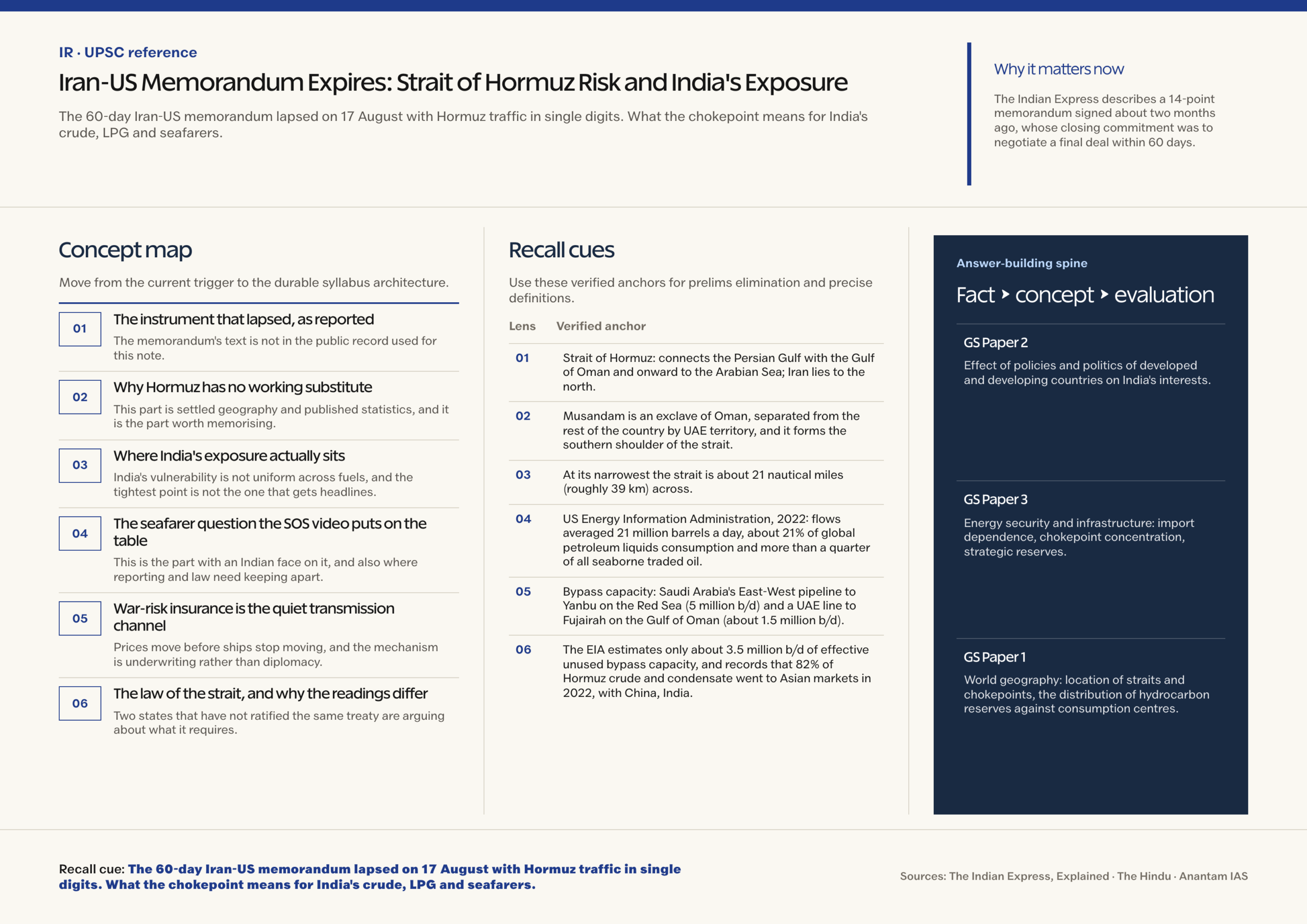
- The Strait of Hormuz joins the Persian Gulf to the Gulf of Oman; Iran north, Oman’s Musandam and the UAE south.
- At its narrowest it is about 21 nautical miles, so it sits inside territorial seas.
- UNCLOS Part III creates non-suspendable transit passage through international straits.
- Iran signed but did not ratify UNCLOS. The United States also has not ratified it.
- UKMTO is a reporting and advisory point, not an investigating authority.
- India’s ISPRL Phase I caverns are at Visakhapatnam, Mangaluru and Padur.
Mains Relevance
GS Paper 2
- How a bargain between two third countries reshapes India’s energy and shipping risk.
- UNCLOS transit passage versus innocent passage, and why the readings differ.
GS Paper 3
- Energy security at a chokepoint: crude, LPG, freight, insurance and thin strategic reserves.
Essay
- Agreements that pause a war are not agreements that end one.
Background and Context
Why Hormuz has no working substitute
This part is settled geography. It is the part worth keeping.
- The strait is the only sea exit from the Persian Gulf to the Arabian Sea.
- The US EIA put 2022 flows at about 21 million barrels a day of petroleum liquids.
- A large share of seaborne oil and a large share of LNG, especially Qatari cargoes, use this lane.
- Bypass lines to Yanbu and Fujairah exist, but spare capacity is thin against normal Gulf loadings.
- Iraq and Kuwait have no pipeline escape from the Gulf at all.
Where India's exposure sits
India’s vulnerability is not uniform across fuels. The tightest point is not always crude.
- Most Indian crude still loads inside the Gulf, so freight and insurance move before shortages do.
- LPG dependence on Gulf suppliers is tighter, and the demand is household cooking.
- Strategic reserves buy days, not months. Phase I of ISPRL is a thin buffer.
- Indian crew on foreign flags fall first under the flag state, not under DG Shipping.
- Earlier notes on the memorandum as reported at signing cover the same geography.
The law of the strait
Two states that never ratified the same treaty are arguing about what it requires.
- Because the strait is narrower than two 12-nautical-mile seas, every ship enters a territorial sea.
- UNCLOS transit passage is continuous, expeditious, and may not be suspended.
- Iran offers innocent passage instead, which is suspendable.
- The United States treats transit passage as customary law even without ratification.
- UKMTO recorded an unknown projectile. An answer that names the attacker is guessing.
Insurance and crew move before cargo disappears
Prices and refusals arrive first. Physical shortage, if it comes, arrives later.
- Additional war-risk premium is charged on hull value for each listed-area transit and can reprice overnight.
- The Lloyd’s Joint War Committee listing is an underwriting judgement, not a government advisory.
- Seafarers under International Bargaining Forum contracts may decline warlike transits and claim a bonus.
- A Marshall Islands flag puts primary enforcement on that flag state, not on India.
- One public Indian-crew refusal is evidence of risk, not yet evidence of an Indian energy shortage.
Way Forward
Harden the import route and the crew rule
- Raise the share of barrels liftable outside the Gulf and treat LPG storage as the binding constraint.
- Make DG Shipping advisories operational: when Indian crew may decline a listed high-risk transit.
- Keep naval mission-based presence and maritime domain awareness sized to actual traffic.
- Test any Hormuz management scheme against UNCLOS through the IMO, not only through two capitals.
Conclusion
- The lapse of a 60-day paper is a small headline on a large fact: Hormuz traffic is still not normal.
- Keep contested diplomacy separate from geography, UNCLOS passage law and seafarer protection, which will not move with the next statement.
- If you cannot name the attacker or the cargo, do not invent either.
UPSC Practice Questions
Prelims MCQ 1
With reference to the Strait of Hormuz, consider the following statements:
- It connects the Persian Gulf with the Gulf of Oman.
- Oman’s Musandam exclave forms part of its southern shore.
- At its narrowest it is wider than 50 nautical miles, so it lies entirely in the high seas.
How many of the above statements are correct?
(a) Only one (b) Only two (c) All three (d) None
Answer: (b) Only two
Explanation:
Statements 1 and 2 are correct. The strait is about 21 nautical miles at its narrowest and sits inside territorial seas.
Prelims MCQ 2
Transit passage under UNCLOS is best described as:
(a) A suspendable right, identical to innocent passage (b) Continuous and expeditious passage through a strait used for international navigation, which bordering states may not suspend (c) A right available only to states that have ratified UNCLOS (d) A coastal-state licensing regime for tankers
Answer: (b) Continuous and expeditious passage through a strait used for international navigation, which bordering states may not suspend
Explanation:
That is the Part III rule. Innocent passage is the suspendable regime, and the US treats transit passage as customary law.
UPSC Mains Questions
- The Strait of Hormuz does not have to close to raise India’s energy bill. Examine the transmission channels. (250 words)
- Distinguish transit passage from innocent passage and explain why the distinction matters at Hormuz. (150 words)
Sources: The Indian Express, Explained and The Hindu.
Frequently Asked Questions
What lapsed on 17 August 2026?
A reported 60-day Iran-US memorandum that was meant to pause the war and lead to a final deal. No public extension was announced.
Why does the Strait of Hormuz matter to India?
A large share of India’s crude and LPG loadings sit inside the Persian Gulf. Thin traffic and war-risk insurance raise landed costs even without a formal closure.
What is transit passage?
Under UNCLOS Part III, ships have a right of continuous, expeditious passage through an international strait. Bordering states may not suspend it.
Did anyone claim the 18 August strike?
No. UKMTO recorded an unknown projectile, engine-room damage and one casualty. Attribution is not established.