Heritage in the Crossfire: Protecting Cultural Property in Armed Conflict
Why in News?
The Indian Express reported that Israeli military operations since 2023 have damaged several UNESCO-listed and heritage landmarks across Lebanon, Iran and Gaza, reviving debate over the law that protects cultural property during war.
The reported damage spans the ancient port city of Tyre in Lebanon, the Golestan Palace in Tehran, and Gaza’s Great Omari Mosque and Church of Saint Porphyrius, drawing UNESCO condemnation of what it called unlawful attacks on cultural property.
- Lebanon’s Culture Minister Ghassan Salame told Reuters on June 28 that a full damage assessment is blocked because a roughly 10-km deep zone in the south remains off-limits.
- A crown was reportedly blown off an ancient column at the UNESCO-listed Al-Bass site in Tyre; Lebanon has asked UNESCO to reclassify Tyre as World Heritage in Danger.
- Israeli strikes on March 1 reportedly damaged mirrorwork at Tehran’s Golestan Palace, a World Heritage complex.
- In Isfahan, strikes reportedly reached the 17th-century Chehel Sotoun Palace, the Masjed-e Jame and the Ali Qapu Palace on Naqsh-e Jahan Square.
- UNESCO added Gaza’s Saint Hilarion Monastery, among the oldest monastery complexes in the Middle East, to its List of World Heritage in Danger.
The development matters in the context of:
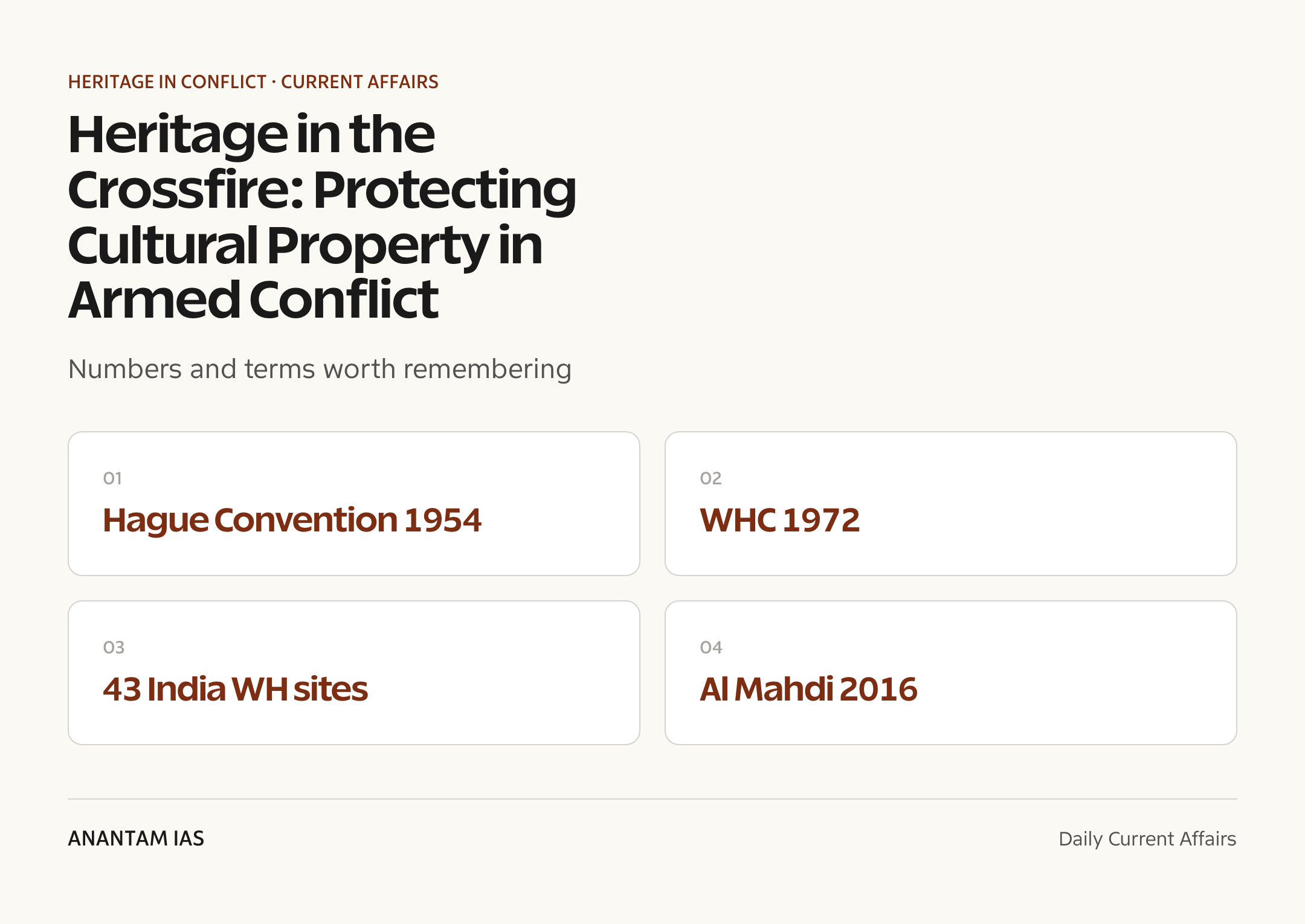
- The episode tests whether the 1954 Hague Convention and 1972 World Heritage Convention can shield cultural property once fighting begins.
- Deliberate destruction of cultural heritage is now a recognised war crime under the Rome Statute, a threshold set by the ICC’s Al Mahdi case.
UPSC Relevance
Prelims Relevance
- 1954 Hague Convention for the Protection of Cultural Property in Armed Conflict (+ 1954 and 1999 Protocols)
- UNESCO World Heritage Convention, 1972 and the List of World Heritage in Danger
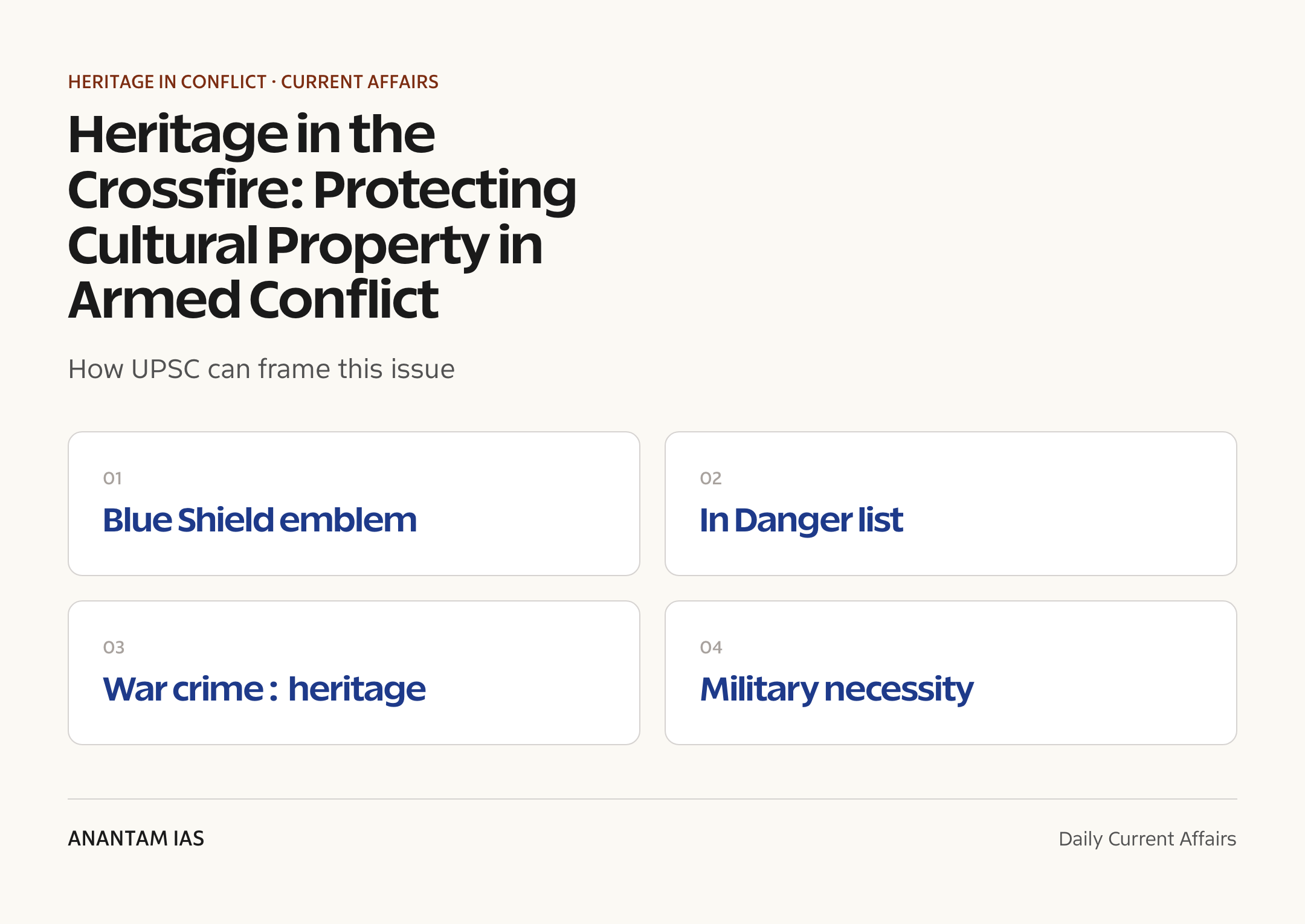
- The Blue Shield emblem as the distinctive marking for protected cultural property
- Rome Statute of the ICC and the Al Mahdi (Timbuktu) conviction for destroying cultural heritage
- UNESCO-listed sites named: Tyre (Lebanon), Golestan Palace and Naqsh-e Jahan Square (Iran)
- ‘Enhanced protection’ regime under the 1999 Second Protocol to the Hague Convention
- India as a State Party to the 1954 Hague Convention and the 1972 World Heritage Convention
- The World Heritage Committee and the UNESCO ‘Blue Helmets for Culture’ initiative
Mains Relevance
GS Paper 1
- Cultural heritage as a marker of civilisation and identity; the cost of losing tangible heritage in conflict.
- Why heritage destruction during war is treated as a loss to all humanity, not one nation.
GS Paper 2
- International conventions and the UN system’s role in protecting cultural property; gaps in enforcement.
- How international humanitarian law balances military necessity against cultural safeguards.
GS Paper 4
- Ethics of proportionality and restraint in armed conflict where cultural and civilian interests intersect.
Essay
- Heritage belongs to humanity, not to armies: the ethics of protecting culture in war.
- When monuments fall, memory follows: conflict and the fragility of civilisation.
Background and Context
The 1954 Hague Convention: the core treaty
The foundational rulebook for cultural property in war was drafted in the shadow of the Second World War’s devastation.
- The 1954 Hague Convention for the Protection of Cultural Property in Armed Conflict was the first universal treaty focused solely on safeguarding heritage during war.
- It obliges states to protect and respect cultural property and to refrain from using it, or its surroundings, for military purposes.
- It introduced the Blue Shield emblem as the internationally recognised marker for protected sites, akin to the Red Cross for cultural property.
- Its 1954 First Protocol curbs the export and return of cultural property from occupied territory; the 1999 Second Protocol created an ‘enhanced protection’ tier and clarified individual criminal responsibility.
- A key limit is the ‘military necessity’ exception, which parties have historically invoked to justify strikes near cultural sites.
The 1972 World Heritage Convention and the Danger List
A separate UNESCO framework identifies sites of ‘outstanding universal value’ and flags those under threat.
- The World Heritage Convention, 1972 created the World Heritage List and the World Heritage Committee that inscribes sites.
- The List of World Heritage in Danger signals sites facing serious, specific threats, including armed conflict, and can unlock international assistance.
- UNESCO added Gaza’s Saint Hilarion Monastery to the Danger List, and Lebanon has sought the same status for Tyre.
- Listing is largely a moral and diplomatic lever; the Convention has no standing army to physically defend a site.
- UNESCO can document damage, satellite-monitor sites, and mobilise emergency funds, but relies on states honouring their obligations.
Sites reported damaged across three theatres
The reported damage cuts across Phoenician ports, Safavid palaces and some of the oldest Christian and Islamic sites in the region.
- Lebanon: Tyre, a nearly 5,000-year-old port that flourished under Phoenicians, Greeks and Romans; the Crusader-era Beaufort Castle; and the 12th-century Chama Citadel.
- Iran: the Qajar-era Golestan Palace in Tehran, and in Isfahan the Safavid Chehel Sotoun and Ali Qapu palaces plus the Masjed-e Jame.
- Gaza: the Great Omari Mosque, Gaza’s oldest, heavily damaged in December 2023, and the Church of Saint Porphyrius, among the world’s oldest churches in use.
- Iran’s cultural heritage minister told Al Jazeera that restoring Golestan Palace alone would take at least two years, with some losses possibly permanent.
- UNESCO said it was ‘deeply alarmed’ and condemned what it termed unlawful attacks against cultural property.
Destroying heritage as a war crime
International criminal law has moved from treating heritage destruction as collateral damage to prosecuting it as a distinct crime.
- The Rome Statute of the International Criminal Court lists intentional attacks on historic monuments and buildings dedicated to religion as a war crime, absent military justification.
- In the landmark Al Mahdi case (2016), the ICC convicted a defendant for destroying mausoleums in Timbuktu, Mali, the first conviction solely for cultural destruction.
- The 1999 Second Protocol to the Hague Convention also provides for individual criminal responsibility for serious violations.
- Enforcement remains uneven: jurisdiction depends on state cooperation, and major military powers are not all parties to the ICC.
- UN Security Council Resolution 2347 (2017) was the first to focus squarely on protecting cultural heritage in conflict.
The Blue Shield and monitoring architecture
Beyond treaties, a network of institutions tries to shield heritage in real time.
- The Blue Shield organisation is the cultural counterpart to the Red Cross, working to protect heritage before, during and after conflict.
- UNESCO uses satellite imagery and remote monitoring to assess damage where ground access is blocked, as in southern Lebanon.
- The ‘enhanced protection’ list under the 1999 Protocol offers the strongest treaty-based immunity, though few sites are enrolled.
- UNESCO’s proposed ‘Blue Helmets for Culture’ concept envisions rapid-response teams to safeguard heritage in emergencies.
- Documentation matters: verified damage records feed future accountability, restoration funding and Danger-List decisions.
The India angle
India is embedded in this legal architecture and carries its own memory of heritage lost to conflict.
- India is a State Party to both the 1954 Hague Convention and the 1972 World Heritage Convention.
- India hosts 43 World Heritage Sites and has an interest in a strong, enforceable protection regime.
- India’s own experience, from monuments damaged in past wars and communal strife to the recovery of smuggled antiquities, informs its stake in cultural-property law.
- The Antiquities and Art Treasures Act, 1972 governs the protection and movement of India’s cultural objects domestically.
- As a rising voice at UNESCO, India can champion accountability for heritage destruction and the return of illicitly trafficked artefacts.
Way Forward
Strengthen the treaty regime
- Widen ratification of the 1999 Second Protocol and enrol more sites under ‘enhanced protection’.
- Push warring parties to publish ‘no-strike’ lists of cultural sites and honour the Blue Shield marking.
Improve monitoring and access
- Guarantee neutral experts and UNESCO teams safe access to assess damage promptly.
- Scale satellite monitoring and open damage databases to preserve evidence for accountability.
Close the accountability gap
- Use UNSC Resolution 2347 and the ICC framework to deter deliberate destruction.
- Fund emergency restoration and support Danger-List interventions before losses become permanent.
Conclusion
Cultural heritage is a shared inheritance, and its destruction in war is treated in international law as a loss to all humanity rather than to any single side.
The reported damage across Lebanon, Iran and Gaza shows the gap between the promise of the 1954 Hague Convention and the reality of modern conflict, where enforcement lags behind aspiration.
For a heritage-rich State Party like India, the durable lesson is to strengthen the norms, monitoring and accountability that turn treaty text into real protection on the ground.
UPSC Practice Questions
Prelims MCQ 1
With reference to the protection of cultural property in armed conflict, consider the following statements:
- The 1954 Hague Convention introduced the Blue Shield emblem to mark protected cultural property.
- The List of World Heritage in Danger is maintained under the 1972 World Heritage Convention.
- India is not a party to the 1954 Hague Convention.
How many of the above statements are correct?
(a) Only one (b) Only two (c) All three (d) None
Answer: (b) Only two
Explanation:
Statements 1 and 2 are correct. Statement 3 is wrong: India is a State Party to the 1954 Hague Convention as well as the 1972 World Heritage Convention.
Prelims MCQ 2
The ICC’s Al Mahdi case (2016) is significant because it was the first international conviction for:
(a) using chemical weapons in an internal conflict (b) recruiting child soldiers (c) the intentional destruction of cultural heritage (d) crimes of aggression between two states
Answer: (c) the intentional destruction of cultural heritage
Explanation:
Ahmad al-Faqi al-Mahdi was convicted for directing attacks on historic and religious mausoleums in Timbuktu, Mali, the first ICC conviction based solely on cultural-heritage destruction as a war crime.
UPSC Mains Questions
- International conventions protecting cultural property in war have grown in ambition but remain weak in enforcement. Critically examine, with reference to the 1954 Hague Convention and the 1972 World Heritage Convention. (250 words)
- The destruction of cultural heritage during conflict is a loss to all humanity, not to one nation. Discuss the international legal framework that treats such destruction as a war crime, and India’s stake in it. (250 words)
Sources: The Indian Express (Explained) and UNESCO.
Frequently Asked Questions
What is the 1954 Hague Convention?
It is the first universal treaty devoted to protecting cultural property, such as monuments, museums and archives, during armed conflict. Adopted after the Second World War, it obliges states to respect and safeguard such property, avoid military use of heritage sites, and mark protected property with the Blue Shield emblem.
What is the World Heritage in Danger list?
Maintained under the 1972 World Heritage Convention, it flags World Heritage Sites facing serious, specific threats, including armed conflict, natural disaster or unchecked development. Listing draws global attention and can unlock emergency assistance, but it is chiefly a diplomatic and moral tool rather than a physical shield.
Is destroying heritage a war crime?
Yes. The Rome Statute of the International Criminal Court treats intentional attacks on historic monuments and buildings dedicated to religion or education as a war crime when there is no military justification. The ICC’s 2016 Al Mahdi conviction, over the Timbuktu mausoleums in Mali, was the first based solely on cultural destruction.
What is the Blue Shield?
The Blue Shield is the distinctive emblem created by the 1954 Hague Convention to mark cultural property that must be protected in conflict, functioning as culture’s counterpart to the Red Cross. An associated international organisation, also called Blue Shield, works to safeguard heritage before, during and after emergencies.
Is India part of these frameworks?
India is a State Party to both the 1954 Hague Convention and the 1972 World Heritage Convention, and hosts 43 World Heritage Sites. Domestically, the Antiquities and Art Treasures Act, 1972 governs the protection and movement of cultural objects, giving India a direct stake in a strong, enforceable protection regime.
Why does heritage protection lag in practice?
The treaties rely on states honouring their obligations, and the ‘military necessity’ exception is often invoked to justify strikes near cultural sites. UNESCO has no army to defend a site, ICC jurisdiction depends on cooperation, and access for damage assessment is frequently blocked, so enforcement trails behind the aspirations set out on paper.