ISRO launches Advanced Imaging Satellite EOS-05
Why in News?
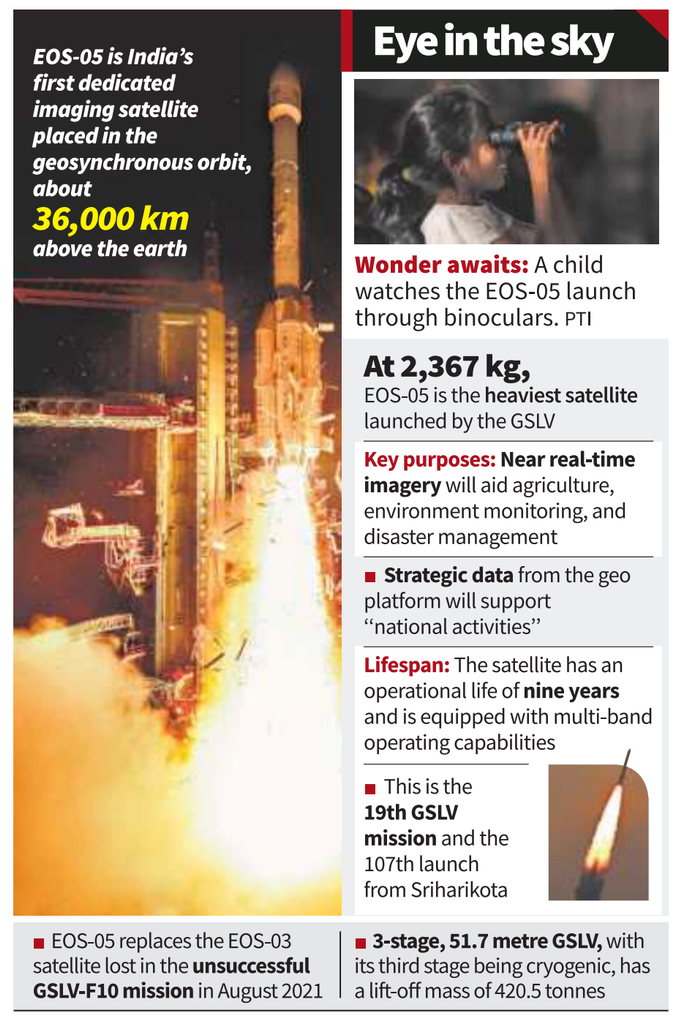
ISRO successfully launched the 2,367-kg EOS-05 Earth-observation satellite aboard GSLV-F17 from Sriharikota on September 4, 2026. The satellite was precisely injected into a sub-geosynchronous transfer orbit about 18 minutes after lift-off.
| UPSC Relevance: GS-3 Science and Technology: Astronomy and Space Technology Prelims: Advanced Imaging Satellite EOS-05; Earth-observation satellite |
About EOS-05:
- EOS-05 is India’s first dedicated imaging satellite designed to operate from geosynchronous orbit, approximately 36,000 km above Earth. After injection into the transfer orbit, its onboard propulsion system will gradually raise and circularise the orbit.
- Launch Vehicle: Geosynchronous Satellite Launch Vehicle (GSLV-F17)
- Unlike most Indian remote-sensing satellites operating in Low Earth Orbit, EOS-05 can continuously observe a large part of the Indian region and provide frequent or near-real-time imagery, subject to cloud cover and sensor limitations. It has therefore been described as an “eye in the sky”.
Major Applications:
- Agriculture: crop monitoring, drought assessment and yield estimation
- Disaster management: rapid tracking of cyclones, floods, forest fires and landslides
- Environment: monitoring forests, wetlands, pollution and land-use changes
- Development planning: urban growth, infrastructure and water-resource management
- Strategic purposes: persistent surveillance of borders, coastlines and other sensitive areas
| Geosynchronous versus Geostationary Orbit: A geosynchronous satellite completes one orbit in roughly 24 hours, matching Earth’s rotation. A geostationary orbit is a special geosynchronous orbit that is circular and lies directly above the equator, making the satellite appear stationary from Earth. These orbits provide wide and persistent coverage. However, because they are far from Earth, their spatial resolution is generally lower than that of Low Earth Orbit satellites. EOS-05 therefore complements, rather than replaces, high-resolution LEO and all-weather radar satellites. |
Significance of the Launch:
The mission marked the 19th flight of the GSLV and carried the heaviest satellite launched by this vehicle so far. GSLV uses India’s indigenous CE-7.5 cryogenic engine in its upper stage. GSLV-F17 restores confidence in ISRO’s launch programme while strengthening India’s sovereign capacity in Earth observation, disaster preparedness and strategic intelligence.
India must integrate EOS-05 data with LEO satellites, radar imagery, drones and ground-based observations. Faster data processing, inter-agency sharing and last-mile delivery to farmers, disaster authorities and local governments will determine its real developmental value.