ISRO Space-Sector Reforms: Research Leadership and Private-Sector Scale
Why in News?
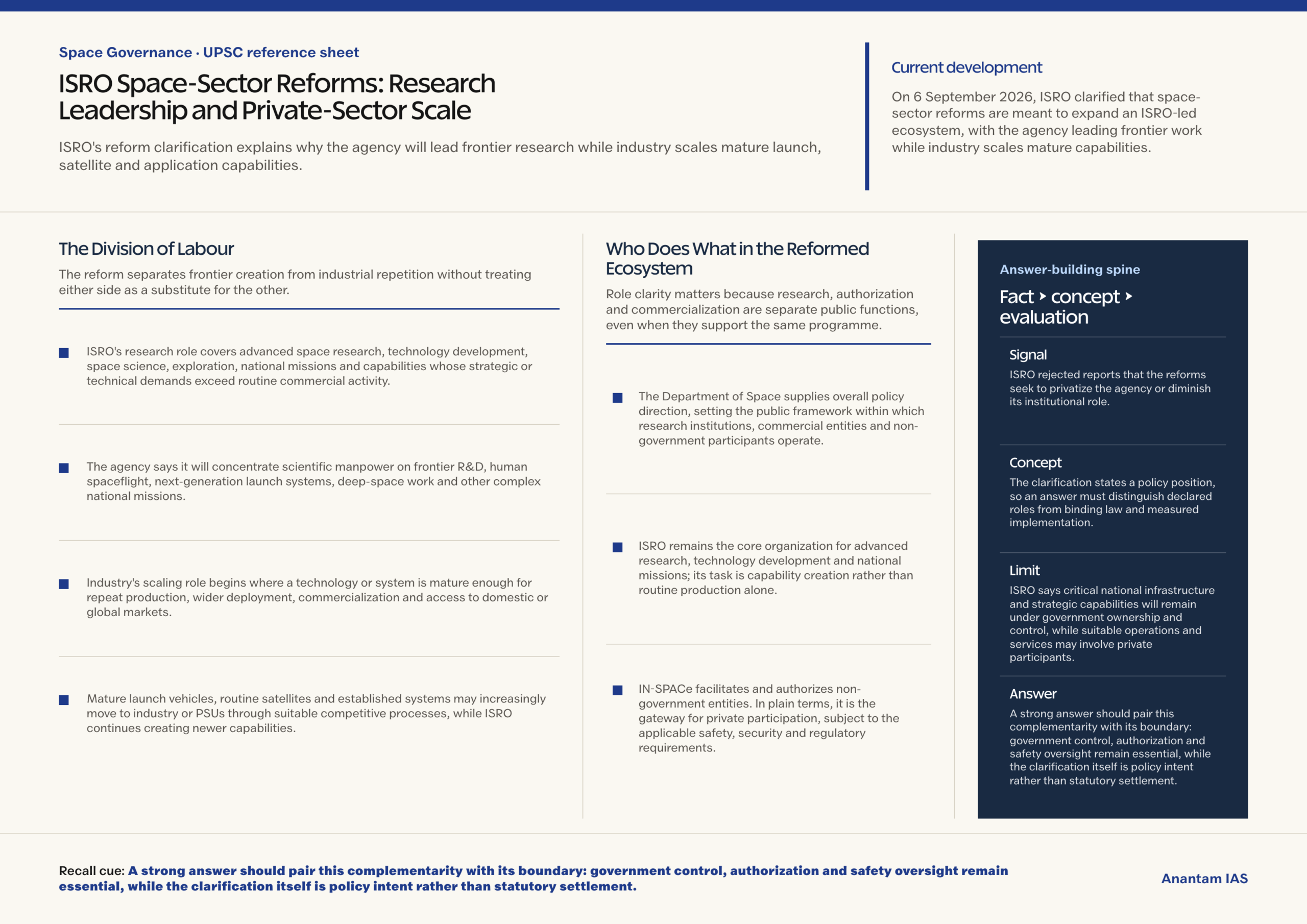
On 6 September 2026, ISRO clarified that space-sector reforms are meant to expand an ISRO-led ecosystem, with the agency leading frontier work while industry scales mature capabilities.
- ISRO rejected reports that the reforms seek to privatize the agency or diminish its institutional role.
- It placed advanced research, national and strategic missions, space science, exploration and frontier capabilities within ISRO’s continuing core role.
- It assigned mature and routinely manufactured systems a different pathway: scaling through Indian industry or public-sector undertakings under appropriate competitive processes.
- The clarification describes an institutional direction. It isn’t a statute, a blanket guarantee against every organizational change or a detailed technology-transfer schedule.
- The key distinction is between creating the next capability and reproducing a proven capability at industrial scale; the two tasks need different institutions and incentives.
- For Mains, evaluate the reform by whether it increases aggregate national capability without weakening public control over strategic infrastructure, safety or long-horizon research.
- This is an ecosystem-expansion argument, not evidence that every transfer has occurred, every private participant can enter freely or implementation risks have disappeared.
UPSC Relevance
Prelims Relevance
- The Indian Space Policy 2023 provides the institutional policy framework cited by ISRO for the post-2020 reforms.
- The Department of Space provides overall policy direction within the stated architecture.
- IN-SPACe facilitates and authorizes participation by non-government entities; it is not the commercial operator for mature ISRO capabilities.
- NSIL undertakes commercialization and industry-led utilization of mature capabilities.
- ISRO remains the core organization for advanced R&D, technology development and national missions.
- Government control continues over critical national space infrastructure and strategic capabilities, according to the clarification.
Mains Relevance
GS Paper 3
- Achievements of Indians in science and technology; indigenization of technology and developing new technology.
- Assess how public research leadership and private manufacturing scale can complement each other in a strategic technology sector.
GS Paper 2
- Government policies and interventions for development in various sectors and issues arising out of their design and implementation.
- Examine role clarity, authorization, commercial functions and public accountability across the space-sector institutions.
Essay
- A capable state need not manufacture every mature system itself, but it must preserve the knowledge, authority and patient investment needed to create the next one.
Background and Context
The Division of Labour
The reform separates frontier creation from industrial repetition without treating either side as a substitute for the other.
- ISRO’s research role covers advanced space research, technology development, space science, exploration, national missions and capabilities whose strategic or technical demands exceed routine commercial activity.
- The agency says it will concentrate scientific manpower on frontier R&D, human spaceflight, next-generation launch systems, deep-space work and other complex national missions.
- Industry’s scaling role begins where a technology or system is mature enough for repeat production, wider deployment, commercialization and access to domestic or global markets.
- Mature launch vehicles, routine satellites and established systems may increasingly move to industry or PSUs through suitable competitive processes, while ISRO continues creating newer capabilities.
- Technology transfer, in this model, changes who reproduces a proven capability at scale; it does not by itself prove that ISRO has abandoned the underlying domain.
Who Does What in the Reformed Ecosystem
Role clarity matters because research, authorization and commercialization are separate public functions, even when they support the same programme.
- The Department of Space supplies overall policy direction, setting the public framework within which research institutions, commercial entities and non-government participants operate.
- ISRO remains the core organization for advanced research, technology development and national missions; its task is capability creation rather than routine production alone.
- IN-SPACe facilitates and authorizes non-government entities. In plain terms, it is the gateway for private participation, subject to the applicable safety, security and regulatory requirements.
- NSIL handles commercialization and industry-led use of mature capabilities, connecting established public technologies with production, services and markets rather than replacing ISRO’s research mandate.
- Industry, start-ups and PSUs can supply investment, manufacturing capacity, innovation and market access, allowing a larger programme than public manpower and production lines could support alone.
The Boundary That Must Be Kept Clear
The clarification states a policy position, so an answer must distinguish declared roles from binding law and measured implementation.
- ISRO says critical national infrastructure and strategic capabilities will remain under government ownership and control, while suitable operations and services may involve private participants.
- Private participation remains subject to national-security, safety, quality and regulatory requirements; commercial opportunity does not remove the state’s authorization and oversight functions.
- The statement does not identify a binding transfer timetable, list every system to be scaled or settle how competitive processes will work in each case.
- It also does not convert role allocation into a statutory guarantee. Parliament, policy instruments, contracts, authorization decisions and future implementation will determine the enforceable details.
- The correct exam reading is narrow: public research leadership and private scale are complementary in the stated design, but outcomes must still be judged through evidence.
Way Forward
Make Complementarity Work in Practice
The division becomes credible only when institutions can transfer mature work without starving frontier research or weakening public oversight.
- Publish transparent selection criteria for mature capabilities, competitive processes and authorization decisions so participants understand the boundary between public research and commercial scaling.
- Protect ISRO’s scientific manpower and long-horizon funding while using industry capacity for repeat manufacturing, services, supply chains and market development.
- Build enforceable safety, security, quality and data-governance safeguards around private operations, especially where services depend on strategic infrastructure or sensitive technologies.
- Measure reform through reliable production, innovation, domestic capability and mission outcomes, not merely through the number of firms, transfers or policy announcements.
Conclusion
- The durable lesson is a division of labour: ISRO creates frontier and strategic capabilities, while industry supplies repeatable production, capital and market scale for mature systems.
- A strong answer should pair this complementarity with its boundary: government control, authorization and safety oversight remain essential, while the clarification itself is policy intent rather than statutory settlement.
UPSC Practice Questions
Prelims MCQ 1
With reference to the institutional architecture described in ISRO’s space-sector reform clarification, consider the following statements:
- ISRO remains the core organization for advanced research, technology development and national missions.
- IN-SPACe undertakes commercialization and industry-led utilization of mature space capabilities.
- NSIL undertakes commercialization and industry-led utilization of mature space capabilities.
How many of the above statements are correct?
(a) Only one (b) Only two (c) All three (d) None
Answer: (b) Only two
Explanation:
Statements 1 and 3 are correct. IN-SPACe facilitates and authorizes non-government participation, while NSIL performs the stated commercialization function.
Prelims MCQ 2
Which option best captures the division of labour stated by ISRO under the space-sector reforms?
(a) ISRO exits research while industry designs all strategic missions (b) IN-SPACe replaces ISRO as India’s principal research institution (c) ISRO leads frontier work while industry scales mature capabilities (d) All space infrastructure moves to private ownership
Answer: (c) ISRO leads frontier work while industry scales mature capabilities
Explanation:
ISRO presents private scale as complementary to its continuing leadership in advanced research, strategic capabilities, science, exploration and national missions.
UPSC Mains Questions
- Public research leadership and private industrial scale are complements, not substitutes, in strategic technology sectors. Discuss with reference to India’s space-sector reforms.
- Critically examine the institutional division of roles among ISRO, IN-SPACe, NSIL and industry. What safeguards are necessary to preserve national capability while expanding commercial participation?
Source: Indian Space Research Organisation.
Frequently Asked Questions
Is ISRO being privatized under the space-sector reforms?
ISRO’s official clarification says no. It states that ISRO will remain India’s principal institution for advanced research, national and strategic missions, space science, exploration and frontier capabilities.
What work does the clarification place with private industry?
Industry may increasingly scale mature technologies and routinely manufactured systems, including established launch vehicles and routine satellites, through appropriate competitive processes.
What is the difference between IN-SPACe and NSIL?
IN-SPACe facilitates and authorizes non-government participation. NSIL undertakes commercialization and industry-led utilization of mature space capabilities.
Does the clarification create a statutory guarantee for ISRO’s role?
No. It records ISRO’s official policy position and intended division of labour, but it is not legislation or a detailed, binding transfer schedule.
Why can technology transfer strengthen rather than shrink ISRO?
Repeat production can move to industry while ISRO’s scientific manpower focuses on advanced research and complex missions. The claim still requires implementation evidence, funding and clear safeguards.