Jammu and Kashmir Business Rules and the Elected Union Territory
Why in News?
The Jammu and Kashmir Transaction of Business Rules returned to focus after Chief Minister Omar Abdullah said on August 14, 2026 that revised rules proposed by the elected government were still awaiting finalisation.
- The Hindu reported that the elected government had answered queries, modified its proposal and was waiting for the revised framework to be implemented.
- The report said the Lieutenant Governor’s office and Chief Minister’s office had not yet finalised the proposed rules for the elected-government phase.
- This does not mean Jammu and Kashmir has no business rules: the 2019 Rules, notified by the President in August 2020 during the Section 73 proclamation, already regulate government business and were amended in 2024.
- Section 55 of the Jammu and Kashmir Reorganisation Act says the Lieutenant Governor shall make allocation and transaction rules on the advice of the Council of Ministers, including a procedure for differences of opinion.
- The unresolved question is how a revised set will operate within powers that the Act itself assigns to the elected institutions and to the Lieutenant Governor.
- Jammu and Kashmir became a Union Territory with a legislature on October 31, 2019 under the Jammu and Kashmir Reorganisation Act, 2019.
- An elected Legislative Assembly and Council of Ministers took office in 2024, converting previously theoretical power-sharing clauses into everyday administrative questions.
- Business rules are procedural delegated legislation. They can organise statutory power, but cannot enlarge or erase powers fixed by the Constitution or the Reorganisation Act.
UPSC Relevance
Prelims Relevance
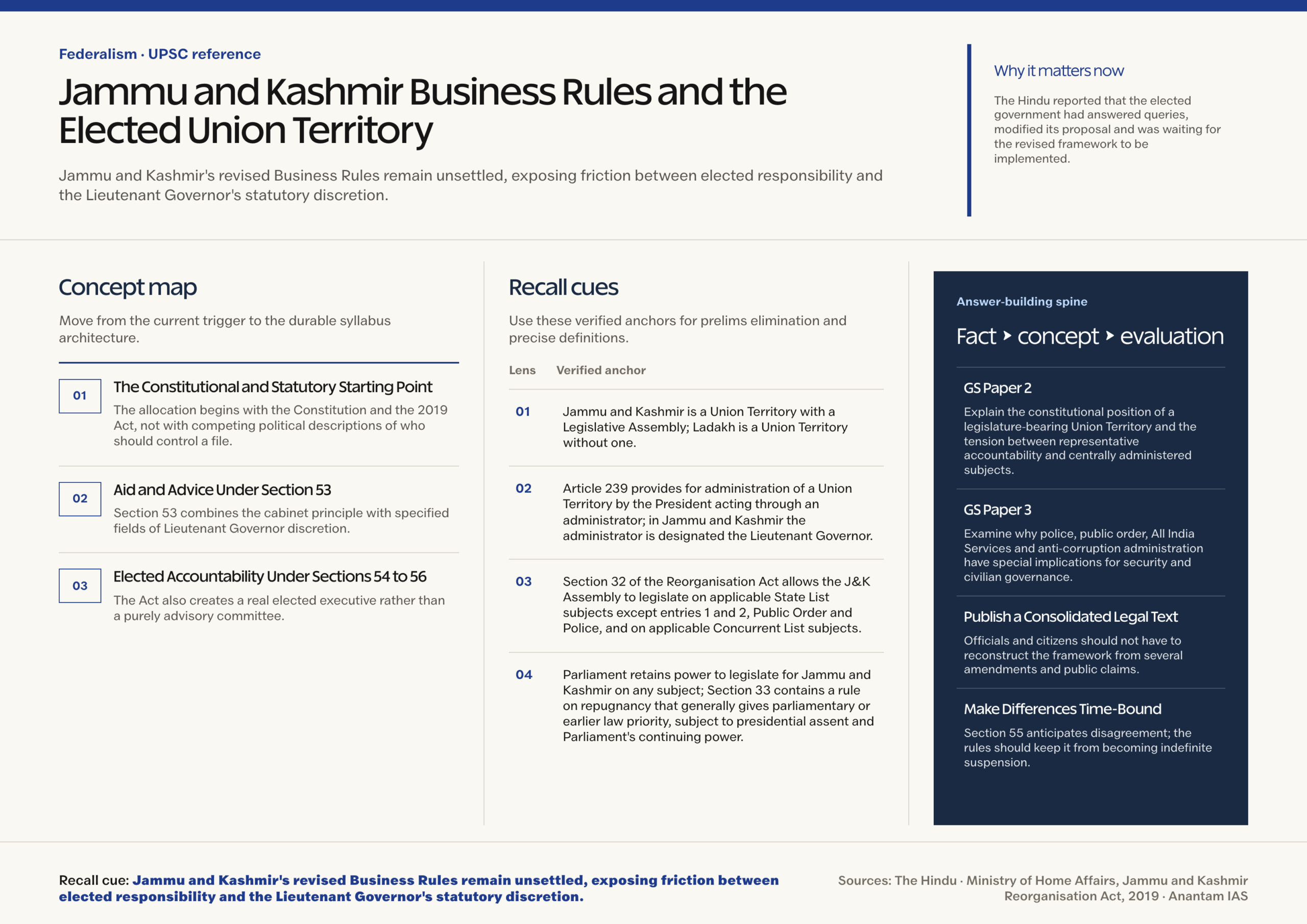
- Jammu and Kashmir is a Union Territory with a Legislative Assembly; Ladakh is a Union Territory without one.
- Article 239 provides for administration of a Union Territory by the President acting through an administrator; in Jammu and Kashmir the administrator is designated the Lieutenant Governor.
- Section 32 of the Reorganisation Act allows the J&K Assembly to legislate on applicable State List subjects except entries 1 and 2, Public Order and Police, and on applicable Concurrent List subjects.
- Parliament retains power to legislate for Jammu and Kashmir on any subject; Section 33 contains a rule on repugnancy that generally gives parliamentary or earlier law priority, subject to presidential assent and Parliament’s continuing power.
- Section 53 establishes a Council of Ministers headed by the Chief Minister to aid and advise the Lieutenant Governor within the Assembly’s legislative sphere, except where discretion applies.
- Section 53 expressly identifies matters outside the Assembly’s power, legally required discretion or judicial functions, and matters related to All India Services and the Anti-Corruption Bureau within the Lieutenant Governor’s discretionary field.
Mains Relevance
GS Paper 2
- Explain the constitutional position of a legislature-bearing Union Territory and the tension between representative accountability and centrally administered subjects.
- Distinguish statutory power under the Reorganisation Act from procedural allocation under Transaction of Business Rules.
GS Paper 3
- Examine why police, public order, All India Services and anti-corruption administration have special implications for security and civilian governance.
- Discuss the effect of prolonged administrative uncertainty on service delivery, public finance and development decisions.
Essay
- Democratic responsibility becomes credible only when citizens can identify who had the lawful power to decide and who must explain delay or failure.
Background and Context
The Constitutional and Statutory Starting Point
The allocation begins with the Constitution and the 2019 Act, not with competing political descriptions of who should control a file.
- Under Article 239, every Union Territory is administered by the President through an appointed administrator, subject to the constitutional scheme and any law made by Parliament.
- The Reorganisation Act created the Union Territory of Jammu and Kashmir with a legislature and the Union Territory of Ladakh without a legislature from October 31, 2019.
- Section 32 gives the J&K Assembly substantial but not state-equivalent legislative competence. It excludes Public Order and Police from its State List field, while Parliament retains a plenary power to legislate for the Union Territory.
- Executive responsibility broadly follows the legislative domain, but the Act adds express discretionary areas for the Lieutenant Governor and retains Union control characteristic of a Union Territory.
- This makes J&K neither an ordinary State nor a Union Territory without representative government. It is a hybrid constitutional design whose institutions must work through carefully drawn boundaries.
Aid and Advice Under Section 53
Section 53 combines the cabinet principle with specified fields of Lieutenant Governor discretion.
- There must be a Council of Ministers, limited to not more than 10% of the Assembly’s total membership, with the Chief Minister at its head.
- The Council aids and advises the Lieutenant Governor on matters within the Legislative Assembly’s power, except where the Act or another law requires the Lieutenant Governor to act in discretion.
- Section 53(2) identifies discretion for matters outside the Assembly’s legislative power, matters where a law requires discretion or a judicial function, and matters related to All India Services and the Anti-Corruption Bureau.
- Public Order and Police fall outside the Assembly’s Section 32 competence. Their executive treatment cannot be inferred merely from a department’s name or from ordinary cabinet practice in a State.
- The Act says the Lieutenant Governor’s decision is final if a question arises on whether a matter falls within required discretion. That clause is part of the statutory text, though particular exercises of public power remain.
Elected Accountability Under Sections 54 to 56
The Act also creates a real elected executive rather than a purely advisory committee.
- The Lieutenant Governor appoints the Chief Minister and appoints other Ministers on the Chief Minister’s advice. The Council is collectively responsible to the Legislative Assembly.
- Collective responsibility means the Ministry must defend government policy in the Assembly and may remain in office only while it commands legislative confidence.
- Section 55 says the Lieutenant Governor shall make rules on the Council’s advice for allocating business to Ministers and transacting business with them.
- The same section specifically requires those rules to contain a procedure for a difference of opinion between the Lieutenant Governor and the Council or an individual Minister.
- Section 55 also provides that executive action is expressed in the Lieutenant Governor’s name and that authenticated orders cannot be challenged merely on the ground that they were not made by the Lieutenant Governor.
What Transaction of Business Rules Actually Do
Business rules convert a high-level legal settlement into a repeatable administrative workflow.
- They distribute subjects among departments, allow allocation of departments to Ministers and specify which matters a Minister, the Council, Chief Minister or Lieutenant Governor must see.
- They prescribe consultation among departments, especially with Finance and Law, and identify proposals that cannot be issued without prior concurrence.
- They define how Cabinet agendas, minutes, legislation, contracts, appointments, prosecution decisions and references to the Union Government are processed.
- They also establish the administrative chain through the Chief Secretary and departmental Secretaries, who must ensure compliance and flag departures.
- Good rules make routine cases routine and exceptional cases visible. Badly drawn or ambiguous routing can turn every file into a jurisdictional contest and make delay hard to attribute.
Way Forward
Publish a Consolidated Legal Text
- Notify the final agreed rules and publish a consolidated version incorporating the 2020 notification and all amendments.
- Include a subject-and-route schedule showing ministerial matters, discretionary matters, mandatory consultation and Union-reference cases.
- Explain the legal source beside each exceptional route so that a procedural rule is not mistaken for a new substantive power.
Conclusion
- Jammu and Kashmir’s business-rules dispute is not a contest that can be resolved by slogans about absolute control.
- The immediate need is a final, consolidated and legally faithful workflow for the elected-government phase.
UPSC Practice Questions
Prelims MCQ 1
With reference to the Jammu and Kashmir Reorganisation Act, 2019, consider the following statements:
- The Legislative Assembly of Jammu and Kashmir may make laws on Public Order and Police.
- The Council of Ministers is collectively responsible to the Legislative Assembly.
- Section 55 provides for rules covering allocation of business and the procedure for differences between the Lieutenant Governor and Ministers.
How many of the above statements are correct?
(a) Only one (b) Only two (c) All three (d) None
Answer: (b) Only two
Explanation:
Statements 2 and 3 are correct. Section 32 excludes State List entries 1 and 2, Public Order and Police, from the J&K Assembly’s legislative competence. Sections 54 and 55 provide collective responsibility and the business-rules framework respectively.
Prelims MCQ 2
Which one of the following best describes the status of the proposed revised J&K Transaction of Business Rules reported in August 2026?
(a) No business rules exist for the Union Territory (b) The Supreme Court has drafted and notified the revised rules (c) Existing rules continue, while a revised post-election framework was reported as awaiting finalisation (d) The Legislative Assembly can amend Section 53 by a simple resolution
Answer: (c) Existing rules continue, while a revised post-election framework was reported as awaiting finalisation
Explanation:
The President notified the existing 2019 Rules in August 2020 and they were later amended. Public reporting in August 2026 concerned the pending finalisation of revised rules proposed after the elected government took office, not the absence of any operative framework.
UPSC Mains Questions
- Transaction of Business Rules can clarify statutory power but cannot redistribute it beyond the parent Act. Examine this proposition in the context of Jammu and Kashmir’s elected Union Territory government. (250 words)
- How can institutional design reconcile Lieutenant Governor discretion with collective ministerial responsibility in a Union Territory with a legislature? Suggest procedural safeguards. (250 words)
Sources: The Hindu and Ministry of Home Affairs, Jammu and Kashmir Reorganisation Act, 2019.
Frequently Asked Questions
What are the J&K Transaction of Business Rules?
They are procedural rules under Section 55 of the Jammu and Kashmir Reorganisation Act. They allocate government business among Ministers, regulate file and Cabinet processes, identify matters requiring Lieutenant Governor or Union attention, and prescribe a method for handling differences.
Does Jammu and Kashmir currently have no Business Rules?
No. The Transaction of Business Rules titled as the 2019 Rules were notified by the President on August 27, 2020 and later amended. The current dispute concerns finalisation of a revised framework after an elected Council of Ministers took office.
Which subjects are outside the J&K Assembly’s legislative power?
Section 32 excludes State List entries 1 and 2, Public Order and Police. The Assembly may legislate on other applicable State List subjects and applicable Concurrent List matters, subject to the Reorganisation Act. Parliament retains power to legislate for the.
What does Section 55 require?
Section 55 says the Lieutenant Governor shall make rules on the advice of the Council of Ministers for allocating business to Ministers and for convenient transaction of business. The rules must include a procedure for a difference of opinion between.
What did the 2024 Second Amendment do?
It revised routes for specified matters involving Police, Public Order, All India Services, the Anti-Corruption Bureau, law-officer appointments, prosecution sanctions, appeals, prisons, forensic science and senior personnel postings. It amended procedural rules under Section 55; it did not amend the.