Jan Vishwas Act: Health-sector minor offences moved to administrative penalties
Why in News?
The Ministry of Health and Family Welfare, through a PIB release, has detailed how the Jan Vishwas (Amendment of Provisions) framework is being operationalised across health-sector laws, replacing imprisonment for minor and procedural violations with graded monetary penalties and a structured adjudication mechanism. The reform extends the trust-based, decriminalisation approach first set out in the Jan Vishwas Act, 2023 to core public-health statutes such as the Drugs and Cosmetics Act, 1940 and the Food Safety and Standards Act, 2006.
The change matters for governance because it tries to thread a difficult needle: easing compliance burdens and improving ease of doing business for legitimate manufacturers, while keeping strict criminal liability for serious offences involving spurious or adulterated drugs that endanger patient safety. The Ministry stresses that minor lapses (such as labelling or documentation errors) now attract civil penalties, but toxic, adulterated, or spurious products remain firmly within the criminal net.
- Health-sector laws being streamlined under the Jan Vishwas framework include the Drugs and Cosmetics Act, 1940, the Pharmacy Act, 1948, the Food Safety and Standards Act, 2006, the Clinical Establishments (Registration and Regulation) Act, 2010, and the National Commission for Allied and Healthcare Professions Act, 2021.
- Imprisonment for several minor and procedural violations is being replaced by graded monetary penalties decided through a civil adjudication route rather than a criminal court.
- An adjudication mechanism has been introduced for specified violations (for example, certain cosmetics offences other than spurious or adulterated ones), with appointment of adjudicating authorities by Central and State Governments.
- The process now provides for issuance of show-cause notices, a personal hearing, and an appellate mechanism before penalties are finalised.
- Strict criminal provisions are retained for serious offences involving spurious or adulterated drugs, products causing bodily injury or death, and manufacturing without licence or in unsanitary conditions.
The development matters in the context of:
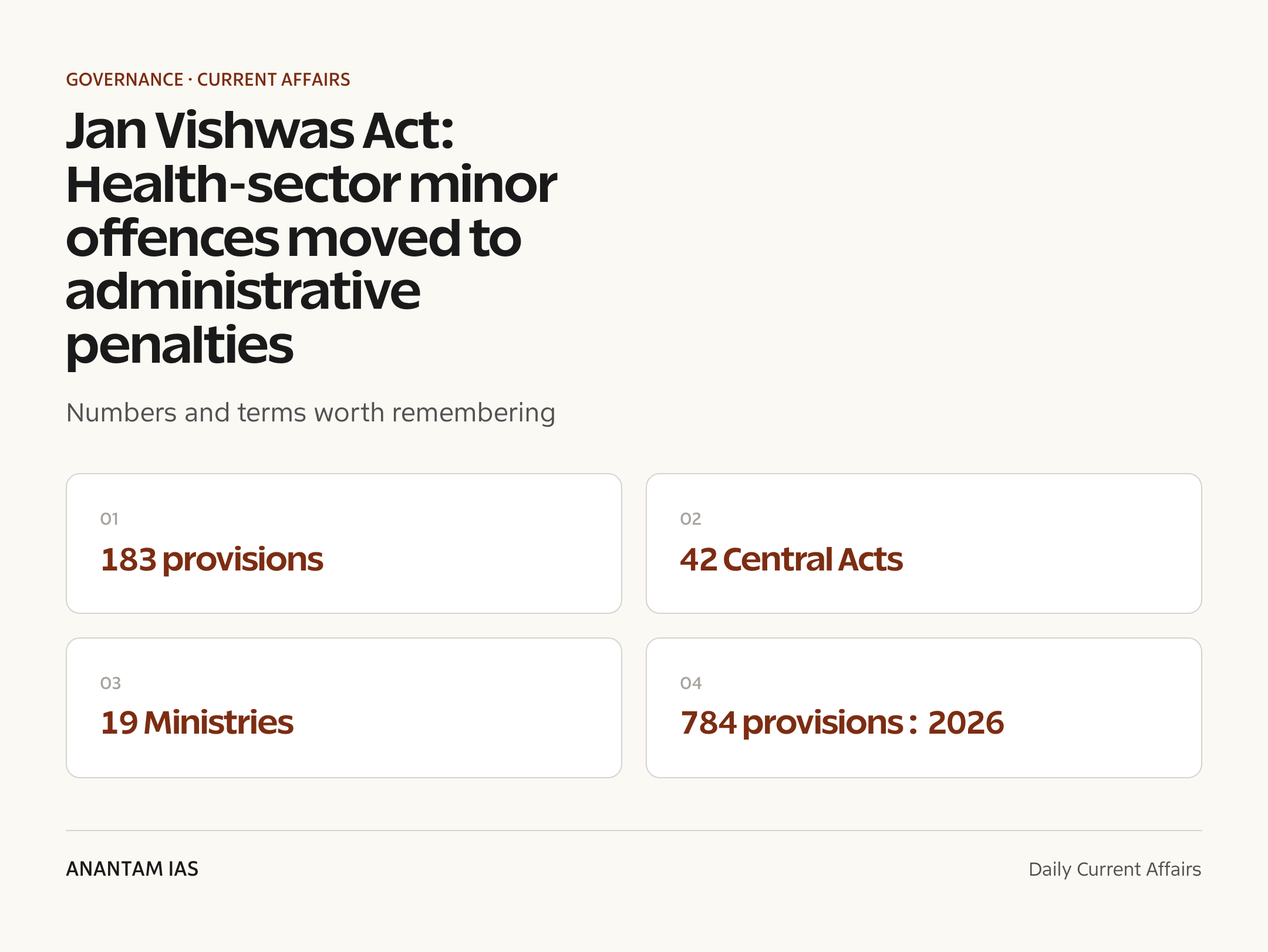
- The parent statute, the Jan Vishwas (Amendment of Provisions) Act, 2023, decriminalised 183 provisions across 42 Central Acts administered by 19 Ministries/Departments.
- The wider Jan Vishwas (Amendment of Provisions) Bill, 2026, introduced in the Lok Sabha on 27 March 2026, took the agenda further by touching 784 provisions across 79 Central Acts under 23 Ministries, of which 717 were decriminalised for ease of doing business and 67 amended for ease of living.
- The health-sector amendments form one of the most debated parts of this exercise because they affect medicines and food, where consumer harm can be severe.
UPSC Relevance
Prelims Relevance
- The Jan Vishwas (Amendment of Provisions) Act, 2023 decriminalised 183 provisions in 42 Central Acts across 19 Ministries/Departments.
- Methods of decriminalisation used include removing imprisonment, retaining or enhancing fines, converting offences to civil penalties, and introducing compounding of offences.
- The Drugs and Cosmetics Act, 1940 is administered by the Ministry of Health and Family Welfare and regulates import, manufacture, and sale of drugs and cosmetics.
- The Food Safety and Standards Act, 2006 established the Food Safety and Standards Authority of India (FSSAI) as the apex food regulator.
- The Pharmacy Act, 1948 regulates the profession and practice of pharmacy through the Pharmacy Council of India.
- The Clinical Establishments (Registration and Regulation) Act, 2010 provides for registration and regulation of clinical establishments.
- Under the reforms, adjudicating officers/authorities are appointed by the Central and State Governments, with a show-cause notice, personal hearing, and appeal built in.
- Adjudication for cosmetics offences applies to violations other than spurious or adulterated products; serious drug offences remain criminal.
- The Jan Vishwas Bill, 2026 was introduced in the Lok Sabha on 27 March 2026 and amended 784 provisions across 79 Central Acts.
- ‘Not of Standard Quality’ (NSQ) drugs are a distinct category in drug-quality regulation, separate from spurious or adulterated drugs.
Mains Relevance
GS Paper 2
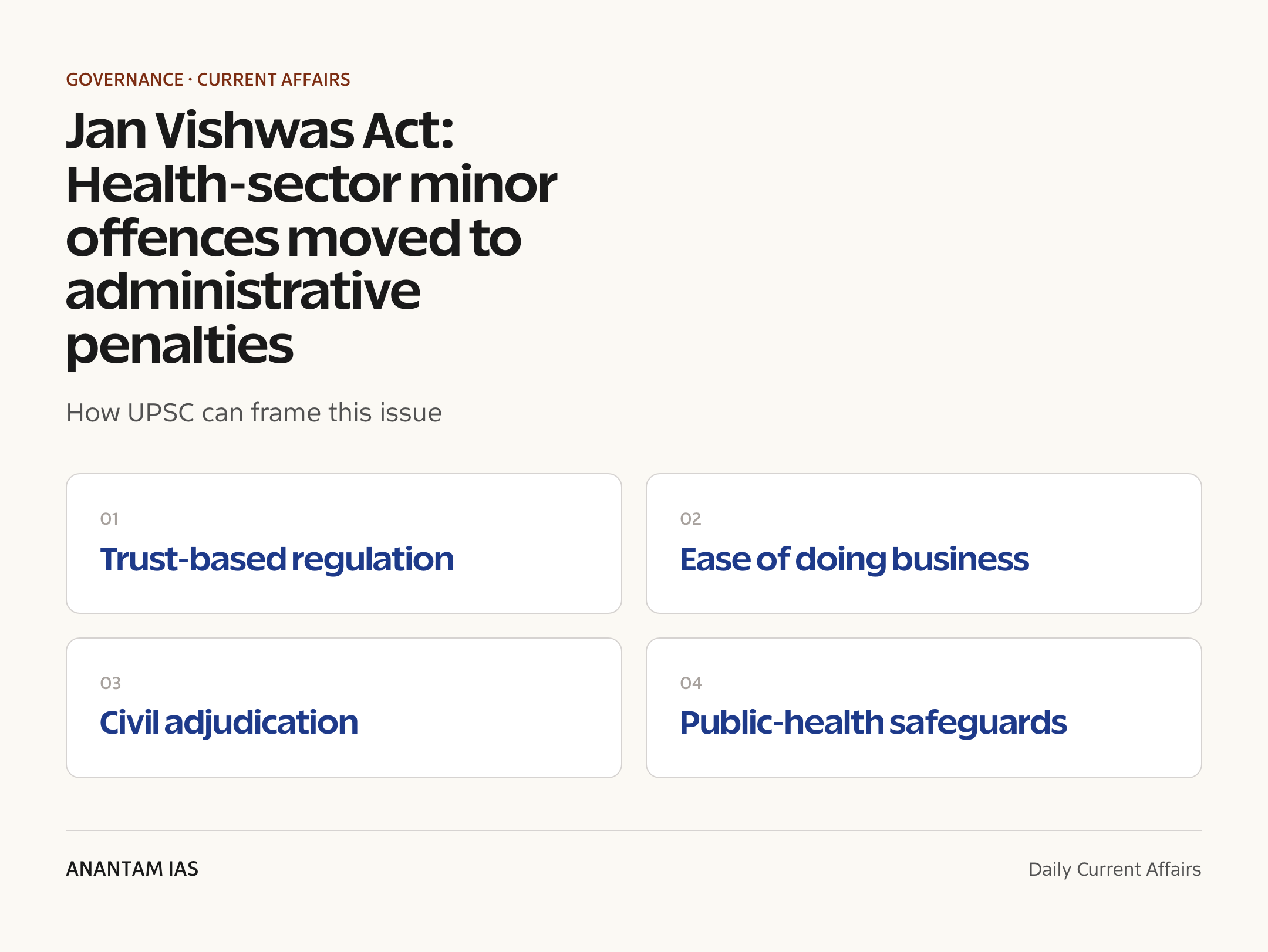
- Trust-based, citizen-friendly governance and regulatory reform: how decriminalising minor offences reshapes the State-business-citizen relationship and reduces adversarial enforcement.
- Role of administrative adjudication in reducing the burden on courts, pendency of cases, and the trade-off between speed of disposal and procedural safeguards.
- Balancing ease of doing business with the State’s duty to protect public health and the right to health under Article 21.
GS Paper 3
- Ease of doing business, regulatory cholesterol, and the compliance burden on the pharmaceutical and food-processing industries.
- Drug-quality regulation and the risk that lighter penalties for substandard drugs could weaken deterrence against NSQ and counterfeit medicines.
Essay
- Trust is the foundation of governance: when the State stops treating every citizen as a suspect.
- Ease of doing business cannot mean ease of doing harm.
Background and Context
What the Jan Vishwas framework does
The reform is built on the idea that minor, technical defaults should not carry the threat of jail.
- The Jan Vishwas (Amendment of Provisions) Act, 2023 was the first omnibus law to systematically decriminalise minor offences across many statutes in one go.
- It decriminalised 183 provisions in 42 Central Acts administered by 19 Ministries/Departments, aiming to convey trust-based governance and ease of doing business.
- Decriminalisation was done through several routes: removing imprisonment and/or fine, removing imprisonment while retaining or enhancing fines, converting offences into civil penalties, and allowing compounding of certain offences.
- The follow-on Jan Vishwas Bill, 2026 widened the canvas dramatically, touching 784 provisions across 79 Central Acts under 23 Ministries, with 717 decriminalised for ease of doing business and 67 for ease of living.
- The core philosophy is a shift from criminal penalties for minor, technical, or procedural defaults to civil and administrative enforcement mechanisms.
The health-sector changes: drugs, cosmetics and food
Several public-health statutes have been brought under the decriminalisation lens.
- Affected laws include the Drugs and Cosmetics Act, 1940, the Pharmacy Act, 1948, the Food Safety and Standards Act, 2006, the Clinical Establishments (Registration and Regulation) Act, 2010, and the National Commission for Allied and Healthcare Professions Act, 2021.
- In the Drugs and Cosmetics Act, 1940, imprisonment for several minor violations is substituted with financial penalties decided through a structured adjudication mechanism.
- An adjudication route has been introduced for specified violations, including certain cosmetics offences that are not spurious or adulterated, so that such cases need not go to a criminal court.
- Under the Food Safety and Standards Act, 2006, provisions are streamlined so that penalties are proportionate to the nature of the offence while enforcement against genuinely unsafe food is strengthened.
- For the first time, the framework provides for appointment of adjudicating authorities by Central and State Governments, with show-cause notice, personal hearing, and an appellate path.
The rationale: trust-based regulation and ease of doing business
The government frames the reform as a move from a suspicion-first to a trust-first regulatory model.
- Treating every procedural lapse as a criminal offence creates ‘regulatory cholesterol’ that deters investment and clogs the courts.
- Replacing jail terms for minor defaults with civil penalties reduces undue pressure on the justice system and helps cut the pendency of cases.
- A graded, proportionate penalty structure lets regulators distinguish a labelling slip from a genuine threat to health.
- Predictable, administrative adjudication improves the compliance climate for legitimate manufacturers and small businesses in the pharma and food sectors.
- The approach links to broader efforts on ease of doing business and ease of living, complementing reforms readers can explore via ease of doing business in India and good governance.
Safeguards retained for serious public-health offences
Decriminalisation of minor lapses does not extend to dangerous products.
- Strict criminal liability is retained for offences involving spurious or adulterated drugs.
- Cases causing bodily injury or death, or involving manufacturing without licence or in unsanitary conditions, stay within the criminal net.
- Only relatively minor offences (labelling errors, minor documentation lapses, and certain NSQ drug cases that do not cause harm) are eligible for civil penalties or compounding.
- The framework deliberately distinguishes minor procedural violations from serious offences that endanger patient safety and food safety.
- The State’s duty to protect the right to health under Article 21 is cited as the bright line the reform does not cross.
Criticism and concerns
Health activists and legal scholars question whether drug offences belong in a business-easing law at all.
- Critics from the All India Drug Action Network (AIDAN) warn that the option of compounding may let makers of substandard drugs get away too lightly.
- A ‘Not of Standard Quality’ (NSQ) medicine can still be ineffective or harmful and can fuel antimicrobial resistance, so weaker deterrence is risky.
- Legal scholars at the Vidhi Centre for Legal Policy have questioned why the Drugs and Cosmetics Act features in a decriminalisation Bill at all.
- Some argue the reform is justified largely in terms of ease of business and foreign investment, with less attention to the consumer’s point of view.
- There are concerns that capacity gaps among newly empowered adjudicating authorities could weaken enforcement if appointments and training lag.
Way Forward
Sharpen the minor-versus-serious distinction
- Publish clear, public criteria separating compoundable procedural lapses from offences that endanger health, to remove discretion-driven uncertainty.
- Keep NSQ cases that pose real risk inside the criminal track rather than defaulting them to compounding.
Build adjudication capacity
- Appoint and train adjudicating authorities promptly so that civil penalties are imposed consistently and fairly.
- Ensure the appellate mechanism is well-resourced to prevent it from becoming a fresh source of backlog.
Strengthen deterrence where it matters
- Pair lighter penalties for minor lapses with tougher surveillance and quicker sampling of drug quality.
- Use higher monetary penalties and repeat-offender escalation to keep deterrence credible for substandard products.
Protect the consumer interest
- Maintain transparent public dashboards of penalties imposed and serious prosecutions, so accountability is visible.
- Consult patient-safety and consumer groups before extending compounding to any new category of health offence.
Conclusion
The Jan Vishwas approach to the health sector reflects a genuine reform instinct: a State that trusts compliant businesses, frees courts from trivial cases, and reserves criminal force for conduct that actually harms people. Applied to labelling slips and paperwork lapses, decriminalisation is sound governance.
The harder question is medicines. A wrong move that softens deterrence against substandard or spurious drugs would shift risk onto the most vulnerable patients. The test of these reforms will be whether the safeguards on spurious and adulterated products hold in practice, and whether adjudicating authorities are equipped to enforce them. Ease of doing business has value only when it never becomes ease of doing harm.
UPSC Practice Questions
Prelims MCQ 1
With reference to the Jan Vishwas (Amendment of Provisions) Act, 2023, consider the following statements:
- It decriminalised provisions across more than 40 Central Acts.
- It relied only on the removal of imprisonment, without introducing any civil penalty or compounding mechanism.
- Its stated objectives include trust-based governance and ease of doing business.
How many of the above statements are correct?
(a) Only one (b) Only two (c) All three (d) None
Answer: (b) Only two
Explanation:
Statements 1 and 3 are correct: the 2023 Act decriminalised 183 provisions across 42 Central Acts and aimed at trust-based governance and ease of doing business. Statement 2 is wrong, as the Act also introduced civil penalties and compounding of offences.
Prelims MCQ 2
Under the health-sector reforms in the Jan Vishwas framework, which one of the following is most accurate?
(a) All offences under the Drugs and Cosmetics Act, 1940 have been fully decriminalised, including those involving spurious drugs. (b) Minor and procedural violations may attract civil penalties through an adjudication mechanism, while serious offences involving spurious or adulterated drugs remain criminal. (c) The Food Safety and Standards Act, 2006 has been repealed and replaced. (d) Adjudicating authorities can be appointed only by the Central Government, not the States.
Answer: (b) Minor and procedural violations may attract civil penalties through an adjudication mechanism, while serious offences involving spurious or adulterated drugs remain criminal.
Explanation:
The reform replaces imprisonment for minor violations with civil penalties via adjudication, but retains strict criminal liability for spurious or adulterated drugs. Both Central and State Governments may appoint adjudicating authorities, so (d) is wrong; (a) and (c) are incorrect.
UPSC Mains Questions
- Decriminalising minor offences can ease compliance, but in the health sector it risks diluting deterrence against unsafe products. Critically examine the trade-offs in the Jan Vishwas reforms. (250 words)
- “Trust-based regulation is sound governance only when matched by credible enforcement.” Discuss with reference to the shift from criminal sanctions to administrative penalties in India. (250 words)
Sources: PIB, Ministry of Health and Family Welfare and Ministry of Health and Family Welfare (PIB release on health-sector decriminalisation).
Frequently Asked Questions
What is the Jan Vishwas (Amendment of Provisions) Act, 2023?
It is an omnibus law that decriminalised minor and procedural offences across many statutes at once, covering 183 provisions in 42 Central Acts administered by 19 Ministries/Departments, to promote trust-based governance and ease of doing business.
What are the health-sector changes?
Minor violations under laws like the Drugs and Cosmetics Act, 1940 and the Food Safety and Standards Act, 2006 are being shifted from imprisonment to graded monetary penalties decided through a civil adjudication mechanism, rather than a criminal court.
Does this mean makers of fake or spurious drugs face lighter punishment?
No. The reforms retain strict criminal liability for spurious or adulterated drugs, products causing bodily injury or death, and unlicensed or unsanitary manufacturing. Only minor lapses such as labelling or documentation errors are decriminalised.
Who decides the penalties now?
Adjudicating authorities appointed by the Central and State Governments decide civil penalties, following a process of show-cause notice, personal hearing, and an appellate mechanism, instead of routine recourse to criminal courts.
Why have some experts criticised the move?
Health activists and legal scholars worry that allowing compounding for some drug offences could weaken deterrence against substandard medicines, which can be ineffective and may fuel antimicrobial resistance, and they question why drug law features in a business-easing statute.
How does this connect to ease of doing business?
By removing the threat of jail for minor defaults and reducing court burden, the reform aims to make compliance simpler and the regulatory climate more predictable for legitimate manufacturers, part of the broader ease of doing business and ease of living agenda.