Jharkhand’s Four New GI Tags: Tribal Silk, Jewellery and Bamboo Craft
Why in News?
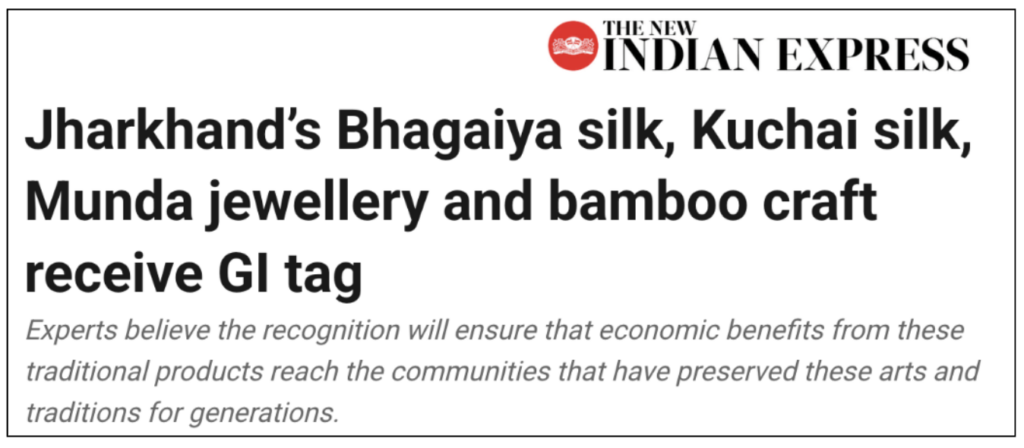
Four traditional Jharkhand products secured the Geographical Indication (GI) tag in mid-June 2026, the state’s biggest single haul of GI recognitions to date.
The four products are Bhagaiya silk (Godda district), Kuchai silk — a tasar variety from the Seraikela-Kharsawan district, Munda jewellery made by the Munda tribal community, and Jharkhand’s bamboo craft. GI status is granted by the Geographical Indications Registry, Chennai, and ties each product legally to its place and producer community of origin.
- Bhagaiya silk originates in the Bhagaiya belt of Godda district.
- Kuchai silk is a tasar (tussar) silk from the Kuchai region of Seraikela-Kharsawan, reared on Asan and Arjun host trees.
- Munda jewellery reflects the motifs and metal craft of the Munda tribe; bamboo craft covers utility and decorative items.
- NABARD facilitated documentation, producer organisation and the GI filing under its Tribal Development Fund interventions.
The development matters in the context of:
- GI is the legal instrument that lets tribal and rural artisans capture a price premium and block imitation — directly relevant to tribal livelihoods and the One District One Product (ODOP) agenda.
- Jharkhand, a tribal-majority state with a thin formal-manufacturing base, gains a branding and export lever for its handloom and handicraft clusters.
UPSC Relevance
Prelims Relevance
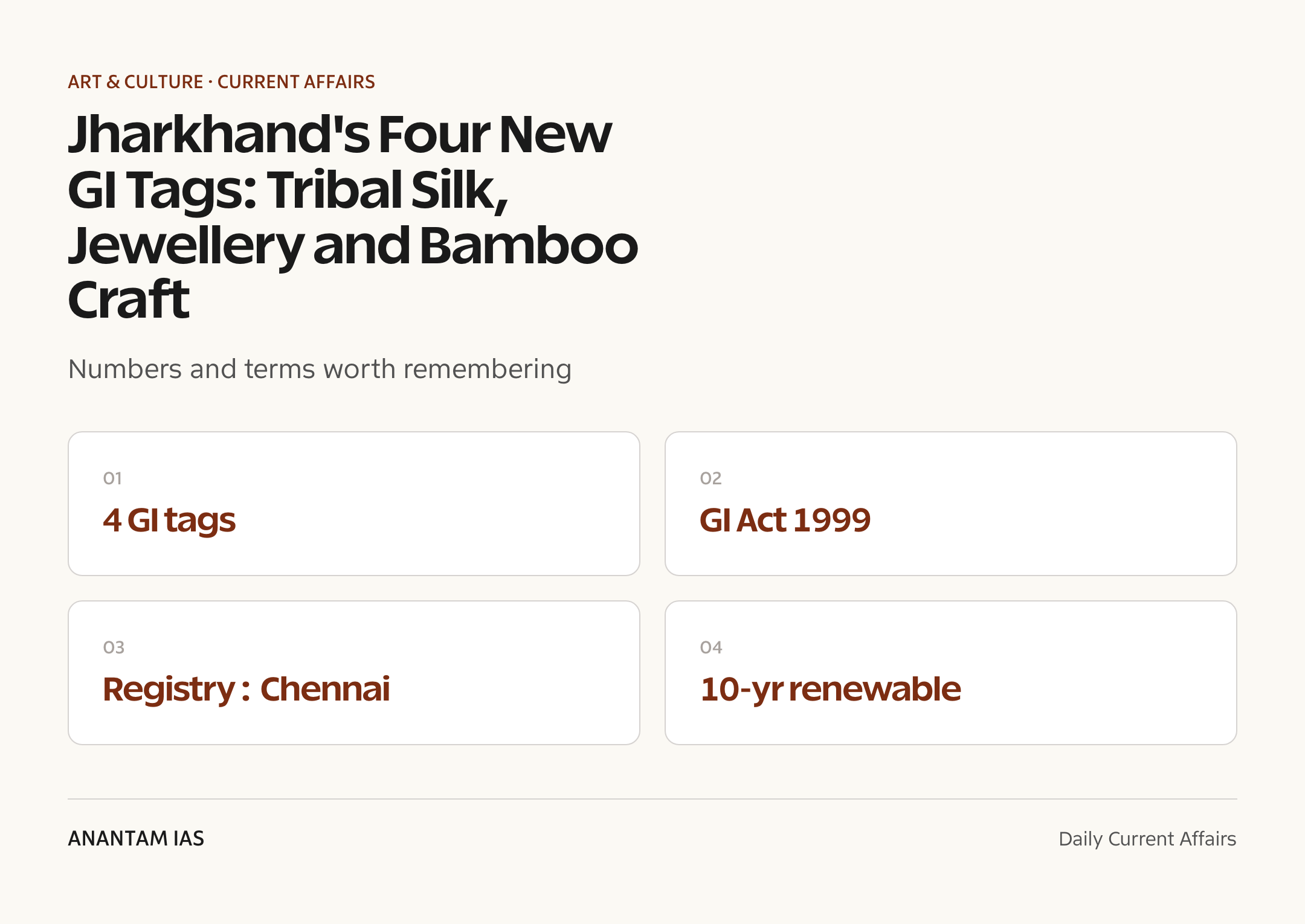
- Geographical Indications of Goods (Registration and Protection) Act, 1999 — entered into force in 2003.
- GI is an intellectual property right under the WTO’s TRIPS Agreement (Articles 22-24).
- GI Registry, Chennai — under the Office of the Controller General of Patents, Designs and Trade Marks (CGPDTM), Ministry of Commerce and Industry.
- GI registration is valid for 10 years and is renewable.
- Darjeeling tea was India’s first registered GI (2004-05).
- GI protects a community/collective, not a single firm — unlike a trademark or patent.
- Jharkhand’s four 2026 GIs: Bhagaiya silk, Kuchai silk, Munda jewellery, and bamboo craft.
- Kuchai silk is a tasar variety; tasar is a wild silk reared outdoors, distinct from mulberry silk.
Mains Relevance
GS Paper 1
- GI as a tool to safeguard and revive tribal art, craft and intangible cultural heritage.
- Role of indigenous knowledge systems in India’s handloom and handicraft traditions.
GS Paper 3
- GI and One District One Product as drivers of rural livelihoods, branding and exports.
- Institutional handholding (NABARD, state departments) in formalising the unorganised craft economy.
Essay
- Heritage is not a museum piece — it is a living livelihood.
- Protecting the maker protects the craft: intellectual property and the informal economy.
Background and Context
What a Geographical Indication is
A GI is a sign on goods that have a specific geographical origin and possess qualities or a reputation due to that origin.
- Governed by the Geographical Indications of Goods (Registration and Protection) Act, 1999, operational from 2003.
- Flows from India’s obligations under the TRIPS Agreement of the WTO, which mandates GI protection for members.
- Registration is handled by the GI Registry, Chennai, under the CGPDTM in the Ministry of Commerce and Industry.
- A registered GI protects a producer community collectively and bars unauthorised users from passing off goods as the genuine article.
- Covers agricultural, natural, manufactured and handicraft goods — from Darjeeling tea to Banarasi sarees.
GI vs trademark vs patent
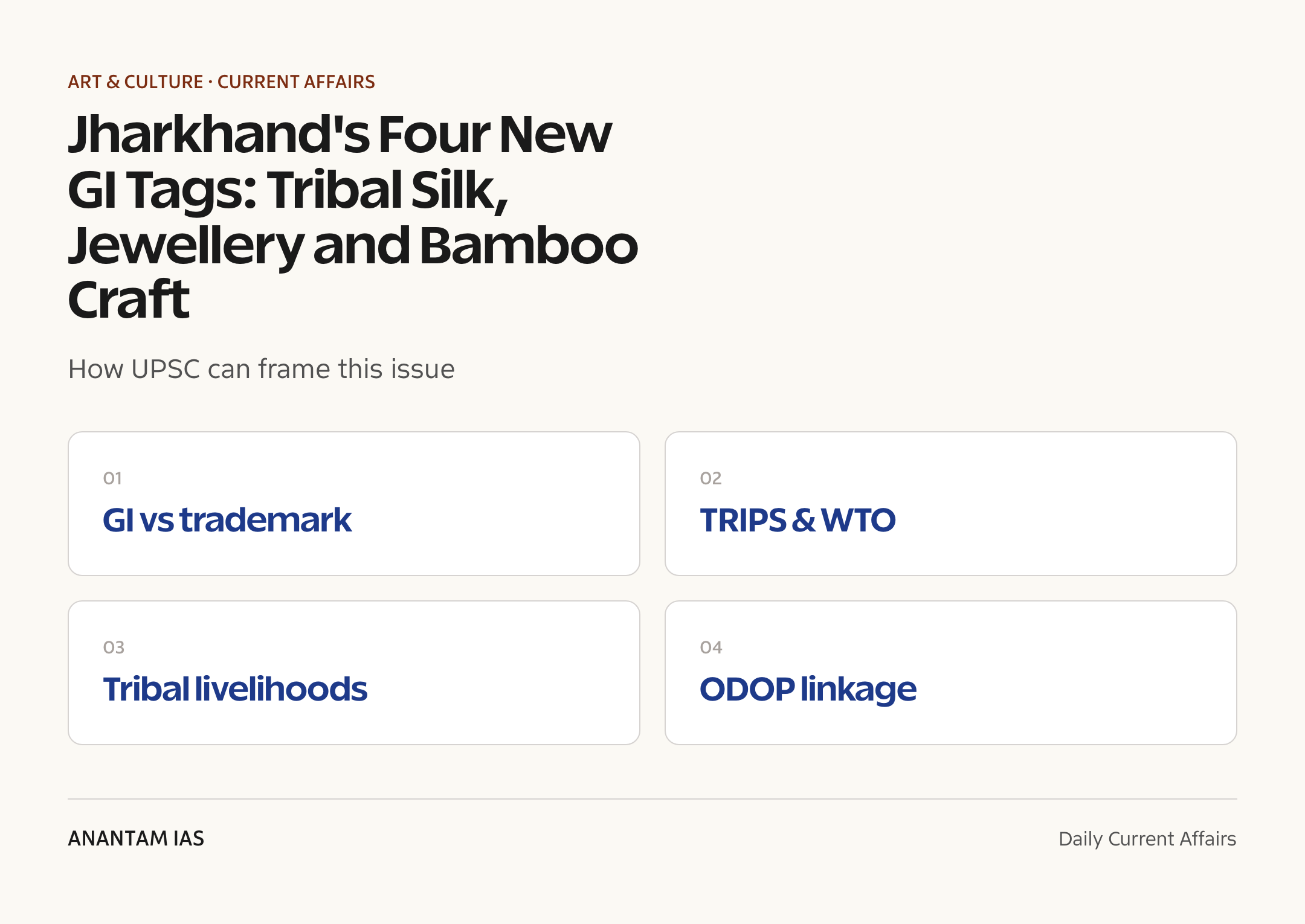
Students confuse these three intellectual-property rights; the distinctions are frequently tested.
- GI — collective right tied to a place and a community; cannot be assigned or transferred individually; valid 10 years, renewable indefinitely.
- Trademark — protects a single proprietor’s brand/logo; assignable and licensable; renewable every 10 years.
- Patent — protects a novel invention for a fixed 20-year term, after which it enters the public domain.
- A GI guards origin and reputation, not novelty or a brand name; it is the natural fit for traditional crafts and produce.
The registration process
GI registration is a structured, multi-stage process that turns informal know-how into a defended right.
- An association of producers, an authority or an organisation files the application with the GI Registry.
- The application must define the product, its geographical boundary, the production method and the historical/cultural link to the place.
- Steps include examination, publication in the GI Journal, an opposition window, and finally registration.
- Once registered, authorised users (the actual artisans/producers) must also enrol to use the GI and enforce it.
- NABARD here did the heavy lifting — documentation, producer mapping and stakeholder consultations through its Tribal Development Fund.
The four Jharkhand products
Each of the four GIs encodes a distinct cluster of tribal and rural skills.
- Bhagaiya silk — a silk tradition from the Bhagaiya belt of Godda district, rooted in local weaving knowledge.
- Kuchai silk — a tasar (tussar) silk from the Kuchai region of Seraikela-Kharsawan, where worms are reared on Asan and Arjun trees.
- Munda jewellery — ornaments of the Munda tribe with distinctive motifs and metalwork, carrying cultural and ritual meaning.
- Bamboo craft — utility and decorative bamboo products, an example of low-input, sustainable rural manufacturing.
Why GI matters for tribal livelihoods
For a tribal-majority state, a GI tag is less about prestige and more about price, protection and market access.
- Premium pricing — a verified origin lets artisans command a higher value than an anonymous handloom or handicraft.
- Anti-counterfeit protection — outsiders cannot legally sell mass-produced lookalikes as the genuine Kuchai silk or Munda jewellery.
- Market and export visibility — GI products gain shelf identity in domestic markets and on e-commerce and export channels.
- Cultural preservation — formal recognition incentivises the next generation to keep the craft alive.
- Collective bargaining — producer organisations built for the GI filing become durable institutions for the cluster.
GI, ODOP and India’s craft map
Jharkhand’s haul fits a wider national push to formalise district-level products.
- The One District One Product (ODOP) initiative identifies a flagship product per district for branding and value-chain support.
- GI registrations feed directly into ODOP, ground-truthing which products deserve protection and promotion.
- Comparable handloom/handicraft GIs include Madhubani painting (Bihar), Pochampally Ikat (Telangana) and Channapatna toys (Karnataka).
- India has registered well over 600 GIs, but handicraft producers often struggle to convert recognition into enforced, monetised rights — the next challenge for Jharkhand.
Way Forward
Convert tags into authorised users
- Enrol the actual artisans and weavers as authorised users so the GI is enforceable on the ground, not just on paper.
- Build and fund producer organisations that can market, certify and litigate on behalf of the cluster.
Market and enforce
- Link the four GIs to ODOP, GeM, and e-commerce, so premium pricing actually reaches the maker.
- Invest in quality control, packaging and traceability, and act against counterfeits to protect the price premium.
Pair GI recognition with skilling, design support and credit so the next generation of tribal artisans stays in the craft rather than migrating out of it.
Conclusion
Jharkhand’s four GI tags turn quiet tribal know-how — Bhagaiya and Kuchai silk, Munda jewellery, bamboo craft — into legally defended, marketable assets. The recognition rewards generations of indigenous skill and gives a tribal-majority state a rare branding and livelihood lever.
But a GI is only as strong as its enforcement and market follow-through. The real test is whether artisans become enrolled authorised users, command a premium, and beat back counterfeits — turning a certificate into income and a living heritage.
UPSC Practice Questions
Prelims MCQ 1
With reference to Geographical Indications (GI) in India, consider the following statements:
- A GI is registered under the Geographical Indications of Goods (Registration and Protection) Act, 1999.
- A registered GI is valid for ten years and can be renewed.
- The GI Registry is located in Chennai under the Office of the CGPDTM.
How many of the above statements are correct?
(a) Only one (b) Only two (c) All three (d) None
Answer: (c) All three
Explanation:
All three are correct. The 1999 Act (in force 2003) governs GIs, registration runs 10 years and is renewable, and the GI Registry sits at Chennai under the CGPDTM, Ministry of Commerce and Industry.
Prelims MCQ 2
Kuchai silk, which recently received a GI tag, is best described as:
(a) A mulberry silk woven in the Godda district
(b) A tasar (tussar) silk from the Seraikela-Kharsawan region
(c) A muga silk from Assam
(d) An eri silk from Manipur
Answer: (b) A tasar (tussar) silk from the Seraikela-Kharsawan region
Explanation:
Kuchai silk is a tasar (tussar) variety from the Kuchai area of Seraikela-Kharsawan, Jharkhand, reared on Asan and Arjun host trees — distinct from mulberry, muga and eri silks.
UPSC Mains Questions
- Geographical Indication tags are increasingly used as instruments of tribal livelihood and cultural preservation. Examine, with reference to Jharkhand’s recent GI registrations, how GI protection can revive indigenous crafts and the conditions needed to make that protection effective. (250 words)
- Distinguish between a Geographical Indication, a trademark and a patent. How does the GI framework, backed by institutions such as NABARD, help formalise India’s unorganised craft economy? (250 words)
- Heritage crafts survive only when their makers earn from them. Discuss the role of GI tagging and the One District One Product approach in linking cultural preservation to rural incomes. (150 words)
Sources: Business Standard / The Pioneer and NABARD statement (via Business Standard, The Pioneer).
Frequently Asked Questions
What are the four new Jharkhand GI tags?
Around 15 June 2026, four Jharkhand products received Geographical Indication tags: Bhagaiya silk from Godda district, Kuchai tasar silk from Seraikela-Kharsawan, Munda tribal jewellery, and the state’s bamboo craft. NABARD facilitated all four filings, and the tags were granted by the GI Registry in Chennai.
What is a Geographical Indication (GI) tag?
A GI is an intellectual-property sign on goods that originate from a specific place and owe their quality or reputation to that origin. In India it is granted under the Geographical Indications of Goods Act, 1999, flowing from the WTO’s TRIPS Agreement, and protects the producer community collectively rather than a single firm.
Who grants GI tags in India and for how long?
The Geographical Indications Registry in Chennai, under the Office of the CGPDTM in the Ministry of Commerce and Industry, registers GIs. A registration is valid for ten years and can be renewed indefinitely, keeping the protection alive as long as the producers maintain it.
How is a GI different from a trademark or a patent?
A GI is a collective right tied to a place and a community and cannot be individually transferred. A trademark protects a single owner’s brand and is assignable. A patent protects a novel invention for a fixed 20-year term. Only the GI is built specifically for origin-linked traditional products.
Why does Kuchai silk’s tasar status matter?
Kuchai silk is a tasar (tussar) silk, a wild variety reared outdoors on Asan and Arjun trees, not the cultivated mulberry silk. This distinction is commonly tested in prelims, and the tasar tradition is central to Jharkhand’s tribal sericulture economy in Seraikela-Kharsawan.
How do GI tags help tribal artisans?
GI tags let artisans command a premium price, block counterfeiters from selling lookalikes, and gain market and export visibility. They also strengthen producer organisations and preserve cultural skills. The real benefit comes when actual artisans enrol as authorised users so the protection is enforceable on the ground.