Jharkhand PESA Rules 2026: Tribal Self-Governance After 25 Years
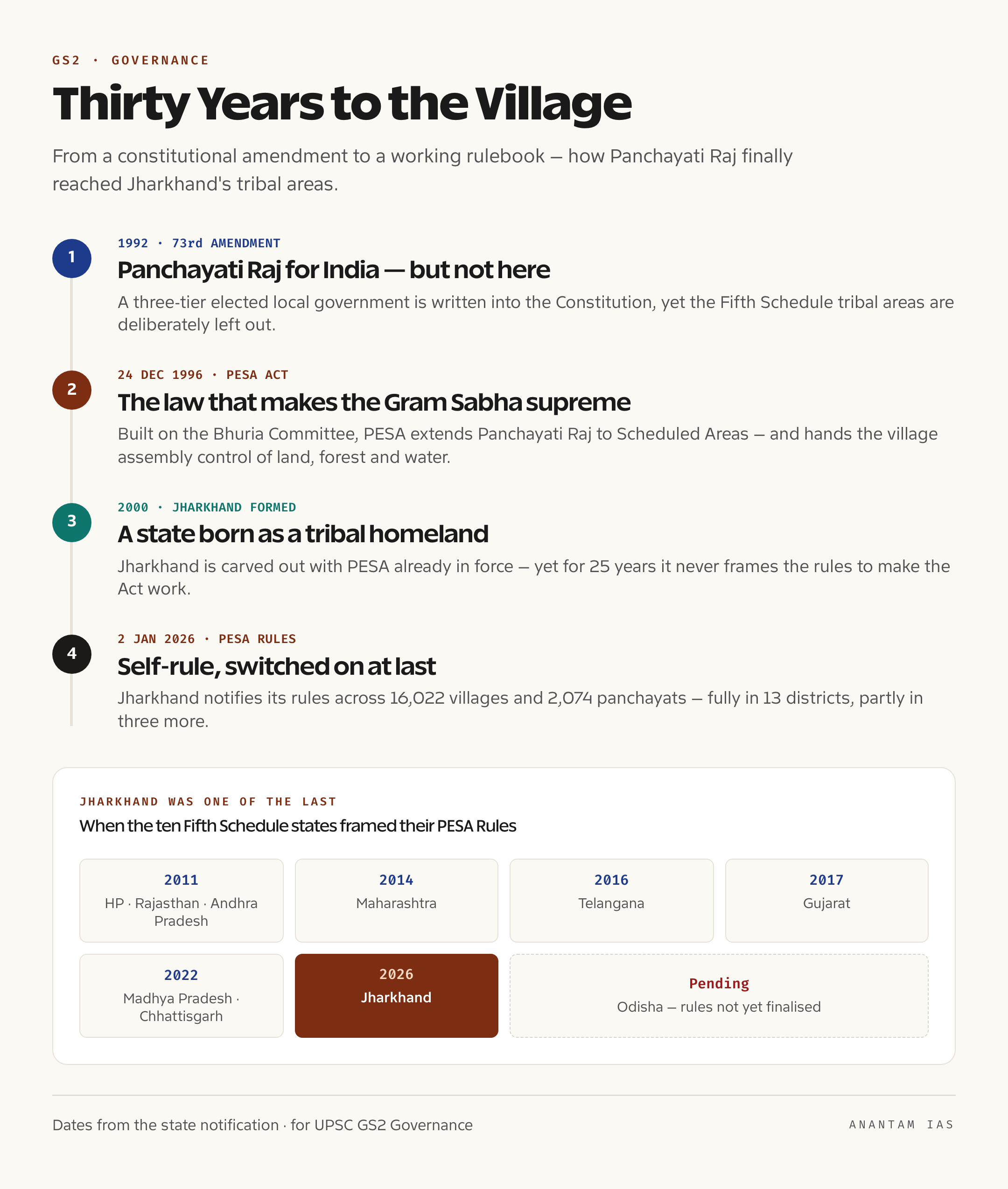
On 2 January 2026, Jharkhand’s Panchayati Raj department issued a notification that the state’s tribal heartland had waited a quarter of a century to read. With it, Jharkhand finally framed the rules to operate the Panchayats (Extension to Scheduled Areas) Act — PESA, the 1996 law that lets the village assembly, not the district office, govern tribal India. The cabinet had cleared the draft on 23 December 2025, and the notification a few days later switched the law on across 16,022 villages and 2,074 panchayats in the state’s Fifth Schedule areas. After almost 30 years on the central statute book and 25 years after Jharkhand itself was carved out in 2000, the Gram Sabha — the assembly of every adult voter in a village — was at last named the supreme authority over its own land, water and forest.
And that is why this is more than a piece of state-level paperwork. PESA is the boldest experiment in self-rule India has tried below the level of an elected council, built on a simple, radical idea: that in tribal areas the smallest unit of democracy should be the strongest. For a state where roughly a quarter of the population is tribal and where the fight over land, mines and forests is the fight over everything, putting that idea into working rules is a genuine turning point. It also sits at the centre of UPSC’s GS2 syllabus on devolution, the Fifth Schedule and the empowerment of vulnerable sections — and it rewards an aspirant who can explain not just what PESA says, but why it took Jharkhand so long to say it.
Why It’s in the News
Jharkhand notified its PESA Rules on 2 January 2026, becoming one of the last major Fifth Schedule states to operationalise a law Parliament passed back in 1996. The Fifth Schedule is the part of the Constitution that sets up a special administrative regime for “Scheduled Areas” — tribal-majority tracts where ordinary laws can be modified to protect Adivasi land and custom. PESA extends Panchayati Raj to exactly these areas, but with tribal-friendly twists. A central Act, though, only sets the frame. The actual powers come alive only when a state writes its own rules to put flesh on the bones — who calls the Gram Sabha, how it votes, what happens when it says no to a mine. For 25 years Jharkhand had the Act but not the rules, so the Gram Sabha’s grand powers stayed mostly on paper.
The notification ends that limbo. The rules apply fully in 13 of Jharkhand’s districts — Ranchi, Khunti, Lohardaga, Gumla, Simdega, Latehar, East Singhbhum, West Singhbhum, Seraikela-Kharswan, Dumka, Jamtara, Sahibganj and Pakur — and partly in three more, Palamu, Godda and Garhwa. The trigger was a mix of pressure and politics. The Jharkhand High Court had been hearing petitions pushing the state to frame the rules, tribal organisations had agitated for years, and a state government elected on a promise of tribal rights finally moved. But the moment it landed, it also drew fire. Within days, a delegation from the Customary Tribal Coordination Committee met the Governor to object that the rules dilute the Act — that they blur PESA into Jharkhand’s ordinary 2001 Panchayati Raj law and weaken the protection of customary governance. So the news is twofold: a long-delayed empowerment, and an immediate argument over whether it goes far enough.
What PESA Is, the Fifth Schedule, and Why the Delay Ran So Long
To see why this matters, go back to the design. When Parliament passed the 73rd Constitutional Amendment in 1992, it created a uniform three-tier Panchayati Raj across the country — elected village, block and district councils everywhere. But the amendment deliberately left out the Fifth Schedule areas. Tribal society governs itself through its own customs, its own village councils and headmen, and Parliament worried that a one-size-fits-all panchayat would simply flatten those institutions. So Part IX, the panchayat chapter of the Constitution, was switched off for Scheduled Areas until a separate law could extend it on tribal terms.
That separate law was PESA, the Panchayats (Extension to Scheduled Areas) Act, enacted on 24 December 1996. Its blueprint came from the Bhuria Committee of 1994-95, chaired by the tribal leader Dilip Singh Bhuria, which argued that in tribal areas the Gram Sabha — not the bureaucracy, not even the elected panchayat — should be the real seat of power over natural resources and development. PESA wrote that conviction into law. It made the Gram Sabha “competent to safeguard and preserve” the traditions, customs and community resources of the people, and it handed the assembly a list of powers no Gram Sabha in the rest of India enjoys. Crucially, PESA covers ten states with Fifth Schedule areas, and it required each of those states to amend its own Panchayat law and frame rules in line with the central Act. Most dragged their feet. Himachal Pradesh, Rajasthan and Andhra Pradesh notified their rules in 2011, Maharashtra in 2014, Telangana in 2016, Gujarat in 2017, and Madhya Pradesh and Chhattisgarh as late as 2022. Odisha still hasn’t finalised its rules, and Jharkhand only got there in 2026.
Why did Jharkhand of all states — born in 2000 expressly as a tribal homeland — take the longest? Part of it is the awkward truth that PESA cuts against the grain of how states like to run. A Gram Sabha with a veto over a mine or a land transfer is a Gram Sabha that can say no to revenue, to industry, to the line departments that prize control. Land, forests, mining and excise are exactly the sectors where state power and PESA collide, so successive governments found it easier to leave the rules unwritten than to surrender that grip. Add political churn, administrative inertia and genuine confusion over how to fit PESA’s customary Gram Sabha into Jharkhand’s regular 2001 panchayat structure, and the delay compounds. It took sustained High Court pressure and tribal mobilisation to force the issue — which is itself a lesson about how decentralisation in India often advances only when courts and communities push together.
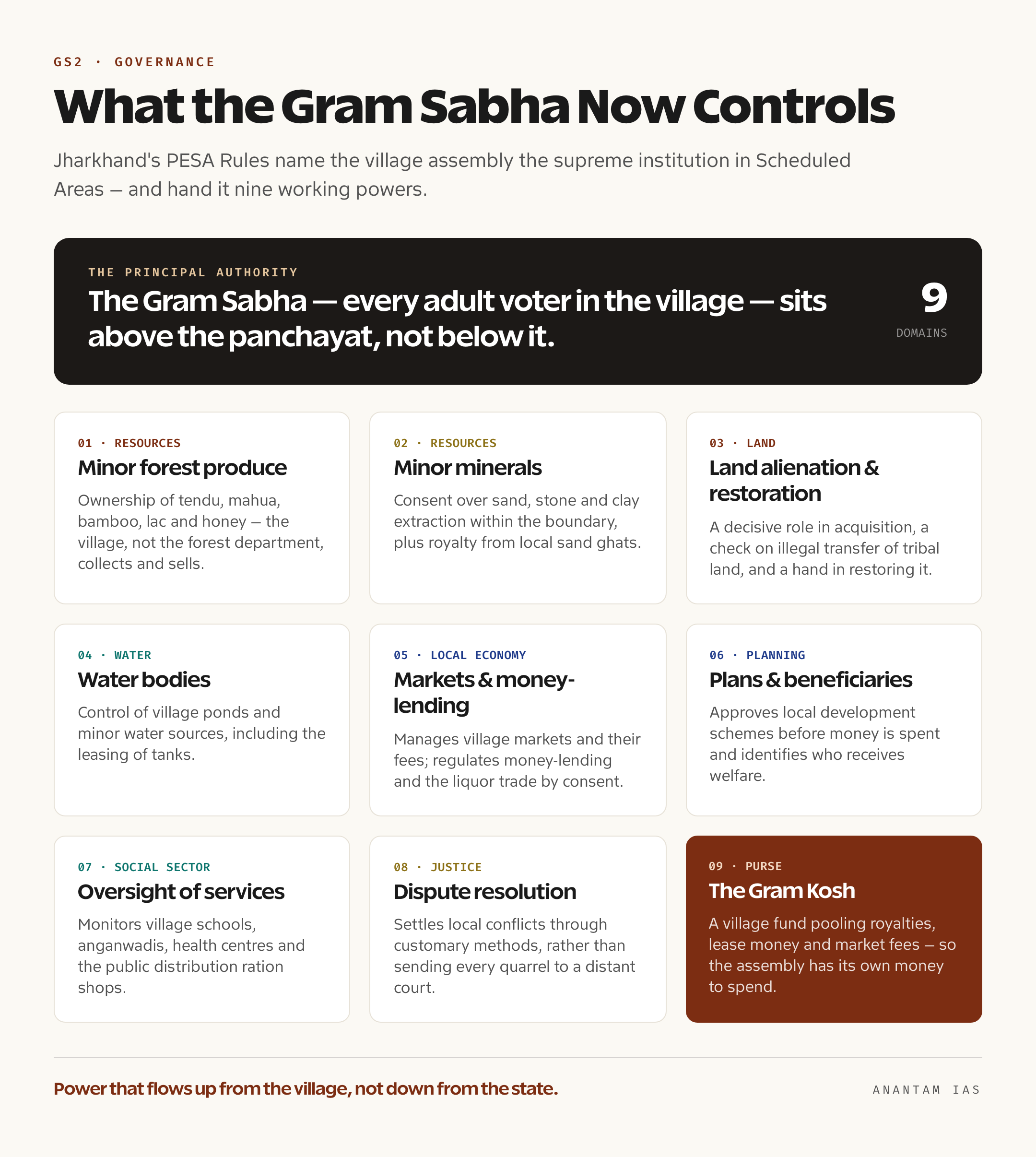
The Powers Jharkhand’s Rules Devolve to the Gram Sabha
So what can a Jharkhand Gram Sabha now actually do? The rules name it the strongest and supreme institution in the Scheduled Areas, and they translate PESA’s broad mandate into concrete, examinable powers. Start with natural resources, because that’s where the stakes are highest. The Gram Sabha gets ownership and control over minor forest produce — the tendu leaves, mahua flowers, bamboo, lac, honey and wild fruit that tribal households gather and sell, which PESA explicitly vests in the village rather than the forest department. It gets a say over minor minerals — sand, stone, ordinary clay and the like — including the power to monitor and consent to mining and quarrying within its boundary, and to take royalty and fees from sand ghats and the local extraction it allows.
Then comes the heart of the matter for Adivasi India: land. The rules give the Gram Sabha a decisive role in land acquisition, requiring its involvement before tribal land is taken for any project, and a role in preventing land alienation — the illegal transfer of tribal land to non-tribals — and in restoring land that has been wrongly taken. They hand it control over village water bodies and minor water sources, including the leasing of ponds. And they devolve a cluster of everyday governance powers that decide how a village actually lives. The Gram Sabha now manages village markets and collects their fees. It regulates money-lending to Scheduled Tribes, the historic trap that has stripped Adivasis of land for generations. It controls the local liquor trade — no manufacture, storage or sale without the assembly’s consent, a recognition that excise has long preyed on tribal areas.
Beyond resources, the rules wire the Gram Sabha into the machinery of the state. It approves local plans and development schemes before money is spent, and it identifies the beneficiaries of poverty-reduction and welfare programmes — turning the assembly from a petitioner into a planner. It oversees the social sector running in the village: the power to monitor schools, anganwadis (the rural child-care and nutrition centres), health sub-centres and the ration shops of the public distribution system. It is empowered in dispute resolution, settling local conflicts through customary methods rather than sending every quarrel to a distant court. And to give all this teeth, each Gram Sabha can build a Gram Kosh — a village fund pooling royalties, lease money, market fees and other local income, so the assembly has its own purse to spend. Take those together — minor minerals, minor forest produce, land alienation and restoration, water bodies, village markets, money-lending, local plans and beneficiary lists, social-sector oversight and dispute resolution — and you have a Gram Sabha that, on paper at least, governs almost everything that touches a tribal villager’s daily life.
What Operationalising PESA Means for Tribal Self-Rule
Step back and the significance is constitutional, not just administrative. PESA is the only place in Indian law where the Gram Sabha is not a junior body under an elected panchayat but the principal authority above it. Everywhere else in India, real power flows downward from the state through elected councils. In Scheduled Areas under PESA, it is supposed to flow upward from the village assembly. That inversion is the whole point — it tries to make decentralisation genuine, pushing decisions to the people who live with their consequences. By framing its rules, Jharkhand has at last given that principle an operating manual within its borders, and it brings the state into line with the spirit of the Fifth Schedule, which exists precisely to let tribal areas be governed differently.
The deeper purpose is protective. For tribal communities, land and forest are not assets to be traded but the basis of identity, livelihood and culture, and the long history of Adivasi dispossession is a history of that base being eroded — by moneylenders, by acquisition, by quiet alienation. A Gram Sabha with real authority over land restoration, minor forest produce and consent for projects is a shield against that erosion, and a way to keep the fruits of local resources in local hands through the Gram Kosh. It also revives institutions of self-governance that predate the Indian state itself, giving legal weight to customary decision-making rather than overriding it.
And the timing carries its own message. Jharkhand acting in 2026, however late, adds momentum to a wider push for tribal rights and reads alongside the Forest Rights Act of 2006, which gives communities title to the forests they have long used, as part of a slow constitutional project to make Adivasi self-rule real rather than rhetorical. When it works, PESA can do what few laws manage — turn a marginalised community from the object of governance into its author. For a state that defines itself by its tribal identity, finally switching the law on is a statement about what kind of democracy Jharkhand wants to be.
Gaps, Challenges and the Way Forward
But a notification is not a transformation, and the criticism that greeted these rules is worth taking seriously. The sharpest objection from tribal groups is that Jharkhand has diluted PESA by folding it into the state’s ordinary Panchayati Raj Act of 2001, instead of treating PESA as the special, stand-alone law it is meant to be. Activists argue that key safeguards have been weakened — that the protection of customary law, religious practice and cultural identity, which PESA insists on, has been thinned, and that on land restoration the rules stop short of the full authority PESA envisages. When the body that recognises a Gram Sabha is a district official rather than the community itself, critics say, you have reintroduced the very bureaucratic control PESA was written to remove. That is the difference between empowering an assembly and merely permitting one.
The bigger, structural problem is one PESA has faced everywhere it operates. The law sits inside a thicket of older laws — on land, forests, mining, excise and revenue — that often contradict it, and line departments routinely treat the Gram Sabha’s consent as a box to tick rather than a decision to respect. A village can say no to a mine and still find the clearance granted, because a sectoral law lets the department proceed. There is also the consent-versus-consultation gap: where PESA demands the Gram Sabha’s agreement, officials too often settle for a token meeting. And unlike the Sixth Schedule areas of the Northeast, which have their own autonomous district councils, Fifth Schedule Gram Sabhas lack a higher tier of self-government to back them up, which can leave them strong on paper and weak in practice.
So the way forward is less about new laws than about honouring this one. The state needs to harmonise its land, mining and excise rules with PESA so the Gram Sabha’s word is not quietly overruled, treat consent as real consent, and invest in the unglamorous work of capacity-building — training Gram Sabha members, funding the Gram Kosh, and protecting assemblies from capture by local elites, contractors and political muscle. Genuine recognition of customary institutions, not their absorption into the standard panchayat, would answer the central complaint. And the test, ultimately, is on the ground: whether a village in Khunti or Simdega can actually stop an illegal transfer, collect its mahua royalty and plan its own school. If it can, Jharkhand’s 2026 rules will be remembered as the year self-rule arrived. If it can’t, they will be another well-drafted law waiting, like the Act itself, for someone to mean it.
For Your Mains Answer
This is a core topic for GS Paper 2, which covers devolution of powers, local self-government, the Panchayati Raj system, statutory and constitutional provisions for vulnerable sections, and the working of mechanisms for protecting the rights of the Scheduled Tribes. It links the 73rd Amendment, the Fifth Schedule and PESA into one chain, and it offers a sharp, current case study — Jharkhand’s January 2026 rules — for any question on decentralisation, tribal rights or the gap between legislation and implementation. It also feeds GS1 on the issues of the Scheduled Tribes and Essay themes of inclusion and grassroots democracy.
How to Build the Answer
Move in a clear chain: the 73rd Amendment (1992) brought Panchayati Raj but left out Scheduled Areas → PESA (1996), built on the Bhuria Committee, extended it on tribal terms and made the Gram Sabha supreme → states had to frame rules, and most delayed → Jharkhand finally notified its rules on 2 January 2026, 25 years after statehood → list the powers devolved (minor forest produce, minor minerals, land restoration, water, markets, money-lending, plans, beneficiaries, social-sector oversight, dispute resolution) → assess the significance and the gaps → close with the way forward. That arc — context, law, delay, powers, significance, critique, fix — fits almost any PESA or tribal-governance question.
Common Mistakes to Avoid
Don’t confuse PESA with the Forest Rights Act of 2006 — PESA is about self-governance and the Gram Sabha’s powers, the FRA about individual and community forest title; mention both, but keep them distinct. Don’t say PESA created Panchayati Raj; the 73rd Amendment did that, and PESA extended it to Scheduled Areas. Don’t forget that PESA needs state rules to work — the whole Jharkhand story is about the rules, not the Act. And don’t present the notification as an unqualified success; the marks come from noting the dilution debate and the consent-versus-consultation problem.
A Compact Answer Spine
73rd Amendment (1992) excludes Fifth Schedule areas → PESA Act (24 Dec 1996), from the Bhuria Committee, extends Part IX to Scheduled Areas with the Gram Sabha as supreme → covers 10 Fifth Schedule states → Jharkhand notifies rules 2 Jan 2026, 25 years late, across 16,022 villages and 2,074 panchayats in 13+3 districts → powers: minor forest produce, minor minerals, land alienation/restoration, water bodies, markets, money-lending, local plans, beneficiaries, social-sector oversight, dispute resolution, Gram Kosh → significance: makes the Gram Sabha principal authority, shields tribal land → gaps: dilution into 2001 panchayat law, sectoral-law conflicts, consent treated as formality → way forward: harmonise laws, real consent, capacity-building.
Diagram or Flowchart Idea
Draw a simple downward funnel: Constitution (Fifth Schedule, Art. 244) → PESA 1996 → State Rules (Jharkhand 2026) → Gram Sabha, with the Gram Sabha box ringed by its powers (land, minor forest produce, minor minerals, water, markets, money-lending, schemes, disputes). A parallel timeline strip — 1992 → 1996 → 2000 → 2026 — drives home the delay at a glance.
A Balanced-Conclusion Line
A line that lands the marks: “Jharkhand’s PESA Rules of 2026 are a belated but real step toward making the Gram Sabha the author of its own development — yet their promise will be measured not by the notification, but by whether a tribal village can finally say no and be heard.”
How to Use Data Without Cramming
You need only a handful of anchors: PESA enacted 24 December 1996; rules notified 2 January 2026; 25 years after Jharkhand’s formation in 2000; 16,022 villages and 2,074 panchayats; full coverage in 13 districts. Drop those into the right sentences and attribute them plainly — “as the state’s January 2026 notification showed” — rather than scattering figures loose.
FAQ
What are the Jharkhand PESA Rules 2026? They are the operating rules that Jharkhand notified on 2 January 2026 to implement the central Panchayats (Extension to Scheduled Areas) Act, 1996 — PESA — in the state’s Fifth Schedule tribal areas. The cabinet cleared them on 23 December 2025. The rules apply across 16,022 villages and 2,074 panchayats, fully in 13 districts and partly in three more, and they name the Gram Sabha, the assembly of all adult voters in a village, the supreme authority over local land, water, forest and governance.
What is the PESA Act and when was it passed? PESA, the Panchayats (Extension to Scheduled Areas) Act, was enacted on 24 December 1996. After the 73rd Constitutional Amendment of 1992 brought Panchayati Raj to the rest of India but left out the Fifth Schedule areas, PESA extended that system to those tribal tracts on special terms — making the Gram Sabha, rather than the bureaucracy, the principal authority over natural resources and development, in line with the Bhuria Committee’s recommendations.
What powers does the Gram Sabha get under PESA? A Gram Sabha in a PESA area controls minor forest produce (tendu, mahua, bamboo and the like), has a say over minor minerals and mining within its boundary, plays a decisive role in land acquisition and the prevention of land alienation and its restoration, manages village water bodies and markets, regulates money-lending and the liquor trade, approves local plans and identifies scheme beneficiaries, oversees village schools, anganwadis, health centres and ration shops, and resolves local disputes by custom. In Jharkhand it can also build a Gram Kosh, a village fund of local royalties and fees.
Why did Jharkhand take 25 years to frame the PESA Rules? Because PESA gives the Gram Sabha powers — a veto over mines, over land transfers, over local revenue — that successive governments and line departments were reluctant to surrender, since land, mining and excise are exactly where state power and PESA collide. Political churn, administrative inertia and confusion over fitting PESA into the state’s 2001 panchayat law added to the delay. Sustained Jharkhand High Court pressure and tribal mobilisation finally forced the notification in January 2026.
Practice Questions
Prelims MCQs
- With reference to the PESA Act, consider the following:
(a) it was enacted in 1996
(b) it extends Part IX of the Constitution to Fifth Schedule areas
(c) it makes the Gram Sabha the principal authority over local resources
(d) all of the above
Answer: (d) PESA, enacted on 24 December 1996, extends the Panchayati Raj provisions of Part IX to Scheduled Areas and makes the Gram Sabha the supreme local authority. - The 73rd Constitutional Amendment of 1992 did which of the following with respect to the Fifth Schedule areas?
(a) automatically applied Panchayati Raj to them
(b) excluded them, leaving extension to a separate law
(c) abolished the Fifth Schedule
(d) created autonomous district councils for them
Answer: (b) The amendment excluded Scheduled Areas, and PESA (1996) later extended Panchayati Raj to them on tribal-friendly terms. - Which committee’s recommendations formed the basis of the PESA Act?
(a) the Balwant Rai Mehta Committee
(b) the Ashok Mehta Committee
(c) the Bhuria Committee
(d) the Sarkaria Commission
Answer: (c) The Bhuria Committee of 1994-95, chaired by Dilip Singh Bhuria, recommended that the Gram Sabha control natural resources in tribal areas, shaping PESA. - Under PESA, the Gram Sabha is empowered with which of the following?
(a) ownership of minor forest produce
(b) prevention of land alienation and its restoration
(c) a role in approving local plans and identifying beneficiaries
(d) all of the above
Answer: (d) PESA vests the Gram Sabha with minor forest produce, land-alienation safeguards, planning approval, beneficiary identification and more. - The Fifth Schedule of the Constitution is associated with which Article?
(a) Article 244(1)
(b) Article 370
(c) Article 280
(d) Article 356
Answer: (a) The Fifth Schedule is provided for under Article 244(1) and deals with the administration of Scheduled Areas and Scheduled Tribes outside the Sixth Schedule states.
Mains Practice Questions
- The PESA Act, 1996 makes the Gram Sabha the principal authority in Scheduled Areas, yet its promise has remained largely unrealised. Examine the powers it devolves and the reasons for its weak implementation. (15 marks, 250 words)
- “A notification is not a transformation.” In light of Jharkhand’s framing of its PESA Rules after 25 years, critically analyse the gap between legislating tribal self-governance and delivering it. (15 marks, 250 words)
- Trace the constitutional journey from the 73rd Amendment to PESA and discuss why a separate law was needed for Panchayati Raj in the Fifth Schedule areas. (10 marks, 150 words)
- Discuss how conflicts between PESA and sectoral laws on land, forests, mining and excise dilute the authority of the Gram Sabha, and suggest measures to harmonise them. (15 marks, 250 words)
- PESA and the Forest Rights Act, 2006 are often described as twin pillars of tribal empowerment. Compare their objectives and assess their combined significance for tribal self-rule in India. (15 marks, 250 words)