Jonnagiri Gold Fields: India’s First Large Private Gold Mine in 70 Years
Why in News?
The Jonnagiri gold project in Kurnool district of Andhra Pradesh has begun commercial operations and is being reported as India’s first large private-sector gold mine with an integrated processing facility since Independence. Developed by Geomysore Services India Pvt Ltd, backed by Deccan Gold Mines Ltd and Thriveni Earthmovers, the venture has drawn attention because domestic gold output has long been dominated by a single state producer, Hutti Gold Mines in Karnataka.
The story matters for the economy because India imports the bulk of its gold, with imports reaching record value in 2025-26 even as volumes eased. Any meaningful domestic mine output is framed as a small step toward reducing the gold component of the import bill, which weighs on the current account. The Jonnagiri figures, however, vary across reports and should be read as reported estimates rather than confirmed final numbers.
- Jonnagiri, in Kurnool district of Andhra Pradesh, is reported as India’s first large private gold mine with integrated processing in about 70 years.
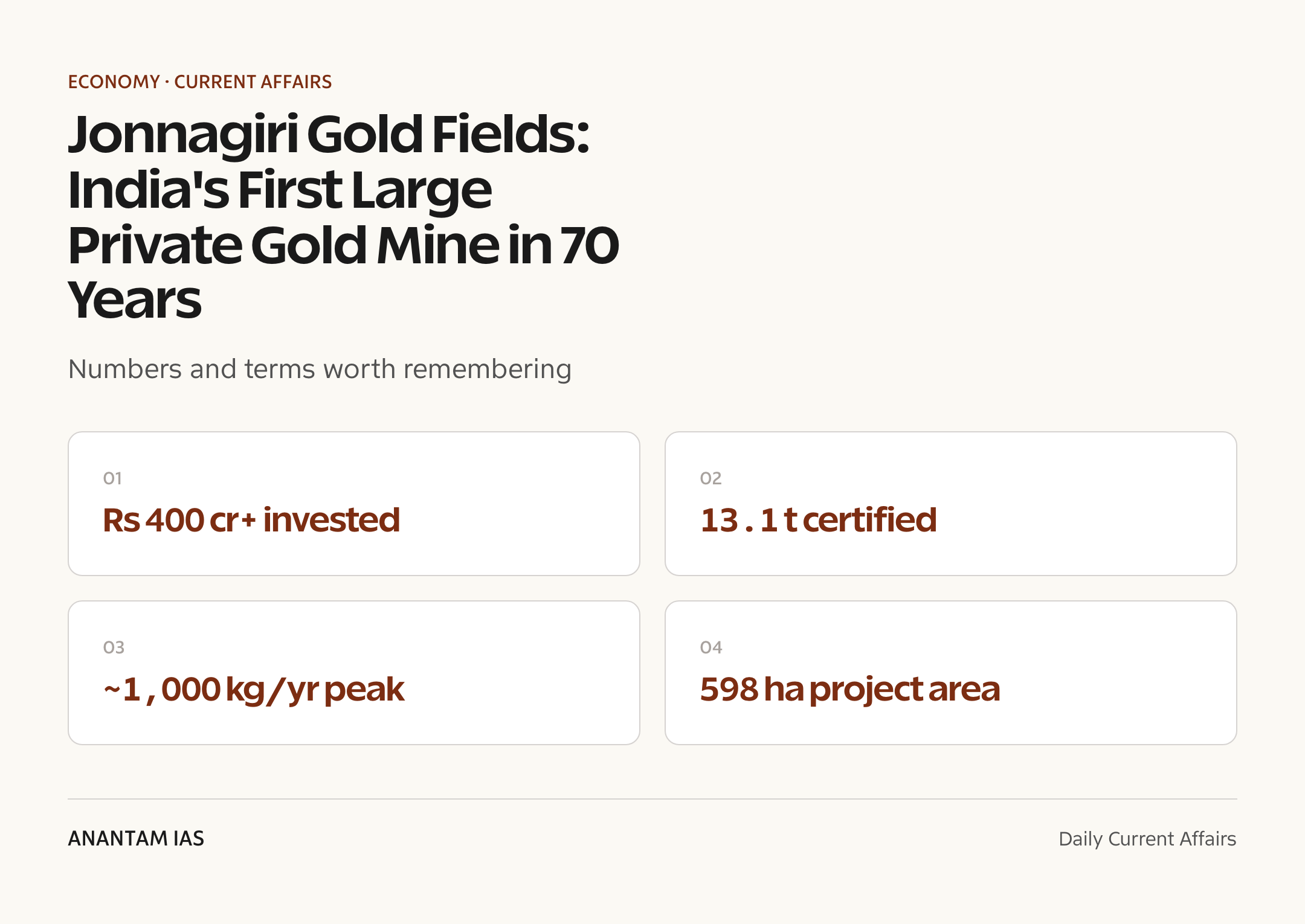
- Investment of over Rs 400 crore has gone into the mine, ore-handling and on-site processing infrastructure.
- Certified gold resource is put at roughly 13.1 tonnes, with exploration potential cited up to about 42.5 tonnes.
- Peak annual output is projected near 1,000 kg of refined gold; first-year output is reported lower (around 600 kg), so the 1,000 kg figure is a peak target.
- Until now, Hutti Gold Mines in Karnataka has been India’s only significant operating gold producer.
The development matters in the context of:
- The project area spans nearly 598 hectares across Jonnagiri, Erragudi and Pagidirayi villages.
- Reports describe the geology as part of the Dharwar craton greenstone-belt terrain of the Rayalaseema region, which hosts known gold occurrences.
- Gold imports remain one of India’s largest non-energy import lines, linking this mineral story to forex and the rupee.
UPSC Relevance
Prelims Relevance
- Jonnagiri gold project lies in Kurnool district, Andhra Pradesh (Rayalaseema region).
- Hutti Gold Mines (Karnataka, Raichur district) is India’s main operating gold producer, in the Hutti-Maski schist belt.
- Kolar Gold Fields (KGF) in Karnataka, once a leading deep gold mine, was closed around 2000-01.
- Indian gold-bearing terrains sit largely in the Dharwar craton greenstone belts of peninsular India.
- India is among the world’s largest gold importers; FY26 gold imports were around 721 tonnes by volume and near USD 72 billion by value (reported).
- Mineral concessions and auctions are governed by the Mines and Minerals (Development and Regulation) Act, 1957 (MMDR Act).
- Gold is a major mineral, with mineral administration shared between the Union (Ministry of Mines, Geological Survey of India) and states.
- High gold imports widen the trade deficit and feed into the current account deficit (CAD), pressuring the rupee.
Mains Relevance
GS Paper 3
- Mineral resources and domestic value addition: how a private gold mine fits India’s mineral-sector reforms and import-substitution goals.
- External sector linkage: gold imports, the current account deficit and exch-rate management as a policy challenge.
- Private participation in mining after MMDR auction reforms, and the balance between investment, environment and local livelihoods.
- Regional development: mineral-led employment and infrastructure in the Rayalaseema region of Andhra Pradesh.
Essay
- Self-reliance and the limits of import substitution: what a single gold mine can and cannot do for a 700-800 tonne-a-year appetite.
- Mineral wealth, regional growth and the duty of sustainable extraction.
Background and Context
The Jonnagiri project: what is reported
A framing of the mine’s scale, ownership and output, treating contested numbers as reported estimates.
- Location: Jonnagiri, with adjoining Erragudi and Pagidirayi villages, in Kurnool district, Andhra Pradesh, across nearly 598 hectares.
- Developer: Geomysore Services India Pvt Ltd, backed by Deccan Gold Mines Ltd and Thriveni Earthmovers.
- Investment: over Rs 400 crore reported across mining, ore handling and an on-site processing plant.
- Resource: about 13.1 tonnes of certified gold resource, with exploration potential cited up to roughly 42.5 tonnes.
- Output: a peak target near 1,000 kg of refined gold a year; early-year output is reported lower, so treat 1,000 kg as a peak rather than launch figure.
- Significance claim: described in reports as India’s first large private-sector gold mine with integrated processing since Independence.
India's gold-mining landscape: Hutti and KGF
Domestic mined gold has been thin and concentrated, which is why a new mine draws notice.
- Hutti Gold Mines Ltd (a Karnataka state undertaking) in Raichur district has been the only significant operating gold producer, with reported annual output in the low single-digit tonnes.
- Kolar Gold Fields (KGF), once among the world’s deepest gold mines, closed around 2000-01 as ore grades fell and costs rose.
- Domestic mined gold is a tiny fraction of national demand, which runs to several hundred tonnes a year met mostly by imports.
- India’s gold-bearing rocks lie largely in the greenstone belts of the Dharwar craton in peninsular India.
Gold imports and the current account
Gold is both a household savings habit and a macroeconomic headache.
- India is among the world’s top gold importers, with annual demand commonly cited around 700-800 tonnes.
- In FY 2025-26, gold imports were reported near 721 tonnes by volume, with value at a record around USD 72 billion as prices surged.
- Heavy gold imports widen the trade deficit and feed the current account deficit, adding pressure on the rupee.
- Policy levers have included import-duty changes and gold-monetisation and sovereign-bond schemes to curb physical imports.
Mining regulation and private entry
A private gold mine reflects the post-reform mineral concession regime.
- The MMDR Act, 1957 governs grant of mineral concessions; amendments shifted major-mineral allocation toward transparent auctions.
- Gold is a major mineral; the Union (Ministry of Mines, Geological Survey of India) and states share regulatory roles.
- Auction-based allocation and exploration incentives were designed to attract private capital and modern processing.
- On-site integrated processing (mining plus extraction and refining) is what distinguishes Jonnagiri from mere ore extraction.
Why it matters
Place the mine in proportion before reading too much into one project.
- A peak output near 1 tonne a year is small against national demand of several hundred tonnes, so import substitution is marginal at this scale.
- The symbolic and demonstration value is larger: it shows private capital can run a viable gold mine with processing in India.
- Industry voices cited in reports aspire to 50-100 tonnes a year of domestic output over the next decade if more deposits are developed.
- Local effects include employment and infrastructure in a part of Rayalaseema that has lagged on industrial investment.
Way Forward
Treat Jonnagiri as a proof of concept: encourage further exploration of Dharwar-craton greenstone belts so domestic output can scale beyond a single mine.
Pair private mining with strict environmental safeguards, tailings management and community benefit-sharing so mineral wealth does not become a local burden.
Conclusion
Jonnagiri is a genuine milestone for India’s mineral sector, the first large private gold mine with integrated processing in about seven decades, but its near-1,000 kg peak target sits against national demand running into hundreds of tonnes a year.
Its real worth lies in signalling that private capital can mine and process gold viably at home; whether that translates into a meaningful dent in gold imports and the current account depends on many more deposits being found, financed and worked responsibly.
UPSC Practice Questions
Prelims MCQ 1
With reference to the Jonnagiri gold project recently in the news, consider the following statements: 1. It is located in the Kurnool district of Andhra Pradesh. 2. It is reported as India’s first large private-sector gold mine with integrated processing since Independence. 3. It is owned and operated by the Geological Survey of India. Which of the statements given above is/are correct?
1 and 2 only 2 and 3 only 1 and 3 only 1, 2 and 3
Answer: 1 and 2 only
Explanation:
Jonnagiri is in Kurnool district, Andhra Pradesh, and is reported as India’s first large private gold mine with integrated processing since Independence. It is developed by a private company (Geomysore Services India Pvt Ltd), not the Geological Survey of India, so statement 3 is wrong.
Prelims MCQ 2
Consider the following statements regarding gold mining in India: 1. Hutti Gold Mines in Karnataka has been India’s principal operating gold producer. 2. The Kolar Gold Fields are currently India’s largest producing gold mine. 3. India’s gold-bearing terrains lie largely in the greenstone belts of the Dharwar craton. Which of the statements given above is/are correct?
1 and 2 only 1 and 3 only 2 and 3 only 1, 2 and 3
Answer: 1 and 3 only
Explanation:
Hutti Gold Mines is India’s principal operating producer and Indian gold occurs largely in Dharwar-craton greenstone belts, so 1 and 3 are correct. Kolar Gold Fields closed around 2000-01 and is no longer producing, so statement 2 is wrong.
UPSC Mains Questions
- India imports the bulk of its gold even as it widens the current account deficit. Examine the role domestic gold mining can play in this context, using the Jonnagiri project to illustrate both its promise and its limits.
- Discuss how the auction-based regime under the Mines and Minerals (Development and Regulation) Act has shaped private participation in India’s mineral sector. What safeguards are needed to balance investment with environmental and community interests?
- Mineral-led development can transform lagging regions but also impose ecological and social costs. Critically analyse this trade-off with reference to gold mining in the Rayalaseema region of Andhra Pradesh.
Sources: Swarajya and The Federal.
Frequently Asked Questions
Where is the Jonnagiri gold project located?
It is in Kurnool district of Andhra Pradesh, spread across Jonnagiri, Erragudi and Pagidirayi villages over nearly 598 hectares, in the Rayalaseema region.
Why is Jonnagiri called India’s first private gold mine since Independence?
Reports describe it as the first large private-sector gold mine with an integrated processing facility to come up in roughly 70 years. India’s main producer, Hutti Gold Mines, is a Karnataka state undertaking, so a private operator at this scale is treated as a first. The claim is as reported.
How much gold will Jonnagiri produce?
The project carries a certified resource of about 13.1 tonnes, with exploration potential cited up to around 42.5 tonnes. Peak annual output is projected near 1,000 kg of refined gold, though early-year output is reported lower, so 1,000 kg is a peak target rather than a launch figure.
How does gold mining connect to India’s current account deficit?
India imports several hundred tonnes of gold a year, with FY26 value reported near USD 72 billion. Such large imports widen the trade and current account deficits and pressure the rupee, so any rise in domestic output is seen as helpful, even if marginal at present scales.
What law governs gold mining in India?
The Mines and Minerals (Development and Regulation) Act, 1957 governs mineral concessions. Amendments shifted major-mineral allocation toward transparent auctions, which the Union (Ministry of Mines and Geological Survey of India) and states administer together.
What was Kolar Gold Fields?
Kolar Gold Fields in Karnataka was once among the world’s deepest gold mines and a major Indian producer. It was shut down around 2000-01 as ore grades declined and mining costs became unviable.