July CPI Inflation Rises to a 19-Month High as Food Prices Harden
Why in News?
The National Statistics Office reported that India’s year-on-year headline CPI inflation rose to 4.45% in July 2026, from 4.38% in June, marking the highest reading in 19 months.
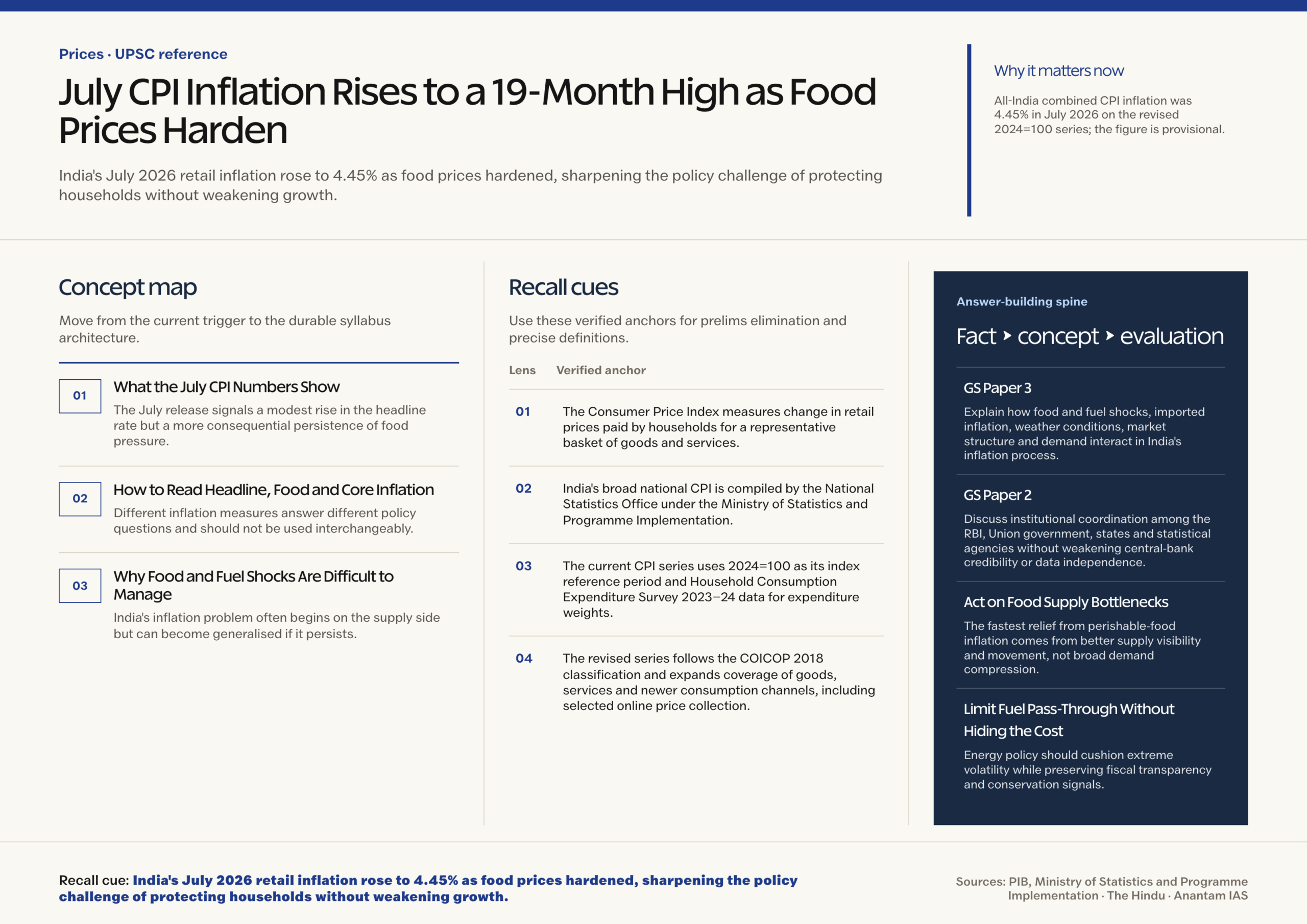
- All-India combined CPI inflation was 4.45% in July 2026 on the revised 2024=100 series; the figure is provisional.
- Combined Consumer Food Price Index inflation rose to 5.52%, compared with 5.32% in June 2026.
- Rural headline inflation stood at 4.84%, while urban inflation was 3.96%, showing that the cost pressure was heavier outside cities.
- Rural food inflation was 5.79%, against 5.05% in urban India, which matters because food occupies a larger share of poorer and rural household budgets.
- The July print was only slightly higher than June’s 4.38%, but the sequence from 3.93% in May to 4.38% in June and 4.45% in July shows a clear.
- A headline rate above 4% does not itself breach the statutory tolerance band, but it reduces room for monetary easing if food and energy shocks begin affecting inflation expectations and service prices.
- Food-led inflation is distributionally unequal: households with lower incomes spend a larger fraction of their budget on essentials and cannot easily substitute away from staples, vegetables, cooking fuel or transport.
- The policy response must distinguish a temporary seasonal supply shock from generalised inflation; interest rates restrain demand but cannot by themselves produce food, repair supply chains or reduce imported fuel costs.
UPSC Relevance
Prelims Relevance
- The Consumer Price Index measures change in retail prices paid by households for a representative basket of goods and services.
- India’s broad national CPI is compiled by the National Statistics Office under the Ministry of Statistics and Programme Implementation.
- The current CPI series uses 2024=100 as its index reference period and Household Consumption Expenditure Survey 2023–24 data for expenditure weights.
- The revised series follows the COICOP 2018 classification and expands coverage of goods, services and newer consumption channels, including selected online price collection.
- The Consumer Food Price Index tracks prices in the food component and is published separately for rural, urban and combined India.
- Headline inflation includes the entire CPI basket; core inflation is an analytical measure that commonly excludes volatile food and fuel components and is not the statutory target variable.
Mains Relevance
GS Paper 3
- Explain how food and fuel shocks, imported inflation, weather conditions, market structure and demand interact in India’s inflation process.
- Assess the limits of repo-rate action against supply-side inflation and the need for coordinated monetary, fiscal, trade and agricultural-market responses.
GS Paper 2
- Discuss institutional coordination among the RBI, Union government, states and statistical agencies without weakening central-bank credibility or data independence.
- Link price stability with food security, welfare delivery, federal supply management and protection of vulnerable households.
Essay
- Price stability is not merely a macroeconomic statistic; it shapes trust in institutions, the dignity of household choice and the distribution of growth.
Background and Context
What the July CPI Numbers Show
The July release signals a modest rise in the headline rate but a more consequential persistence of food pressure.
- Headline CPI rose by 7 basis points, from 4.38% in June to 4.45% in July. The change is small in isolation, yet it extended the upward movement from May’s 3.93% reading.
- CFPI inflation increased by 20 basis points, from 5.32% in June to 5.52% in July. Food inflation was 1.07 percentage points above the headline rate.
- The rural headline rate exceeded the urban rate by 0.88 percentage point; the rural food rate exceeded the urban food rate by 0.74 percentage point.
- The 19-month-high label describes the level relative to preceding monthly readings. It does not mean that prices rose 4.45% in a single month; it means the combined index was 4.45% higher than.
- A high food rate can coexist with falling prices in selected items because CPI is a weighted average. What matters is the combined movement of all items multiplied by their expenditure shares.
How to Read Headline, Food and Core Inflation
Different inflation measures answer different policy questions and should not be used interchangeably.
- Headline CPI measures the total household basket and is the relevant index for India’s inflation-targeting framework. It captures the cost of living more directly than a producer-price measure.
- CFPI isolates the food component. It is especially important in India because food has a large household-budget share and food-price shocks quickly affect welfare, wages and expectations.
- Core inflation usually removes food and fuel to reveal more persistent price pressure. Its precise construction can vary, so an analyst should state the exclusion used rather than treat core inflation as a uniquely defined official.
- A rise driven by a few perishable foods can reverse after arrivals improve. A broad rise across food, transport, housing-related energy and services is more likely to create second-round effects through wages, freight and business pricing.
- Year-on-year data smooth some seasonal variation but carry base effects. Month-on-month momentum, category breadth and persistence are needed to judge whether the shock is fading or spreading.
Why Food and Fuel Shocks Are Difficult to Manage
India’s inflation problem often begins on the supply side but can become generalised if it persists.
- Food prices respond to monsoon distribution, heat, floods, crop disease, sowing choices, input costs, storage losses and the timing of market arrivals. A normal national rainfall total can hide damaging spatial or temporal deficits.
- Perishables such as vegetables have short production cycles and weak storability. Their prices may rise sharply when transport, wholesale-market access or local supply is disrupted.
- Fuel enters household bills directly and also affects freight, irrigation, farm machinery, fertiliser, manufacturing and services. This creates a cost-push channel from energy to a wide set of retail prices.
- Imported crude oil and edible oils expose domestic inflation to exchange-rate movements, geopolitical disruption and international commodity prices.
- Poor households absorb shocks by reducing diet quality, healthcare, education or discretionary consumption. The same headline rate can impose a much larger welfare loss on them than on higher-income households.
The Monetary Policy Trade-Off
The RBI must judge whether the shock will remain in food and energy or alter broader pricing behaviour.
- Higher policy rates can reduce interest-sensitive demand, slow credit growth and signal commitment to the inflation anchor. They also work through exchange-rate expectations and the credibility of future policy.
- Monetary transmission operates with lags and cannot directly increase vegetable supply or lower global oil prices. An aggressive response to a temporary supply shock can impose unnecessary costs on investment and employment.
- Looking through a first-round shock is defensible only when inflation expectations remain anchored and the shock does not spill into wages, services and non-food goods.
- The 4.45% print lies above the 4% anchor but below the 6% upper tolerance level. The framework calls for a medium-term assessment, not an automatic rate move triggered by one.
- A durable response combines a credible monetary stance with supply management, trade calibration, fiscal restraint and targeted support for households most exposed to essential-price inflation.
Way Forward
Act on Food Supply Bottlenecks
- Use high-frequency mandi arrivals, retail prices, weather and crop-condition data to identify shortages early and release buffer stocks through transparent, rules-based triggers.
- Improve cold chains, storage, grading, transport links and farmer access to competitive markets so temporary regional shortages do not become national price spikes.
- Calibrate imports and exports with published criteria and adequate notice, protecting consumers while preserving credible production incentives for farmers.
Conclusion
- July’s 4.45% CPI reading is not a crisis-level breach, but it is a warning against complacency.
- The sound response is neither automatic monetary tightening nor indiscriminate price control.
UPSC Practice Questions
Prelims MCQ 1
With reference to India’s Consumer Price Index (CPI), consider the following statements:
- The current national CPI series uses 2024 as its index reference year.
- Headline CPI excludes food and fuel prices.
- The National Statistics Office compiles the national CPI.
How many of the above statements are correct?
(a) Only one (b) Only two (c) All three (d) None
Answer: (b) Only two
Explanation:
Statements 1 and 3 are correct. The revised series uses 2024=100 and is compiled by the National Statistics Office under MoSPI. Headline CPI covers the whole consumption basket; an analytical core measure commonly excludes food and fuel.
Prelims MCQ 2
A rise in the policy repo rate is least likely to directly correct which one of the following causes of inflation?
(a) Excessive credit-funded consumption demand (b) Unanchored medium-term inflation expectations (c) A flood-induced shortage of perishable vegetables (d) Broad demand pressure on interest-sensitive goods
Answer: (c) A flood-induced shortage of perishable vegetables
Explanation:
The repo rate can moderate aggregate demand and influence expectations, but it cannot directly restore crops or repair a physical supply disruption. Food-supply, logistics and targeted fiscal measures are better suited to the first-round shortage.
UPSC Mains Questions
- Food inflation in India is simultaneously a macroeconomic, welfare and supply-chain problem. Discuss in the context of the July 2026 CPI data. (250 words)
- Examine the limits of monetary policy in responding to food- and fuel-led inflation. What policy mix can prevent second-round effects without weakening growth? (250 words)
Sources: PIB, Ministry of Statistics and Programme Implementation and The Hindu.
Frequently Asked Questions
What was India’s CPI inflation rate in July 2026?
India’s combined year-on-year CPI inflation was 4.45% in July 2026, according to the provisional National Statistics Office release. Rural inflation was 4.84% and urban inflation was 3.96%. The combined rate rose from 4.38% in June and was the highest monthly.
How high was food inflation in July 2026?
Combined Consumer Food Price Index inflation was 5.52% in July 2026. Rural food inflation was 5.79%, while urban food inflation was 5.05%. The gap matters because food takes a larger share of low-income and rural household budgets, making the welfare.
Does 4.45% inflation mean prices rose 4.45% during July alone?
No. The 4.45% figure is a year-on-year rate, comparing the combined CPI in July 2026 with July 2025. A month-on-month rate would compare July with June 2026. Separating the two is essential because annual inflation can rise due to current.
Why can the RBI not solve food inflation only by raising interest rates?
A higher repo rate can slow demand and keep expectations anchored, but it cannot produce vegetables, reverse flood damage or reduce an international oil price. Food- and fuel-led shocks need supply, logistics, trade and targeted fiscal action. Monetary policy becomes.
What changed in India’s revised CPI series?
The revised CPI uses 2024=100, weights based on Household Consumption Expenditure Survey 2023–24, the COICOP 2018 classification and a broader set of goods, services and price sources. It includes selected online markets and online collection for some services, helping the.