Kaleshwaram Project Controversy: Governance, Accountability and Infrastructure Challenges
Why in News?
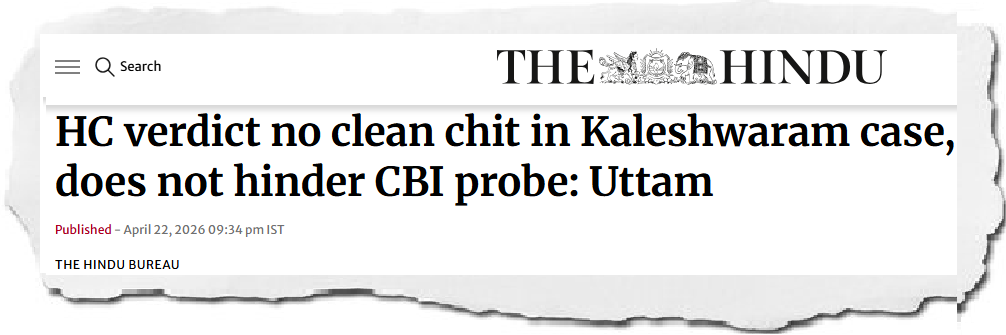
The Telangana High Court upheld the validity of the Commission of Inquiry into the Kaleshwaram Lift Irrigation Project, while clarifying that its findings do not prevent further investigation, including a proposed probe by the Central Bureau of Investigation.
UPSC Relevance
GS-II: Governance, Accountability, Statutory Bodies
GS-III: Infrastructure, Water Resources, Disaster Management
About Kaleshwaram Lift Irrigation Project (KLIP)
- One of the largest multi-stage lift irrigation projects in the world
- Built on the Godavari River in Telangana
- Objective:
- Irrigation support
- Drinking water supply
- Industrial use
- Key component:
- Series of barrages, including Medigadda
Institutional Framework
1. Commission of Inquiry
- Set up under the Commissions of Inquiry Act, 1952
- Purpose:
- Investigate alleged irregularities
- Examine project execution and failures
2. Role of Judiciary
- High Court upheld:
- Legality of the Commission
- Clarified:
- Commission findings alone cannot be the sole basis for punitive action without due process
What are the Key Issues Highlighted?
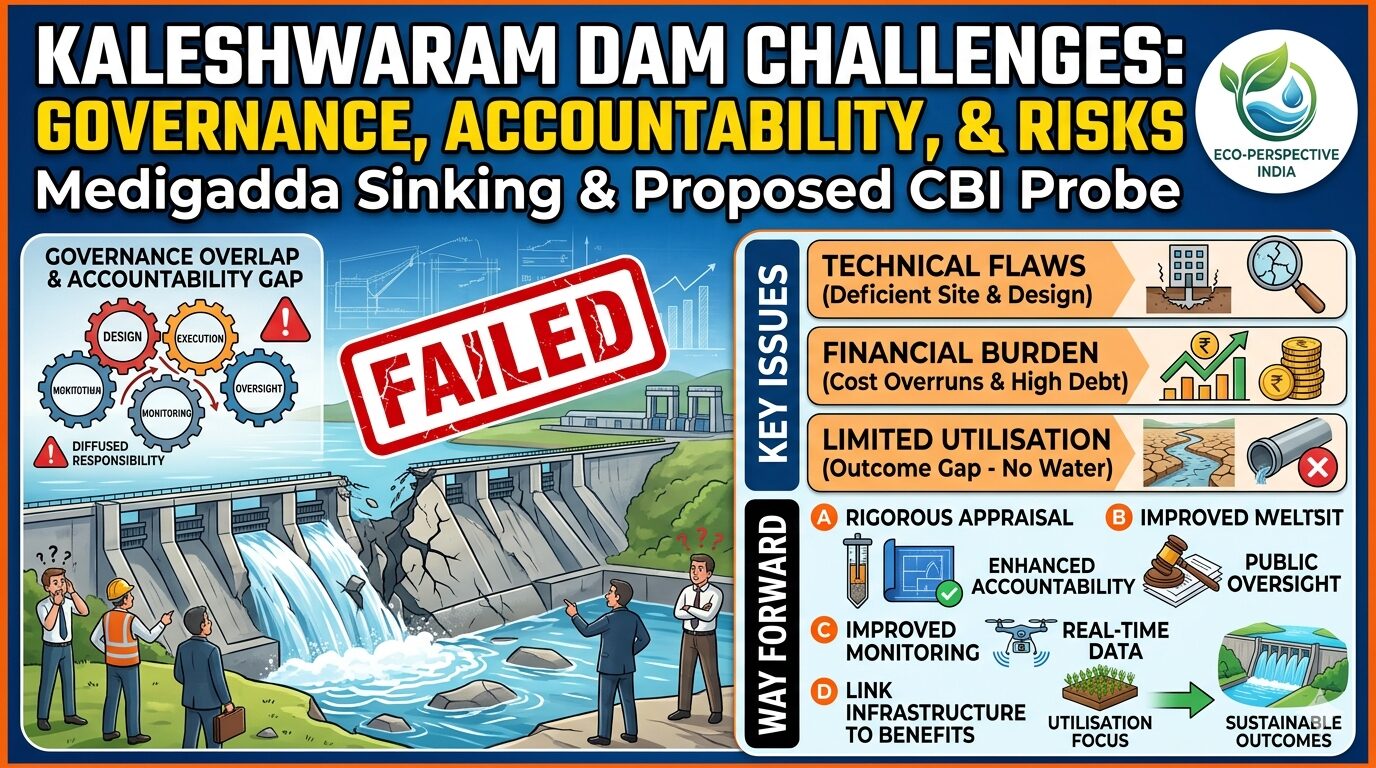
1. Structural and Technical Concerns
- Reports indicate deficiencies in:
- Site selection
- Design
- Construction quality
- Maintenance
The sinking of a portion of the Medigadda barrage points to serious engineering lapses, raising concerns about infrastructure safety.
2. Financial Burden
- Annual debt servicing estimated at ₹15,000–20,000 crore
- Limited or no operational output in recent years
This raises questions about:
- Cost-benefit analysis
- Fiscal sustainability of large infrastructure projects
3. Governance and Accountability Deficit
Multiple agencies, including:
- National Dam Safety Authority
- Vigilance bodies
have flagged irregularities, indicating:
- Weak oversight mechanisms
- Possible lapses in project monitoring
4. Role of Investigative Agencies
The proposed CBI probe reflects:
- Need for independent investigation
- Ensuring accountability in public expenditure
5. Infrastructure vs Outcome Gap
Despite massive investment:
- Limited utilisation (no water lifting in recent period)
This highlights a broader issue in India:
- Focus on project creation rather than long-term performance and sustainability
What are the Broader Issues Involved?
1. Challenges in Large Infrastructure Projects
- Cost overruns
- Delays
- Technical flaws
- Weak feasibility assessment
2. Institutional Overlap and Coordination
Multiple bodies involved in:
- Design
- Execution
- Monitoring
Often leads to:
- Diffused accountability
3. Environmental and Safety Concerns
Large irrigation projects may:
- Alter river ecosystems
- Pose structural risks if poorly designed
4. Public Finance Implications
Heavy borrowing for such projects can:
- Strain state finances
- Reduce fiscal space for welfare spending
Way Forward
1. Strengthening Pre-Project Appraisal
All major infrastructure projects should undergo:
- Rigorous feasibility studies
- Independent technical evaluation
- Environmental and social impact assessments
This will reduce risks of flawed design and execution.
2. Enhancing Institutional Accountability
Clear allocation of responsibility at each stage of the project lifecycle is necessary. Independent auditing mechanisms should regularly review:
- Financial management
- Technical quality
3. Improving Project Monitoring
Real-time monitoring using technology and third-party audits can help detect:
- Structural weaknesses
- Implementation gaps
at an early stage.
4. Ensuring Transparency and Public Oversight
Making project data publicly accessible can:
- Improve accountability
- Enable expert scrutiny
5. Strengthening Dam Safety and Regulation
Institutions like the National Dam Safety Authority should be empowered with:
- Greater enforcement powers
- Mandatory compliance mechanisms
6. Linking Infrastructure to Outcomes
Evaluation of projects should focus not just on completion, but on:
- Actual utilisation
- Economic and social benefits
Conclusion
The Kaleshwaram project highlights critical challenges in India’s infrastructure development model, including issues of planning, execution, and accountability. Strengthening institutional mechanisms, ensuring transparency, and prioritising outcomes over mere project completion are essential to prevent such instances and ensure efficient use of public resources.
Practice Questions
Prelims
- With reference to the Commissions of Inquiry Act, 1952, consider the following statements:
- It empowers the Central Government to set up commissions to investigate matters of public importance.
- The findings of such commissions are legally binding.
- State Governments can also set up such commissions.
Which of the statements given above is/are correct?
(a) 1 only
(b) 1 and 3 only
(c) 2 and 3 only
(d) 1, 2 and 3
Answer: (b)
Mains
- Discuss the governance and accountability challenges associated with large infrastructure projects in India, with suitable examples.
- “Infrastructure development must prioritise long-term sustainability over short-term gains.” Analyse.