Kalpakkam Fast Breeder Reactor attains Criticality
Why in News?
India’s prototype fast-breeder reactor (PFBR) in Tamil Nadu’s Kalpakkam (500 MWe) has successfully achieved first criticality (the start of a controlled fission chain reaction).
| UPSC Relevance: GS-3 Science and Technology: Nuclear Technology Prelims: Key concepts associated with Nuclear Technology; Mains: India’s Three-Stage Nuclear Programme; Fast Breeder Reactor |
Key concepts associated with Nuclear Technology:
| Back to Basics: Key Concepts | |
| Natural Uranium: • Natural Uranium is composed of three major isotopes: Uranium-238 (99.284% natural abundance) Uranium-235 (0.711%) Uranium-234 (0.005%) • U-235 atoms are the only nuclide existing in nature (in appreciable amounts) that is fissile with thermal neutrons. Hence, Uranium enrichment is necessary to create a high enough concentration of U-235 out of mined Uranium. | |
| Nuclear Fuel (Fertile vs Fissile): • Fissile Material: Fissile isotopes readily undergo fission when hit by neutrons. E.g., Uranium-235 (U-235), Uranium-233 (U-233) and Plutonium-239 (Pu-239). • Fertile Material: Fertile isotopes are not directly fissile by slow neutrons. However, fertile isotopes can absorb neutrons and transmute into fissile materials through radioactive decay. E.g., Uranium-238 (U-238); Thorium-232 (Th-232). | |
| Nuclear Transmutation: • Refers to the conversion of one nuclide into another within the fuel or target material. This process can involve the absorption of a neutron, the emission of a neutron, or the capture and subsequent decay of a particle. | |
| Criticality of Nuclear Reactor: • Criticality in a nuclear reactor is the point at which the nuclear chain reaction becomes self-sustaining. • A nuclear reactor is said to be critical when the number of neutrons produced in Nuclear fission reactions equals the number of neutrons lost through absorption, leakage, and other processes. This equilibrium state allows for a sustained and controlled chain reaction. | |
| Pressurised Heavy Water Reactors (PHWRs): • PHWRs commonly use unenriched natural uranium as their fuel and heavy water (deuterium oxide, D2O) as both coolant and moderator. • Control Rods: Boron or cadmium control rods are used to absorb excess neutrons and regulate the nuclear reaction. • Advantages: PHWRs use natural uranium fuel, produce less high-level radioactive waste, and operate at lower pressures compared to some other reactor types. | |
| Fast Breeder Reactor (FBR): • A breeder reactor is a nuclear reactor that produces more fissile material than it consumes. • FBR uses fast neutrons (without a moderator) to convert fertile material into fissile fuel, thereby “breeding” additional nuclear fuel. • Fuelled by: Mixed Oxide (MoX) Fuel. It generally contains 3%-5% Plutonium Oxide blended with 95-97% natural or depleted Uranium Oxide. It uses liquid sodium as a coolant. Prototype Fast Breeder Reactor (PFBR), Kalpakkam: • India’s first 500 MWe nuclear reactor. Located at Kalpakkam, Tamil Nadu. • Being implemented by Bharatiya Nabhikiya Vidyut Nigam Limited (BHAVINI), a public sector enterprise under India’s Department of Atomic Energy (DAE). • Fuelled by: Mixed Oxide (MoX) Fuel. It generally contains 3%-5% Plutonium Oxide blended with 95-97% natural or depleted Uranium Oxide. It uses liquid sodium as a coolant. • Operational Timeline: scheduled for full power generation by late 2026. The reactor has been fully designed and constructed indigenously by BHAVINI and the Indira Gandhi Centre for Atomic Research (IGCAR). • Significance: PFBR is central to 2nd Stage of India’s three-stage nuclear power programme. |
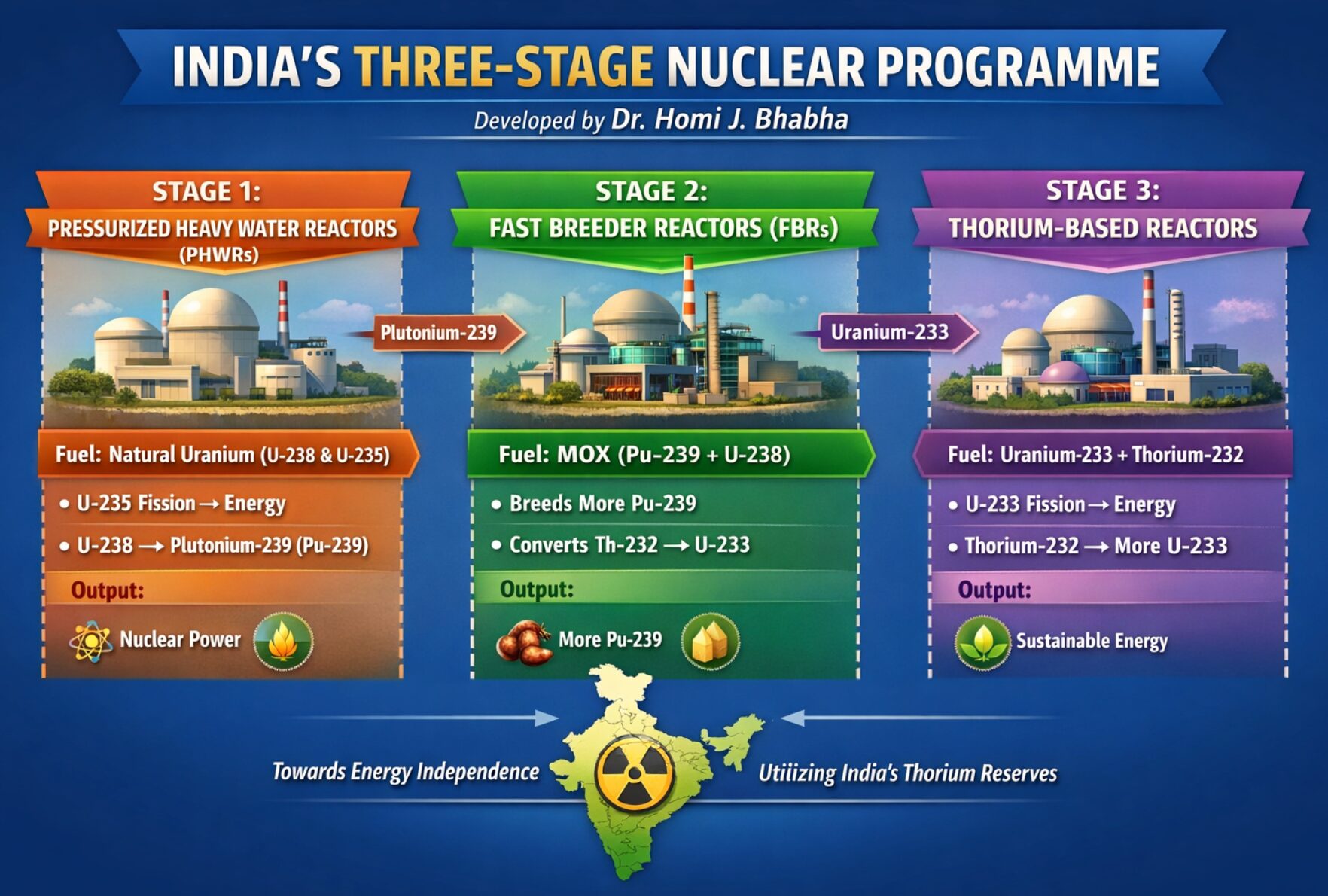
India’s Three-Stage Nuclear Programme:
- The three-stage nuclear programme of India was formulated by Dr Homi J. Bhabha.
- Aim: It is a long-term strategy designed to make the country self-reliant in nuclear energy, especially using its abundant thorium reserves.
- Need: India lacks large uranium reserves but has vast thorium deposits. So, the programme is structured to:
- Use limited uranium efficiently.
- Gradually shift to thorium-based energy.
| Thorium Reserves of India: • India has about 25% of the global thorium in the form of monazite sands along its coastline. • Distribution: Coastal and inland placer sands on the beaches of Kerala, Tamil Nadu, Odisha, Andhra Pradesh, Maharashtra, and Gujarat, and inland riverine sands of Jharkhand and West Bengal. |
First Stage: Pressurised Heavy Water Reactors (PHWRs)
- The first stage includes the setting up of Pressurised Heavy Water Reactors.
- Fuel used: Natural Uranium (99.3% U-238 and 0.7% U-235)
- Process:
- U-235 undergoes fission and produces energy.
- U-238 absorbs neutrons and gets converted into Plutonium-239 (Pu-239).
- Outcome: Generation of Nuclear Energy & production of Plutonium for the next stage.
Second Stage: Fast Breeder Reactor (FBR)
- Fuel used: Uranium-Plutonium Mixed Oxide (MOX) fuel. It is a mix of Plutonium-239 (byproduct/radioactive waste produced in the 1st stage) and Uranium-238.
- Process:
- Pu-239 is used as the fuel core. The surrounding blanket of U-238 absorbs neutrons to produce more fuel (Pu-239). Since the amount of Plutonium produced inside the reactor is more than that initially used, it is called a breeder reactor.
- Begins conversion of thorium (Th-232) into fissile uranium-233 (U-233) that will be used in the 3rd stage.
- The reactor uses fast neutrons without the need for a moderator to slow them down. Fast neutrons are more efficient at inducing fission in certain isotopes (such as Plutonium-239).
- Outcome: Breeds more fuel (Pu-239) than it consumes. Prepares U-233 for stage 3.
| Significance of Fast Breeder Reactor: • Closed fuel cycle: Significant reduction in nuclear waste generated as FBR utilises (reprocesses) the radioactive waste (Plutonium-239) from the 1st stage as fuel in the 2nd stage. • Energy independence: Act as a critical link between uranium and thorium fuel cycles. Stepping stone for the 3rd stage of India’s Nuclear Programme. • Advanced safety features: Advanced reactor with inherent passive safety features, which enable automatic reactor shutdown in case of abnormal conditions. • Economic viability: Both the capital cost and the per-unit electricity cost are comparable to those of other nuclear and conventional power plants. |
Third Stage: Thorium-Based Reactors
- Fuel used: Uranium-233 + Thorium-232
- Process:
- U-233 undergoes fission.
- Thorium-232 converts into more U-233.
- Outcome: Sustainable nuclear energy using India’s thorium reserves.
This is a landmark achievement for India’s nuclear energy programme, marking a historic step in providing long-term energy security and advancing indigenous nuclear technology capabilities.
UPSC PYQ 2023
Q. Consider the following statements:
Statement I: India, despite having uranium deposits, depends on coal for most of its electricity production.
Statement II: Uranium, enriched to the extent of at least 60%, is required for the production of electricity.
Which one of the following is correct with respect to the above statements?
(a) Both Statement I and Statement II are correct, and Statement II is the correct explanation for Statement I
(b) Both Statement-I and Statement-II are correct, and Statement-II is not the correct explanation for Statement-I
(c) Statement I is correct, but Statement II is incorrect
(d) Statement I is incorrect, but Statement II is correct
Answer: (c)
UPSC PYQ 2016
Q. India is an important member of the ‘International Thermonuclear Experimental Reactor’. If this experiment succeeds, what is the immediate advantage for India?
(a) It can use thorium in place of uranium for power generation
(b) It can attain a global role in satellite navigation
(c) It can drastically improve the efficiency of its fission reactors in power generation
(d) It can build fusion reactors for power generation
Answer: (d)
UPSC Mains PYQ 2018
Q. With growing energy needs, should India keep on expanding its nuclear energy programme? Discuss the facts and fears associated with nuclear energy.
UPSC Mains PYQ 2017
Q. Give an account of the growth and development of nuclear science and technology in India. What is the advantage of the fast breeder reactor programme in India?