Major Kandla Port capacity projects announced
Why in News?
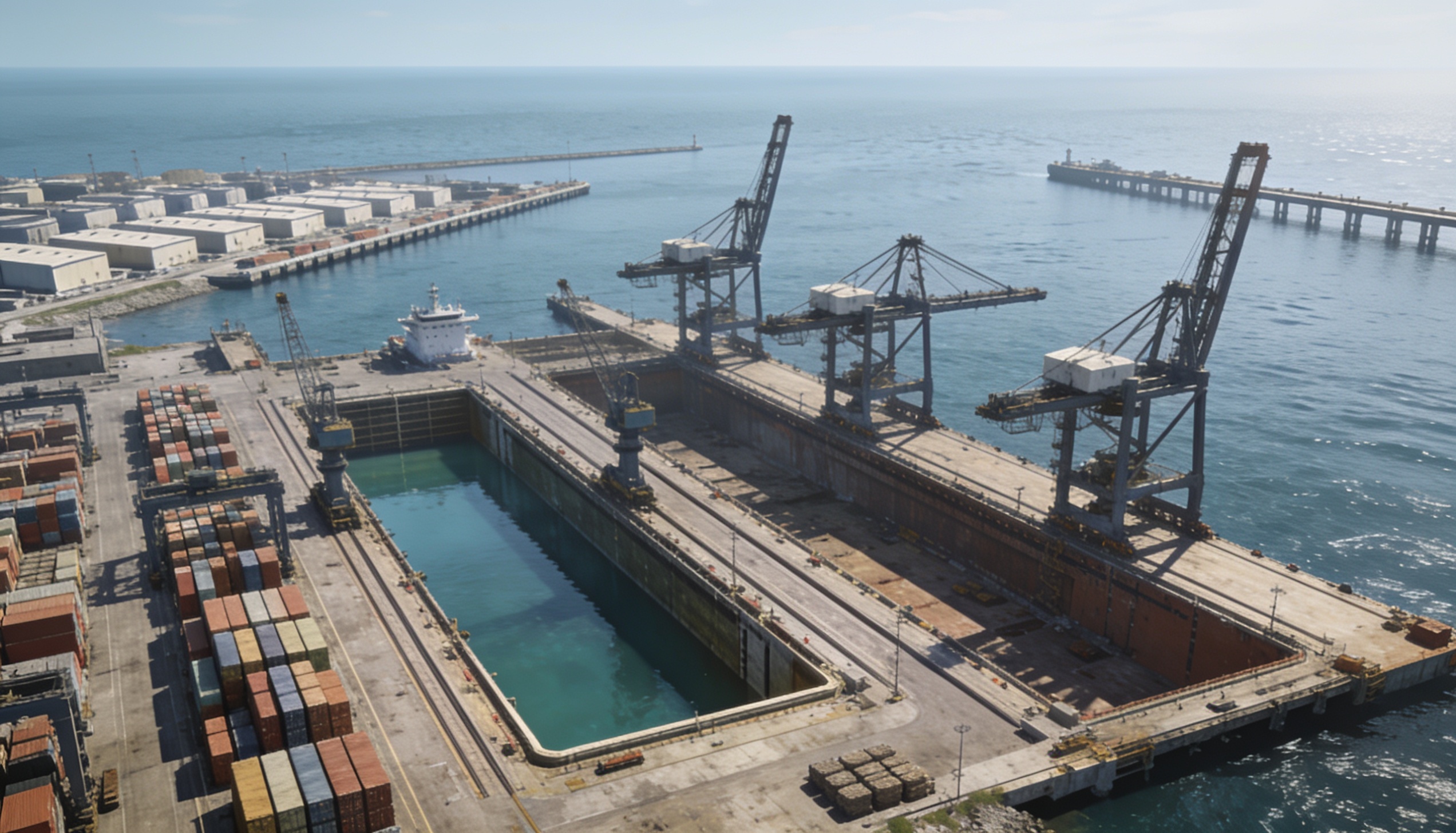
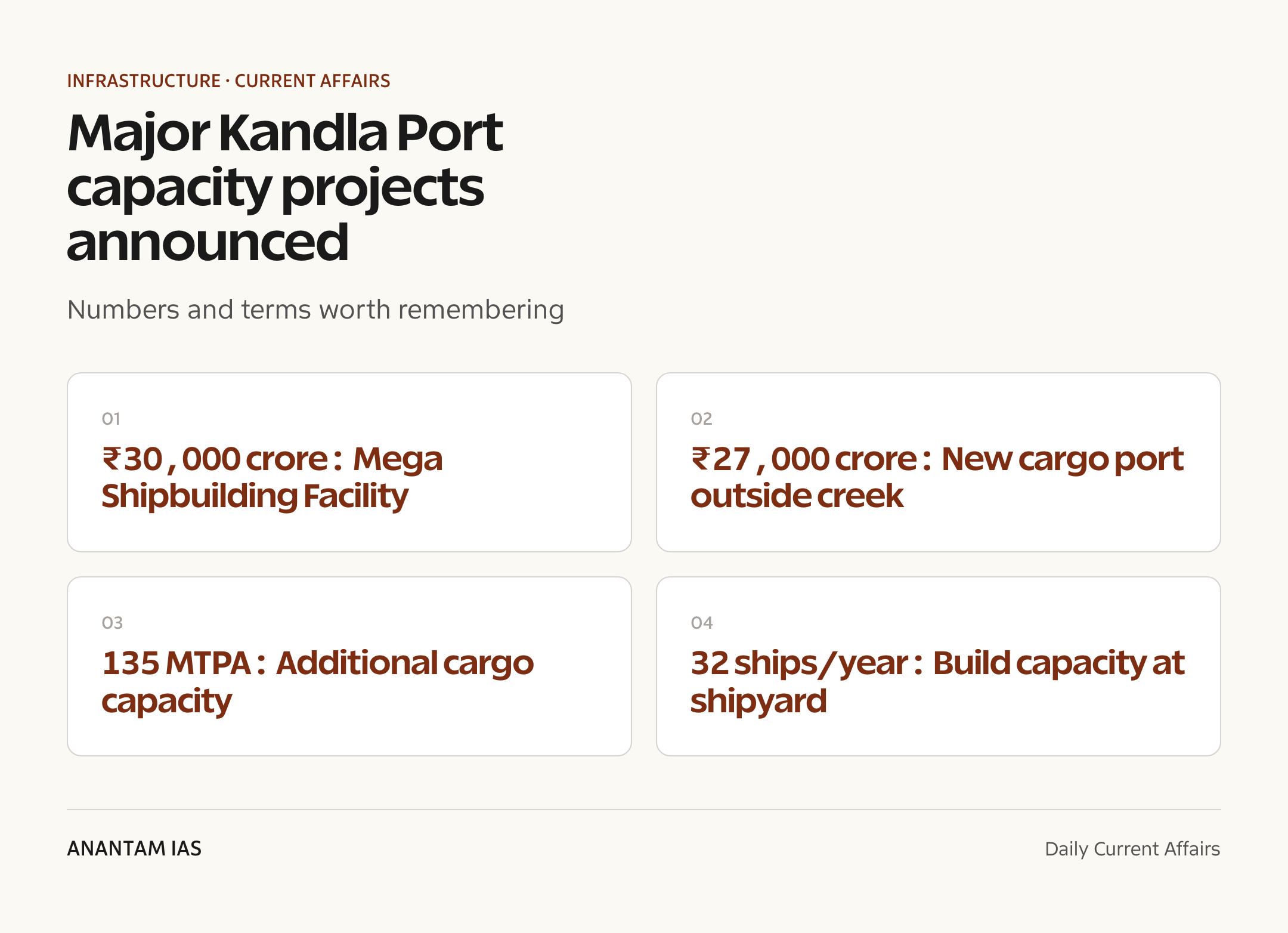
Government announced large investments to expand Kandla (Deendayal) Port capacity: a mega shipbuilding complex and a new external cargo port, together costing about ₹57,000 crore and adding substantial cargo and shipbuilding capacity.
- Announcement covers two headline projects: ₹30,000 crore Mega Shipbuilding Facility and ₹27,000 crore new cargo port outside Kandla creek.
- New cargo port will add 135 MTPA to Kandla’s throughput and allow segregation of dry and liquid cargo.
- Shipbuilding complex will have capacity to build 32 ships and repair 50 vessels annually, including VLCC-class units up to 3,20,000 DWT.
- Projects aim to catalyse a marine industrial cluster, marina, fishing harbour and townships on over 8,000 acres.
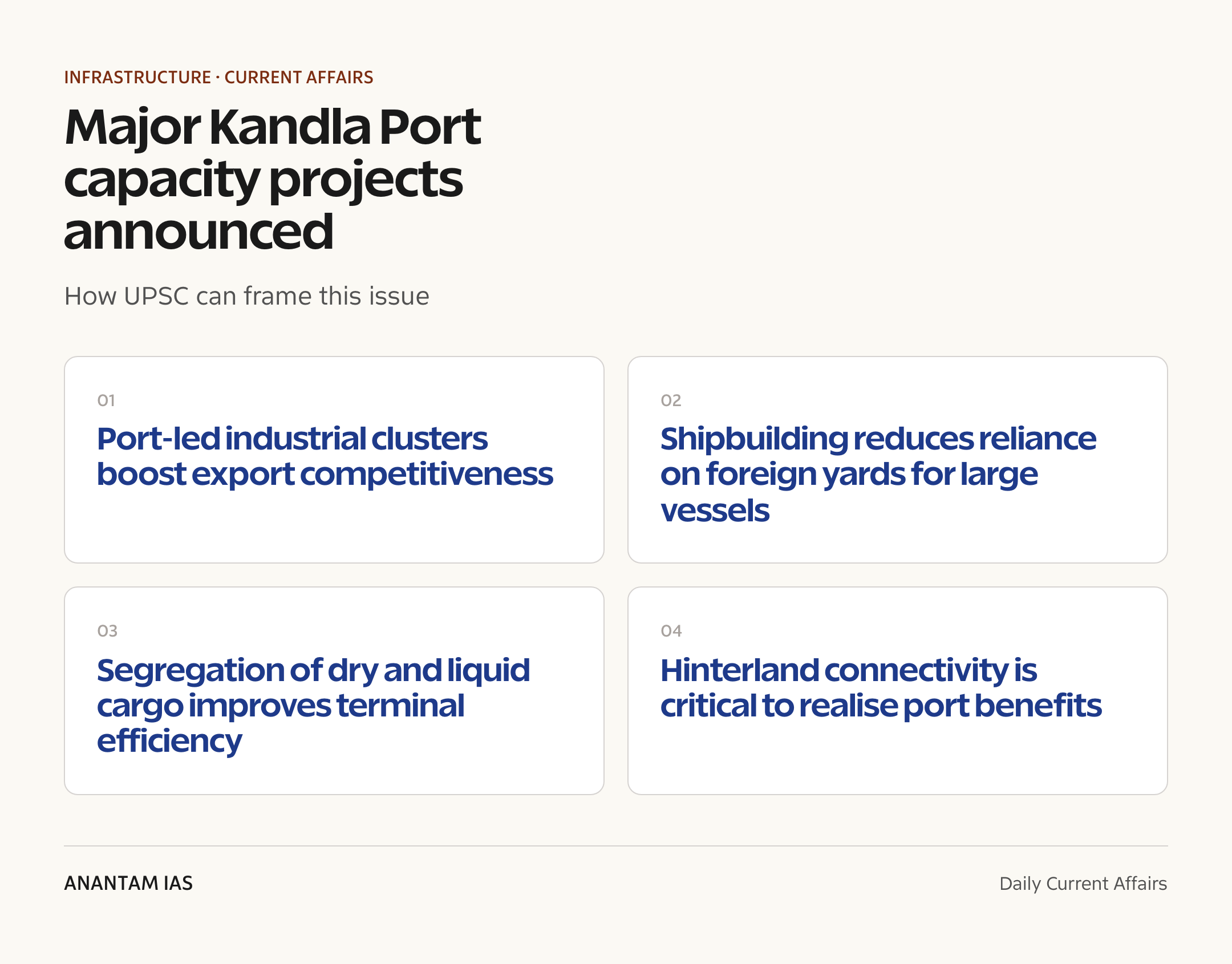
- Announcements are pitched as elements of the government’s Make in India, Make for the World and port-led industrialisation agenda.
The development matters in the context of:
- Kandla (Deendayal) Port is one of India’s oldest and largest multipurpose ports and a key hub on the western coast handling bulk, liquid and container traffic.
- India’s port capacity expansion is part of a broader strategy to improve logistics efficiency, reduce turnaround time, and lower trade costs for importers and exporters.
- Shipbuilding and repair capacity in India has been a policy priority to reduce dependence on foreign yards for large commercial and strategic vessels.
- Coastal Economic Zones and port-led industrial clusters are promoted to link ports with manufacturing, services and export-oriented units.
- Large greenfield port projects require significant coastal land, dredging, and environmental and social clearances, plus long-term cargo commitments under PPP models.
- Port modernisation interacts with inland connectivity (rail and road), hinterland logistics, and national-level initiatives like Sagarmala and PM Gati Shakti.
UPSC Relevance
Prelims Relevance
- Numbers and facts: investment amounts (₹30,000 crore and ₹27,000 crore) and added capacity (135 MTPA).
- Deendayal Port (Kandla) location: Gujarat, near Gulf of Kutch and Tuna coast; relevance to questions on Indian ports.
- Technical terms: VLCC (Very Large Crude Carrier) and DWT (deadweight tonnage) — common in shipping prelims vocabulary.
Mains Relevance
GS3 Infrastructure and Economy
- Discuss port-led development and its role in trade competitiveness, employment generation and regional industrialisation.
- Evaluate public-private partnership models in port infrastructure and financing large greenfield maritime projects.
- Analyse environmental, social and coastal regulation challenges in large port and shipbuilding projects.
- Assess strategic and security implications of enhancing shipbuilding and repair capacity domestically.
Essay
- Topics on infrastructure-led growth, Make in India, coastal economy and India’s integration with global value chains.
- Questions on sustainable development, balancing economic development with coastal ecology and fisherfolk livelihoods.
Background and Context
Deendayal (Kandla) Port: profile and significance
A strategic western port that anchors trade in Gujarat and the larger western hinterland.
- Located on the Gulf of Kutch coastline, Kandla is one of India’s busiest multipurpose ports handling dry bulk, liquid bulk and containers.
- Serves hinterlands of Gujarat, Rajasthan, Madhya Pradesh and parts of western India, making it crucial for export-import flows.
- Historically developed as a response to partition-era maritime needs; now rebranded administratively as Deendayal Port Authority.
- Existing infrastructure includes multiple jetties, liquid berths at Vadinar and container facilities at Tuna Tekra (ongoing expansion).
Existing capacity and recent projects
Kandla has been expanding incrementally through discrete projects under PPP and authority-led investments.
- Tuna Tekra container terminal is already being developed under PPP with plans for multi-cargo handling and TEU capacity additions.
- New oil jetties, SBMs and product jetties at Vadinar have added liquid handling capacity over recent years.
- Ship repair and smaller shipbuilding activities exist, but not at VLCC construction scale; capacity mostly for coastal and medium-size vessels.
- Port modernisation under national programmes has emphasised mechanisation, automation and hinterland connectivity improvements.
Technical aspects: shipbuilding and port construction
Shipyards and new port terminals require specialised infrastructure and ecosystem linkages.
- VLCC construction demands large slipways or dry docks, heavy-lift equipment, block assembly facilities and deep-water access.
- Ship repair depends on dry docks, floating docks, repair berths and skilled labour for diverse trades — welding, piping, electrical works.
- Port terminals need berths with sufficient draft, quay cranes, conveyor systems for bulk, pipelines for liquid cargo and yard space.
- Dredging and channel maintenance are recurring costs; placing a port outside the creek can reduce dredging needs if near navigation channels.
Economic multipliers and employment
Large maritime projects can stimulate direct and indirect economic activity across supply chains.
- Shipbuilding/repair cluster creates skilled and semi-skilled jobs across manufacturing, engineering and services.
- Ancillary industries include steel fabrication, engine suppliers, electrical equipment, ship interiors and maritime logistics firms.
- Townships, marina and fisheries infrastructure bring non-maritime employment in retail, hospitality and local services.
- Long-term cargo terminal operations generate port operations staff, stevedoring, customs-related services and logistics firms.
Environmental and social considerations
Coastal projects face risks that need mitigation through regulation, technology and community consultation.
- Dredging, reclamation and construction can impact mangroves, fisheries and coastal erosion patterns; environmental impact assessments are mandatory.
- Fisherfolk displacement and access to traditional fishing grounds need to be addressed through rehabilitation and compensation.
- Pollution control plans for shipbuilding yards are essential to manage metal, paint and chemical effluents.
- Regulatory clearances involve central and state agencies; compliance with CRZ (Coastal Regulation Zone) and environmental norms is central.
Financing and PPP models
Large capex projects typically rely on mixed financing and long-term concession arrangements.
- Projects can be funded through central allocations, port authority balance sheets, PPP concessions and private investor capital.
- Risk allocation in PPP includes traffic risk, construction risk, environmental approvals and land acquisition responsibilities.
- Long-term offtake commitments, common user policies and tariff frameworks determine bankability of port projects.
- Sovereign support or viability gap funding may be needed for strategic projects with long gestation.
Way Forward
Robust environmental and social safeguards
Integrate strong mitigation measures early in project design to reduce delays and social friction.
- Conduct comprehensive, public EIA with transparent disclosure of findings and independent review panels.
- Design fishery access corridors and compensation schemes to protect livelihoods of coastal communities.
- Adopt low-impact dredging techniques and silt management plans to reduce ecological damage.
- Mandate zero-liquid-discharge and effluent treatment standards for shipbuilding and repair units.
Hinterland connectivity and modal integration
Ensure rail and road links and logistics parks are planned in tandem to realise full throughput benefits.
- Prioritise dedicated freight corridors, last-mile rail links and multimodal freight terminals to decongest roads.
- Synchronise port capacity addition timelines with rail/road projects under PM Gati Shakti planning processes.
- Facilitate connected inland container depots and warehousing clusters to speed cargo evacuation.
- Promote digital integration for customs, terminal operations and cargo tracking to lower turnaround times.
Skill development and local industry linkages
Build human capital and supplier networks to capture value from shipbuilding and repair activity.
- Set up specialised maritime skill centres for welding, marine engineering and shipfitting near the project site.
- Incentivise supplier parks and component manufacturers to locate within the marine industrial cluster.
- Use local hiring quotas and apprenticeship programmes to ensure community benefits and build workforce depth.
- Link vocational institutes with shipyards for internships and on-the-job training pipelines.
Financing structures and risk mitigation
Adopt financing models that spread risk and secure long-term cargo commitments.
- Use blended finance: combine sovereign support, institutional investors and strategic industry partners.
- Structure PPPs with clear traffic sharing, performance benchmarks and dispute resolution mechanisms.
- Offer anchor tenancy or throughput guarantees for initial years to make projects bankable.
- Explore green finance instruments for eco-friendly construction practices and pollution-control investments.
Conclusion
The Kandla announcements aim to transform Deendayal Port into a major shipbuilding and cargo-handling hub with large economic multipliers. Success will depend on aligned hinterland connectivity, strict environmental and social safeguards, skill creation, and robust financing and PPP frameworks. If implemented with balanced regulation and stakeholder engagement, the projects can advance port-led industrialisation and strengthen India’s maritime capabilities.
UPSC Practice Questions
Prelims MCQ 1
Which of the following statements about the Kandla (Deendayal) Port announcements of January 2025 is/are correct? 1. A Mega Shipbuilding Facility with capacity to build VLCC-class ships up to 3,20,000 DWT was announced. 2. A new cargo port outside Kandla creek will add 135 MTPA to existing capacity. 3. The total announced investment for both projects is ₹75,000 crore. Select the correct answer using the code given below: A. 1 and 2 only B. 2 and 3 only C. 1 and 3 only D. 1, 2 and 3
(a) A (b) B (c) C (d) D
Answer: (a) A
Explanation:
Statements 1 and 2 are correct: the shipbuilding facility includes construction of VLCC-class vessels up to 3,20,000 DWT and the new cargo port is projected to add 135 MTPA. The combined investment announced is about ₹57,000 crore, not ₹75,000 crore, so statement 3 is incorrect.
Prelims MCQ 2
Consider the following features related to Very Large Crude Carrier (VLCC) construction: 1. Requires deep-draft access for launching and commissioning. 2. Demands large dry docks or slipways and heavy-lift equipment for block assembly. 3. Is typically free from environmental regulations due to its strategic nature. Which of the above statements are correct? A. 1 and 2 only B. 2 only C. 1 and 3 only D. 1, 2 and 3
(a) A (b) B (c) C (d) D
Answer: (a) A
Explanation:
Statements 1 and 2 are correct: VLCC construction needs deep-draft access and large docks/slipways and heavy-lift equipment. Statement 3 is incorrect because shipbuilding is subject to environmental regulations and clearances.
UPSC Mains Questions
- {‘question’: ‘Analyse how large port-capacity projects like the Kandla shipbuilding complex and new cargo port can influence regional economic development. Discuss both the potential gains and the challenges that must be managed.’, ‘model_answer’: ‘Large port-capacity projects act as catalysts for regional industrialisation by providing scale, connectivity and cost advantages. Potential gains include direct employment in construction, shipbuilding and terminal operations; indirect employment across steel, engineering, logistics and services; improved trade competitiveness through lower turnaround times and higher berth capacity; technology transfer and domestic manufacturing capability with shipyards building VLCCs; and attraction of foreign and domestic investment into the marine industrial cluster. Challenges include environmental risks from dredging and reclamation affecting fisheries and mangroves; displacement of coastal communities and associated social costs; requirement for large upfront capital leading to long payback periods and financial risk; dependence on hinterland connectivity and modal integration to realise throughput; and need for skilled labour and supplier ecosystems. Policy responses should include rigorous environmental impact management, stakeholder consultations and rehabilitation plans, integrated planning for rail and road links, skill development programmes, blended finance and PPP structures with clear risk sharing, and strong governance to ensure timely implementation and tariff discipline.’}
- {‘question’: ‘Critically examine the role of PPP (public-private partnership) in port development in India, using recent Kandla projects as an example. What policy measures would improve PPP outcomes in large maritime projects?’, ‘model_answer’: ‘PPP has been central to Indian port development to mobilise private capital and operational expertise. In the Kandla context, the Tuna Tekra container terminal and possibilities for multi-cargo terminals show scope for PPPs to deliver capacity. PPP strengths include access to private investment, enhanced efficiency, innovation and quicker execution. Limitations are traffic risk for private partners, delays in clearances, land acquisition hurdles, tariff regulation constraints, and mismatch between public policy objectives and private return horizons. Policy measures to improve outcomes include: offering structured viability gap funding where cargo certainty is weak; providing anchor client arrangements or minimum throughput guarantees for initial years; streamlining environmental and coastal clearances to reduce timeline risk while keeping safeguards; improving land acquisition and compensation frameworks; establishing clear tariff-setting mechanisms and dispute resolution systems; and promoting blended finance with institutional investors to lower cost of capital.’}
Source: PIB, Ministry of Ports, Shipping and Waterways.
Frequently Asked Questions
q
a
q
a
q
a
q
a
q
a
q
a