HFSS Foods Near Schools: Karnataka Tightens the Healthy-Food Zone
Why in News?
The Karnataka Food Safety and Drug Administration issued a July 24 advisory prohibiting the sale, free distribution, advertisement and promotion of foods high in fat, sugar and salt within school and college campuses and a 50-metre radius around them.
- The advisory was issued on July 24, 2026 and covers sale, free supply, advertising and promotion of HFSS products.
- Educational institutions must display warning signboards prominently and prevent restricted sales within 50 metres of their premises.
- Nearby hotels, bakeries, canteens and stalls must hold the required FSSAI licence or registration and follow hygiene standards.
- A July State-wide drive inspected 134 institutions and establishments; officials collected 53 food samples for laboratory analysis.
- Schools were advised to favour millets, pulses, eggs, fruits and vegetables, local seasonal produce and freshly prepared meals.
- The measure treats the food environment, not personal choice alone, as a determinant of children’s nutrition and later non-communicable disease risk.
- It tests whether a national food standard can become effective through State Food Authorities, schools, local bodies and street-level inspection.
- It also raises a policy-design question: restrictions work best when paired with affordable healthy substitutes, clear nutrient criteria and nutrition literacy.
UPSC Relevance
Prelims Relevance
- The Food Safety and Standards Authority of India is the national food regulator created under the Food Safety and Standards Act, 2006.
- The 2020 school-food regulations apply to pre-primary, primary, secondary, day-care and boarding schools covered by their definition of school.
- They restrict foods high in saturated fat, trans-fat, added sugar or sodium on school campuses and to schoolchildren within 50 metres of the school gate.
- The restriction covers sale, free sale, marketing and advertising; it is wider than a canteen-only ban.
- A school serving food itself must be registered as an FBO; contracted food businesses must be registered or licensed under food-safety law.
- A Food Safety Display Board shows the registration or licence number, key hygiene requirements and a consumer-feedback mechanism.
Mains Relevance
GS Paper 2
- Assess preventive public health through regulation of children’s food environments rather than dependence on individual awareness alone.
- Examine child nutrition as part of health, education, dignity and equality of opportunity under the social-justice syllabus.
GS Paper 3
- Discuss the regulatory balance between public-health safeguards, food-business compliance and proportionate enforcement.
- Connect diet-related risk with the economic burden of non-communicable diseases and the value of early prevention.
Essay
- A healthy choice is meaningful only when the surrounding choice architecture makes it available, affordable and visible.
Background and Context
What HFSS Means
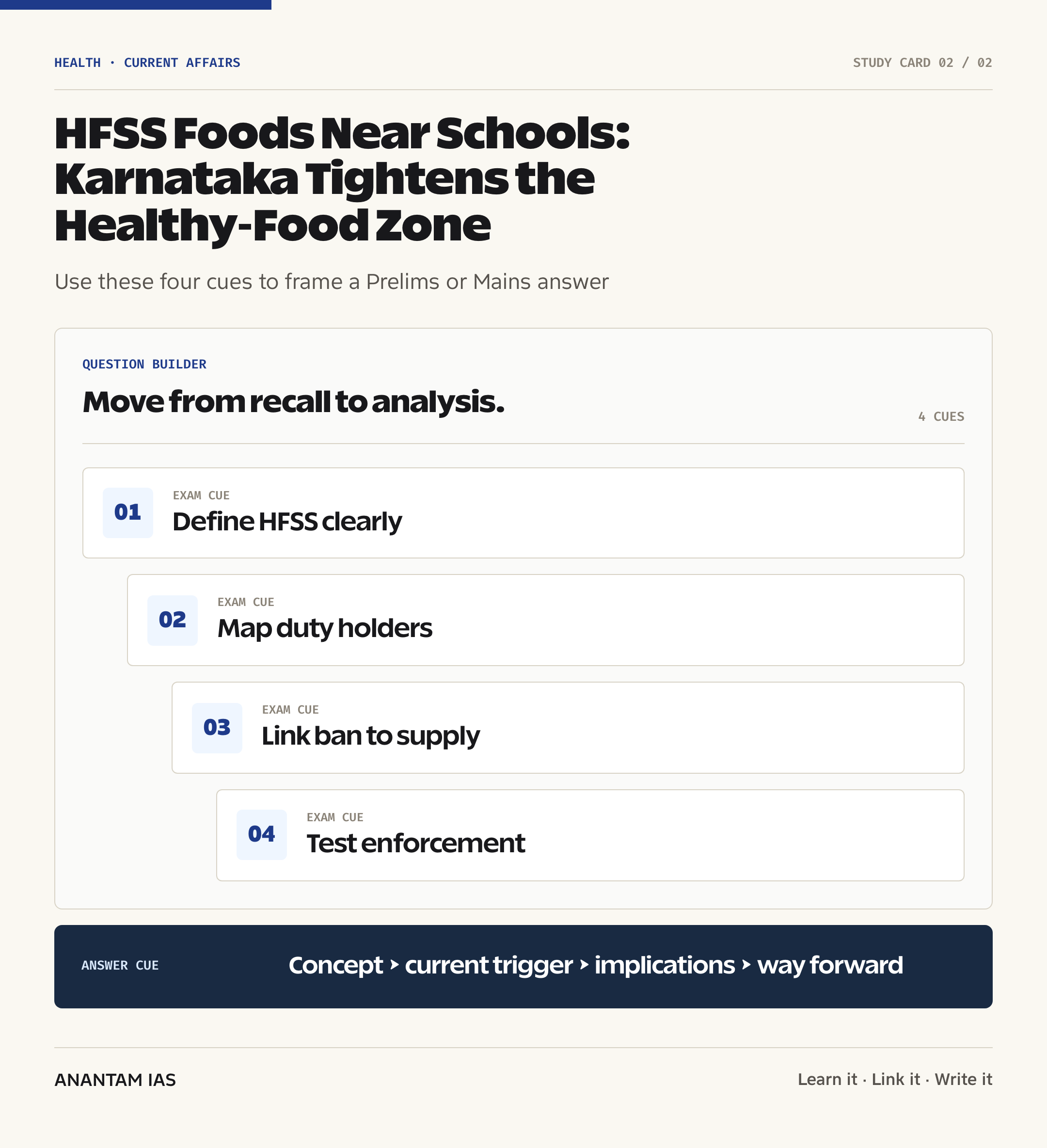
HFSS is a policy shorthand for foods whose nutrient profile is high in fats, salt or sugar, but the legal test must follow the wording and standards of.
- India’s school-food rules refer specifically to products high in saturated fat, trans-fat, added sugar or sodium, which is more precise than the everyday label junk food.
- HFSS classification focuses on nutrient composition, not whether a product is packaged, foreign, branded or sold by a large company.
- A broad food-category ban can misclassify products, so enforcement needs clear nutrient thresholds, labels, sampling protocols and reasoned orders.
- The health concern is repeated exposure to energy-dense, nutrient-poor options that can displace balanced meals during a formative stage of life.
- This topic complements the ICMR-NIN processed-food framework, which separates the degree of processing from nutritional quality.
The 2020 National Framework
The Food Safety and Standards (Safe Food and Balanced Diets for Children in School) Regulations, 2020 create duties for schools, food businesses and enforcement authorities.
- A school authority that supplies meals must secure FBO registration; a school hiring a caterer must check that the operator is registered or licensed.
- On-campus food businesses must meet sanitary and hygienic practices, display food-safety information and provide trained supervision where required.
- The rules bar restricted products on the school campus and prohibit their sale or marketing to schoolchildren within 50 metres from the gate in any direction.
- The marketing ban reaches free samples, coupons, rewards, sponsorships and branding on school property, not merely conventional advertisements.
- Schools are encouraged to work towards an Eat Right Campus based on safe food, balanced diets, local seasonal food and reduced food waste.
Karnataka's Operational Push
Karnataka’s advisory converts the national framework into a visible compliance programme covering educational institutions and nearby food establishments.
- The State advisory extends its operational directions across schools and colleges, while the central 2020 regulations are titled and defined around schoolchildren and schools.
- Managements must use warning boards and check campus vendors; Food Safety Officers must inspect establishments near educational institutions.
- The direction to nearby bakeries, hotels, canteens and stalls to obtain licences or registration addresses informality as well as food composition.
- The 134 inspections and 53 samples create an evidence trail, but sanctions should follow laboratory results and due process rather than labels alone.
- The State’s meal advice favours cereals, millets, pulses, dairy, eggs, fruits and vegetables and asks institutions to avoid reheated oils.
Why the School Food Environment Matters
Children’s diets reflect the availability, price, placement and promotion of food around them, making the school food environment a public-health intervention point.
- Children spend a substantial part of the day at school, so repeated exposure can shape preferences and habits that continue into adulthood.
- WHO’s 2026 school-food guideline supports nutrition standards for foods served or sold and nudges that make healthier choices easier.
- WHO also recommends comprehensive mandatory protection from HFSS marketing because marketing affects children’s food choices, attitudes and dietary intake.
- Healthy diets support learning, concentration and attendance, while long-term prevention can reduce avoidable non-communicable disease costs.
- India faces a double burden of malnutrition: undernutrition and micronutrient gaps can coexist with overweight, obesity and metabolic risk.
Way Forward
Make the Rule Measurable
- Publish a plain-language nutrient-profile protocol, illustrative product list, sampling method and appeal process for consistent decisions.
- Geo-tag school gates and covered establishments so the 50-metre zone is clear to vendors, parents and enforcement teams.
- Report inspections, test outcomes and corrective action in aggregated form through a public dashboard without naming children.
Conclusion
- Karnataka’s advisory is best understood as an implementation test for preventive health governance .
- Lasting impact will depend on precise standards, fair inspection and attractive healthy food.
UPSC Practice Questions
Prelims MCQ 1
With reference to India’s school-food regulations, consider the following statements:
- They were framed under the Food Safety and Standards Act, 2006.
- Their HFSS restriction is confined to food sold inside school canteens.
- A notified local body may help ensure compliance with the 50-metre rule.
How many of the above statements are correct?
(a) Only one (b) Only two (c) All three (d) None
Answer: (b) Only two
Explanation:
Statements 1 and 3 are correct. The 2020 regulations operate under the 2006 Act, and a notified municipal body, local body or panchayat may help enforce the external zone. Statement 2 is wrong because the restriction also reaches schoolchildren within 50 metres of the gate.
Prelims MCQ 2
Which institution is India’s national food-safety regulator?
(a) National Institute of Nutrition (b) Food Corporation of India (c) Food Safety and Standards Authority of India (d) Central Board of Indirect Taxes and Customs
Answer: (c) Food Safety and Standards Authority of India
Explanation:
FSSAI is the national regulator established under the Food Safety and Standards Act, 2006. NIN conducts nutrition research, while FCI primarily manages procurement, storage and distribution of foodgrains.
UPSC Mains Questions
- Regulating HFSS foods near schools is a test of preventive health as well as regulatory capacity. Analyse how nutrient standards, healthy alternatives, nutrition literacy and coordinated enforcement can convert a spatial restriction into durable gains for child health. (250 words)
- India’s school-food framework distributes responsibility across FSSAI, State Food Authorities, education departments, school managements and local bodies. Examine the strengths and accountability gaps of this multi-level design, with reference to Karnataka’s recent advisory and the challenge of enforcing the external food zone. (250 words)
Sources: Food Safety and Standards Authority of India and The Hindu.
Frequently Asked Questions
What are HFSS foods?
HFSS foods are foods high in fat, salt or sugar. India’s school-food regulations use the more specific formulation of products high in saturated fat, trans-fat, added sugar or sodium. The classification should rest on nutrient standards and evidence, not simply.
What does Karnataka’s advisory prohibit?
The July 24 advisory prohibits sale, free distribution, advertising and promotion of covered HFSS products on school and college campuses and within a 50-metre radius. It also directs institutions to display warnings, requires nearby food businesses to meet licensing.
Why is the 50-metre rule important?
The 50-metre zone extends child protection beyond the formal campus to the immediate food environment. It reduces the contradiction between nutrition education inside school and aggressive availability or promotion just outside the gate. Its impact depends on clear mapping, local-body.
Who enforces school food rules?
Enforcement is shared. FSSAI supplies the national regulatory framework; State Food Authorities conduct surveillance and inspections; school authorities control campus food; education departments can act on institutional non-compliance; and notified municipal bodies or panchayats may help enforce the rule around.
Does a ban alone improve nutrition?
A restriction can reduce exposure, but it won’t automatically produce a balanced diet. Schools also need affordable local meals, safe water, hygienic kitchens, nutrition education and student acceptance. Clear nutrient criteria matter because vague category labels can encourage inconsistent.