Prison Technology: AI Surveillance, Signal Jammers and Proportionality
Why in News?
Karnataka’s Cabinet approved AI-based surveillance cameras, portable signal jammers and regulated inmate calling for prisons on 21 August 2026, while nearby residents reported that existing jammers disrupt lawful mobile and internet services.
- The decision followed reported instances of unauthorised mobile-phone use inside Bengaluru’s Parappana Agrahara Central Prison.
- The proposed package combines AI-assisted camera surveillance, portable signal jammers and regulated calling facilities for inmates.
- Residents around the prison reported disruption to calls, OTP-based transactions, Wi-Fi and internet-dependent services, including difficulty making emergency calls.
- Cabinet approval marks a policy and procurement stage; it does not establish that the new equipment is installed, technically contained or proven effective.
- Illicit phones can enable intimidation, fraud, coordination of crime or circulation of prohibited content, making communication control a legitimate prison-security objective.
- A jammer that extends beyond the prison can burden neighbours, workers, visitors and emergency communication, shifting the cost of security onto lawful users.
- AI may help screen camera feeds, but accountability remains human: agencies must define alerts, verify them and document decisions before taking coercive action.
UPSC Relevance
Prelims Relevance
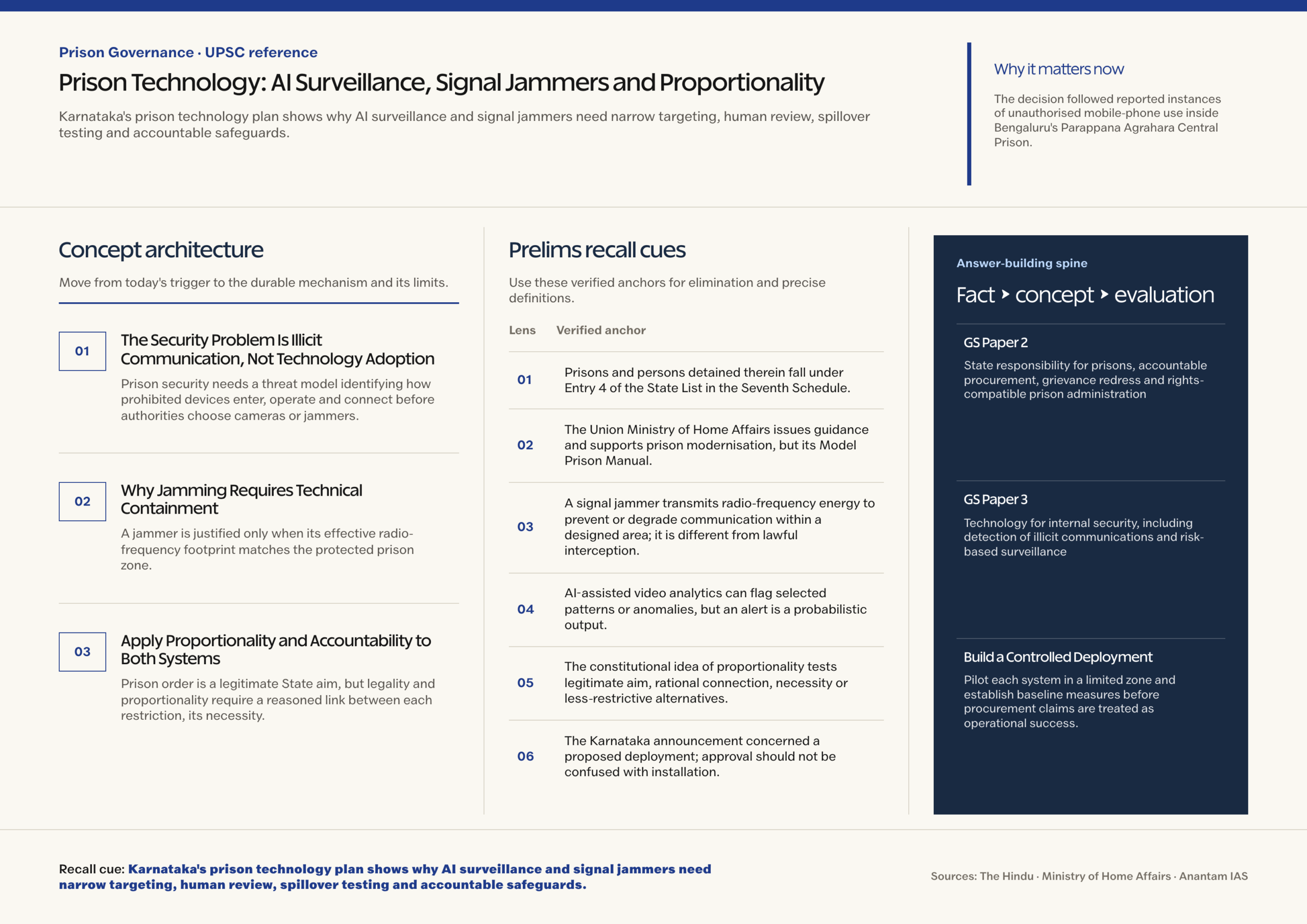
- Prisons and persons detained therein fall under Entry 4 of the State List in the Seventh Schedule, so prison administration is primarily a State responsibility.
- The Union Ministry of Home Affairs issues guidance and supports prison modernisation, but its Model Prison Manual, 2016 is a model for adoption by States and Union Territories.
- A signal jammer transmits radio-frequency energy to prevent or degrade communication within a designed area; it is different from lawful interception, which accesses communication under legal authority.
- AI-assisted video analytics can flag selected patterns or anomalies, but an alert is a probabilistic output, not automatic proof of misconduct.
- The constitutional idea of proportionality tests legitimate aim, rational connection, necessity or less-restrictive alternatives, and the balance between benefit and rights impact.
- The Karnataka announcement concerned a proposed deployment; approval should not be confused with installation, successful testing or measured reduction in illicit communication.
Mains Relevance
GS Paper 2
- State responsibility for prisons, accountable procurement, grievance redress and rights-compatible prison administration
- Application of legality, necessity, proportionality and procedural safeguards to technology-led restrictions
GS Paper 3
- Technology for internal security, including detection of illicit communications and risk-based surveillance
- Cyber-physical spillovers, false positives, system audits, human oversight and resilient emergency communication
Essay
- Security technology earns legitimacy when it narrows harm, preserves lawful activity and remains answerable to evidence rather than technological claims.
Background and Context
The Security Problem Is Illicit Communication, Not Technology Adoption
Prison security needs a threat model identifying how prohibited devices enter, operate and connect before authorities choose cameras or jammers, because procurement without diagnosis can displace risk.
- An illicit phone can connect inmates to external criminal networks, enable threats or fraud, compromise witnesses and move operational information beyond prison walls.
- Technology addresses only part of that chain. Searches, staff integrity, visitor controls, inventory records and investigation of supply routes remain essential to prevent device entry and identify organized facilitation.
- AI-assisted cameras may prioritize footage or flag configured events, reducing monitoring burden, but performance depends on camera placement, lighting, training data, thresholds and maintenance.
- False positives can trigger unnecessary searches or disciplinary attention, while false negatives create false confidence; both require human verification and recorded outcomes.
- Procurement should begin with measurable objectives such as reduced device recovery, faster incident detection or fewer verified breaches, not a vague promise that AI itself creates security.
Why Jamming Requires Technical Containment
A jammer is justified only when its effective radio-frequency footprint matches the protected prison zone, measurably suppresses prohibited connections and avoids unnecessary interference outside it.
- Radio coverage does not respect a prison wall automatically; terrain, building materials, antenna placement, power and network bands influence where interference actually reaches.
- Portable equipment may allow targeted use, but portability alone does not guarantee precision. Authorities need site surveys, calibrated power, directional design and boundary testing before routine operation.
- Reported spillovers around Parappana Agrahara affect calls, OTP delivery and internet access, showing how a security measure can impair lawful communication, livelihoods, payments and ordinary services.
- Emergency risk deserves a separate protocol: administrators should test access at surrounding homes, roads and institutions and provide a rapid shutdown and escalation channel when harmful interference appears.
- Regulated inmate calling facilities complement enforcement by providing an authorised, logged and time-bound channel, reducing incentives to seek covert alternatives while supporting family contact.
Apply Proportionality and Accountability to Both Systems
Prison order is a legitimate State aim, but legality and proportionality require a reasoned link between each restriction, its necessity, its available alternatives and its wider effects.
- The authority, purpose and operating limits of surveillance and jamming should be written clearly, with designated responsibility for activation, access, review, maintenance, complaints and incident response.
- Necessity asks whether an equally effective, less restrictive mix exists, such as better perimeter detection, managed calling, targeted searches or narrower jamming zones.
- Camera analytics should collect only what the defined security purpose requires, with controlled access, retention limits and deletion schedules that reduce function creep and insider misuse.
- A human reviewer should confirm consequential alerts, record the evidence used and permit challenge through prison procedures; an algorithmic score must not become self-validating proof.
- Independent technical audits should test accuracy, outages, cybersecurity, interference boundaries and complaint patterns, converting procurement claims into verifiable public accountability without exposing security-sensitive details.
Way Forward
Build a Controlled Deployment
- Pilot each system in a limited zone and establish baseline measures before procurement claims are treated as operational success.
- Map the jammer footprint across bands and times, publish a complaint channel, protect emergency access and require immediate corrective action for confirmed spillover.
- Adopt written rules for camera purposes, alert review, retention, access logs, disciplinary use, vendor access and periodic privacy and cybersecurity audits.
- Combine technology with searches, staff vetting, anti-corruption controls, regulated inmate calls and investigation of device-supply routes through a layered security model.
Conclusion
- Karnataka’s decision should be assessed as an approved modernisation proposal, not proof that AI surveillance or portable jammers are installed, accurate, contained or effective across different prison conditions and sustained operating loads.
- A sound policy targets illicit communication while minimizing harm to lawful users through technical containment, human review, controlled data, emergency safeguards and independent audits backed by published performance criteria and transparent complaint data.
- In a Mains answer, organize the solution around a layered sequence: prevent devices, detect risks, restrict narrowly, preserve regulated contact, audit outcomes, correct failures and provide accessible redress to prisoners and affected neighbours during implementation and review.
UPSC Practice Questions
Prelims MCQ 1
With reference to prison administration and security technology in India, consider the following statements:
- Prisons and persons detained therein are included in the State List.
- The Model Prison Manual, 2016 automatically operates as binding law in every State.
- A signal jammer and lawful interception perform the same technical function.
How many of the above statements are correct?
(a) Only one (b) Only two (c) All three (d) None
Answer: (a) Only one
Explanation:
Only Statement 1 is correct. The Manual is a model for adoption by States and Union Territories. Jamming disrupts communication, whereas lawful interception accesses communication under legal authority.
Prelims MCQ 2
Which option best expresses the necessity limb of the proportionality test?
(a) The restriction must be announced by the executive (b) The restriction must use the newest available technology (c) No equally effective but less restrictive alternative should be available (d) The restriction must apply uniformly across all locations
Answer: (c) No equally effective but less restrictive alternative should be available
Explanation:
Necessity asks whether the legitimate objective can be achieved through an equally effective measure that restricts rights less. It is distinct from suitability and final balancing.
UPSC Mains Questions
- Prison modernisation must strengthen security without making technological surveillance self-justifying. Discuss with reference to AI-assisted cameras, human oversight and prisoners’ rights.
- How should public authorities apply proportionality when prison signal jammers disrupt lawful communications in surrounding communities? Suggest technical and institutional safeguards.
Sources: The Hindu and Ministry of Home Affairs.
Frequently Asked Questions
What did the Karnataka Cabinet approve for prisons?
It approved AI-based surveillance cameras and portable signal jammers, alongside regulated calling facilities. The announcement concerns proposed deployment, not verified installation or proven effectiveness.
Why are mobile phones a prison-security concern?
Unauthorised phones can support threats, fraud, witness intimidation or coordination with outside networks. Technology must accompany searches, staff controls and investigation of device-supply routes.
Why can prison signal jammers affect nearby residents?
Radio interference may extend beyond prison walls depending on power, antennas, bands, terrain and building materials. Site surveys and boundary testing are needed to contain the footprint.
Does an AI camera alert prove misconduct?
No. An alert is a system output shaped by data, thresholds and conditions. A trained human must verify relevant evidence before any consequential or disciplinary action.
What does proportionality require in this case?
Authorities should establish legality and a legitimate security aim, show a rational connection, consider equally effective less-restrictive options, balance wider harm and maintain safeguards against misuse.