Kaziranga Eco-Sensitive Zone: The Debate Over a One-Kilometre Buffer
Why in News?
The Kaziranga eco-sensitive zone has returned to public debate after Assam indicated that the proposed buffer around the protected area could be limited to about one kilometre in width.
- The Hindu reported the controversy as a dispute over the width of the proposed ESZ and the consequences of reducing the wider default regulatory reach associated with an unnotified protected area.
- The one-kilometre figure should be treated as a proposal or policy indication unless and until the legally prescribed process produces an applicable draft or final notification with mapped boundaries.
- The Ministry of Environment, Forest and Climate Change’s public ESZ notification inventory did not show a final Kaziranga ESZ notification when checked for this note.
- The debate is not simply ‘protection versus development’. It concerns which activities should be prohibited, regulated or promoted at different locations and what ecological evidence should determine the outer boundary.
- Kaziranga’s case is especially sensitive because wildlife movement, flood escape, hydrology and tourism pressure operate across the park boundary rather than stopping at a fixed radial distance.
- An Eco-Sensitive Zone is intended to act as a transition from the higher protection inside a national park or sanctuary to the more intensively used landscape outside it.
- ESZs are regulatory zones, not blanket no-human zones. Their notifications normally classify activities as prohibited, regulated or permissible and provide for a zonal master plan and monitoring mechanism.
- A narrow uniform strip may simplify demarcation, but ecological risk is not uniform. Corridors, wetlands, hill slopes, catchments and high-pressure tourism nodes may require different treatment.
UPSC Relevance
Prelims Relevance
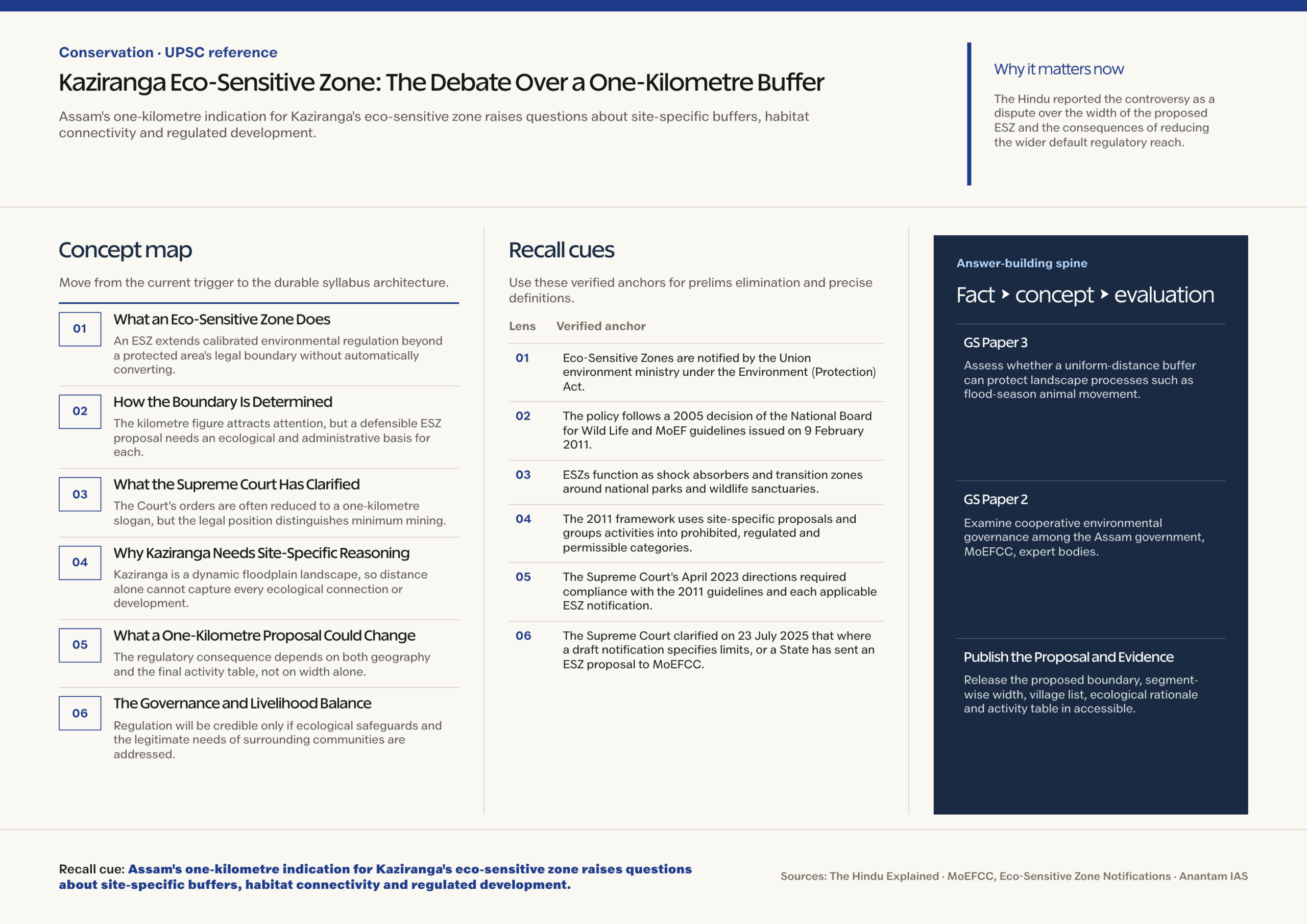
- Eco-Sensitive Zones are notified by the Union environment ministry under the Environment (Protection) Act, 1986 and the Environment (Protection) Rules, 1986.
- The policy follows a 2005 decision of the National Board for Wild Life and MoEF guidelines issued on 9 February 2011.
- ESZs function as shock absorbers and transition zones around national parks and wildlife sanctuaries; they are distinct from the legally notified protected area itself.
- The 2011 framework uses site-specific proposals and groups activities into prohibited, regulated and permissible categories.
- The Supreme Court’s 26 April 2023 directions required governments to follow the 2011 guidelines and the applicable ESZ notification for each protected area.
- The Supreme Court clarified on 23 July 2025 that where a draft notification specifies limits, or a State has sent an ESZ proposal to MoEFCC, those proposed limits apply pending the relevant decision rather than an.
Mains Relevance
GS Paper 3
- Assess whether a uniform-distance buffer can protect landscape processes such as flood-season animal movement, hydrological connectivity and habitat continuity.
- Explain how activity-based zoning can reconcile biodiversity protection with lawful livelihoods, settlements and public infrastructure.
GS Paper 2
- Examine cooperative environmental governance among the Assam government, MoEFCC, expert bodies, local authorities and courts.
- Discuss why publication of maps, reasons and monitoring data improves regulatory legitimacy and reduces conflict.
Essay
- A boundary is administratively precise but ecologically incomplete.
Background and Context
What an Eco-Sensitive Zone Does
An ESZ extends calibrated environmental regulation beyond a protected area’s legal boundary without automatically converting surrounding land into a national park.
- The legal route is the Environment (Protection) Act, 1986, read with the Environment (Protection) Rules. The Union government issues a notification describing the boundary, governance arrangement and activity table.
- The policy idea is a transition zone. Activities with serious ecological effects may be prohibited, others may need scrutiny or conditions, and low-impact livelihood or conservation activities may continue or be promoted.
- A notification commonly requires a Zonal Master Plan that integrates land use, water bodies, catchments, forests, settlements, tourism and infrastructure. A monitoring committee then oversees compliance with the notification.
- ESZ status does not by itself cancel lawful ownership or erase villages. The practical effect depends on the exact activity table, mapped extent and other applicable environmental, forest and wildlife laws.
- The Ministry’s ESZ notification inventory shows that widths differ across protected areas. Site-specific ecology, geography and existing land use matter more than a single national template.
How the Boundary Is Determined
The kilometre figure attracts attention, but a defensible ESZ proposal needs an ecological and administrative basis for each segment of the boundary.
- The State’s role is to prepare and forward a proposal with the protected-area boundary, proposed ESZ extent, villages, land uses, ecological features, activity rules and enforcement arrangements.
- MoEFCC examines the proposal and may publish a draft notification for objections and suggestions. The final instrument can change after scrutiny; a political announcement is not a substitute for this process.
- The Ministry’s 2014 clarification said the basis for identifying an ESZ must be available in the proposal. It highlighted habitats and corridors beyond protected areas and the need for the Wildlife Warden’s technical role in governance.
- A boundary may vary in width. A river, corridor, steep slope, wetland or dense settlement can justify a segment different from another part of the same perimeter.
- For Kaziranga, the claim that the buffer ‘has been reduced to one kilometre’ would be premature without an applicable mapped draft or final notification. The safe formulation is that Assam has indicated or proposed a one-kilometre.
What the Supreme Court Has Clarified
The Court’s orders are often reduced to a one-kilometre slogan, but the legal position distinguishes minimum mining protection, site-specific ESZ limits and final notification rules.
- On 3 June 2022, the Supreme Court directed a minimum one-kilometre ESZ around protected forests, national parks and wildlife sanctuaries, subject to the qualifications stated in its judgment.
- On 26 April 2023, the Court modified the universal approach and restored the central role of the 2011 ESZ guidelines and site-specific notifications. It also maintained that mining within one kilometre of a national park or.
- In a 28 April 2023 clarification, the Court held that commercial mining remains barred throughout an ESZ even if the notified zone extends beyond one kilometre. The one-kilometre mining rule is a floor, not permission to.
- On 23 July 2025, the Court stated that a draft notification’s specified limits, or limits in a proposal sent by a State to MoEFCC, should be followed instead of treating one kilometre as the.
- This makes the content and procedural status of any Kaziranga proposal decisive. Students should separate an ESZ boundary rule from a mining prohibition and from project-specific wildlife or environmental clearances.
Why Kaziranga Needs Site-Specific Reasoning
Kaziranga is a dynamic floodplain landscape, so distance alone cannot capture every ecological connection or development risk.
- The park is influenced by the Brahmaputra floodplain, seasonal water movement, grasslands, wetlands and adjoining higher terrain. Ecological functions can extend beyond the line drawn around the national park.
- Animals may move outside the protected boundary, especially during flood stress. A buffer assessment should identify actual movement routes, bottlenecks, road-crossing risks and disturbance sources rather than assume equal sensitivity everywhere.
- Tourism construction, road expansion, lighting, traffic, waste and water demand can produce cumulative pressure even when individual projects appear small. The ESZ process should evaluate their combined spatial effect.
- Kaziranga’s southern landscape also has distinct court-ordered protections linked to catchments and wildlife corridors. Those safeguards do not disappear merely because a future ESZ has a particular width.
- The 13 August note on riverbed mining near Kaziranga explains the separate catchment-scale dispute. The present issue is narrower: how the ESZ boundary and activity regime should be designed.
Way Forward
Publish the Proposal and Evidence
- Release the proposed boundary, segment-wise width, village list, ecological rationale and activity table in accessible formats.
- Clearly state whether the document is an internal indication, a State-approved proposal sent to MoEFCC, a published draft notification or a final notification.
- Provide enough time and local-language access for affected communities and independent experts to study the maps.
Conclusion
- Kaziranga’s ESZ debate should not be settled by choosing between two round numbers.
- One kilometre may be appropriate along some segments, but it cannot be presumed adequate everywhere before the evidence and legal proposal are public.
UPSC Practice Questions
Prelims MCQ 1
With reference to Eco-Sensitive Zones around national parks and wildlife sanctuaries, consider the following statements:
- They are notified by the Union Government under the Environment (Protection) Act, 1986.
- Every activity, including existing agriculture and residence, is prohibited inside an ESZ.
- The width of an ESZ may vary around different parts of the same protected area.
How many of the above statements are correct?
(a) Only one (b) Only two (c) All three (d) None
Answer: (b) Only two
Explanation:
Statements 1 and 3 are correct. ESZs are notified under the Environment (Protection) framework and can have variable widths. Statement 2 is incorrect because ESZs classify activities as prohibited, regulated or permissible; they are not blanket exclusion zones.
Prelims MCQ 2
Which one of the following best describes the Supreme Court’s position on mining and Eco-Sensitive Zones?
(a) Mining is permissible anywhere beyond one kilometre from a protected-area boundary. (b) Mining is decided exclusively by State governments without reference to ESZ notifications. (c) Mining is barred within one kilometre of a national park or sanctuary and remains barred throughout a wider ESZ where the applicable ESZ extends farther. (d) A final ESZ notification automatically cancels every earlier court direction concerning the same landscape.
Answer: (c) Mining is barred within one kilometre of a national park or sanctuary and remains barred throughout a wider ESZ where the applicable ESZ extends farther.
Explanation:
The Court clarified in April 2023 that the one-kilometre prohibition is a minimum mining safeguard. Commercial mining prohibited by ESZ rules cannot be allowed merely because a site lies beyond one kilometre while remaining inside a wider ESZ.
UPSC Mains Questions
- A uniform radial buffer is administratively simple but may be ecologically weak. Discuss with reference to the design of Eco-Sensitive Zones around protected areas.
- The Kaziranga ESZ controversy is a test of evidence-based cooperative environmental governance. Examine the roles of the State government, MoEFCC, courts and local communities.
Sources: The Hindu Explained and MoEFCC, Eco-Sensitive Zone Notifications.
Frequently Asked Questions
Has Kaziranga’s Eco-Sensitive Zone been finally reduced to one kilometre?
No final reduction should be assumed from a public indication alone. An applicable ESZ boundary depends on the formal proposal, draft and final notification process. Until the official mapped instrument and its procedural status are clear, one kilometre should be.
What is the purpose of an Eco-Sensitive Zone?
An ESZ creates a regulated transition around a national park or wildlife sanctuary. It seeks to reduce harmful land-use and development pressures while allowing compatible livelihoods and activities under stated conditions. The notification normally lists prohibited, regulated and permissible uses.
Does an ESZ prohibit all construction and livelihoods?
No. An ESZ is not automatically a no-construction or no-residence belt. The effect depends on the notification’s activity table and other applicable laws. High-impact projects may be prohibited or regulated, while existing lawful uses, civic needs and low-impact local activities.
Why may one kilometre be inadequate in some parts of Kaziranga?
Ecological sensitivity does not follow a uniform circle. Wildlife routes, flood refuges, wetlands, catchments, slopes and tourism pressure may extend beyond one kilometre in particular segments. A site-specific proposal should map these features and justify why each part of the.
Who notifies an Eco-Sensitive Zone?
The State government prepares and forwards the proposal with maps, ecological details and proposed regulations. The Union Ministry of Environment, Forest and Climate Change scrutinises it and issues the draft and final notifications under the Environment (Protection) framework, following the.