KCC-MISS Assessment: What ₹2.30 Farm Value per ₹1 Support Means
Why in News?
The Ministry of Finance told the Lok Sabha on 3 August 2026 that a third-party assessment by the Institute for Social and Economic Change, Bengaluru, had examined KCC-MISS across India’s diverse agro-regions.
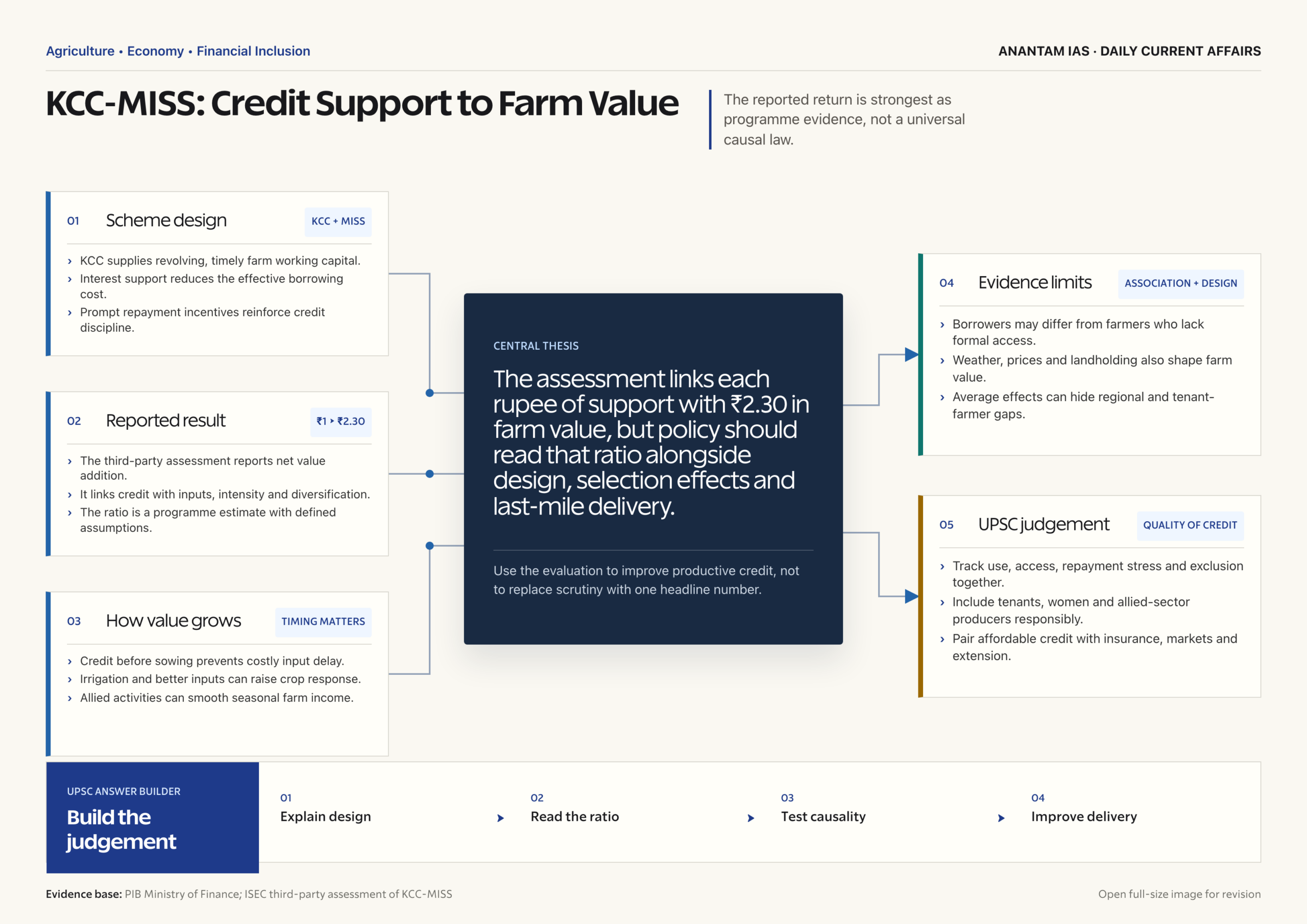
- The reported benefit is net value addition in agriculture and allied activities. It is not ₹2.30 deposited into a farmer’s account and not a guaranteed private return for every borrower.
- ISEC found higher cultivated area, cropping intensity, multi-season cultivation and more diversified crop portfolios among KCC-MISS farmers, supported by reliable irrigation and concessional credit.
- Adequate working capital improved the timeliness of input use, while recipients of the Prompt Repayment Incentive showed better credit discipline and strengthened lenders’ confidence.
- The assessment linked the scheme with dairy and livestock expansion, crop-income supplementation and working capital for inland fisheries, including a diversification role in the North-Eastern Region.
- The government reported an estimated ₹1.87 lakh crore subsidy outlay from inception through 2024-25. This is a cumulative fiscal figure, not the annual cost of the current version of MISS.
- Agriculture is seasonal, input-intensive and exposed to weather and price shocks. A farmer who receives credit after the sowing window may have a sanctioned loan but still lose the productive purpose of that loan.
- KCC is the credit-delivery instrument; MISS is the fiscal mechanism that lowers the price of eligible short-term KCC borrowing. Keeping the two distinct prevents a common Prelims error.
- The finding strengthens the case for affordable institutional credit, but the policy test is not aggregate disbursement alone. It is whether smallholders, tenants, women farmers and allied-activity producers obtain timely, adequately sized and usable credit.
UPSC Relevance
Prelims Relevance
- Kisan Credit Card was introduced in 1998 as a flexible single-window credit facility for cultivation and associated farm needs.
- KCC covers short-term crop production, post-harvest expenses, produce marketing, limited household consumption, maintenance of farm assets and investment credit for agriculture and allied activities.
- Eligible borrowers include owner cultivators, joint borrowers, tenant farmers, oral lessees and sharecroppers, as well as farmer SHGs and JLGs under the RBI framework.
- Commercial banks, Regional Rural Banks, Small Finance Banks and cooperative institutions implement the KCC scheme under the applicable regulatory framework.
- MISS subsidises eligible short-term agricultural loans routed through KCC; KCC itself can also contain components outside the subsidised short-term portion.
- Under the current design described by official sources, eligible short-term KCC loans carry a concessional rate of 7% per annum, supported by a 1.5% interest subvention to lending institutions.
Mains Relevance
GS Paper 3
- Assess the role of timely institutional working capital in raising cropping intensity, input productivity, diversification and agricultural value addition.
- Evaluate interest subvention against alternative uses of public money such as irrigation, extension, storage, insurance and long-term agricultural investment.
GS Paper 2
- Examine inclusion and accountability in digital farm-credit delivery through the Kisan Rin Portal, Jan Samarth, e-KCC and KRISHIKA.
- Discuss Centre-state-bank coordination, grievance redress and the risks of excluding tenants or farmers with incomplete land and identity records.
Essay
- Cheap credit creates value only when it arrives before the productive decision.
Background and Context
KCC and MISS perform different jobs
The policy architecture becomes clear once the credit product is separated from the interest subsidy.
- The Kisan Credit Card is a revolving and flexible bank-credit arrangement. The sanctioned limit is based on the crop’s scale of finance, cultivated area, post-harvest and household needs, farm-asset maintenance, insurance and any approved term-loan component.
- The RBI framework allows one window to combine a short-term credit limit for recurring needs with a longer-term component for agricultural and allied investment. The repayment pattern should reflect harvest or income-generation cycles.
- The Interest Subvention Scheme began in 2006-07; the Modified Interest Subvention Scheme version was introduced in 2022 with a 1.5% subvention to lenders and a 3% Prompt Repayment Incentive for eligible farmers.
- MISS does not turn every KCC withdrawal into a 4% loan. The concessional benefit applies to the eligible short-term amount and the 4% effective rate depends on prompt repayment.
- A useful answer phrase is: KCC improves the availability and flexibility of formal credit, while MISS improves its affordability and rewards repayment discipline.
Who can access KCC and what can it finance?
KCC is broader than a landowner’s seasonal crop loan, though access on the ground can still depend heavily on documents and bank appraisal.
- The RBI master circular lists individual or joint owner cultivators, tenant farmers, oral lessees, sharecroppers, farmer Self Help Groups and Joint Liability Groups as eligible categories.
- The short-term portion can finance seeds, fertiliser, pesticides, labour and other crop costs, as well as approved post-harvest, marketing, consumption and farm-maintenance needs.
- For fisheries, eligible working capital may include seed, feed, fertiliser, fuel, ice, labour, lease rent and landing charges. For animal husbandry, it may include feed, veterinary support, labour, water and electricity.
- KCC for allied activities matters because dairy, livestock and fisheries generate cash flows on a schedule different from a crop harvest. The credit limit and repayment design should match the activity’s production cycle.
- Formal eligibility does not automatically produce inclusion. Tenants, oral lessees and women cultivators may lack recorded land rights or activity documentation, while remote borrowers may face branch distance, digital friction and weak awareness.
How the subsidy changes the farmer's cost of credit
The scheme uses both a lender-side subsidy and a borrower-side repayment incentive.
- On an eligible short-term KCC loan, the farmer is charged a concessional 7% annual rate. The Union government supports participating lending institutions through a 1.5% interest subvention.
- A borrower who repays within the prescribed period can receive the 3% Prompt Repayment Incentive, reducing the effective cost on the eligible amount to 4% per annum.
- The PRI creates a behavioural incentive: timely repayment lowers the farmer’s cost and may preserve the bank’s willingness to renew or expand working capital.
- The 2025-26 policy change raised the MISS-linked limit from ₹3 lakh to ₹5 lakh. A larger nominal ceiling can help when input costs have risen, but sanction size still depends on assessed need.
- The collateral-free limit of ₹2 lakh is a separate threshold. Collateral-free does not mean interest-free, documentation-free or appraisal-free, and a higher KCC limit does not remove bank credit assessment.
What the ISEC assessment reports
The assessment connects affordable working capital with both farm production and repayment behaviour.
- The headline estimate says every ₹1 invested under KCC-MISS contributes ₹2.30 to net value addition in agriculture and allied activities. The denominator should be read as scheme support or investment, not as.
- Beneficiary farmers reportedly cultivated larger areas, achieved higher cropping intensity and adopted more diversified crop portfolios across seasons. Reliable irrigation and concessional credit worked as complementary conditions.
- Timely working capital allowed inputs to be purchased and applied closer to the agronomic window. This channel matters because late seed, fertiliser, feed or veterinary expenditure can reduce output even when finance eventually arrives.
- PRI beneficiaries showed better credit discipline, which may improve lender confidence and subsequent credit access. This is an institutional benefit as well as a private borrowing benefit.
- The scheme supported dairy and livestock expansion and inland-fisheries working capital, helping households diversify away from complete dependence on one seasonal crop.
Way Forward
Publish an auditable evaluation package
- Release the ISEC report with the sampling frame, agro-regional coverage, beneficiary and comparison groups, survey instruments, definition of net value addition and sensitivity checks.
- Report outcomes by landholding, tenancy status, gender, social group, irrigation access, state, bank type and crop or allied activity so the average does not hide exclusion.
- Separate correlation from estimated causal impact and attach confidence intervals or robustness ranges to the headline return figure.
Conclusion
- The ISEC assessment offers a strong policy signal: affordable and timely KCC working capital can support cropping intensity, diversification, allied livelihoods and repayment discipline.
- A balanced UPSC judgement should add two conditions.
UPSC Practice Questions
Prelims MCQ 1
With reference to the Kisan Credit Card (KCC) and Modified Interest Subvention Scheme (MISS), consider the following statements:
- Tenant farmers, oral lessees and sharecroppers can be eligible under the KCC framework.
- The Prompt Repayment Incentive can reduce the effective interest rate on the eligible short-term loan to 4% per annum.
- Every loan component sanctioned under a KCC automatically receives MISS benefit and requires no credit appraisal.
How many of the above statements are correct?
(a) Only one (b) Only two (c) All three (d) None
Answer: (b) Only two
Explanation:
Statements 1 and 2 are correct. RBI’s KCC framework includes tenants, oral lessees and sharecroppers, and prompt repayment can lower the effective rate on the eligible short-term amount to 4%. MISS does not automatically cover every KCC component, and normal documentation and appraisal rules still apply.
Prelims MCQ 2
Which one of the following best describes the ₹2.30 figure reported in the ISEC assessment of KCC-MISS?
(a) A guaranteed ₹2.30 cash transfer to each farmer for every ₹1 borrowed (b) A uniform 230% profit earned by every KCC account holder (c) Reported net value addition in agriculture and allied activities per ₹1 invested under KCC-MISS (d) The interest paid by banks to the Union government on each subsidised loan
Answer: (c) Reported net value addition in agriculture and allied activities per ₹1 invested under KCC-MISS
Explanation:
The Ministry of Finance reported ISEC’s estimate as ₹2.30 in net value addition per ₹1 invested under KCC-MISS. It is an evaluation estimate at the sector or programme level, not an individual cash transfer, universal profit rate or interest payment.
UPSC Mains Questions
- The success of agricultural credit depends as much on timing and inclusion as on the volume disbursed. Discuss in the light of the third-party assessment of KCC-MISS. (250 words)
- Every ₹1 invested under KCC-MISS reportedly contributes ₹2.30 to agricultural net value addition. Evaluate the evidentiary value and methodological limits of using this estimate to justify farm-credit subsidy. (250 words)
Sources: PIB, Ministry of Finance and Reserve Bank of India.
Frequently Asked Questions
What did the KCC-MISS third-party assessment find?
The Institute for Social and Economic Change reported that every ₹1 invested under KCC-MISS contributes ₹2.30 to net value addition in agriculture and allied activities. It also found positive effects on cropping intensity, multi-season cultivation, input timing, diversification, allied livelihoods.
Does ₹2.30 mean every farmer receives that amount in cash?
No. The figure is a reported estimate of net value addition associated with programme investment. It is not a cash transfer, a guaranteed farmer-level profit or the amount returned by a bank. The public release does not provide the full.
What is the difference between KCC and MISS?
KCC is the bank-credit product that provides flexible finance for crop, post-harvest, household, asset-maintenance and allied needs. MISS is the government subsidy mechanism that lowers the interest cost of an eligible short-term KCC loan and rewards prompt repayment.
Who is eligible for a Kisan Credit Card?
RBI’s framework includes individual or joint owner cultivators, tenant farmers, oral lessees, sharecroppers, and farmer SHGs or JLGs. Separate activity rules cover animal husbandry and fisheries. Actual sanction still depends on documentation, assessed need and the lending institution’s appraisal.
How does the Prompt Repayment Incentive work?
Eligible short-term KCC borrowing is offered at a concessional 7% annual rate. A farmer who repays within the prescribed period can receive a 3% Prompt Repayment Incentive, reducing the effective interest cost on the eligible amount to 4% per annum.