Kerala High Court: No Commercial Filming in Sanctuaries, Parks or Tiger Reserves
Why in News?
A Kerala High Court Division Bench on 19 August 2026 observed that commercial films and television serials cannot be shot in sanctuaries, national parks or tiger reserves.
- The Bench of Justice Raja V. Vijayaraghavan and Justice K.V. Jayakumar heard a plea by filmmaker Tharun Moorthy for the film Athimanoharam.
- The petition sought directions to the Divisional Forest Officer, Ranni, and the Deputy Director, Periyar West Division, Peerumedu, to consider the shooting requests.
- The Travancore Devaswom Board had granted permission subject to Forest clearance. The Deputy Director treated the sites as part of Periyar Tiger Reserve.
- Two locations in the director’s request could be allowed from 18 to 28 August if fees were paid and an agreement executed with the Forest and Wildlife department.
- The petition was dismissed. The court noted the petitioners were still free to challenge the Deputy Director’s denial of permission.
- The exam object is commercial use inside a notified protected area, not a buffer around it.
- A pilgrimage lease does not convert tiger-reserve land into ordinary temple land.
- A High Court observation on a dismissed petition is not a Supreme Court ruling or a WPA amendment.
UPSC Relevance
Prelims Relevance
- Sanctuary: Section 18. National Park: Section 35. Tiger reserve: notified under Section 38V.
- Section 2(24A) defines a protected area as a National Park, sanctuary, conservation reserve or community reserve. A tiger reserve is a separate overlay.
- Section 28: the Chief Wildlife Warden may permit photography and film-making without habitat change or adverse impact on wildlife.
- The State Government notifies a tiger reserve on the recommendation of the National Tiger Conservation Authority.
- Periyar Tiger Reserve in Kerala includes land leased to the Travancore Devaswom Board for the Sabarimala pilgrimage.
- The observation is a Kerala High Court line on a dismissed writ, not a nationwide statutory filming ban.
Mains Relevance
GS Paper 3
- Why commercial filming inside a sanctuary, park or tiger reserve is not ordinary land use under the Wild Life (Protection) Act, 1972.
- How a tiger-reserve overlay under Section 38V sits on, and does not erase, protected-area status.
GS Paper 2
- How a High Court writ can be dismissed while leaving liberty to challenge an administrative denial.
- Why a temple-board lease cannot outrank Forest permission inside a notified reserve.
Essay
- A lease can move pilgrims to a shrine. It cannot un-notify a tiger.
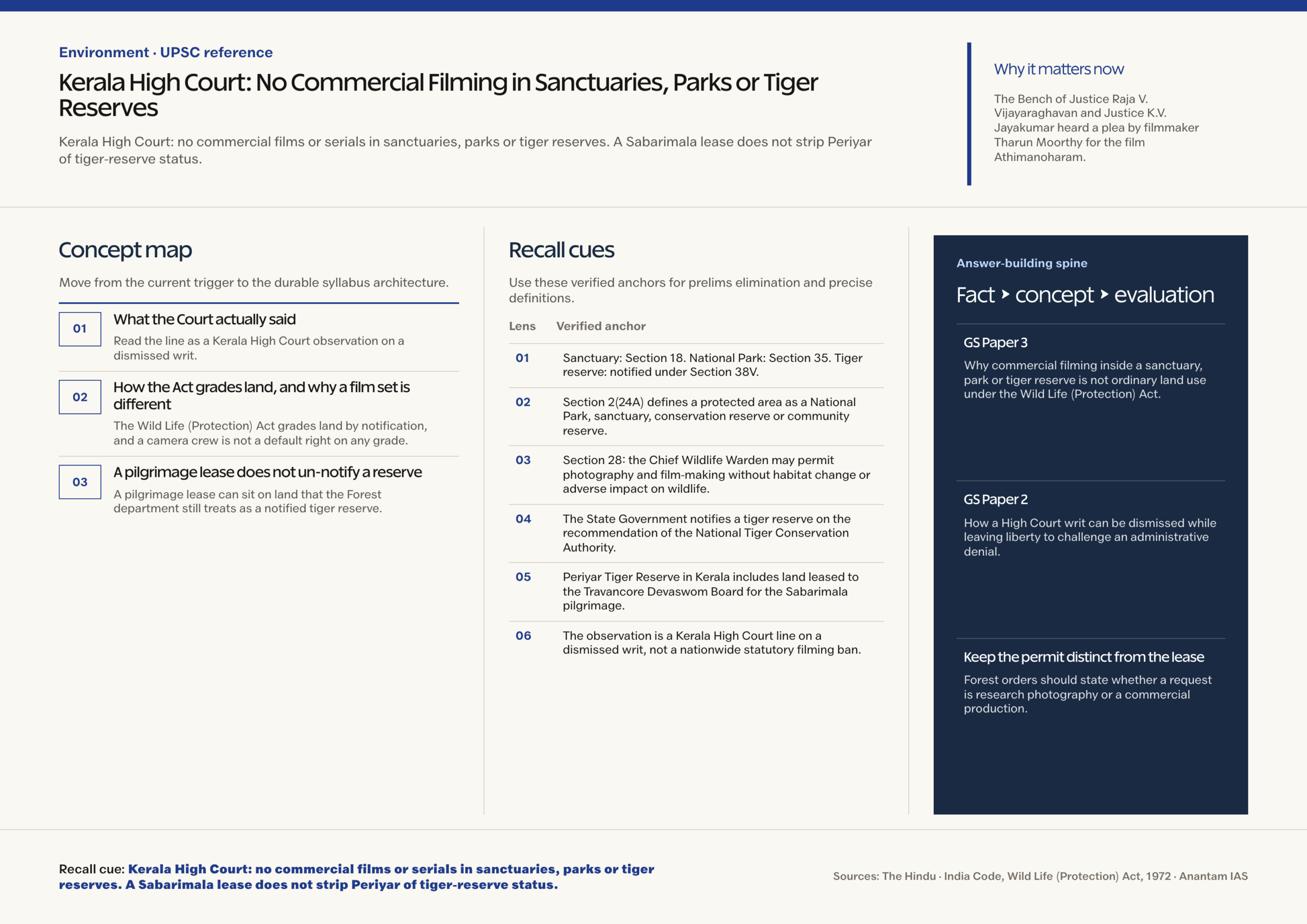
Background and Context
What the Court actually said
Read the line as a Kerala High Court observation on a dismissed writ, not as a new all-India filming statute for every reserve.
- The Division Bench, on the filmmaker’s plea, said permission cannot be granted for shooting commercial films and television serials in wildlife sanctuaries, national parks or tiger reserves.
- The writ asked the Divisional Forest Officer, Ranni, and the Deputy Director, Periyar West Division, Peerumedu, to consider the shooting requests. The court dismissed that plea.
- Two named locations in the director’s request could still be used from 18 to 28 August if required fees were paid and an agreement executed with the Forest and Wildlife department.
- Even after dismissal, the court noted that the petitioners remained free to challenge the Deputy Director’s denial of permission as a separate administrative decision, not a closed filming file.
- The Hindu reported the observation as a High Court line on this plea, not as Parliament rewriting the Wild Life (Protection) Act, 1972.
How the Act grades land, and why a film set is different
The Wild Life (Protection) Act grades land by notification, and a camera crew is not a default right on any grade.
- A sanctuary is declared under Section 18, with regulated entry and permitted uses. A National Park is declared under Section 35 and bars habitat destruction more tightly than a sanctuary.
- A tiger reserve is notified by the State Government on the recommendation of the National Tiger Conservation Authority under Section 38V. Its core is meant to stay inviolate.
- Section 2(24A) lists National Park, sanctuary, conservation reserve and community reserve as protected areas. A tiger reserve is a further overlay, not a fifth name in that list.
- The 2022 amendment of Section 28 lets the Chief Wildlife Warden permit photography and film-making only where there is no habitat change and no adverse impact on wildlife.
- A commercial film or serial brings crews, generators, sets and shooting schedules. That is not ordinary photography or a default use of reserve land. The High Court drew that line for commercial films and serials.
A pilgrimage lease does not un-notify a reserve
A pilgrimage lease can sit on land that the Forest department still treats as a notified tiger reserve.
- After the petition was lodged, the Deputy Director said the requested areas form part of Periyar Tiger Reserve, leased to the Devaswom Board to facilitate the Sabarimala pilgrimage.
- A lease for pilgrimage facilities is only a land-management arrangement. Protected-area and tiger-reserve status come from a WPA notification, not from who holds the lease or who admits a film crew.
- Temple-board permission cannot outrank Forest permission inside a reserve. The Travancore Devaswom Board itself granted its nod only subject to prior permission from Forest officials.
- An eco-sensitive zone is a buffer instrument around a protected area. Today’s dispute is commercial use inside the reserve, not the width of a surrounding belt.
- A tiger reserve still needs inviolate-core logic, as in our note on Buxa tiger reintroduction. Filming is a use question, not a release or corridor question.
Way Forward
Keep the permit distinct from the lease
- Forest orders should state whether a request is research photography or a commercial production.
- Board or temple leases inside reserves should recite that WPA restrictions continue to bind the land.
- Cite High Court observations with the petition outcome: dismissed, with a narrow location window still open.
- A state filming protocol should distinguish non-invasive recording from occupation of habitat by a film set.
Conclusion
- Commercial filming inside a sanctuary, national park or tiger reserve is not ordinary land use, even if a temple board has leased the ground for pilgrimage.
- Cite this as a Kerala High Court observation on a dismissed petition, not as a Supreme Court ruling, a WPA amendment, or a nationwide statutory ban.
- Keep the two-location, fee-and-agreement window in the same answer, or the holding will be overstated as an absolute filming lock with no Forest window at all.
UPSC Practice Questions
Prelims MCQ 1
With reference to commercial filming in protected areas, consider the following statements:
- The Kerala High Court observed that permission cannot be granted for shooting commercial films and television serials in wildlife sanctuaries, national parks or tiger reserves.
- The writ petition seeking directions to Forest officers to consider the shooting request was allowed.
- Under the Wild Life (Protection) Act, 1972, a tiger reserve is notified by the State Government on the recommendation of the National Tiger Conservation Authority.
How many of the above statements are correct?
(a) Only one (b) Only two (c) All three (d) None
Answer: (b) Only two
Explanation:
Statements 1 and 3 are correct. The petition was dismissed, so statement 2 is wrong.
Prelims MCQ 2
Land proposed for a film shoot in Periyar had been leased to the Travancore Devaswom Board for the Sabarimala pilgrimage. Which one of the following is the correct implication?
(a) The lease converts the land into ordinary temple land outside the Wild Life (Protection) Act. (b) Permission from the temple board is a complete substitute for Forest permission. (c) The lease does not, by itself, strip tiger-reserve or protected-area status. (d) The Kerala High Court amended the Wild Life (Protection) Act to create a nationwide filming ban.
Answer: (c) The lease does not, by itself, strip tiger-reserve or protected-area status.
Explanation:
The Deputy Director treated the sites as part of Periyar Tiger Reserve despite the pilgrimage lease. The Board’s own nod was subject to Forest permission. The High Court dismissed the writ; it did not amend the Act.
UPSC Mains Questions
- Commercial filming in a tiger reserve is not ordinary land use. Examine with reference to the Wild Life (Protection) Act, 1972 and the Kerala High Court observation. (250 words)
- A pilgrimage lease over forest land does not extinguish protected-area status. Discuss. (150 words)
Sources: The Hindu and India Code, Wild Life (Protection) Act, 1972.
Frequently Asked Questions
Did the Kerala High Court ban filming nationwide?
No. It observed, on a dismissed Kerala plea, that permission cannot be granted for commercial films and serials in sanctuaries, national parks or tiger reserves. That is not a WPA amendment or a Supreme Court ruling.
What happened to the filmmaker’s petition?
The Division Bench dismissed the writ seeking directions to Forest officers at Ranni and Peerumedu. Petitioners remain free to challenge the Deputy Director’s denial of permission.
Could any shooting still happen?
Yes. Two locations in the director’s request could be allowed from 18 to 28 August if required fees were paid and an agreement was executed with the Forest and Wildlife department.
Does a Sabarimala lease remove Periyar from the WPA?
No. The Deputy Director treated the sites as part of Periyar Tiger Reserve, leased to the Travancore Devaswom Board for pilgrimage. A lease does not un-notify a tiger reserve.
Does the WPA allow any filming in a sanctuary?
Section 28 lets the Chief Wildlife Warden permit photography and film-making without habitat change or adverse impact on wildlife. A commercial film set is not that default permit.