Invasive Species: Preventing Entry Before Managing Spread
Why in News?
The Hindu reported on October 12, 2026, that the Kerala State Biodiversity Board had submitted a policy document recommending prevention, monitoring and management of invasive alien species.
- The reported recommendations include quarantine, risk assessment, scientific identification and community participation.
- The document proposes economic use where eradication is infeasible; this is a management option, not a guarantee of ecological benefit.
- This is a reported policy submission, not evidence that a new invasive-species law has been enacted.
- Prevention addresses the routes that carry organisms; repeated removal treats an invasion after it has already arrived.
- A useful response distinguishes identity, pathway and invasion stage before selecting an intervention.
UPSC Relevance
Prelims Relevance
- Alien species versus invasive alien species.
- Intentional introduction, escape and accidental transport.
- Taxonomic identification and invasion-risk assessment.
- Eradication, containment and long-term control.
Mains Relevance
GS Paper 3
- Biodiversity protection through prevention and early detection.
- Tradeoffs in economic utilisation of invasive biomass.
GS Paper 2
- Coordination between biodiversity, agriculture, fisheries and transport authorities.
Essay
- Preventing ecological damage can be less visible, but more valuable, than repairing it.
Background and Context
Alien Does Not Automatically Mean Invasive
The first decision is biological: establish what the organism is, where it belongs naturally and whether its introduction threatens biodiversity.
- An alien species occurs outside its natural range after introduction; the additional label invasive concerns biodiversity harm associated with establishment or spread, rather than foreign origin alone.
- The Convention on Biological Diversity explanation covers plants, animals and microorganisms: a fish or insect can create an invasion problem just as a visibly spreading weed can.
- Scientific identification establishes the species; risk assessment asks a different question: whether its biology, invasion history and receiving habitat indicate a credible threat needing preventive action.
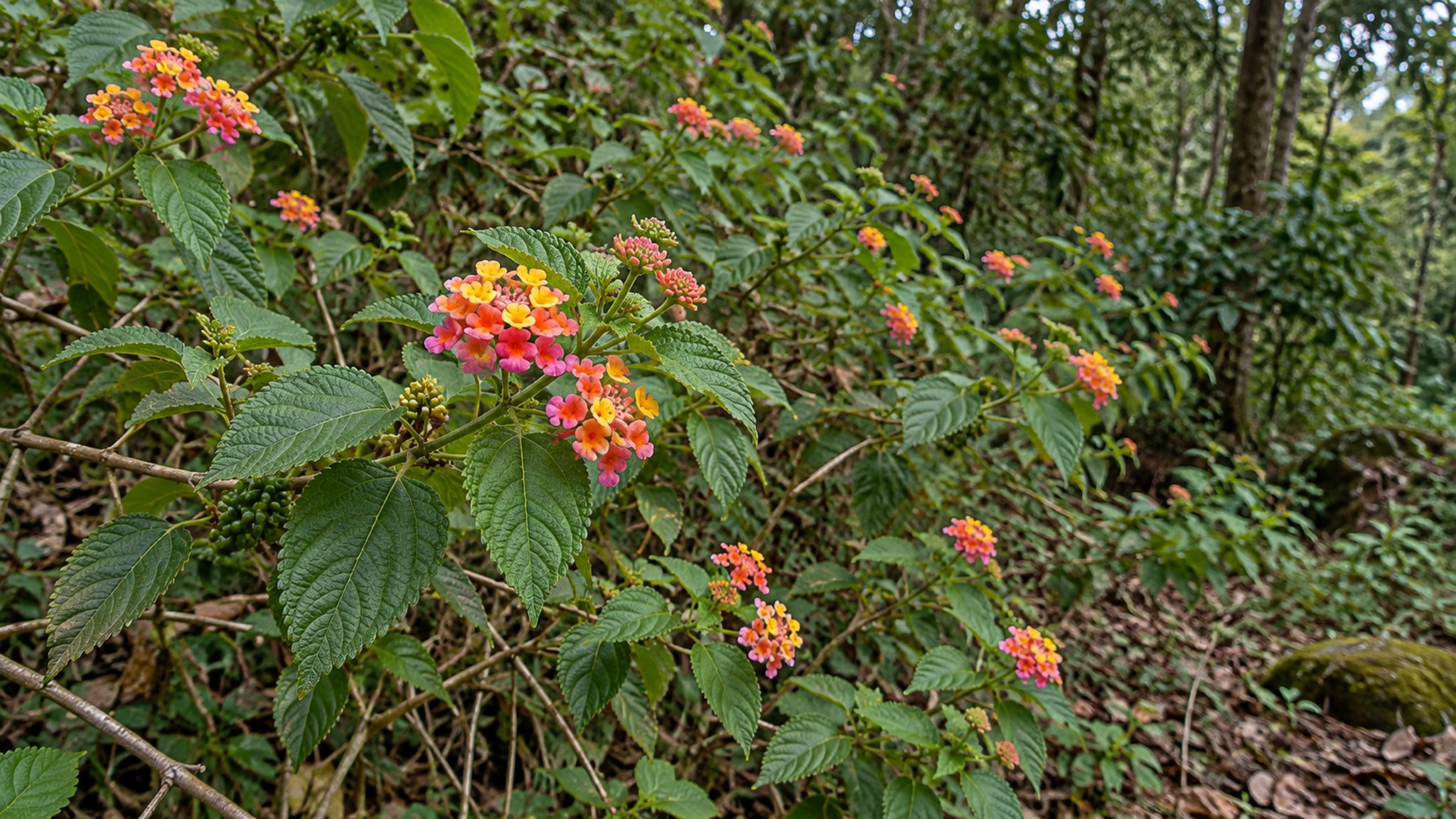
- The Kerala report identifies lantana among invasive forest plants that obstruct native regeneration; the concern is the replacement of ecological relationships, not simply the presence of unfamiliar vegetation.
- Habitat context matters: the same species may face different competitors or constraints elsewhere, so a photograph or popular name alone cannot establish either reliable identity or local ecological impact.
Close the Pathway Before an Invasion Establishes
A pathway is the route by which an organism crosses a barrier; managing that route can prevent repeated arrivals of multiple unwanted species.
- Intentional movement includes bringing organisms for aquaculture or horticulture; escape into surrounding habitats may be unintended, even when importing or cultivating the original organism was a deliberate commercial decision.
- Accidental transport can carry organisms with nursery material or ships’ ballast water; inspecting only the advertised commodity misses accompanying organisms that may survive the journey and establish after unloading.
- The CBD pathway guidance distinguishes deliberate imports from contamination and transport vectors; this helps match preventive checks to the actual route instead of treating all introductions alike.
- Quarantine and risk assessment work upstream, before release; monitoring nurseries, farms and receiving ecosystems works downstream, helping identify escapes that controls at the original entry point did not prevent.
- As a practical policy test, traceability should connect a verified detection with its likely route; removing organisms while leaving repeated introductions unchecked can turn a local clearance into an endless cycle.
Match the Response to the Invasion Stage
Prevention, eradication and control solve different problems; the appropriate objective changes as the population becomes established and spreads across a larger area.
- The CBD guiding principles put prevention first; after establishment, they distinguish eradication, containment and control, with feasibility determining the appropriate management objective rather than an automatic promise of complete removal.
- Early detection preserves the possibility of eradication while an occurrence remains limited; verified identification and rapid assessment help authorities decide whether complete removal is still a credible objective locally.
- Containment aims to restrict spread beyond an affected area, while control reduces abundance or damage; neither should be described as eradication merely because a visible patch has been cleared.
- The proposed economic utilisation creates an analytical tradeoff: using removed biomass may offset costs, but a dependable market could encourage people to retain or propagate the organism that management seeks to suppress.
- A sensible performance measure would track recurrence, spread and ecological damage alongside removal activity; counting harvested biomass alone cannot establish that native habitats are safer or the invasion is retreating.
Way Forward
Connect Detection to a Responsible Response
- Give verified field reports a named receiving authority and a response pathway, rather than collecting sightings without follow-up.
- Prioritise high-risk pathways and vulnerable habitats; coordinate inspections with fisheries, nurseries, transport operators and local communities.
- Tie any biomass-use project to containment safeguards, no propagation and monitoring for renewed spread.
Conclusion
- Invasive-species policy works best when it prevents repeated entry and matches intervention to the stage of invasion; removal campaigns alone cannot substitute for pathway management.
- Kerala’s submission supplies a useful governance case, but its recommendations remain proposals; distinguish reported policy advice from enacted legal duties and demonstrated ecological results.
UPSC Practice Questions
Prelims MCQ 1
With reference to invasive alien species, consider the following statements:
- Every alien species is necessarily invasive.
- An organism can be deliberately imported but unintentionally escape into the wild.
- Containment and eradication have different management objectives.
How many of the above statements are correct?
(a) Only one (b) Only two (c) All three (d) None
Answer: (b) Only two
Explanation:
Statements 2 and 3 are correct. Alien origin alone does not establish invasiveness; biodiversity harm matters.
Prelims MCQ 2
Which measure most directly addresses repeated introduction through a transport pathway?
(a) Counting biomass removed after establishment (b) Inspecting and managing contaminated nursery consignments (c) Promoting cultivation of the invasive plant (d) Renaming the affected habitat
Answer: (b) Inspecting and managing contaminated nursery consignments
Explanation:
Pathway management targets the route of arrival. Biomass removal acts after arrival and does not itself prevent new introductions.
UPSC Mains Questions
- Why should prevention and early detection receive priority in invasive-species management? Explain using entry pathways and invasion stages. (150 words)
- Evaluate the proposal to use invasive species economically when eradication is infeasible. What safeguards would prevent commercial demand from undermining ecological objectives? (250 words)
Sources: The Hindu and Convention on Biological Diversity.
Frequently Asked Questions
Are all alien species invasive?
No. Alien describes introduction outside a species’ natural range. Invasiveness additionally concerns threats to biodiversity from its introduction or spread; unfamiliar origin alone is not enough to establish that threat.
What is an introduction pathway?
It is the route carrying an organism into a new area, such as deliberate introduction, escape from cultivation or accidental transport with goods. Identifying the pathway helps prevent repeated arrivals.
How does containment differ from eradication?
Eradication seeks complete removal from the relevant area. Containment aims to prevent further spread, while control reduces abundance or damage. A successful containment programme need not eliminate the established population.
Has Kerala enacted a new invasive-species law?
The October 12 report describes a policy document submitted by the Kerala State Biodiversity Board. A submission or recommendation does not, by itself, demonstrate that a new law has been enacted.