Kerala’s Migratory Birds: Climate and Habitat Signals Behind the Decline
Why in News?
The Hindu has reported concern among Kerala bird researchers and observers over a decline in winter migratory birds , renewing attention to the condition of wetlands, estuaries, mudflats and farm landscapes used by seasonal visitors.
- Kerala receives winter visitors that use a wider migration network commonly discussed in India under the Central Asian Flyway; conserving only the final wintering site cannot address threats across the full annual cycle.
- Local counts have not moved uniformly in every district or every year. Some wetlands have recorded declines while others have recorded stable or higher totals, so a single census must not be treated as proof of.
- A decade-long study at the Kadalundi-Vallikkunnu Community Reserve linked changes in shorebird assemblages to alterations in intertidal habitat, including shrinking mudflats, sediment change and sand-bed expansion.
- Long-term monitoring of coastal wetlands in south-western India has also found simultaneous changes in wading-bird density, water and sediment chemistry, primary productivity, fish availability and rainfall. These associations identify pathways for investigation but do not establish.
- The 2025 update of the State of India’s Birds assessment uses modelled reporting-frequency trends from large citizen-science datasets. Such estimates are valuable for trend detection, but they require correction for observation effort and should be read.
- Bird decline is an ecosystem signal: fewer suitable feeding and roosting sites may indicate degraded mudflats, altered water levels, pollution, invasive vegetation or a weakened aquatic food web.
- Migratory species face full-cycle risk. A bird counted in Kerala may also depend on breeding habitat in northern latitudes and several stopover sites outside the State or country.
- Climate variability can alter rainfall, water depth, salinity, prey availability and migration timing. Attribution needs long time series and species-specific analysis because local land-use change can produce similar observations.
UPSC Relevance
Prelims Relevance
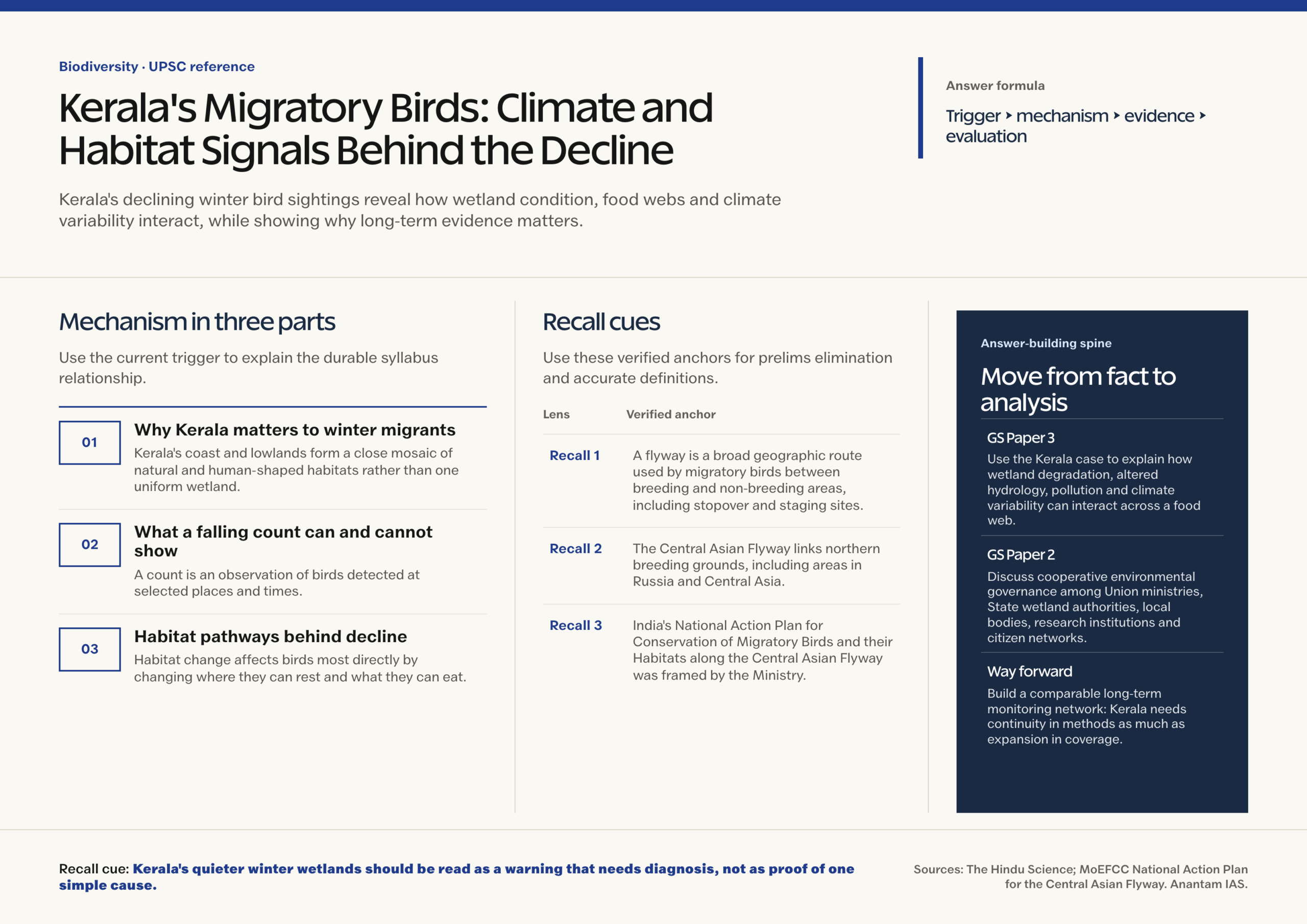
- A flyway is a broad geographic route used by migratory birds between breeding and non-breeding areas, including stopover and staging sites.
- The Central Asian Flyway links northern breeding grounds, including areas in Russia and Central Asia, with wintering grounds in West and South Asia and the Indian Ocean region.
- India’s National Action Plan for Conservation of Migratory Birds and their Habitats along the Central Asian Flyway was framed by the Ministry of Environment, Forest and Climate Change for coordinated species and habitat action.
- The Convention on Migratory Species is a global environmental treaty under the UN system concerned with migratory animals and the habitats on which they depend.
- The Ramsar Convention promotes the conservation and wise use of wetlands; Vembanad-Kol is a Ramsar site in Kerala and supports resident and migratory waterbirds.
- The Wetlands (Conservation and Management) Rules, 2017 were issued under the Environment (Protection) Act, 1986 and provide a regulatory framework for notified wetlands in India.
Mains Relevance
GS Paper 3
- Use the Kerala case to explain how wetland degradation, altered hydrology, pollution and climate variability can interact across a food web.
- Assess the value and limits of migratory birds as indicators for biodiversity and ecosystem health.
GS Paper 2
- Discuss cooperative environmental governance among Union ministries, State wetland authorities, local bodies, research institutions and citizen networks.
- Connect India’s domestic monitoring and habitat protection with cooperation under CMS, Ramsar and the Central Asian Flyway framework.
Essay
- The disappearance of an indicator species can make an otherwise hidden ecological decline visible.
Background and Context
Why Kerala matters to winter migrants
Kerala’s coast and lowlands form a close mosaic of natural and human-shaped habitats rather than one uniform wetland.
- Estuaries, backwaters, beaches, intertidal mudflats, mangroves, reservoirs and seasonally inundated fields offer different combinations of water depth, substrate, shelter and prey.
- Shorebirds often need exposed mud or sand for feeding and undisturbed areas for high-tide roosting. Ducks and other waterbirds may depend on open water, aquatic vegetation or shallow feeding zones.
- Paddy landscapes such as Kole and Kuttanad can function as surrogate wetlands at certain stages of the cropping and water-management cycle. A shift in sowing, drainage, flooding or pesticide practice can change their value to birds.
- The Vembanad-Kol wetland’s Ramsar information identifies a large brackish tropical system with major ecological and livelihood functions, including fisheries, rice production, flood moderation and support for waterbirds.
What a falling count can and cannot show
A count is an observation of birds detected at selected places and times, not a direct measurement of every factor shaping the population.
- Lower numbers may reflect a true population decline, redistribution to another site, changed migration timing, temporary weather, altered water levels, observer effort or detectability. Repeated standardised counts help separate signal from noise.
- Comparisons are strongest when survey dates, site coverage, time spent, observer methods and habitat conditions are comparable. Raw totals from unequal surveys can mislead.
- Citizen-science platforms provide large spatial and temporal datasets, while models can adjust for some differences in effort. They still carry uncertainty and should be combined with field ecology, remote sensing, water-quality data and species-specific studies.
- A district-level increase can coexist with losses elsewhere if birds shift between wetlands. Statewide conclusions need a network view rather than a collection of isolated annual headlines.
Habitat pathways behind decline
Habitat change affects birds most directly by changing where they can rest and what they can eat.
- Reclamation, construction, hard shoreline engineering and disturbance can reduce or fragment shallow-water feeding areas and safe roosts.
- At Kadalundi-Vallikkunnu, long-term research documented changes such as mudflat shrinkage, sand-bed expansion and altered sediment condition alongside changes in shorebird diversity. The lesson is that even conservation-oriented vegetation or hydrological change must be assessed for habitat-specific.
- Nutrient loading, sewage, agricultural runoff and contaminants can alter plankton, benthic invertebrates and fish. The visible bird response may sit at the end of this food-chain pathway.
- Invasive aquatic plants can cover open water, impede access to feeding areas and change oxygen and nutrient conditions. Mechanical removal without ecological planning can also disturb nests or release trapped nutrients.
- Human presence, vehicles, dogs, lighting, fishing activity and repeated flushing increase birds’ energy expenditure. Disturbance is especially costly during migration, when birds must replenish reserves.
Climate signals and the attribution problem
Climate affects migration through several linked mechanisms, but a plausible mechanism is not the same as proved local causation.
- Temperature and day length influence migration schedules, while rainfall and monsoon timing shape water levels, salinity, vegetation and prey production at wintering sites.
- Warmer conditions elsewhere may allow some birds to winter farther north, a pattern called short-stopping. Kerala could then receive fewer individuals even without a collapse in the whole population.
- A mismatch can arise when migration timing does not track a shift in peak food availability. The effect varies by species, diet, route and flexibility.
- Extreme rainfall, drought, heat and storms can reduce habitat quality at breeding, staging or wintering sites. Because these pressures occur across the annual cycle, a local Kerala count cannot by itself locate the decisive stress.
- A defensible attribution study would link multi-year bird trends with comparable habitat, hydrology and climate data, test alternative explanations and report uncertainty.
Way Forward
Build a comparable long-term monitoring network
- Use fixed sites, seasonal windows and standard effort while recording water level, land cover, disturbance and weather with every count.
- Integrate Asian Waterbird Census observations, Kerala Bird Atlas and eBird records, Forest Department surveys and university field studies through a transparent quality-control protocol.
- Publish trends with confidence intervals, survey effort and site-level caveats; avoid treating one annual percentage as a causal finding.
Conclusion
- Kerala’s quieter winter wetlands should be read as a warning that needs diagnosis , not as proof of one simple cause.
- The policy answer is equally layered: protect functional wetland mosaics, improve comparable long-term monitoring, keep farm landscapes ecologically usable and coordinate across the flyway.
UPSC Practice Questions
Prelims MCQ 1
With reference to the Central Asian Flyway, consider the following statements:
- It includes migration routes connecting northern breeding grounds with non-breeding grounds in West and South Asia.
- India has prepared a national action plan for conserving migratory birds and their habitats along this flyway.
- It is confined exclusively to marine birds and excludes inland waterbirds.
How many of the above statements are correct?
(a) Only one (b) Only two (c) All three (d) None
Answer: (b) Only two
Explanation:
Statements 1 and 2 are correct. The Central Asian Flyway covers routes used by many migratory waterbirds across terrestrial, inland-wetland and coastal landscapes; it is not restricted to marine birds.
Prelims MCQ 2
Which one of the following is the most scientifically defensible inference from a lower bird count at one wetland in one winter?
(a) Climate change has been proved to be the sole cause (b) The species has become globally extinct (c) The result is a signal requiring comparison with standardised multi-year and habitat data (d) Wetland quality can be ruled out because birds are mobile
Answer: (c) The result is a signal requiring comparison with standardised multi-year and habitat data
Explanation:
A single count may be affected by population change, redistribution, timing, weather, water levels, effort or detectability. Multi-year standardised monitoring and ecological measurements are needed before causal attribution.
UPSC Mains Questions
- Migratory birds are valuable indicators of wetland health, but their decline cannot be diagnosed from bird counts alone. Discuss with reference to Kerala’s coastal and agricultural wetlands. (250 words)
- Explain how climate variability and local habitat degradation can interact across the annual cycle of migratory birds. Suggest a monitoring framework capable of separating these effects. (250 words)
Sources: The Hindu Science and MoEFCC National Action Plan for the Central Asian Flyway.
Frequently Asked Questions
Why are fewer migratory birds being reported from some Kerala wetlands?
Researchers point to interacting pressures such as loss or alteration of feeding habitat, changing water levels, pollution, reduced prey, disturbance and climate-linked shifts in rainfall or migration timing. A lower count at one site or in one year cannot identify.
Does a decline in Kerala prove that climate change caused it?
No. Climate change offers credible mechanisms, including altered rainfall, temperature, hydrology, prey cycles and wintering ranges, but local land-use change can create similar patterns. Attribution requires multi-year bird, habitat and climate data, tests of alternative explanations and species-specific results.
Why are migratory birds treated as indicators of wetland health?
Their abundance and behaviour respond to water depth, mudflat exposure, vegetation, prey, contaminants and disturbance. Because many occupy higher levels of aquatic food webs, changes can flag wider ecosystem stress. The diagnosis must still be checked with direct measurements of.
What is the Central Asian Flyway?
It is a broad network of migration routes linking northern breeding areas with stopover and non-breeding grounds across Central, West and South Asia and the Indian Ocean region. India is a major range country and has framed a national action.
How can paddy fields help migratory birds?
Seasonally flooded paddy fields can provide shallow feeding areas and prey, acting as surrogate wetlands at particular stages. Their value depends on cropping calendars, water depth, drainage, disturbance and chemical use. They complement natural wetlands but cannot replace every ecological.