Khelo India Mission: Building India’s Sports Ecosystem
Why in News?
A Ministry of Youth Affairs and Sports overview released through the Press Information Bureau in July 2026 set out the scale and design of the Khelo India programme.
- Khelo India was launched in 2017 as a unified sports-development framework.
- It merged the Rajiv Gandhi Khel Abhiyan, Urban Sports Infrastructure Scheme and National Sports Talent Search Scheme.
- The Mission envisages a Khelo India Training Centre in every district, to be developed through State and Union Territory plans.
- The PIB release records 349 approved new sports-infrastructure projects worth ₹3,176 crore as of July 2026.
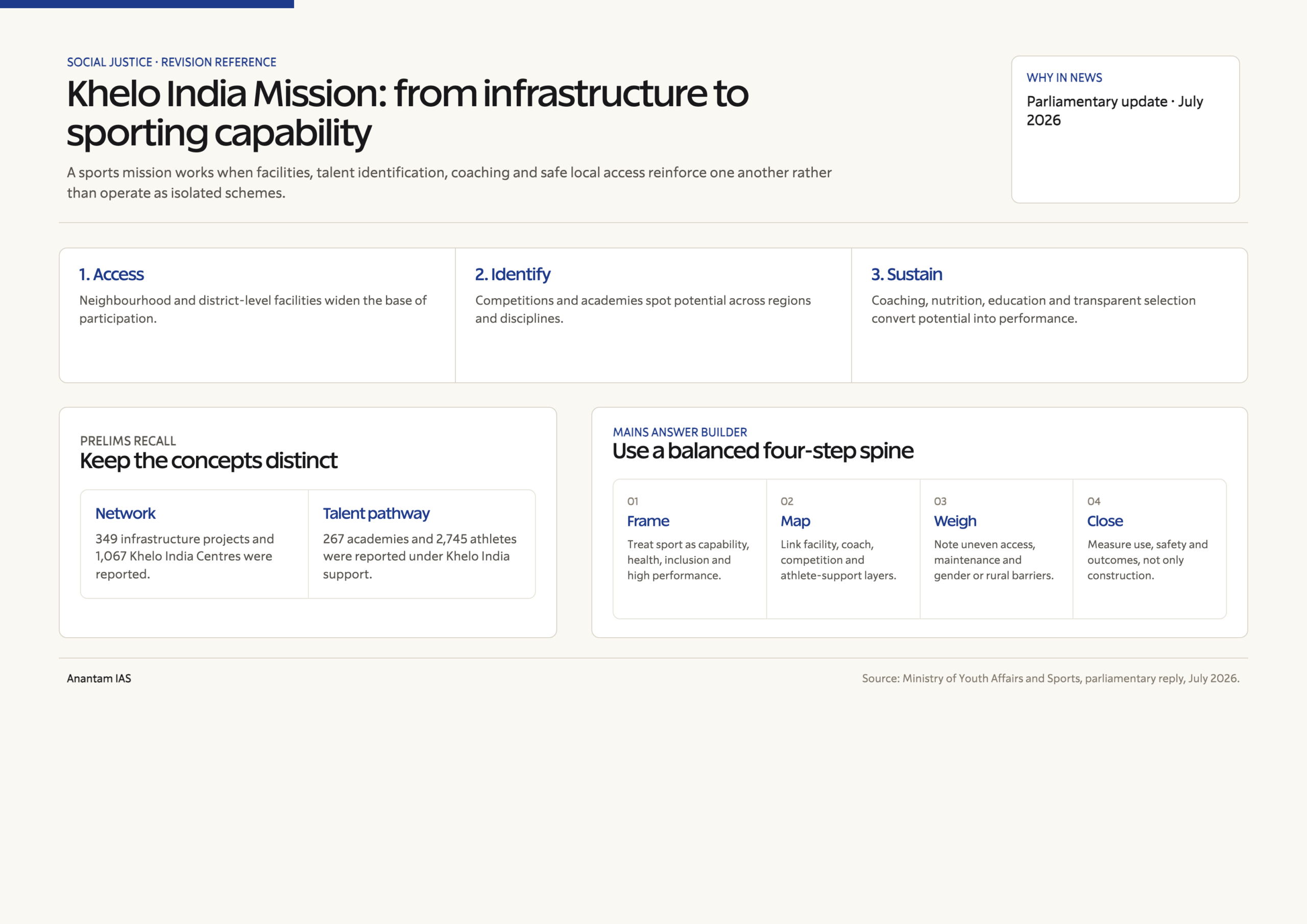
- It records 1,067 Khelo India Centres and 2,745 Khelo India Athletes as of July 2026.
- It is a case study in cooperative federalism because facilities and athlete pathways require coordination between the Union, States, local institutions, schools, universities and sports bodies.
- It connects human development with public infrastructure, nutrition, coaching, sports science, inclusion and opportunities for girls and para-athletes.
- It helps distinguish mass participation, talent identification, elite support and international performance: related objectives, but not interchangeable ones.
UPSC Relevance
Prelims Relevance
- Khelo India was launched in 2017 as a sports-development framework.
- It brought together the Rajiv Gandhi Khel Abhiyan, Urban Sports Infrastructure Scheme and National Sports Talent Search Scheme.
- A Khelo India Centre is a grassroots training and athlete-support facility; it should not be confused with a one-time sporting event.
- The Mission envisages one Khelo India Training Centre in every district through State and Union Territory plans.
- Khelo India Games include youth, university, winter and para-sport formats, alongside beach games, water-sports festivals and tribal games mentioned in the PIB overview.
- The Target Olympic Podium Scheme is a separate athlete-support initiative; the PIB release says it was launched in 2014 and revamped in 2018.
Mains Relevance
GS Paper 2
- Use Khelo India to discuss cooperative federalism and the role of public institutions in widening access to opportunity.
- Analyse sports as a social-development domain involving gender equity, disability inclusion, youth development and local public infrastructure.
GS Paper 3
- Link sporting performance with sports science, nutrition, coaching, data systems, manufacturing of equipment and long-term human-capital investment.
- Assess why capital spending alone cannot create elite outcomes without maintenance, trained personnel and competition exposure.
Essay
- A sporting nation is built not only in stadiums but in the ordinary institutions that allow children to practise safely, repeatedly and with dignity.
Background and Context
What Khelo India Seeks to Solve
India’s sporting challenge is not simply the absence of talented individuals. It is the uneven conversion of interest and raw talent into sustained training, competition and support. Khelo.
- Launched in 2017, the scheme consolidated the Rajiv Gandhi Khel Abhiyan, the Urban Sports Infrastructure Scheme and the National Sports Talent Search Scheme. Consolidation matters because disconnected schemes can leave gaps between facility creation, talent identification.
- The programme’s stated approach is to build training centres, use sports science and technology, develop infrastructure and guide athletes toward professional excellence. These are complementary inputs: a facility without coaches or a selected athlete without competition.
- The Mission’s aspiration of one Khelo India Training Centre in every district makes district access the key governance test. A national announcement is not equivalent to usable local access, particularly for rural athletes, girls, persons with.
- A sound answer should distinguish broad-based participation from elite performance. Mass participation improves the pool from which talent can emerge, while elite outcomes require specialised coaching, recovery, nutrition, psychology, travel support and competition against high-quality opponents.
- The sports ecosystem also extends beyond athletes. Teachers, community coaches, physiotherapists, sports-science personnel, local bodies, schools, universities, federations and equipment makers influence whether public spending becomes durable sporting capability.
The Institutional Pathway: Centre, States and Districts
Sports is delivered where people live and train. The Union can set broad norms, finance programmes and create national platforms, but State governments, local institutions and sports bodies.
- The PIB overview places the proposed district training-centre network within State and Union Territory plans. This makes implementation a cooperative-federal task, not a centrally administered chain of identical facilities.
- State-specific planning should respond to geography, existing facilities, local sporting cultures, school networks and the availability of qualified coaches. A mountain district, a coastal district and a dense city need different facility mixes and different maintenance.
- Transparent criteria are needed for selecting centres, athletes and disciplines. Without published selection processes, grievance redressal and periodic audits, a talent scheme can reproduce social and regional exclusion rather than reduce it.
- Infrastructure has a life-cycle cost. Building a playing surface or centre is only the first stage; safety, repair, equipment replacement, electricity, water, transport access and trained staff determine whether it stays functional.
- Convergence with schools, colleges and community facilities can improve utilisation. It can also prevent public assets from becoming venues used only for occasional events rather than daily training.
Facilities, Centres and Competition Are Different Inputs
The July 2026 figures are useful only when read by function. Approved infrastructure projects, Khelo India Centres and athletes supported through the programme measure different points in the.
- The PIB release records 349 approved new infrastructure projects with a total investment of ₹3,176 crore. Approval and investment commitment are not by themselves proof that every facility is completed, maintained or equally accessible; monitoring must.
- It also records 1,067 Khelo India Centres. Centres are intended to strengthen grassroots training and athlete support, so their performance should be assessed through coach availability, attendance, progression, safety and inclusion as well as through.
- The release lists 2,745 Khelo India Athletes. Athlete support is valuable when it is linked to transparent identification, individual development plans and reliable support for training, nutrition, equipment and competition.
- The Khelo India Games provide a competitive stage. The release says that more than 63,000 athletes have participated since 2018 and identifies youth, university, winter and para-sport formats among the expanding events.
- Competition is not merely a showcase. It offers performance feedback, exposes athletes to rules and pressure, allows selectors to observe progress, and can connect local training with higher-level pathways.
From Sports Policy to Human Development
A sports policy has a wider public value when it treats physical activity, agency and inclusion as development outcomes. Medals can inspire participation, but policy should also be.
- Girls may face constraints linked to safety, travel, sanitation, family expectations and the scarcity of women coaches. Facility design, transport arrangements and safeguarding systems can affect participation as much as an event calendar.
- Para-athletes need accessible venues, trained support staff, appropriate equipment and competitive opportunities. The presence of Khelo India Para Games in the wider programme shows why disability inclusion must be built into routine infrastructure rather than added.
- Sports science, psychology and nutrition are not luxuries reserved for a few national athletes. Age-appropriate coaching, injury prevention, recovery and mental-health support protect young athletes from burnout and unsafe practices.
- Data-enabled athlete tracking can help identify gaps and personalise support, but it requires clear consent, data protection, non-discriminatory use and trained human judgement. A dashboard should strengthen coaching decisions, not replace them.
- The strongest measure of success is a credible progression route: a child can move from a local facility to trained coaching and regular competition, with support based on merit and need rather than on personal connections.
Way Forward
Measure Access and Quality, Not Only Assets
- Publish district-level data on project completion, operating hours, coach vacancies, participation by gender and disability, maintenance status and grievance resolution, while protecting individual athlete data.
- Use independent facility audits and social audits where feasible to verify that centres are open, usable and equipped for their stated disciplines.
- Link future funding to a balanced set of indicators: access, utilisation, athlete retention, safety, competition exposure and progression, rather than medal counts alone.
Conclusion
- Khelo India is most useful as a policy lens when it is seen as a chain: facilities, trained people, fair selection, sustained support and meaningful competition must reinforce one another.
- For UPSC answers, begin with Khelo India’s ecosystem approach, separate infrastructure, centres, competition and athlete support, then evaluate the cooperative-federal, inclusion and accountability conditions that turn a sports scheme into durable human development.
UPSC Practice Questions
Prelims MCQ 1
With reference to the Khelo India programme, consider the following statements:
- It was launched in 2017 as a unified sports-development framework.
- It brought together the Rajiv Gandhi Khel Abhiyan, Urban Sports Infrastructure Scheme and National Sports Talent Search Scheme.
- The Mission envisages a Khelo India Training Centre in every district through State and Union Territory plans.
How many of the above statements are correct?
(a) Only one (b) Only two (c) All three (d) None
Answer: (c) All three
Explanation:
All three statements are correct. The PIB overview describes the 2017 scheme, the three programmes it integrated, and the Mission’s district training-centre vision through State and Union Territory plans.
Prelims MCQ 2
Which one of the following correctly matches the July 2026 Khelo India figures reported by the Press Information Bureau?
(a) 349 approved infrastructure projects, ₹3,176 crore investment, 1,067 Khelo India Centres and 2,745 Khelo India Athletes (b) 349 Khelo India Centres, ₹1,067 crore investment, 2,745 projects and 3,176 athletes (c) 1,067 approved projects, ₹2,745 crore investment, 349 centres and 3,176 athletes (d) 2,745 approved projects, ₹349 crore investment, 3,176 centres and 1,067 athletes
Answer: (a) 349 approved infrastructure projects, ₹3,176 crore investment, 1,067 Khelo India Centres and 2,745 Khelo India Athletes
Explanation:
The July 2026 PIB overview gives these four distinct figures. They refer respectively to approved infrastructure projects, their investment, Khelo India Centres and Khelo India Athletes.
UPSC Mains Questions
- Sports policy must be assessed as a human-development and governance question, not merely through medal tallies. Discuss with reference to Khelo India.
- How can cooperative federalism improve the effectiveness and equity of district-level sports infrastructure and athlete-development programmes in India?
Source: Press Information Bureau, Ministry of Youth Affairs and Sports.
Frequently Asked Questions
What is Khelo India?
Khelo India is a national sports-development framework launched in 2017. It integrated the Rajiv Gandhi Khel Abhiyan, Urban Sports Infrastructure Scheme and National Sports Talent Search Scheme. Its approach links facilities, training centres, talent identification, athlete support, sports science and.
What is the Khelo India Mission’s district goal?
The Mission envisages one Khelo India Training Centre in every district through State and Union Territory plans. This is an aspiration for a training network, not proof that every district already has a fully functional centre. UPSC answers should distinguish.
What were the Khelo India figures reported in July 2026?
The PIB overview reported 349 approved new sports-infrastructure projects with a total investment of ₹3,176 crore, 1,067 Khelo India Centres and 2,745 Khelo India Athletes as of July 2026. These are different measures and should not be treated as a.
How are Khelo India Centres different from Khelo India Games?
Khelo India Centres are intended to provide grassroots training and athlete support. Khelo India Games are competitive platforms that include youth, university, winter and para-sport formats among others. Centres are part of day-to-day development; games provide competition, exposure and performance.
Why is Khelo India relevant for GS2?
It is relevant to governance, cooperative federalism, youth development, gender equity, disability inclusion and public-service delivery. A good GS2 answer can assess how the Union, States, local institutions, schools and sports bodies must coordinate to convert a national scheme into.