Kotada Bhadli: Earliest Harappan Caravanserai Discovered in Kutch (2025)
Introduction
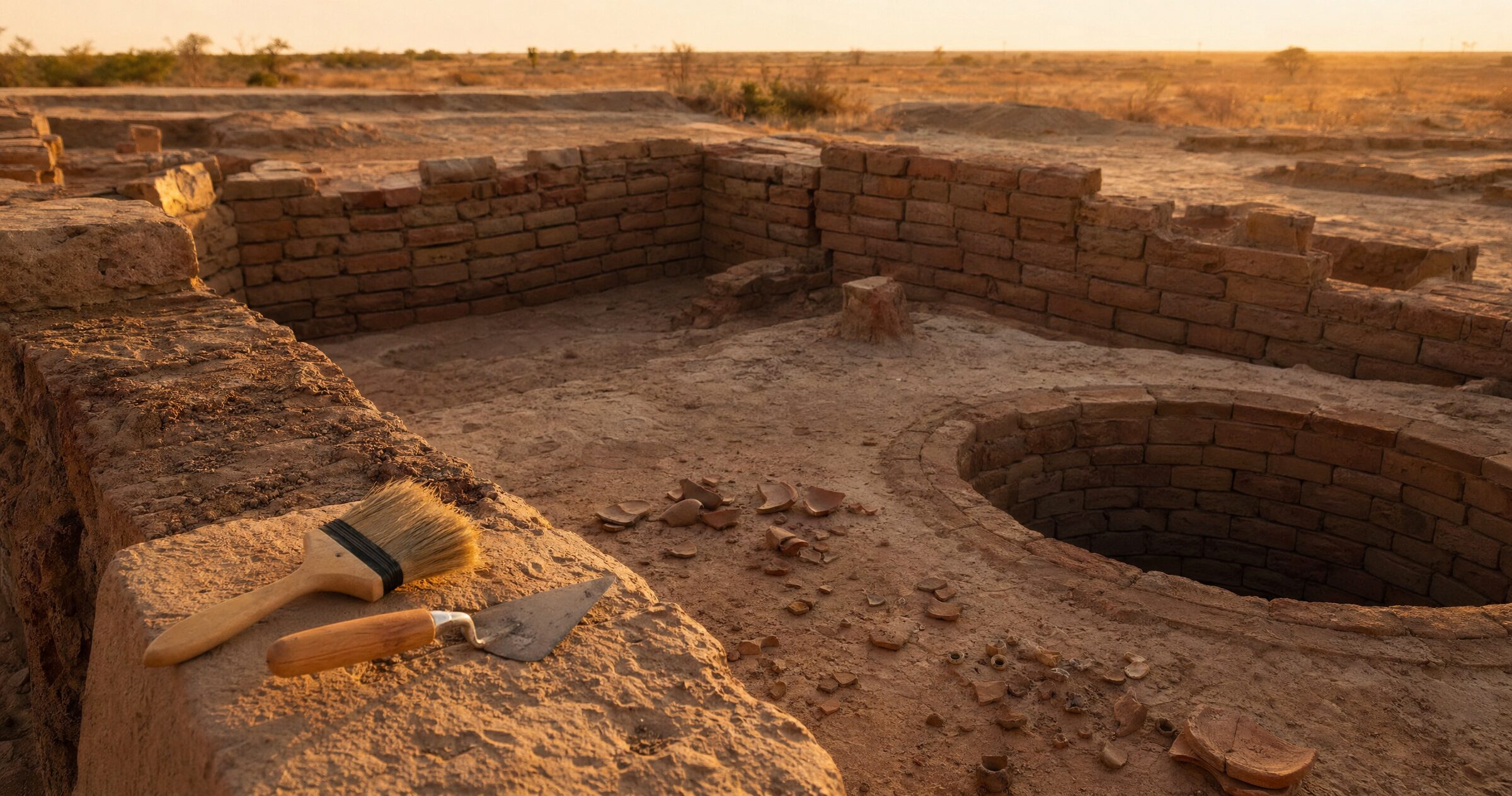
In late October 2025, archaeologists working at Kotada Bhadli, a modest mound in the Nakhatrana taluka of Kutch district in Gujarat, reported a discovery that may reshape long-standing assumptions about the trade architecture of the Indus Valley Civilisation. The team — drawn from the Archaeological Survey of India (ASI) and the archaeology unit of IIT Gandhinagar — exposed a tightly clustered complex of baked-brick animal pens, a granary annex, and a stone-lined water cistern that, taken together, appear to function as a wayside rest-stop along an inland caravan route. If the interpretation holds, Kotada Bhadli would be the earliest known Harappan caravanserai, predating comparable structures across South and West Asia by nearly two millennia.
The find arrives at a moment when the chronology and spatial reach of the Indus Valley network are under active revision. Mature Harappan settlements were once mapped as river-bound clusters along the Indus and the now-dry Ghaggar-Hakra. Sites such as Dholavira, Lothal, and Surkotada already pointed to long-distance maritime and overland exchange, but the infrastructure that supported the daily logistics of caravan movement — water, fodder, secure storage, and shelter for pack animals — has been largely inferred rather than excavated. The Kotada Bhadli complex, dated provisionally to the Mature Harappan phase, offers the first physical anchor for that missing logistical layer and adds a fresh dimension to GS-I preparation on India’s first urban civilisation.
Quick Facts at a Glance
| Aspect | Detail | Source |
|---|---|---|
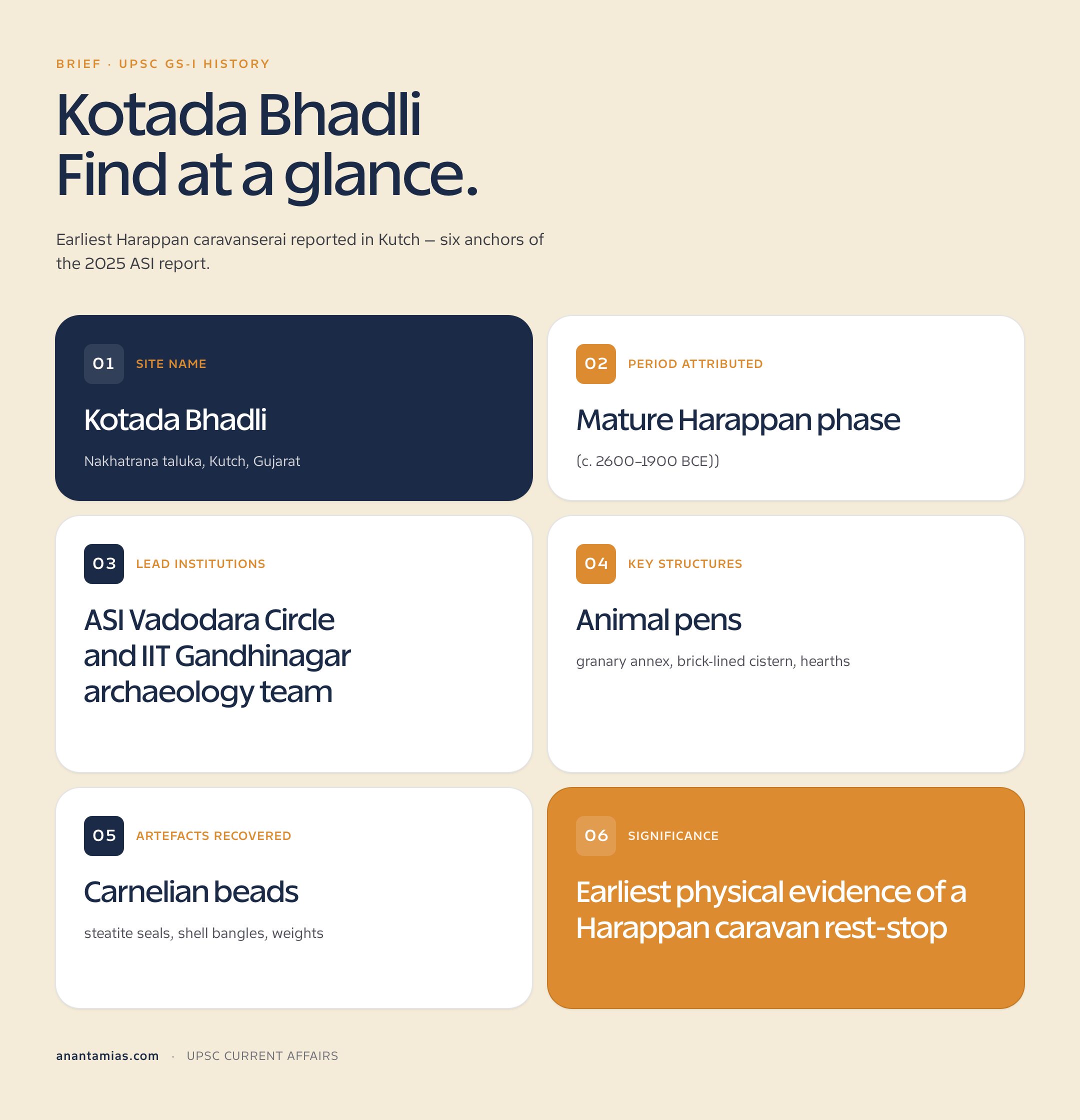
| Site name | Kotada Bhadli, Nakhatrana taluka, Kutch, Gujarat | ASI field report, Oct 2025 |
| Period attributed | Mature Harappan phase (c. 2600–1900 BCE) | asi.nic.in |
| Lead institutions | ASI Vadodara Circle and IIT Gandhinagar archaeology team | IIT-GN press note |
| Key structures | Animal pens, granary annex, brick-lined cistern, hearths | The Hindu, 23 Oct 2025 |
| Artefacts recovered | Carnelian beads, steatite seals, shell bangles, weights | ASI inventory |
| Significance | Earliest physical evidence of a Harappan caravan rest-stop | Field interpretation |
| State protection | Centrally protected monument, ASI | asi.nic.in |
Background and Historical Context
The Indus Valley Civilisation, also called the Harappan civilisation after its first-excavated site, is conventionally divided into Early Harappan (c. 3300–2600 BCE), Mature Harappan (c. 2600–1900 BCE), and Late Harappan (c. 1900–1300 BCE) phases. The Mature phase saw the rise of planned cities such as Harappa and Mohenjo-daro in present-day Pakistan and Dholavira and Rakhigarhi in India, with standardised brick ratios, sophisticated drainage, and a script that remains undeciphered. By the late 2000s BCE, archaeologists working under scholars like R.S. Bisht at Dholavira had established that Harappan trade extended from Mesopotamia in the west to the Deccan in the south, with bead-and-shell trade through Lothal acting as the maritime hinge.
Despite this, prior caravanserai-like finds have been few and contested. Surkotada, also in Kutch, yielded a fortified citadel and stable evidence of horse-related faunal remains, but its primary character was that of a regional outpost rather than a transit halt. The so-called “warehouse” platform at Lothal has long been read as a customs facility, while the dockyard interpretation remains debated. Banawali and Kalibangan in present-day Haryana and Rajasthan offered hearths and ploughed fields but no clearly dedicated halting infrastructure. The Kotada Bhadli interpretation, therefore, fills a structural gap that has irritated Harappan historiography for at least four decades. For the longer arc, see the NCERT overview on Indus Valley Civilisation for UPSC and the NCERT Class XII Themes in Indian History.
Highlights of the Kotada Bhadli Find
Animal pens and tethering posts
The most distinctive feature of the new excavation is a row of three rectangular enclosures, each roughly 6 metres by 4 metres, walled in standard 1:2:4 ratio Harappan baked bricks and flanked by post-holes interpreted as tethering points for cattle, oxen, or possibly Bactrian camels. Faunal remains examined on-site include hoofed-animal teeth, splintered long-bones, and dung-cake residues fired into the floor surfaces. The presence of distinct pen partitions, rather than a single open paddock, suggests a managed halt where multiple caravans could rest simultaneously without mixing herds.
Granary annex with sealed bins
Adjoining the pens to the north sits a smaller rectangular structure with a raised brick plinth and the remains of at least four circular storage bins. Charred grain samples, awaiting AMS dating, appear to include barley and millets. Steatite sealings with the typical unicorn motif and a handful of cubical chert weights conforming to the standard Harappan binary system were recovered in association, indicating regulated grain handling. The plan recalls the so-called “granary” platforms at Harappa and Mohenjo-daro but on a markedly smaller, transit-suited scale.
Brick-lined cistern and hearths
A circular cistern, approximately 3 metres in diameter and lined with kiln-fired bricks set in lime mortar, sits at the western edge of the complex. A shallow channel directs runoff from a hard-packed apron, hinting at deliberate rain-water harvesting, a feature already documented in elaborate form at Dholavira. Three communal hearths with charcoal lenses, animal-bone ash, and fragments of red-slipped ware suggest cooking activity for travellers and herd-handlers. Together, the cistern, hearths, granary, and pens describe a recognisable rest-stop programme — water, food, fodder, and shelter — rather than a domestic homestead.
Significance for UPSC
- GS-I Ancient History: Adds a concrete logistical layer to the Mature Harappan urban story beyond cities, ports, and citadels.
- GS-I Art and Culture: Reinforces standardisation of brick ratios, weights, and seals as pan-Harappan cultural traits.
- GS-I Geography: Connects Kutch’s semi-arid corridor to interior trade flows linking the Saurashtra coast with Sindh and the Indus heartland.
- GS-III Economy (historical): Demonstrates how organised trade infrastructure preceded later Mauryan and Mughal sarais by two millennia.
- Essay paper: Useful as a fresh, well-dated example for themes on civilisational continuity, urbanism, and indigenous innovation.
- Prelims: Likely 1-mark factual on site name, location, period, and excavating institutions.
Detailed Analysis
The Kotada Bhadli complex strengthens the case that Harappan trade was not a series of isolated bilateral exchanges but a managed network with recurring waypoints. Mature Harappan centres exported carnelian beads, etched agate, ivory, shell bangles, copper, and timber. Imports included tin, lapis lazuli, gold, and silver from sources as distant as Afghanistan and Oman. Moving such cargo overland required predictable halts roughly every 25–35 kilometres — the daily range of an ox-cart caravan — and Kotada Bhadli sits, by recent surveys, on a plausible line between Dholavira to the east and the proto-port settlements along the Gulf of Kachchh to the south-west.
The find also forces a reconsideration of the village–city dichotomy that has long dominated IVC scholarship. Earlier classifications, going back to Mortimer Wheeler and refined by B.B. Lal, treated small Harappan sites as agricultural support hamlets. The new evidence suggests a third category: specialised infrastructural settlements whose primary function was logistical rather than residential or productive. Anthropologists working with the Indira Gandhi National Centre for the Arts have already begun to reclassify several similar small mounds across Kutch and Saurashtra; their datasets are accessible via ignca.gov.in.
For aspirants, the most exam-relevant takeaway is the institutional one. Kotada Bhadli demonstrates how the ASI continues to use multidisciplinary excavation — pairing field archaeology with ground-penetrating radar, archaeobotany, and stable-isotope analysis from IIT Gandhinagar — to extract significantly more information from modest mounds than was possible even a decade ago. This is a useful current-affairs hook for questions on the role of scientific tools in heritage conservation, a recurring GS-I and GS-III interface theme. Also see the ASI primer on anantamias.com.
The table below places Kotada Bhadli alongside the major Indian Harappan sites that aspirants are expected to know cold for both Prelims and Mains.
| Site | Location | Excavated | Key discovery |
|---|---|---|---|
| Dholavira | Kutch, Gujarat | 1989–2005 (R.S. Bisht) | Three-tier city, water reservoirs, signboard inscription |
| Lothal | Bhal region, Gujarat | 1955–62 (S.R. Rao) | Dockyard, bead factory, fire altars |
| Rakhigarhi | Hisar, Haryana | 1969 onwards | Largest IVC site by area, ancient DNA samples |
| Banawali | Fatehabad, Haryana | 1973–84 (R.S. Bisht) | Ploughed field, ovoid town plan, terracotta plough |
| Kalibangan | Hanumangarh, Rajasthan | 1960–69 (B.B. Lal, B.K. Thapar) | Earliest ploughed field, fire altars, lower citadel |
| Kotada Bhadli | Kutch, Gujarat | 2019–2025 ongoing | Earliest Harappan caravanserai (proposed) |
Challenges and Criticisms
The caravanserai interpretation is provisional and has already drawn measured scepticism. A first line of critique, voiced by scholars associated with the Deccan College Post-Graduate and Research Institute, is that the structural plan could equally fit a fortified pastoral homestead, of which Kutch has many. Without a clear demarcation between domestic dwellings and the pen-granary-cistern cluster, the rest-stop label rests heavily on functional inference rather than direct epigraphic or iconographic evidence. AMS dates from at least three secure stratigraphic contexts will be needed before the Mature Harappan attribution is locked in, and the team has indicated that those results are expected only by mid-2026.
A second, more politically charged debate concerns the long-running Harappan–Vedic continuity polemic. Some commentators have already cited the find as evidence of an indigenous, unbroken cultural arc from the IVC into the early Vedic period — a position that mainstream archaeologists, including those represented in standard NCERT textbooks, regard as outrunning the evidence. The ASI itself has been careful to frame the discovery in narrowly material terms, avoiding the linguistic and ethnic claims that often crowd public discussion. UPSC aspirants would do well to note both the find and the reception, since balanced treatment of contested historiography is a frequent Mains marker.
Prelims Pointers
- Kotada Bhadli is located in Nakhatrana taluka of Kutch district, Gujarat.
- The Mature Harappan phase is dated approximately 2600–1900 BCE.
- The site is being excavated jointly by ASI and IIT Gandhinagar.
- Standard Harappan baked-brick ratio is 1:2:4 (thickness:width:length).
- Dholavira was excavated primarily under R.S. Bisht and is a UNESCO World Heritage Site since 2021.
- Lothal in Gujarat is famous for its dockyard and bead factory.
- Surkotada, also in Kutch, is associated with disputed early horse remains.
- Rakhigarhi in Haryana is the largest IVC site by area discovered so far.
- Carnelian beads are a hallmark Harappan export, often etched with white lines.
- The Harappan script remains undeciphered as of 2025.
- Cubical chert weights follow a binary-decimal series in standard Harappan trade.
- Indira Gandhi National Centre for the Arts (IGNCA) maintains digitised IVC archives.
Mains Practice Questions
- “Recent Harappan finds in Kutch are reshaping our understanding of Indus Valley trade infrastructure.” Discuss with reference to the Kotada Bhadli discovery. (15 marks, 250 words)
- Examine the role of the Archaeological Survey of India in employing scientific techniques for heritage research. Illustrate with recent examples. (10 marks, 150 words)
- Compare and contrast the Mature Harappan urban centres with smaller specialised settlements. How do recent excavations modify the village–city framework? (15 marks, 250 words)
- “The Harappan economy was organised around managed trade networks, not isolated exchanges.” Critically evaluate. (15 marks, 250 words)
- Discuss the historiographical debates surrounding Harappan–Vedic continuity in light of recent archaeological evidence. (10 marks, 150 words)
Conclusion
The Kotada Bhadli excavation, even at its provisional stage, repositions Kutch from a peripheral Harappan zone to a critical node in the civilisation’s logistical lattice. By exposing the unglamorous but essential infrastructure of caravan halts, the find returns a measure of operational realism to an IVC story too often told through monumental cities and exotic trade goods. For the UPSC aspirant, it is a reminder that current affairs and ancient history are not separate silos: a fresh excavation can revise textbook generalisations and supply ready-made examples for both factual Prelims questions and analytical Mains answers. The next two years of dating evidence and stratigraphic publication will determine whether Kotada Bhadli enters the canon as the earliest Harappan caravanserai or as a well-preserved pastoral outpost — either outcome is exam-relevant.
Frequently Asked Questions
What is Kotada Bhadli and why is it in the news?
Kotada Bhadli is a Harappan-era archaeological site in Kutch, Gujarat. In October 2025, ASI and IIT Gandhinagar archaeologists reported evidence interpreted as the earliest known Harappan caravanserai — a wayside rest-stop with animal pens, a granary, and a cistern.
What is a caravanserai?
A caravanserai is a roadside inn where travellers, traders and their pack animals could rest, refresh, and resupply during long-distance journeys. The form became famous along the Silk Route but, if the Kotada Bhadli interpretation holds, was already being practised by Harappans nearly 4,500 years ago.
To which phase of the Indus Valley Civilisation does Kotada Bhadli belong?
The site is provisionally dated to the Mature Harappan phase, c. 2600–1900 BCE, on the basis of brick ratios, ceramic types, and steatite sealings. Final radiocarbon dates are expected by mid-2026.
Who is leading the excavation at Kotada Bhadli?
The excavation is a joint effort of the Archaeological Survey of India’s Vadodara Circle and the archaeology research team at IIT Gandhinagar, building on earlier surveys conducted from 2019 onwards.
How does Kotada Bhadli relate to other Harappan sites in Gujarat?
It sits on a plausible overland route between Dholavira to the east and the Gulf of Kachchh ports to the south-west, and complements Surkotada and Lothal as part of a Saurashtra–Kutch network of Harappan settlements.
What artefacts have been recovered from the site?
Recovered material includes carnelian beads, steatite sealings with the unicorn motif, shell bangles, cubical chert weights, charred barley and millet grains, and red-slipped ware fragments — a typical Mature Harappan assemblage.
Why is the find important for UPSC preparation?
It is a high-value GS-I example for ancient history, art and culture, and historical economy. It also lends itself to essay paper themes on civilisational continuity and to questions on the ASI’s modern excavation methods.
Has the caravanserai interpretation been universally accepted?
No. Some scholars argue the structures could represent a fortified pastoral homestead, and the interpretation depends on AMS dating and further stratigraphic publication. The ASI has framed the find cautiously while ruling out maximalist Harappan–Vedic continuity claims.