Krishi Vigyan Kendras: A Centre-State Plan for Stronger Extension
Why in News?
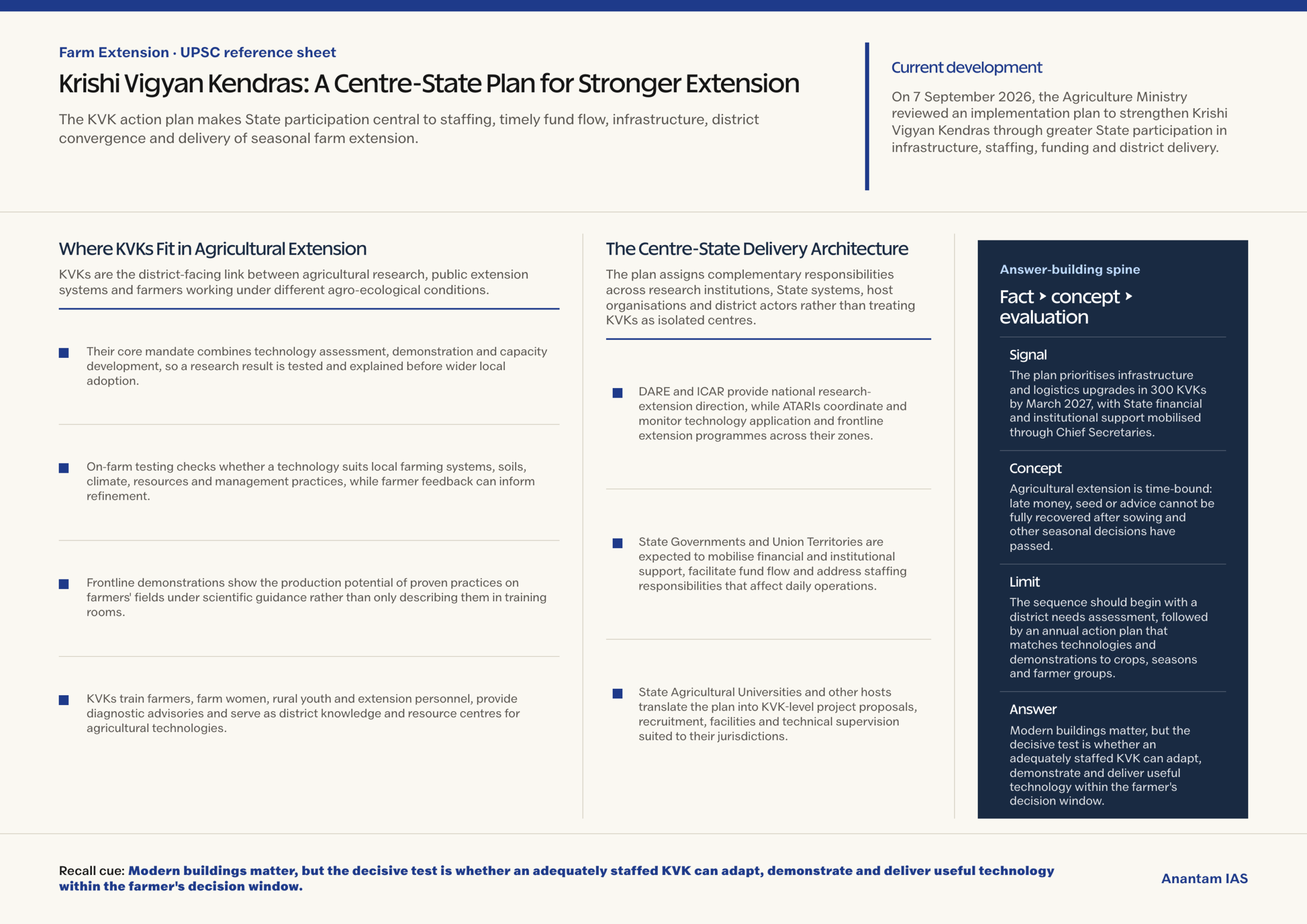
On 7 September 2026, the Agriculture Ministry reviewed an implementation plan to strengthen Krishi Vigyan Kendras through greater State participation in infrastructure, staffing, funding and district delivery.
- The plan prioritises infrastructure and logistics upgrades in 300 KVKs by March 2027, with State financial and institutional support mobilised through Chief Secretaries.
- It also envisages Incubation-cum-Skill Centres in all KVKs by December 2028, linked with enterprises, technical partners and district-specific agricultural opportunities.
- States were asked to fill vacancies, meet applicable staff-benefit responsibilities and release funds before seasonal agricultural windows close.
- The review traced fund flow through ATARIs and KVKs and called for coordinated planning, timely seed availability and execution of field demonstrations.
- KVKs are district-level frontline extension institutions that assess technologies locally, demonstrate them on farmers’ fields, build skills and provide advisories.
- The Centre supplies research coordination and programme direction, while States influence host institutions, personnel support, fund flow and convergence with district departments.
- This development concerns implementation capacity; it is distinct from merely uploading PM-DDKY activities for monitoring and assessment.
UPSC Relevance
Prelims Relevance
- KVK: Krishi Vigyan Kendra or Farm Science Centre
- ICAR: Indian Council of Agricultural Research
- DARE: Department of Agricultural Research and Education
- ATARI: Agricultural Technology Application Research Institute
- On-farm testing: assessment of a technology’s location specificity under farmers’ conditions
- Frontline demonstration: demonstration of a proven technology on farmers’ fields under scientific supervision
Mains Relevance
GS Paper 3
- Agricultural extension as the bridge from research to location-specific farm adoption
- Season-sensitive financing, demonstrations, skills and rural entrepreneurship
GS Paper 2
- Centre-State and district convergence in implementing a national extension network
Essay
- Scientific innovation creates public value only when institutions can adapt and deliver it at the place and season where people need it.
Background and Context
Where KVKs Fit in Agricultural Extension
KVKs are the district-facing link between agricultural research, public extension systems and farmers working under different agro-ecological conditions.
- Their core mandate combines technology assessment, demonstration and capacity development, so a research result is tested and explained before wider local adoption.
- On-farm testing checks whether a technology suits local farming systems, soils, climate, resources and management practices, while farmer feedback can inform refinement.
- Frontline demonstrations show the production potential of proven practices on farmers’ fields under scientific guidance rather than only describing them in training rooms.
- KVKs train farmers, farm women, rural youth and extension personnel, provide diagnostic advisories and serve as district knowledge and resource centres for agricultural technologies.
- Their delivery quality depends on scientists, field staff, laboratories, farms, mobility, inputs and operating funds being available together, not infrastructure construction alone.
The Centre-State Delivery Architecture
The plan assigns complementary responsibilities across research institutions, State systems, host organisations and district actors rather than treating KVKs as isolated centres.
- DARE and ICAR provide national research-extension direction, while ATARIs coordinate and monitor technology application and frontline extension programmes across their zones.
- State Governments and Union Territories are expected to mobilise financial and institutional support, facilitate fund flow and address staffing responsibilities that affect daily operations.
- State Agricultural Universities and other hosts translate the plan into KVK-level project proposals, recruitment, facilities and technical supervision suited to their jurisdictions.
- District convergence should connect KVK expertise with agriculture, horticulture, livestock, rural-development, credit and market institutions so advice is supported by inputs and services.
- Clear responsibility mapping matters because a centrally approved programme can still miss farmers when a State release, host appointment or district input arrangement is delayed.
Implementation Must Follow the Farm Calendar
Agricultural extension is time-bound: late money, seed or advice cannot be fully recovered after sowing and other seasonal decisions have passed.
- The sequence should begin with a district needs assessment, followed by an annual action plan that matches technologies and demonstrations to crops, seasons and farmer groups.
- Staffing, funds, recommended seed and field arrangements must arrive before implementation; releasing them after the agricultural window converts planned activity into administrative compliance.
- The KVK then undertakes trials, demonstrations, training and advisories, records farmer response and measures whether knowledge or technology was adopted under local conditions.
- Incubation-cum-Skill Centres add an enterprise pathway by mapping KVKs to agro-based businesses, technical institutions and district opportunities, then preparing fundable local plans.
- Monitoring should trace the full chain from inputs and field delivery to adoption and problem-solving, without confusing portal reporting with effective extension.
Way Forward
Sequence Capacity Before Accountability
- Assign named Centre, State, host-institution and district responsibilities for each KVK plan, with deadlines tied to local crop calendars rather than uniform administrative dates.
- Map vacancies, infrastructure gaps and fund-flow stages publicly enough to identify the exact point where extension delivery is being delayed.
- Plan demonstrations jointly with district departments, farmer groups and input agencies so recommended technologies are locally suitable and supporting services arrive on time.
- Evaluate KVKs through technology adaptation, farmer learning, adoption and enterprise outcomes, alongside activity counts and expenditure records.
Conclusion
- The KVK plan treats State participation as operational infrastructure: staffing, timely finance and district convergence determine whether national agricultural science reaches farmers.
- A strong Mains answer should follow the implementation sequence from local need and institutional responsibility to seasonal delivery, farmer feedback and outcome assessment.
- Modern buildings matter, but the decisive test is whether an adequately staffed KVK can adapt, demonstrate and deliver useful technology within the farmer’s decision window.
UPSC Practice Questions
Prelims MCQ 1
With reference to Krishi Vigyan Kendras (KVKs), consider the following statements:
- They assess agricultural technologies for location-specific application.
- They organise frontline demonstrations on farmers’ fields.
- They are primarily statutory regulators of agricultural input prices.
How many of the above statements are correct?
(a) Only one (b) Only two (c) All three (d) None
Answer: (b) Only two
Explanation:
Statements 1 and 2 are correct. KVKs are frontline extension institutions for assessment, demonstration, training and advisories; they do not regulate input prices.
Prelims MCQ 2
What is the principal role of ICAR’s Agricultural Technology Application Research Institutes in the KVK system?
(a) Regulation of agricultural commodity exchanges (b) Coordination and monitoring of technology application and frontline extension programmes (c) Procurement of foodgrains for the central pool (d) Adjudication of inter-state river disputes
Answer: (b) Coordination and monitoring of technology application and frontline extension programmes
Explanation:
ATARIs coordinate and monitor technology application and frontline extension education programmes and support agricultural extension research and knowledge management.
UPSC Mains Questions
- Explain why stronger Centre-State convergence is necessary for Krishi Vigyan Kendras to convert agricultural research into timely, location-specific extension delivery.
- Infrastructure upgrades alone cannot strengthen farm extension. Discuss the implementation sequence needed for effective KVK staffing, financing, district convergence and field delivery.
Sources: PIB, Ministry of Agriculture and Farmers Welfare and Indian Council of Agricultural Research.
Frequently Asked Questions
What is a Krishi Vigyan Kendra?
A KVK is a district-level Farm Science Centre that assesses and demonstrates agricultural technologies, develops skills and provides knowledge, diagnostic support and advisories to farmers and extension workers.
Why do States matter in strengthening KVKs?
States influence institutional support, staffing, applicable employee benefits, fund flow and convergence with universities and district departments that enable day-to-day extension delivery.
Why must KVK funds be released on time?
Trials, demonstrations, training and input distribution follow crop seasons. A delayed release can miss the sowing or management window even if the activity is funded later.
What do KVKs deliver at the district level?
They conduct location-specific on-farm tests, frontline demonstrations, farmer and extension-worker training, farm advisories, diagnostics and knowledge-resource services.
How are Incubation-cum-Skill Centres expected to help?
They are intended to connect KVK skills with agro-based enterprises, technical partners and district opportunities, creating locally planned pathways for innovation and rural entrepreneurship.