Ladakh High Court Bench: Access to Justice in a Remote Union Territory
Why in News?
On 20 August 2026, the Union Cabinet decided to enable the High Court of Jammu & Kashmir and Ladakh to sit in Ladakh, aiming to improve access to justice in remote areas.
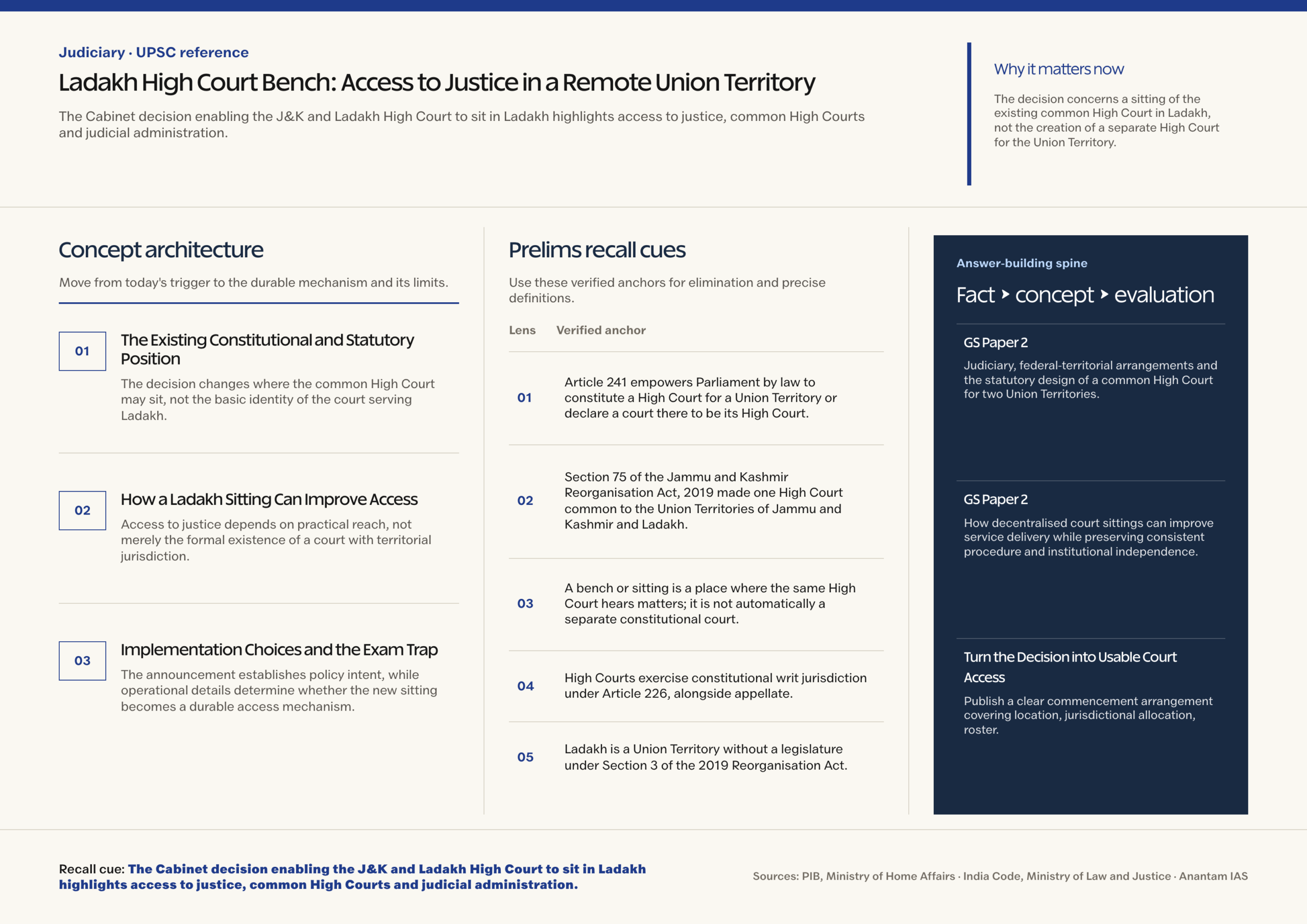
- The decision concerns a sitting of the existing common High Court in Ladakh, not the creation of a separate High Court for the Union Territory.
- The official release links the move to reducing the time residents need to obtain legal services, especially across Ladakh’s remote and difficult terrain.
- The announcement enables a bench to sit in Ladakh; it should not be described as an already operational permanent bench without a notified implementation arrangement.
- Physical distance, travel costs, seasonal constraints and limited local legal infrastructure can turn formal judicial rights into difficult-to-use remedies.
- A local sitting can improve territorial access while preserving the jurisdiction and institutional unity of the common High Court.
UPSC Relevance
Prelims Relevance
- Article 241 empowers Parliament by law to constitute a High Court for a Union Territory or declare a court there to be its High Court.
- Section 75 of the Jammu and Kashmir Reorganisation Act, 2019 made one High Court common to the Union Territories of Jammu and Kashmir and Ladakh.
- A bench or sitting is a place where the same High Court hears matters; it is not automatically a separate constitutional court.
- High Courts exercise constitutional writ jurisdiction under Article 226, alongside appellate, supervisory and other jurisdiction conferred by law.
- Ladakh is a Union Territory without a legislature under Section 3 of the 2019 Reorganisation Act.
Mains Relevance
GS Paper 2
- Judiciary, federal-territorial arrangements and the statutory design of a common High Court for two Union Territories.
- Access to justice as a governance outcome shaped by distance, cost, language, legal aid, infrastructure and case administration.
GS Paper 2
- How decentralised court sittings can improve service delivery while preserving consistent procedure and institutional independence.
- The difference between a Cabinet decision, a notified operational arrangement and the creation of a separate High Court by law.
Essay
- A right becomes meaningful only when institutions are physically, financially and linguistically accessible to those entitled to use it.
Background and Context
The Existing Constitutional and Statutory Position
The decision changes where the common High Court may sit, not the basic identity of the court serving Ladakh.
- The Jammu and Kashmir Reorganisation Act, 2019 divided the former State into the Union Territories of Jammu and Kashmir and Ladakh from the appointed day.
- Under Section 75, the former Jammu and Kashmir High Court became the common High Court for both Union Territories, with the existing judges continuing in the common court.
- The court is now known as the High Court of Jammu & Kashmir and Ladakh, while its common territorial jurisdiction remains the exam-relevant statutory principle.
- Article 241 provides Parliament’s constitutional route for High Courts concerning Union Territories, while the 2019 Act supplies Ladakh’s specific institutional arrangement.
- A bench is part of the same High Court: its orders carry that court’s authority, and creating it does not divide jurisdiction into a new judicial institution.
How a Ladakh Sitting Can Improve Access
Access to justice depends on practical reach, not merely the formal existence of a court with territorial jurisdiction.
- A local sitting can reduce travel time and cost for litigants, lawyers, witnesses and officials who would otherwise travel outside Ladakh for High Court proceedings.
- Shorter journeys can matter especially for urgent writs, bail, service disputes and public-law cases where delay may weaken the value of the eventual remedy.
- Closer hearings can improve lawyer-client consultation, production of records and participation by residents from remote districts, although digital access and legal aid remain necessary complements.
- A local judicial presence can make constitutional remedies under Article 226 more usable without altering their legal scope or the High Court’s control over its procedure.
- The access gain will depend on listing frequency, case categories, judge availability, registry support and reliable hybrid-hearing systems, not on the announcement alone.
Implementation Choices and the Exam Trap
The announcement establishes policy intent, while operational details determine whether the new sitting becomes a durable access mechanism.
- The PIB release says the Cabinet decision enables the High Court to sit in Ladakh; it does not establish a separate Ladakh High Court.
- It should not yet be labelled an operational permanent bench because the cited announcement does not provide commencement, roster, location, staffing or sitting-frequency details.
- Judicial administration must preserve independence and roster authority; executive support for premises and staffing cannot become control over case assignment or adjudication.
- A functional registry should support filing, certified copies, translation, legal-aid referrals and digital case access, so the bench does not become only an occasional ceremonial sitting.
- Consistent procedure across Jammu, Srinagar and Ladakh sittings can prevent forum confusion while allowing scheduling suited to geography, weather and litigant needs.
Way Forward
Turn the Decision into Usable Court Access
- Publish a clear commencement arrangement covering location, jurisdictional allocation, roster, filing routes and predictable sitting calendars.
- Build a staffed registry with e-filing, video hearings, translation, certified-copy services and trained support for litigants who lack reliable connectivity.
- Coordinate legal services institutions, the local Bar and district courts so eligible residents receive advice, representation and referral before matters reach the High Court.
- Track travel burden, disposal time, adjournments and user experience while protecting judicial independence and avoiding performance targets that distort adjudication.
Conclusion
- The Ladakh sitting is best understood as decentralising access within one common High Court, rather than creating a new court or changing Ladakh’s constitutional status.
- In a Mains answer, connect constitutional design with practical access, then test success through predictable hearings, registry capacity, legal aid, digital inclusion and judicial independence.
UPSC Practice Questions
Prelims MCQ 1
With reference to the High Court arrangement for Ladakh, consider the following statements:
- Section 75 of the Jammu and Kashmir Reorganisation Act, 2019 provides a common High Court for the Union Territories of Jammu and Kashmir and Ladakh.
- A High Court bench sitting in Ladakh would necessarily constitute a separate High Court for Ladakh.
- Article 241 concerns High Courts for Union Territories.
How many of the above statements are correct?
(a) Only one (b) Only two (c) All three (d) None
Answer: (b) Only two
Explanation:
Statements 1 and 3 are correct. Statement 2 is incorrect because a bench or sitting remains part of the same High Court unless a separate court is lawfully constituted.
Prelims MCQ 2
What is the most accurate description of the Union Cabinet’s August 2026 decision concerning Ladakh?
(a) It created a separate Supreme Court circuit for Ladakh (b) It immediately constituted a separate High Court for Ladakh (c) It enabled the existing High Court of Jammu & Kashmir and Ladakh to sit in Ladakh (d) It transferred Ladakh’s High Court jurisdiction to the Delhi High Court
Answer: (c) It enabled the existing High Court of Jammu & Kashmir and Ladakh to sit in Ladakh
Explanation:
The decision enables a sitting of the existing common High Court in Ladakh. The official announcement does not create a separate High Court or establish that a permanent bench is already operational.
UPSC Mains Questions
- The physical location of judicial institutions can determine whether constitutional remedies are genuinely accessible. Discuss with reference to the decision enabling the J&K and Ladakh High Court to sit in Ladakh.
- Distinguish between creating a separate High Court and establishing a bench or sitting of an existing High Court. What administrative safeguards should guide the Ladakh arrangement?
Sources: PIB, Ministry of Home Affairs and India Code, Ministry of Law and Justice.
Frequently Asked Questions
Has a separate High Court been created for Ladakh?
No. Section 75 of the 2019 Reorganisation Act provides one common High Court for Jammu and Kashmir and Ladakh; the decision enables that court to sit in Ladakh.
Is the Ladakh bench already an operational permanent bench?
The cited PIB announcement does not establish that. It reports a Cabinet decision enabling a sitting, without specifying commencement, permanent status, roster, staffing or frequency.
Which law governs Ladakh’s existing High Court arrangement?
Section 75 of the Jammu and Kashmir Reorganisation Act, 2019 makes the High Court common to the Union Territories of Jammu and Kashmir and Ladakh.
How can a High Court sitting improve access to justice?
It can reduce travel time and expense, support urgent hearings and bring filing and registry services closer, provided sittings are predictable and supported by legal aid and digital access.
Which constitutional provision addresses High Courts for Union Territories?
Article 241 empowers Parliament by law to constitute a High Court for a Union Territory or declare a court in that territory to be its High Court.