Ladakh seeks belonging through representation
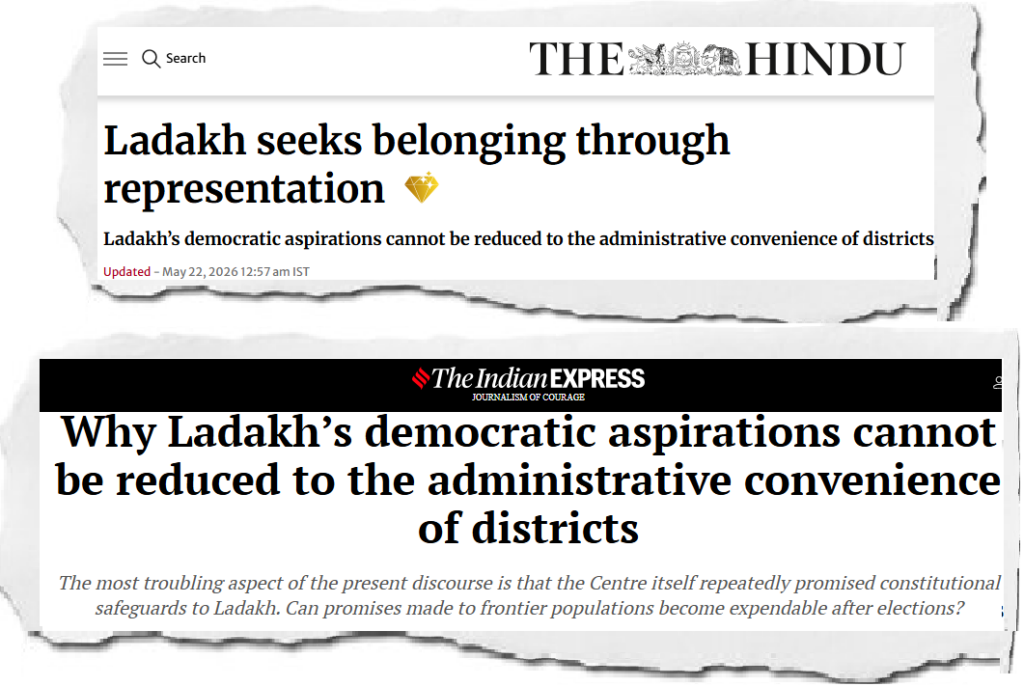
Ladakh’s Demand for Representation: Democracy, Sixth Schedule and the Future of India’s Frontier Governance
Why in News?
The debate over Ladakh’s democratic aspirations has resurfaced following the Union government’s emphasis on administrative decentralisation through creation of additional districts rather than granting a legislature or stronger constitutional safeguards under the Sixth Schedule. The issue has gained significance amid continuing demands by Ladakhi groups for constitutional protection over land, jobs, culture and local governance.
UPSC Relevance
Prelims: Sixth Schedule, Union Territories, 73rd and 74th Constitutional Amendments, Article 370, Autonomous District Councils.
Mains:
GS-II: Issues and challenges pertaining to federal structure, devolution of powers, governance and constitutional mechanisms for vulnerable regions.
GS-III: Border area development, internal security and sustainable development of Himalayan regions.
Background/Context
Ladakh became a separate Union Territory in August 2019 after the abrogation of Abrogation of Article 370 and the enactment of the Jammu and Kashmir Reorganisation Act, 2019.
Unlike Delhi and Puducherry, Ladakh was created as a Union Territory without a legislative assembly.
Since then, various political, social and religious organisations in Ladakh have demanded:
- Statehood or a legislature
- Inclusion under the Sixth Schedule
- Constitutional safeguards for land and employment
- Greater local autonomy
Recently, the Union government announced creation of additional districts such as Nubra, Changthang, Sham, Zanskar and Drass, arguing that administrative decentralisation could improve governance.
However, the debate now extends beyond administrative efficiency and enters larger questions of democracy, federalism and representation.
Understanding the Sixth Schedule
The Sixth Schedule under the Constitution provides special arrangements for tribal-majority areas in northeastern India.
Features of the Sixth Schedule
- Establishes Autonomous District Councils (ADCs).
- Provides legislative and executive powers over specified subjects.
- Protects traditional customs and practices.
- Allows local management of land and natural resources.
- Grants powers related to taxation and local administration.
Currently, Sixth Schedule provisions apply in:
- Assam
- Meghalaya
- Mizoram
- Tripura
Constitutional Basis of Asymmetric Federalism
India does not follow a rigid or uniform federal structure.
The Constitution recognises diversity and allows differentiated arrangements for regions with unique cultural, historical or geographical characteristics.
Examples include:
- Earlier special provisions under Article 370
- Article 371 provisions for several States
- Sixth Schedule arrangements
- Special provisions for northeastern regions
Thus, constitutional asymmetry has historically been used as an instrument of integration rather than fragmentation.
Why is Ladakh Demanding Greater Representation?
Protection of land and demographic identity
Ladakh possesses:
- Fragile mountain ecosystems
- Sparse population
- Distinct tribal cultures
- Limited habitable land
Concerns exist regarding:
- Unregulated land acquisition
- Large-scale infrastructure projects
- Migration pressures
- Cultural dilution
Political participation in decision-making
Administrative bodies can implement policies, but major policy choices require representative institutions.
Issues requiring political participation include:
- Land rights
- Tourism expansion
- Renewable energy projects
- Mining activities
- Grazing rights
- Education and employment policies
Preservation of ecological systems
Ladakh represents a highly sensitive cold desert ecosystem vulnerable to:
- Climate change
- Water scarcity
- Glacial retreat
- Infrastructure expansion
Local communities argue that ecological decisions should involve elected representation.
Border area confidence and national integration
Ladakh borders:
- China
- Pakistan
Border populations often play a significant role in national security.
Political inclusion may strengthen:
- Trust in institutions
- Sense of belonging
- Local participation in governance
Administrative Decentralisation versus Political Representation
A central issue in the debate is the distinction between administrative structures and democratic institutions.
| Administrative decentralisation | Political representation |
|---|---|
| Focuses on service delivery | Focuses on policy-making |
| Implemented through districts | Implemented through legislatures |
| Bureaucratically driven | Citizen-driven |
| Reports upward to government | Accountable downward to people |
| Limited autonomy | Wider policy authority |
Creation of districts improves administrative accessibility but may not address larger concerns regarding political agency.
Arguments Advanced Against Legislature or Sixth Schedule Status
Sparse population
It is argued that Ladakh’s relatively small population may not justify a legislature.
Strategic sensitivity
Because Ladakh lies along sensitive borders, stronger Central control is considered necessary.
Financial dependence
The argument suggests that Ladakh’s dependence on central transfers limits viability of autonomous institutions.
Counter-Arguments to These Objections
Small population has never prevented political empowerment
Several States entered the Union with relatively small populations:
- Nagaland
- Mizoram
- Sikkim
- Arunachal Pradesh
Political representation was not denied because of population size.
Strategic importance may require greater participation
Border populations with stronger political ownership may contribute more effectively to national integration.
Arunachal Pradesh itself demonstrates that strategic sensitivity can coexist with democratic empowerment.
Fiscal dependence is common in Indian federalism
India’s fiscal structure is redistributive.
Several States depend significantly on:
- Tax devolution
- Grants-in-aid
- Centrally sponsored schemes
Fiscal dependence has never been treated as grounds for reducing democratic rights.
Emerging Development Questions in Ladakh
Ladakh increasingly occupies an important position in India’s development strategy.
Renewable energy projects
Large renewable energy projects are being planned in areas such as Changthang.
Potential concerns include:
- Grazing rights of Changpa communities
- Ecological carrying capacity
- Land acquisition
- Revenue sharing
- Local employment opportunities
Tourism expansion
Rapid tourism growth creates both opportunities and pressures:
Opportunities:
- Employment generation
- Infrastructure development
Challenges:
- Waste management
- Water scarcity
- Ecological degradation
Resource extraction and mining
Future mining activities may raise concerns regarding:
- Environmental sustainability
- Community participation
- Benefit-sharing mechanisms
Important Institutions in Ladakh Governance
Ladakh Autonomous Hill Development Council (LAHDC)
Two Autonomous Hill Councils currently function in:
- Leh
- Kargil
Functions:
- Local planning, Development activities, Certain administrative functions
Limitations:
- Limited legislative powers
- Dependence on the Union administration
Challenges in Granting Greater Autonomy
Security considerations
Sensitive border locations require balancing autonomy with national security concerns.
Administrative capacity
Creating new institutional structures requires:
- Human resources
- Financial resources
- Administrative mechanisms
Inter-regional differences
Leh and Kargil sometimes differ in political priorities and developmental expectations.
Need for institutional clarity
Questions remain regarding:
- Extent of legislative powers
- Relationship with Union administration
- Scope of Sixth Schedule provisions
Key Terms
Sixth Schedule: Constitutional provisions providing autonomous governance arrangements to tribal regions.
Asymmetric federalism: A system where different regions receive different constitutional arrangements according to their specific needs.
Autonomous District Council: Local representative body with specified legislative and executive powers.
Political representation: Participation of citizens in governance through elected institutions.
Challenges/Criticisms
- Administrative decentralisation alone may not resolve political demands.
- Lack of constitutional safeguards can create insecurity regarding land and identity.
- Excessive centralisation may reduce local participation.
- Balancing national security and regional autonomy remains complex.
Way Forward
Explore tailored constitutional mechanisms
Ladakh’s unique geography and demographics require a customised approach rather than uniform solutions.
Strengthen local democratic institutions
Existing Hill Councils can be empowered with greater financial and functional authority.
Consider Sixth Schedule-type protections
Safeguards relating to land, tribal culture and local resources may address community concerns.
Promote participatory development
Large infrastructure and energy projects should include structured consultation with local communities.
Balance strategic and democratic objectives
National security and democratic representation should be treated as complementary rather than competing goals.
Encourage sustained dialogue
Continuous engagement among the Union government, local representatives and civil society can create durable solutions.
Conclusion
India’s constitutional strength lies in its ability to accommodate diversity through flexible institutional arrangements. Ladakh’s demands are not merely about administrative restructuring but about participation, dignity and political belonging. The larger challenge before India is to ensure that strategic frontiers are integrated not only through infrastructure and administration, but also through meaningful democratic representation.
Practice Questions
Prelims MCQ 1
With reference to the Sixth Schedule of the Constitution, consider the following statements:
- It provides for Autonomous District Councils in certain tribal areas.
- It currently applies to all northeastern States.
- Autonomous District Councils possess limited legislative powers.
Which of the statements given above is/are correct?
(a) 1 only
(b) 1 and 3 only
(c) 2 and 3 only
(d) 1, 2 and 3
Correct Answer: (b)
Explanation: Sixth Schedule applies only to specified tribal areas of Assam, Meghalaya, Mizoram and Tripura, not all northeastern States.
Prelims MCQ 2
Which of the following best describes asymmetric federalism?
(a) Equal powers distributed to all States
(b) A system where States possess identical constitutional status
(c) A system providing differentiated constitutional arrangements to certain regions
(d) Complete decentralisation of power to local bodies
Correct Answer: (c)
Explanation: Asymmetric federalism recognises regional differences and grants differentiated constitutional arrangements.
Mains Questions
- Examine the role of asymmetric federalism in accommodating regional diversity in India. Discuss in the context of Ladakh’s demands.
- “Administrative decentralisation cannot substitute political representation.” Critically examine this statement with reference to India’s border regions.