Land Port Management System (LPMS): Digitising India’s Border Trade Gateways
On 9 June 2026 the Union Home Minister launched the Land Port Management System (LPMS), a centralised digital platform built by the Land Ports Authority of India (LPAI) to run all of India’s land ports from one electronic backbone. A land port is a notified gateway on a land border where cargo and people are checked, cleared and moved across into a neighbouring country — the road-and-rail equivalent of an airport or a seaport. Until now each port ran its own paper-heavy counters, with a trader registering separately at every gate, paying different fees at different windows and waiting in physical queues for clearance. LPMS folds slot booking, online payments, customs filing and cargo tracking into a single web window, the same way air and sea cargo have worked digitally for years. The launch event also saw upgraded stakeholder facilities inaugurated at the Dawki land port in Meghalaya and the Srimantapur land port in Tripura, both on the India-Bangladesh border, tying the new software to fresh physical capacity on the ground.
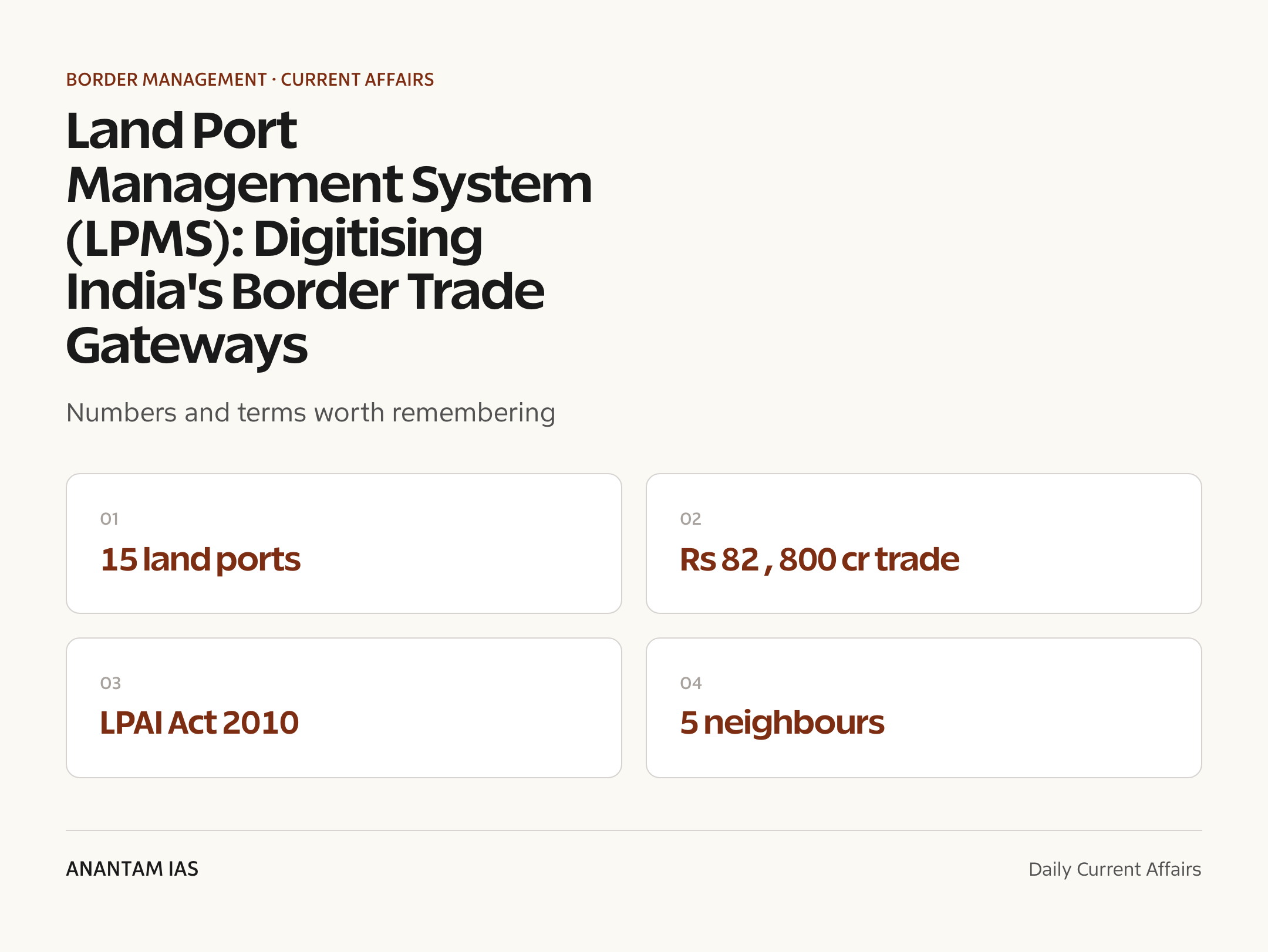
The platform covers the 15 operational land ports that connect India with Bangladesh, Nepal, Bhutan, Myanmar and Pakistan, and it arrives as land-border trade has scaled sharply. EXIM (export-import, the standard shorthand for cross-border trade) routed through these ports grew from about Rs 5,000 crore in 2014-15 to roughly Rs 82,800 crore in 2024-25 — a more-than-sixteenfold rise in a decade — while around 25.8 lakh passengers and 6.69 lakh cargo vehicles crossed via land ports in 2024-25 alone. For the exam this is a governance-meets-trade-facilitation story sitting at the seam of GS3 border management and the neighbourhood economy. It is best understood not as a security gadget but as the moment India’s land frontiers got the same digital plumbing its airports and seaports have had for years, and it tracks closely with what The Hindu, the Indian Express and PIB have flagged as the digitisation of India’s frontier infrastructure under the Viksit Bharat 2047 agenda.
An examiner will read this as a test of whether you can separate border management (a governance and institutional question) from border security (an operational one), and connect a digital tool to the static LPAI Act, 2010 framework behind it.
Quick Facts
- Launched 9 June 2026 by the Union Home Minister in New Delhi.
- Built by the Land Ports Authority of India (LPAI), a statutory body under the LPAI Act, 2010.
- Covers India’s 15 operational land ports across five neighbouring countries.
- Land-port EXIM trade rose from ~Rs 5,000 crore (2014-15) to ~Rs 82,800 crore (2024-25).
- ~25.8 lakh passengers and ~6.69 lakh cargo vehicles crossed via land ports in 2024-25.
- Single-window features: slot booking, online payments, customs filing, cargo tracking.
- Integrates with ICEGATE customs, the Unified Logistics Interface Platform and the motor-vehicle ecosystem.
- Aligned with the Viksit Bharat 2047 vision and neighbourhood-first connectivity.
- Sources: PIB, Ministry of Home Affairs (via GKToday) and Insights on India.
What Just Happened
The Union Home Minister formally launched the Land Port Management System in New Delhi, describing it as a single, secure electronic gateway that standardises how cargo and passenger data move across India’s international land borders. The system was conceptualised and developed by the Land Ports Authority of India, the statutory body that owns and manages the country’s land ports, and is positioned to bring those ports on par with the high-efficiency digital systems already operational at major airports and seaports. The same event saw the inauguration of upgraded stakeholder facilities at the Dawki land port in Meghalaya and the Srimantapur land port in Tripura, both on the India-Bangladesh frontier, signalling that the digital layer and the physical infrastructure are being pushed together rather than in sequence. Government framing tied the launch to the goal of a secure, smart border-management system and to the Viksit Bharat 2047 vision of a developed India.
Functionally, LPMS replaces a scatter of port-by-port manual counters with one online window. Insights on India lists its core modules. A Single Registration Request (SRR) lets a trader file stakeholder details once instead of repeating the paperwork at every port. Predictive slot management lets cargo vehicles book a time-slot in advance against the real-time capacity at an Integrated Check Post (ICP), so trucks arrive to a confirmed window rather than joining an open queue. A unified payment gateway collects customs duties, parking, weighbridge and terminal charges through one online counter. Dedicated warehouse and yard-optimisation modules manage storage, and business-intelligence dashboards give the LPAI and the agencies live cargo tracking and operational analytics. Security recording, including integration with full-body truck scanners, is logged digitally rather than on paper, which keeps the audit trail intact end to end.
Crucially, the platform doesn’t sit in isolation — its value comes from what it talks to. GKToday’s reading of the PIB material notes that LPMS connects to ICEGATE (the Indian Customs Electronic Gateway, the customs department’s online filing portal) for direct filing of Shipping Bills, which document exports, and Bills of Entry, which document imports. It also links to the Unified Logistics Interface Platform (ULIP), the national data backbone meant to stitch together India’s logistics systems, and to the motor-vehicle ecosystem that tracks the trucks themselves. So a single consignment can be registered once, slot-booked, scanned, customs-cleared and paid for inside one connected chain. That interoperability is the real shift: the land port stops being a standalone counter and becomes a node in India’s wider digital trade and logistics network.
Background and Context
The durable anchor here is the Land Ports Authority of India Act, 2010, which created the LPAI as a statutory authority under the Ministry of Home Affairs to develop, sanitise and manage the infrastructure at India’s land borders. The placement under the Home Ministry, rather than Commerce, is itself a clue to read carefully: India treats its land frontiers first as a matter of secure entry and exit, and only then as trade. Before the LPAI, most border-crossing points were makeshift — open patches of land with minimal customs, immigration or warehousing — where formalities were slow, informal trade leaked across, and travellers faced scattered, undignified facilities. The Act gave India a dedicated institution to plan, build and operate proper facilities at notified entry-exit points, the way the Airports Authority of India does for airports and major port trusts do for seaports.
The flagship instrument the LPAI delivers is the Integrated Check Post (ICP). An ICP brings every regulatory agency a traveller or trader meets — customs, immigration, plant and animal quarantine, the border-guarding force, currency exchange, warehousing, parking and weighbridges — under one roof at the border, replacing the old model where each agency sat in a separate shed sometimes kilometres apart. The point of an ICP is a single, modern, secure facility that handles all entry-exit functions at one stop, cutting the dwell time of cargo and the harassment of passengers. India now runs 15 operational land ports of this kind. They are spread across the Pakistan border (Attari and Dera Baba Nanak in Punjab), the Nepal border (Rupaidiha in Uttar Pradesh, Raxaul and Jogbani in Bihar), and the Bangladesh border, which carries the largest share — Petrapole in West Bengal, Dawki in Meghalaya, Agartala, Srimantapur and Sabroom in Tripura, and Sutarkandi, Golakganj and Mankachar in Assam — with the Myanmar gateway at Moreh in Manipur. Petrapole, opposite Benapole in Bangladesh, is among the busiest land ports in South Asia by trade value.
A point the exam loves to test: a land port is not the same as a border outpost (BOP). A BOP is a forward defensive post manned by a border-guarding force — the BSF on the Pakistan and Bangladesh borders, the SSB on the Nepal and Bhutan borders, the Assam Rifles and the Army on the Myanmar and China fronts — whose job is patrolling the line and stopping illegal crossing. That is a security function. A land port is a regulated, civilian trade-and-travel gateway run by the LPAI for lawful cross-border movement. That is a facilitation and governance function. They sit on the same border but answer different questions: the BOP asks who is crossing unlawfully, the land port asks how to clear lawful trade and travel faster. Mixing the two is a classic error in answers, so hold the line cleanly. This distinction sits inside India’s wider neighbourhood policy. India shares land borders of roughly 15,000 km with seven neighbours — Bangladesh (the longest), China, Pakistan, Nepal, Myanmar, Bhutan and Afghanistan — and sub-regional frameworks like BBIN (the Bangladesh-Bhutan-India-Nepal initiative for seamless movement of goods and vehicles) and the Neighbourhood First policy depend on exactly the kind of efficient land connectivity that land ports and LPMS are meant to deliver. Efficient gateways turn shared borders from barriers into corridors.
Key Features of the Land Port Management System
- Single Registration Request (SRR): a trader submits stakeholder details once and reuses them across every land port, ending repeat paperwork.
- Predictive slot management: advance booking of cargo time-slots against real-time capacity at each Integrated Check Post, cutting queues and idle truck time.
- Unified payment gateway: one online counter for customs duties, parking, weighbridge and terminal charges instead of separate cash windows.
- Customs and logistics integration: direct linkage to ICEGATE for Shipping Bills and Bills of Entry, plus the Unified Logistics Interface Platform and motor-vehicle ecosystem.
- Digital security and scanning: shipment recording tied to full-body truck-scanner data, logged electronically rather than on paper.
- Business-intelligence dashboards: live cargo tracking, warehouse and yard optimisation, and operational analytics for the LPAI and agencies.
Why It Matters for UPSC
This is a high-yield topic because it ties a current development to durable syllabus themes.
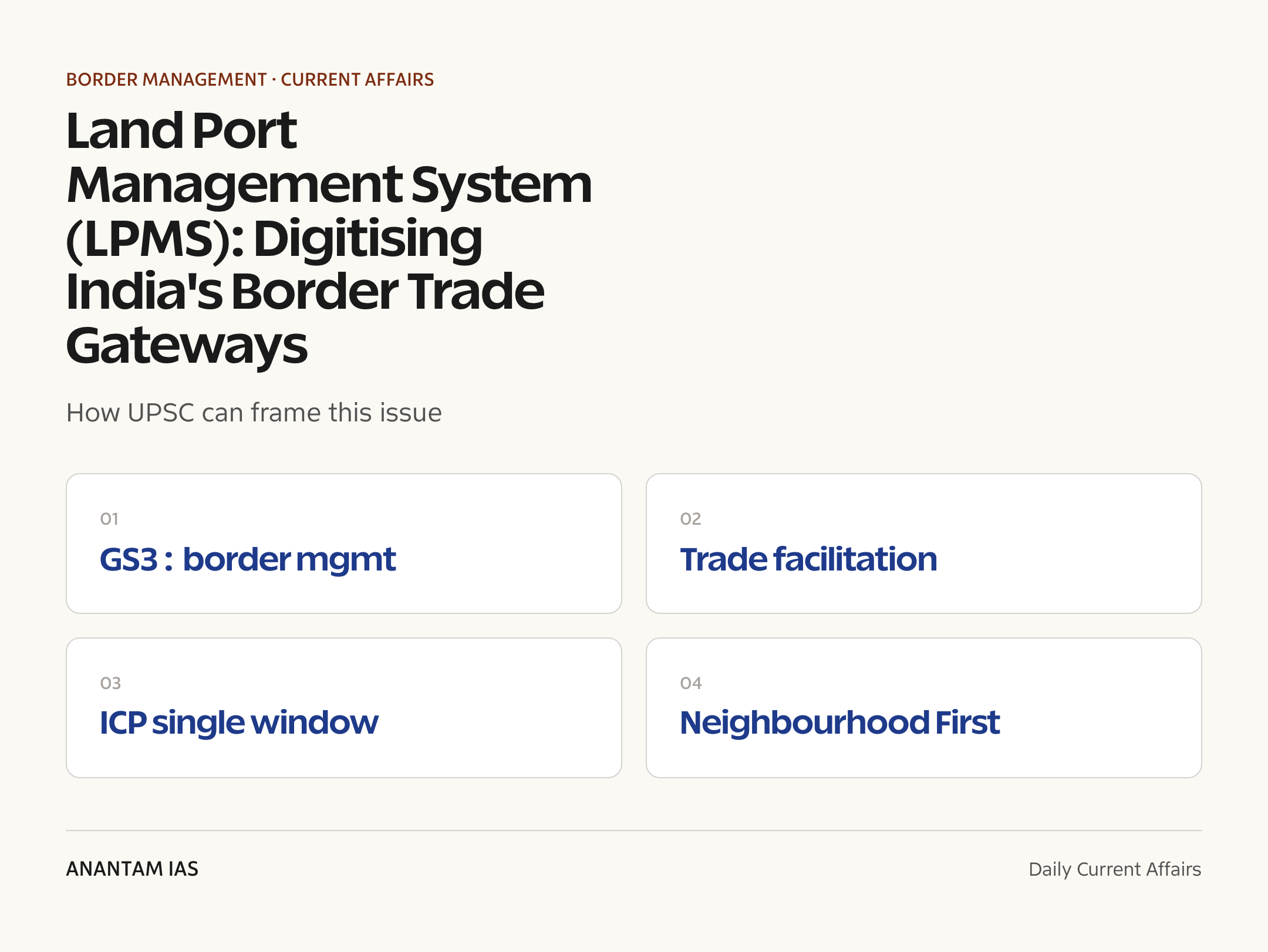
- GS3 border management: shows how India is shifting from purely guarding borders to governing them as managed economic gateways, a structural theme in mains answers.
- Links current to static: a single launch lets you cite the LPAI Act, 2010, the Integrated Check Post model, and the land-port-versus-border-outpost distinction in one frame.
- Prelims angle: clean facts to test — launch authority and date, the parent statute and year, the count of 15 land ports, and the five neighbouring countries.
- Economy and diplomacy crossover: ties trade facilitation and ease-of-doing-business to neighbourhood-first connectivity, BBIN and the cost of cross-border logistics.
What It Means: Border Management Lens
This is border management catching up with how India already runs its airports and seaports. The deeper shift LPMS marks is conceptual: a land border can be treated as a piece of national logistics infrastructure, not merely a defensive line. For most of independent India the frontier was framed almost entirely through security — who crosses, who is stopped. The LPAI Act, 2010 created the institution to govern that geography; LPMS now reframes it as a managed gateway where the headline metric is how fast and cheaply lawful trade clears. That is why the platform’s design language — slot booking, single window, unified payments, business-intelligence dashboards — is borrowed wholesale from civil aviation and ports, not from policing. The same border can be both: a guarded line for the BSF and a throughput system for the LPAI, with LPMS sitting firmly on the second side of that ledger.
The economics explain the urgency. Land-port EXIM trade grew from about Rs 5,000 crore in 2014-15 to roughly Rs 82,800 crore in 2024-25, yet for years the clearance machinery stayed manual, so each port became a bottleneck that taxed trade through waiting time and informal friction. A truck idling for a day at a paper counter is a direct cost to the trader, a source of perishable-cargo loss, and a leak in India’s competitiveness against alternative routes. By digitising registration, payment and customs filing into one chain that talks to ICEGATE and ULIP, LPMS attacks the time-cost of crossing — the dwell time and paperwork that make a land border expensive even when the tariff is low. Lowering that friction is the single biggest lever for land-border trade facilitation, and it maps directly onto India’s wider logistics-cost-reduction agenda under PM Gati Shakti and the National Logistics Policy, which target the same goal of moving goods faster and cheaper.
There’s a governance dividend too. A central platform creates a single, auditable data trail of every consignment and crossing. That improves transparency, narrows the discretion that breeds rent-seeking at manual counters, and gives the LPAI real-time visibility to plan capacity at each ICP — which port needs more parking, which scanner is a chokepoint, where a slot system is straining. Digitising security recording alongside trade clearance also means facilitation and oversight ride on the same rails rather than competing for the same desk. Read alongside the Neighbourhood First policy and BBIN connectivity, the message is that India sees efficient land ports as instruments of regional integration — the soft infrastructure that makes physical corridors actually usable for trade with Bangladesh, Nepal, Bhutan and Myanmar.
The honest caveat keeps the analysis balanced. A digital window on the Indian side speeds clearance only up to the line on the map; the gain is realised in full only when the neighbouring country’s customs and infrastructure can keep pace, which is why cross-border digital harmonisation matters as much as the platform itself. The structural insight worth carrying into an answer: LPMS converts the border from a cost centre into a throughput system, a different and more ambitious goal than simply securing it — but one whose payoff depends on diplomacy, last-mile connectivity and physical capacity catching up with the software.
Challenges and Concerns
- Cross-border benefit is asymmetric: a digital window on the Indian side speeds clearance only as far as the neighbouring country’s customs and infrastructure can match it.
- Adoption and digital literacy among small traders and transporters at remote land ports can lag, leaving parallel manual processes alive.
- Connectivity and uptime risk: a single platform concentrates dependency, so outages or weak last-mile internet at frontier locations can stall entire ports.
- Data security and interoperability: linking customs, payments and scanner data raises questions of protection and clean integration across legacy agency systems.
- Hardware gaps remain: software cannot fix shortfalls in warehousing, scanners, road access or staffing where the physical ICP is still being built out.
Prelims Pointers
- The Land Port Management System (LPMS) was launched on 9 June 2026 by the Union Home Minister.
- LPMS is built and operated by the Land Ports Authority of India (LPAI).
- The LPAI is a statutory body created under the Land Ports Authority of India Act, 2010.
- The LPAI functions under the Ministry of Home Affairs, not the Ministry of Commerce.
- India currently has 15 operational land ports.
- India’s land ports connect it with Bangladesh, Nepal, Bhutan, Myanmar and Pakistan.
- An Integrated Check Post (ICP) houses customs, immigration, quarantine and border-guarding functions under one roof.
- Attari and Dera Baba Nanak are land ports on the India-Pakistan border.
- Petrapole and Dawki are land ports on the India-Bangladesh border; Moreh is on the India-Myanmar border.
- LPMS integrates with ICEGATE (Indian Customs Electronic Gateway) for Shipping Bills and Bills of Entry.
- A land port is a civilian trade-and-travel gateway, distinct from a Border Out Post (BOP), which is a forward security post.
- BBIN refers to the Bangladesh-Bhutan-India-Nepal sub-regional connectivity grouping.
Mains Practice Questions
- Distinguish between a land port and a border outpost, and examine how institutions such as the Land Ports Authority of India have reshaped India’s approach to border management. (GS3, 15 marks)
- “Efficient land ports are as much an instrument of neighbourhood diplomacy as of trade.” Discuss in the light of India’s Neighbourhood First policy and frameworks like BBIN. (GS2/GS3, 15 marks)
- Digital platforms are turning India’s land borders from security lines into managed economic gateways. Evaluate the gains and the risks of this shift. (GS3, 10 marks)
- Examine the role of Integrated Check Posts in facilitating cross-border trade while maintaining security at India’s land borders. (GS3, 15 marks)
Way Forward
Pair the platform with diplomacy: push neighbouring customs administrations toward compatible digital systems so single-window gains are not lost at the far side of the border.
Close the hardware gap in step with the software — warehousing, scanners, road and rail access and staffing at every notified ICP — so the digital window opens onto a working port.
Build redundancy and offline fallbacks for connectivity-poor frontier sites, train small traders and transporters, and publish performance data so the throughput gains are measurable and durable.
Frequently Asked Questions
What is the Land Port Management System?
It’s a centralised digital platform launched on 9 June 2026 by the Union Home Minister and built by the Land Ports Authority of India. LPMS unifies slot booking, online payments, customs filing and cargo tracking across India’s 15 land ports, replacing scattered manual counters with one secure electronic window for cross-border trade and travel.
Who runs India’s land ports?
The Land Ports Authority of India (LPAI), a statutory body under the Ministry of Home Affairs created by the Land Ports Authority of India Act, 2010. The LPAI plans, builds and operates land ports and Integrated Check Posts, doing for land borders what the Airports Authority of India does for airports.
How is a land port different from a border outpost?
A border outpost (BOP) is a forward security post manned by a border-guarding force to patrol and stop illegal crossing. A land port is a regulated civilian gateway run by the LPAI for lawful cross-border trade and travel. One is a security function, the other a facilitation function on the same border.
How many land ports does India have?
India has 15 operational land ports connecting it with Bangladesh, Nepal, Bhutan, Myanmar and Pakistan. They include Attari and Dera Baba Nanak with Pakistan, Petrapole and Dawki with Bangladesh, Raxaul with Nepal, and Moreh with Myanmar. All now run on the single LPMS digital backbone.
What is an Integrated Check Post (ICP)?
An ICP brings every agency at a border crossing — customs, immigration, quarantine, the border-guarding force, currency exchange and warehousing — under one roof. It replaces the old model of scattered sheds, so a trader or traveller clears all formalities in a single, modern facility at the frontier.
Why does LPMS matter for the economy?
Land-port trade grew from about Rs 5,000 crore in 2014-15 to roughly Rs 82,800 crore in 2024-25, but clearance stayed manual and slow. LPMS cuts the time-cost of crossing by digitising registration, payment and customs into one chain, making land borders work as efficient economic gateways rather than bottlenecks.